What's the Fastest Way to Learn Design Thinking?
Design Thinking is human-centered problem solving — and you don't need a design background to learn it. Here are the courses, free resources, books, and tools that actually get you there.
Have a design? We'll build it — the devs behind TutorialSearch.io
Pixel-accurate, responsive front-ends from your Figma — wired to real back-ends by the team that built this site.
Most people start learning Design Thinking by trying to memorize the five stages: empathize, define, ideate, prototype, test. They treat it like a checklist. Then they get stuck — because real problems don't move in a straight line.
Design Thinking isn't a process you follow step by step. It's a mindset shift. The fastest way to learn it isn't to race through a course — it's to pick up a framework and immediately apply it to a real problem you care about.
This guide cuts through the options. You'll find courses, free resources, tools, and books that actually help you make that shift. You can browse all 145+ Design Thinking courses on TutorialSearch.io or keep reading for curated picks across every budget and skill level.
Key Takeaways
- Design Thinking is a human-centered problem-solving approach used by companies like Apple, Google, and IDEO — not just for professional designers.
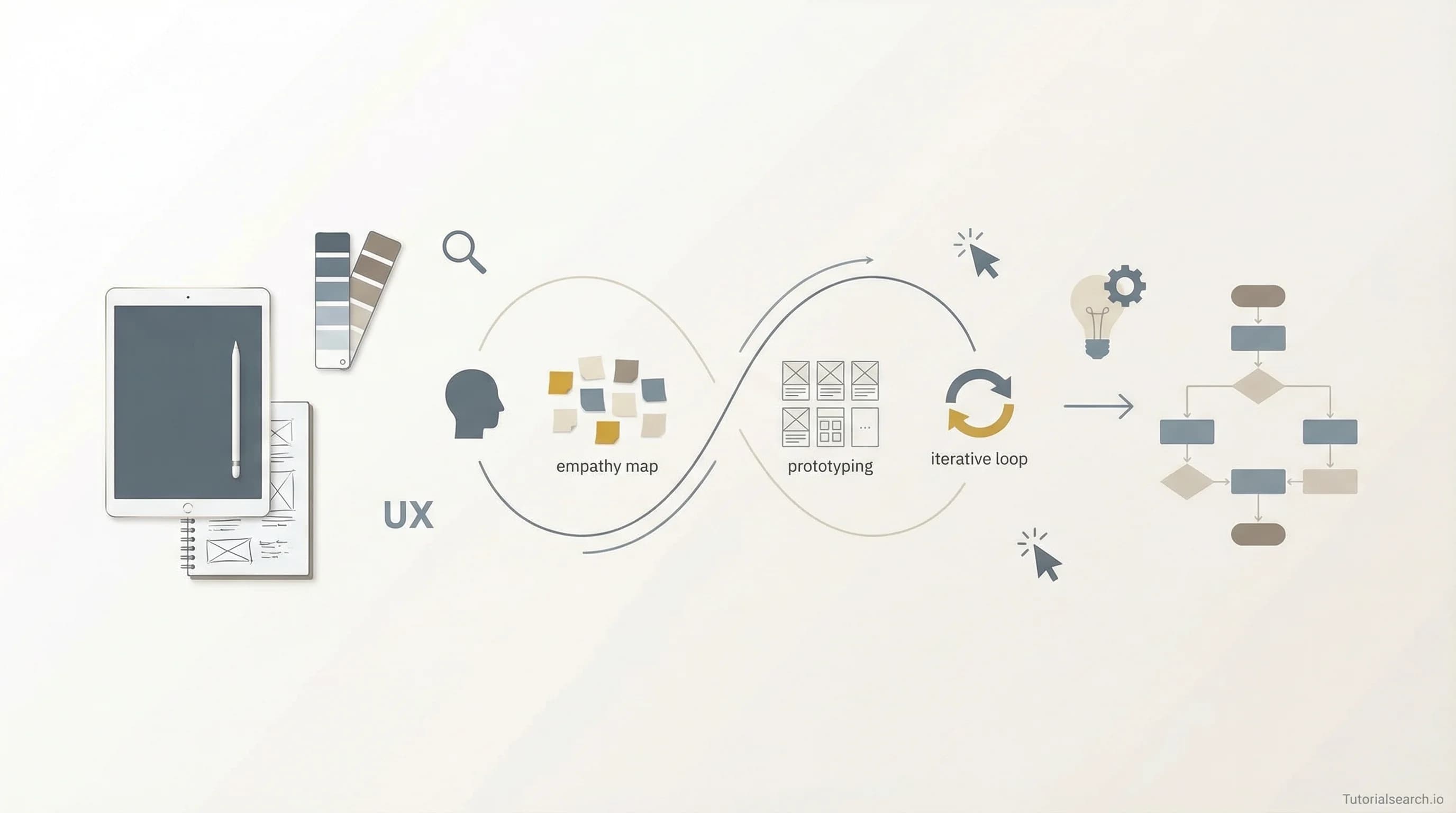
- The five stages (empathize, define, ideate, prototype, test) are iterative, not linear — most beginners get tripped up treating them as a checklist.
- Stanford d.school and IDEO both offer high-quality Design Thinking materials for free — you can learn the fundamentals without paying anything.
- The best Design Thinking courses combine real case studies with hands-on practice — watching lectures alone won't build the skill.
- Pairing Design Thinking with UI/UX Design or Product Design creates a much stronger skill set for most careers.
In This Article
- Choosing Your Entry Point Into Design Thinking
- The Design Thinking Courses That Actually Stick
- Free Design Thinking Resources That Surprise You
- Design Thinking in Action: Tools, Templates, and Practice
- Design Thinking Books Worth the Time
- The Design Thinking Communities Where Ideas Actually Flow
- Related Skills That Pair Well With Design Thinking
- Frequently Asked Questions About Design Thinking
Choosing Your Entry Point Into Design Thinking
Design Thinking looks the same from a distance, but the way you should learn it depends heavily on why you're learning it.
Are you a product manager who needs to run better workshops? A designer who wants a more structured problem-solving approach? A complete newcomer who just heard the term and wants to understand the hype?
Each person needs a different starting point. This quick guide helps you find yours:
| Your Situation | Start Here |
|---|---|
| Complete beginner, no design background | Laura Pickel's beginner course on Udemy |
| Business professional or manager | Susmita Dutta's course for professionals |
| Want to understand the methodology deeply | Jamal Lazaar's fundamentals course |
| Want practical templates you can use today | Julia Lettinger's Tool Box course |
| Learning on a budget | Stanford d.school's free guide + Design Thinking for Startups |
| Curious about AI-integrated approaches | SeaportAi's Design Thinking with ChatGPT |
If you're a total beginner and don't mind paying for a course, start with Laura Pickel's class. It has nearly 118,000 students, holds a solid 4.4-star rating, and is built for people with zero design background. More on that below.
One more thing before you pick: Design Thinking is used by nurses, software engineers, nonprofit founders, and teachers — not just designers. The word "design" in the name misleads people into thinking it's a visual craft. It's not. It's structured empathy and iteration.
The Design Thinking Courses That Actually Stick
Not all Design Thinking courses are created equal. The enrollment numbers don't always tell the whole story. Here's an honest look at which paid options are worth it.
For Beginners
1. Design Thinking for Beginners: Develop Innovative Ideas — Laura Pickel (Udemy) ★ 4.4 | 117,998 students [Editors' Choice]
This is the course I'd send to a friend asking "what is design thinking, really?" Pickel builds the framework from scratch. She walks through empathy interviews, user personas, and rapid prototyping using real-world examples from education, healthcare, and tech.
Almost 118,000 students have taken it. That's not an accident. The course is beginner-friendly without being shallow.
Topics covered:
- Empathy maps and user interview techniques
- Ideation methods (brainstorming, SCAMPER)
- Rapid prototyping basics
- How to run a short design sprint
2. Design Thinking Guide for Successful Professionals — Susmita Dutta (Udemy) ★ 4.3 | 109,804 students
If you're coming from a business or management background, this shifts the framing usefully. Dutta targets professionals who want to use Design Thinking to improve team dynamics, solve organizational challenges, and drive innovation. The word "design" here doesn't mean visual design — it means structured problem-solving.
Over 100,000 enrolled. That's a strong signal.
For Intermediate Learners
3. Design Thinking: the fundamentals — Jamal Lazaar (Udemy) ★ 4.5 | 17,138 students [Editors' Choice]
Don't let the modest enrollment numbers mislead you. This is the highest-rated course on this list by instructor rating, and Lazaar earns it. The focus is depth over breadth — he gets into the theory behind the methodology with more intellectual rigor than most competitors.
If you already understand the basics and want a cleaner mental model of why Design Thinking works the way it does, start here rather than with a beginner course.
4. Design Thinking Tool Box | 50+ Methods | 25+ Templates — Julia Lettinger (Udemy) ★ 4.6 | 6,338 students [Editors' Choice]
This is the most practical course on this list by a clear margin. Lettinger gives you 50+ actual methods with 25+ downloadable templates. For learners who prefer doing over watching lectures, this is the one.
Honestly, this course is underrated. The rating is the highest of any course here (4.58 stars), the content is dense, and the templates alone justify the fee.
What you get:
- How-might-we statement exercises
- Journey mapping templates
- Voting and prioritization methods
- Stakeholder mapping frameworks
5. Design Thinking | Design with ChatGPT — SeaportAi (Udemy) ★ 4.4 | 19,170 students
Everyone recommends traditional Design Thinking courses. But if AI tools are already part of your workflow, this one integrates ChatGPT into the design thinking process for ideation, user persona generation, and synthesis. It's a niche pick — but it reflects how teams actually work right now, not how they worked five years ago.
6. Design Thinking | Unlock Innovation and User-centricity — Tony Bulcaen (Udemy) ★ 4.4 | 8,314 students
Bulcaen takes a strong business innovation angle. This one is useful if you're specifically applying Design Thinking to product development or organizational innovation challenges.
7. Design Thinking: Design for New Experiences — Jason Severs (Skillshare) ★ 4.3 | 12,887 students
The only Skillshare course in the top group, and it earns its spot. Severs focuses on applying Design Thinking to create genuinely new experiences — not just optimize what already exists. It's more conceptually ambitious than most of the Udemy options. Worth it if you already have a Skillshare subscription.
8. Design Thinking & Project Management: 2 in 1 Complete Guides — Peter Alkema (Udemy) ★ 4.4 | 6,888 students
If you manage projects and want to merge Design Thinking with structured delivery frameworks, this two-in-one format makes sense. Alkema knows both worlds well.
9. Design Thinking: How to Use Creative Problem Solving for Better Design — Andy Budd (Skillshare) ★ 4.3 | 5,628 students
Andy Budd is a respected name in the design industry. His Skillshare class is concise and well-structured — if you want a seasoned practitioner's take on creative problem solving through a Design Thinking lens, this delivers.
You can find more options on the full Design Thinking course search page, which covers 145+ courses from beginner to advanced.
Free Design Thinking Resources That Surprise You
Some of the best Design Thinking resources in the world are free. The challenge is sorting through the noise. Here are the ones actually worth your time.
Stanford d.school's Free Materials
Stanford's d.school has a 90-minute introductory experience — the "Getting Started with Design Thinking" guide — complete with videos, worksheets, and facilitation tips. This is legitimate Stanford curriculum, specifically designed for first-timers, and it's free.
The Design Thinking Bootleg is their more comprehensive free toolkit. It's a downloadable resource that breaks down every stage of the process with methods you can actually run in workshops. Both resources are used in real Stanford courses. The quality shows.
IDEO's Design Thinking Hub
IDEO's Design Thinking website is another strong free starting point. Everything on the site is free to use with attribution. You'll find case studies, methodology explanations, and links to their deeper paid courses at IDEO U. The blog content alone is worth reading even if you don't take any paid courses.
Free Design Thinking Course (250+ Videos)
freedesignthinking.com is an unexpected gem. It curates 250+ videos from Stanford d.school, Harvard, and MIT into one structured free course. You get printable worksheets, brainstorming guides, prototyping tutorials, and guided learning pathways — all at no cost. [Editors' Choice] for free resources.
It's not polished. But it's genuinely comprehensive in a way that most free resources aren't.
IBM Skills Build (Free Badge)
IBM Skills Build offers a free Design Thinking course with a verifiable digital badge upon completion. For anyone who wants a credential at zero cost, this is worth noting. It covers the process, principles, and core practices clearly.
Design Thinking For Startups (Free Udemy Course)
Design Thinking For Startups by Jonathan Sadler on Udemy is one of the few free options in this category. If your context is specifically a startup or early-stage product, this is the right free starting point.
Interaction Design Foundation (IxDF)
The IxDF's Design Thinking: The Ultimate Guide is one of the most comprehensive free educational resources on the methodology. IxDF is built for designers and UX professionals, and their Design Thinking content goes deeper than most. Worth bookmarking even if you're doing preliminary research.
If you're interested in how Design Thinking overlaps with UX and broader design disciplines, the Design & UX category on TutorialSearch has 1,600+ courses covering everything in that space.
Design Thinking in Action: Tools, Templates, and Practice
Have a design? We'll build it — the devs behind TutorialSearch.io
Pixel-accurate, responsive front-ends from your Figma — wired to real back-ends by the team that built this site.
Reading about Design Thinking is only part of the work. At some point you have to run a workshop, map a user journey, or sketch a prototype. Here's where to find practical tools.
Stanford's Process Guide PDF
The Stanford Design Thinking Process Guide is a foundational document used in academic and professional settings. It's more structured than the Bootleg — useful if you want to understand the methodology at a deeper level before running workshops.
Miro and FigJam Templates
Both Miro and FigJam have large free libraries of Design Thinking templates — empathy maps, journey maps, how-might-we boards, and retrospective exercises. These are collaborative tools, so you can run remote workshops with your team using them.
If you find yourself facilitating workshops regularly, you'll likely spend more time in Miro or FigJam than in any course.
Class Central's Design Thinking Aggregator
Class Central aggregates 700+ Design Thinking courses across every major platform. You can filter by free vs. paid, institution, and level. If you want a single overview of what's available globally, this is the most useful single-page resource for that.
Design Thinking pairs naturally with Product Design and Graphic Design — both help you take ideas from conceptual frameworks to finished artifacts.
Design Thinking Books Worth the Time
The conventional wisdom says: start with The Design of Everyday Things, then Creative Confidence, then Sprint. That's reasonable, but not the full picture. Here's a more honest take.
Change by Design — Tim Brown (CEO of IDEO)
This is the source document in book form. Tim Brown codified modern Design Thinking at scale through this book. It reads quickly and gives you the IDEO perspective directly. Start here if you want the methodology from the people who made it a global practice.
Creative Confidence — Tom Kelley & David Kelley
David Kelley founded IDEO and Stanford d.school. This book is less about process and more about mindset — specifically, how to develop the confidence to call yourself a creative thinker even if you never have. It's readable and, at times, genuinely moving. Best for people who feel like Design Thinking "isn't for them."
Sprint — Jake Knapp
Jake Knapp designed the 5-day sprint process at Google Ventures. This book is Design Thinking applied under tight constraints and real deadlines. If you want a tactical, time-boxed framework you can run with a team next week, Sprint is the most practical book in this list by far.
The Design of Everyday Things — Don Norman
Everyone recommends this one, and I'll slightly push back on the framing: it's essential reading, but it's really about design psychology rather than Design Thinking methodology. Read it — just don't expect it to teach you how to facilitate an ideation session. It builds the underlying mindset, not the process.
The Design Thinking Communities Where Ideas Actually Flow
r/UXDesign on Reddit is the most active community for Design Thinking in practice. Posts range from beginner questions to senior practitioners sharing real-world case studies. It's messy in the best way.
Designer Hangout on Slack is more curated — UX designers worldwide discussing methodology, tools, and career paths. If you prefer async, thoughtful conversation over real-time chat, it's worth requesting an invite.
Design Buddies on Discord is the largest dedicated design community globally. They run workshops, offer mentorship, and organize portfolio reviews. For anyone trying to build connections in the design world, this is the most active English-language community for it.
For ongoing reading, the IDEO U Design Thinking Blog publishes consistently useful articles on methodology and application. Not a community per se, but worth following if Design Thinking becomes a regular part of your work.
If your Design Thinking interests lean toward UX, the UI/UX Design community and courses on TutorialSearch cover that intersection with 1,600+ options.
Related Skills That Pair Well With Design Thinking
Design Thinking is a methodology, not a standalone discipline. The more you practice it, the more you'll see how much it benefits from adjacent skills.
- UI/UX Design — The natural partner. Design Thinking gives you the problem-solving framework; UX Design gives you the craft to execute on it. Over 1,600 courses available.
- Product Design — If your goal is shipping products, Product Design bridges Design Thinking and actual development workflows. 552 courses available.
- Graphic Design — Visual communication skills make your prototypes and stakeholder presentations sharper. 843 courses.
- Layout Design — Especially relevant for anyone building wireframes or visual artifacts from Design Thinking workshops. 336 courses.
- Presentation Design — Design Thinking produces ideas. Presentation Design helps you communicate them to decision-makers. 115 courses.
- Canva Design — For quick visual prototyping and stakeholder decks, Canva is faster than most alternatives. 194 courses.
- Illustrator Design — If you want to raise the fidelity of your visual prototypes, Illustrator skills help. 133 courses.
- Interior Design — An unexpected pairing, but Design Thinking principles apply directly to spatial and experience design. 172 courses.
Frequently Asked Questions About Design Thinking
How long does it take to learn Design Thinking?
You can grasp the core framework in a weekend. Stanford's free 90-minute guide gives you enough to run a basic session. A good beginner course like Laura Pickel's takes 4-8 hours to complete. But applying Design Thinking well — facilitating workshops, synthesizing user research, iterating prototypes under real constraints — takes months of practice. Browse Design Thinking courses on TutorialSearch to find the format that fits your timeline.
What are the core stages of Design Thinking?
The five stages are: empathize, define, ideate, prototype, and test. Empathize means researching and understanding your users. Define means framing the right problem (not always the obvious one). Ideate means generating many ideas without judgment. Prototype means building rough, testable versions of your best ideas. Test means learning from real users and iterating. The key thing most beginners miss: these stages aren't a one-way path. You'll move back and forth constantly.
Do I need a design background to learn Design Thinking?
No. Design Thinking is used by nurses, software engineers, nonprofit founders, and teachers — not just designers. Laura Pickel's beginner course is built specifically for people with no design background. The methodology is about human-centered problem solving, not visual craft. If that sounds like a useful skill in your work, you qualify.
Can I get a job using Design Thinking skills?
Design Thinking is increasingly expected in UX research, product management, service design, and innovation roles. It's rarely a standalone job title — it's a skill set that makes you more effective in adjacent positions. If you're targeting specific roles, pairing Design Thinking with UI/UX Design or Product Design skills strengthens your candidacy significantly.
How does Design Thinking differ from traditional problem solving?
Traditional problem solving often starts with a solution already in mind. Design Thinking forces you to start with deep user research before generating any solutions. The process is messier up front but tends to produce outcomes that fit what users actually need — rather than what you assumed they needed. That distinction matters more in some industries (healthcare, education, civic design) than others.
Ready to start? Pick one resource, apply it to a real problem, and iterate from there. For a full overview of what's available, the Design Thinking course library on TutorialSearch.io has 145+ options across every level and format.