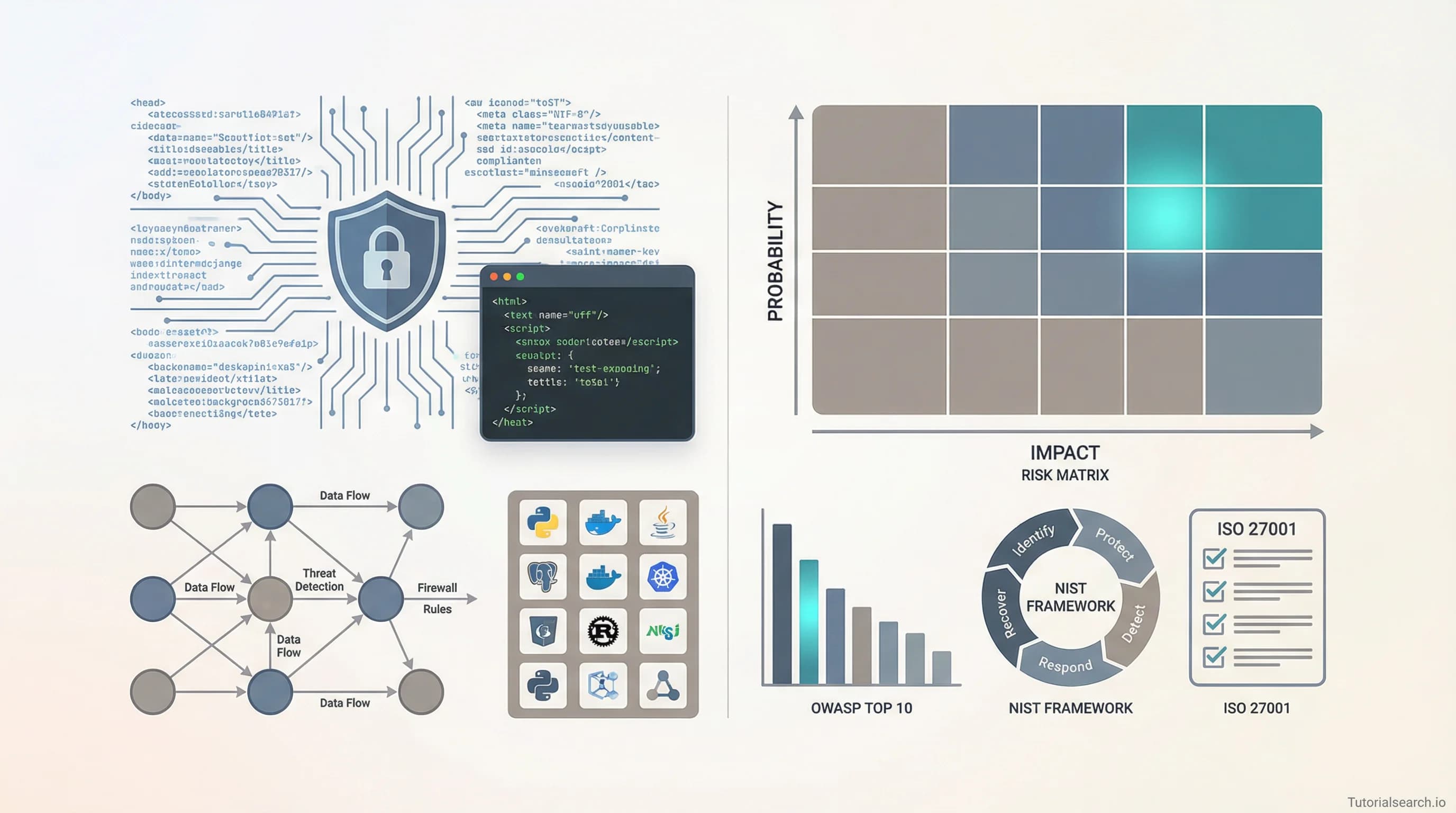
Risk Analysis Skills Every Cybersecurity Pro Should Master
Cybersecurity risk analysis is the skill that separates reactive security teams from proactive ones. This guide covers top courses, free frameworks (NIST, OWASP, ISO 27001), books, GitHub repos, and communities for mastering it.
Need a web app built? Hire the team behind TutorialSearch.io
We ship fast, production-grade full-stack apps (Next.js, React, edge infra) — the same stack that powers this site.
Cybersecurity risk analysis is the process that decides which threats get fixed first — and which get ignored at significant cost. IBM's 2024 Cost of a Data Breach Report put the average breach at $4.88 million. The stat that stands out more than the number: organizations with mature risk analysis practices reduced that cost by nearly 40%.
That gap is why risk analysis skills now appear in job descriptions across every cybersecurity category — from GRC analysts to cloud security architects to CISOs. Organizations aren't just looking for people who can identify threats. They want people who can rank them.
Key Takeaways
- Risk analysis identifies threats, assesses their likelihood, and prioritizes response — a core skill across cybersecurity roles
- The NIST Risk Management Framework (RMF) is the most widely used standard for risk analysis in U.S. and enterprise environments
- Free frameworks from NIST, OWASP, and ISO give you a solid foundation before spending money on courses
- The best risk analysis training combines qualitative methods, quantitative techniques, and hands-on practice with real asset inventories
- Risk analysis skills directly support roles in GRC, security architecture, cloud security, and compliance
In This Article
- The Risk Analysis Training Professionals Actually Use
- Risk Analysis Frameworks: Where the Standards Live
- Free Risk Analysis Resources That Go Deeper Than You'd Expect
- Risk Analysis YouTube Channels Worth Your Time
- Risk Analysis Books That Changed How I Think About Security
- Risk Analysis GitHub Repos Worth Starring
- Where Risk Analysis Professionals Actually Hang Out
- Related Cybersecurity Skills Worth Exploring
- Frequently Asked Questions About Risk Analysis
The Risk Analysis Training Professionals Actually Use
Most beginners start in the wrong place. They search for "risk analysis course" and land on something theoretical that never shows them how to open a risk register, score a vulnerability, or present findings to a non-technical stakeholder. Here are the courses that close that gap.
1. Learn Risk Analysis, Evaluation & Assessment — From A to Z [Editors' Choice]
With 21,600+ students, this is the most-enrolled risk analysis course on Udemy — and volume matters here because it means the material has been pressure-tested by a very wide audience. Instructor Marco Catanossi covers qualitative and quantitative methods, risk matrices, and the full assessment lifecycle from asset identification through mitigation planning.
The sections on threat identification are particularly strong. Catanossi doesn't just define what a threat is — he shows you how to build a credible threat catalog for different types of organizations. That's the piece most introductory resources skip entirely. His treatment of residual risk (what's left after you apply controls) is also unusually practical.
- Qualitative vs. quantitative risk analysis methods
- Building and maintaining a risk register
- Risk treatment options: accept, mitigate, transfer, avoid
- Real-world risk matrices and scoring exercises
Rating: 4.4 | 21,600+ students | Beginner-friendly
Browse all 175 risk analysis courses if you want to compare alternatives before committing.
2. NIST Risk Management Framework (RMF) — For Beginners [Editors' Choice]
If you're going to work in cybersecurity — especially in U.S. federal environments or any company that sells to government — you will encounter the NIST RMF. This course covers the 7-step framework in plain language: Prepare, Categorize, Select, Implement, Assess, Authorize, and Monitor.
What I appreciate most: the instructor doesn't pretend the RMF is simple. It genuinely isn't. The framework involves dozens of control families, authorization decision trees, and documentation requirements. This course respects that complexity and walks through each step with enough depth that you'll know what to do in a real implementation — not just what to say in an interview.
Rating: 4.6 | Strong government and enterprise focus
3. Master CGRC (CAP Certified Authorization Professional) Guide [Editors' Choice]
The CGRC (Certified in Governance, Risk and Compliance, formerly CAP) from ISC² is the gold standard credential for risk management and system authorization. This prep course covers risk management principles, security assessment, authorization processes, and continuous monitoring at an advanced level.
Rating: 4.9 — one of the highest-rated in this entire category. If you're planning to pursue CGRC certification, this is where to start.
4. Credit Risk Analysis and Rating (For Bankers)
Risk analysis isn't only a cybersecurity discipline. This course from Shuddh Desi Banking covers credit risk assessment, loan portfolio risk, and rating methodologies for financial services professionals.
Why include it here? The core skill — identifying likelihood and impact, then building response plans — translates directly. Many GRC professionals come from banking or audit backgrounds. Understanding how risk analysis works in finance gives you a useful second frame for applying it to information security.
Rating: 4.6 | 4,200+ students | Intermediate level
5. Credit Risk Analysis — Real Estate Sector
EDUCBA's course extends credit risk concepts into real estate investment analysis. If your security role touches real estate fintech, lending platforms, or proptech, this niche pairing of domain knowledge and risk methodology is unusually practical.
Rating: 4.7 | 1,650+ students
6. Primavera Risk Analysis (Pertmaster) Training
For project managers who need to quantify schedule and cost risk, Oracle's Primavera Risk Analysis (formerly Pertmaster) is the industry-standard tool. This course teaches Monte Carlo simulation for project risk — a quantitative technique that converts uncertainty into probability distributions.
Niche, but if your work involves large infrastructure, engineering, or construction projects, this skill is worth more than most certifications in that space.
Rating: 4.5 | 1,200+ students
7. Quantitative Risk Analysis for Projects on Excel
A more accessible entry into quantitative methods. If you're not ready to invest in specialized software, this course builds Monte Carlo simulations and decision trees using tools you already have. The rating (3.5) is below average, but the underlying content — quantitative risk methods in Excel — fills a gap that pricier courses often don't cover.
Which Risk Analysis Course Should You Pick First?
| Your Situation | Best Starting Point |
|---|---|
| General info security risk assessment | Learn Risk Analysis, Evaluation & Assessment (A to Z) |
| U.S. federal / government security work | NIST RMF For Beginners |
| Pursuing CGRC or ISC² certification | Master CGRC (CAP) Certified Authorization Professional |
| Banking or financial sector | Credit Risk Analysis and Rating (For Bankers) |
| Project / schedule risk management | Primavera Risk Analysis Training |
| Quantitative methods on a budget | Quantitative Risk Analysis for Projects on Excel |
Risk Analysis Frameworks: Where the Standards Live
Honest take: most beginners over-invest in courses before ever reading the actual frameworks. The frameworks are free, they're well-documented, and once you've run one real assessment, they make complete sense.
The first time I sat down to do a proper risk assessment at an organization, I spent three days obsessing over scoring methodology — high vs. medium vs. low, which scale to use, how to weight likelihood versus impact. The framework gave me all of that. What it couldn't give me was agreement from stakeholders on what "high impact" actually meant for their specific business. That realization — that the human side is harder than the technical side — is what the best risk analysts figure out early.
NIST Risk Management Framework (RMF)
The authoritative U.S. standard, updated as recently as February 2026. NIST also publishes SP 800-30 Rev. 1 — a standalone guide for conducting risk assessments that's worth reading cover-to-cover. It's not exciting prose, but it's precise in ways that matter. If you only read one free document about risk analysis methodology, make it this one.
The go-to framework for web application security. The core formula is elegant: Risk = Likelihood × Impact. Both factors are rated on a 0–9 scale, producing LOW (0–3), MEDIUM (3–6), and HIGH (6–9) severity bands. What I respect about OWASP's documentation: it openly acknowledges debate about this methodology and suggests NIST 800-30 for more rigorous assessments. That kind of intellectual honesty is rare in standards bodies. The free OWASP Risk Calculator lets you practice scoring vulnerabilities before doing it in a real environment — run through ten OWASP Top 10 items and you'll understand the system quickly.
There's also the OWASP Risk Assessment Framework project specifically for structured web application assessments.
ISO/IEC 27001 and ISO 27005
The international standard for information security risk management. ISO 27005 specifically addresses the risk management process within an ISMS (Information Security Management System). Both UpGuard and Secureframe provide free editable spreadsheet templates for ISO 27001 risk assessment. If you're preparing for ISO 27001 compliance, the Security Management courses on TutorialSearch cover ISMS implementation across 713 courses.
FAIR (Factor Analysis of Information Risk)
FAIR is the industry standard for quantitative risk analysis — translating vague "high/medium/low" risk ratings into actual financial estimates. The Open Group maintains the standard. The awesome-security-GRC GitHub repo includes solid FAIR resources alongside ISO 27005 and GRC tooling.
Free Risk Analysis Resources That Go Deeper Than You'd Expect
Need a web app built? Hire the team behind TutorialSearch.io
We ship fast, production-grade full-stack apps (Next.js, React, edge infra) — the same stack that powers this site.
Free previews from SANS's 65+ courses include content on risk assessment methodology. The full courses are expensive, but the free material shows you how senior security professionals frame risk — which is itself valuable.
Rochester Institute of Technology (RITx) — Cybersecurity Risk Management on edX
Part of RIT's MicroMasters program and free to audit. It covers the full Risk Management Process, Quantitative vs. Qualitative Assessment techniques, and real industry case studies. This is structured university-level content, and it's a strong starting point before paying for any certification course.
UC Irvine — Introduction to Cybersecurity & Risk Management on Coursera
Another free-to-audit option. Covers security governance, compliance strategies, and the foundational relationship between assets, vulnerabilities, threats, and risk. Good for beginners who need the vocabulary before diving into frameworks.
EC-Council Free Beginner Cybersecurity Courses
EC-Council's free courses for beginners include risk analysis fundamentals and are a solid on-ramp if you're new to the security space. Certification-adjacent content without the price tag.
A note on free resources generally: the real depth isn't on tutorial sites. It's in the NIST documentation, the OWASP methodology pages, and the ISO standard guides. Those are where practitioners actually go. The courses help you understand what you're reading — but don't skip the primary sources.
Risk Analysis YouTube Channels Worth Your Time
Video content specifically for risk analysis is thinner than it should be. Most channels either cover cybersecurity too broadly or focus on one certification. These are worth bookmarking.
RISK ACADEMY (Alex Sidorenko)
One of the few channels run by a practitioner with 17+ years in enterprise risk management. Sidorenko is direct, genuinely contrarian, and covers foundational concepts alongside advanced quantitative methods. He publishes free templates and articles alongside the videos. If you want someone who'll push back on lazy risk thinking — including the overuse of red-amber-green heat maps — this channel is it.
Intaver Institute
Produces webinars and tutorials on risk analysis theory and RiskyProject software. If you're doing project risk analysis specifically — schedule risk, cost uncertainty, Monte Carlo simulations — their content is among the best free video material available.
Certification-linked YouTube content
Searching for "CRISC exam prep" or "CISSP risk domain" on YouTube yields solid free content. The CRISC (Certified in Risk and Information Systems Control) from ISACA is the most recognized risk-specific credential in cybersecurity, and several instructors post full study walkthroughs.
If you're also building security certification knowledge alongside your risk analysis work, the 1,063 courses in that category on TutorialSearch cover everything from CompTIA Security+ to CISSP.
Risk Analysis Books That Changed How I Think About Security
Most cybersecurity books on risk analysis are either too academic or too shallow. These four aren't.
How to Measure Anything in Cybersecurity Risk by Douglas Hubbard & Richard Seiersen [Editors' Choice]
This is the book that fundamentally changed how I approach every assessment. Hubbard is a statistician, not a security professional — and that outside perspective demolishes a lot of conventional wisdom. His core argument: "high/medium/low" risk ratings are nearly meaningless because they mean different things to every person in the room. The better approach is to estimate probability ranges and financial impact using actual data.
Most organizations aren't ready for this level of rigor. But understanding why qualitative ratings fail makes you a better risk analyst regardless of what methodology you're forced to use at your organization. Spend more time with this book than any other on this list.
Cybersecurity Risk Management: Mastering the Fundamentals Using the NIST Cybersecurity Framework by Cynthia Brumfield
Covers the NIST framework with unusual clarity. Brumfield is a veteran technology analyst, and she writes the way analysts write — concise, well-organized, no filler. Good for practitioners who need NIST depth without a PhD in computer science.
How Cybersecurity Really Works by Sam Grubb
The entry-level book for anyone starting from zero. It covers threat analysis, risk concepts, and how real attacks work — in language that doesn't require a security background. Read this before you tackle NIST or OWASP documentation.
Cyber-Risk Management by Springer
Covers ISO 31000, ISO/IEC 27005, and industrial best practices. Dense, but pragmatic. Worth it if you work in critical infrastructure or large enterprise environments where standards compliance isn't optional.
Risk Analysis GitHub Repos Worth Starring
Curated by Veeral Patel, this repo collects projects, papers, blog posts, and tools focused specifically on quantifying risk. It includes Netflix's open-source riskquant library and references to FAIR methodology implementations. If you want to move beyond qualitative risk ratings into actual financial modeling, this is your starting point.
Covers Governance, Risk, and Compliance resources comprehensively. The FAIR framework section, ISO 27005 guidance, and compliance tooling make it a solid reference for anyone working in a GRC function. Well-maintained and regularly updated.
awesome-annual-security-reports
This one is underrated. It collects major industry security reports — Verizon DBIR, IBM Cost of a Data Breach, Security Scorecard Third Party Breach Report — which are essential reading for any risk analyst. Real breach data beats hypothetical threat models every time. Star this one and read at least one report before your next risk assessment.
Where Risk Analysis Professionals Actually Hang Out
Reddit r/cybersecurity
The most active general cybersecurity community. Threads on GRC, CRISC exam prep, risk register templates, and breach post-mortems come up regularly. Good for crowdsourcing opinions on specific frameworks or tools, and for seeing how practitioners at real organizations think about risk.
SOC Prime Discord
1,500+ members focused on threat intelligence and detection engineering. Less about risk management frameworks and more about the operational side — but that perspective matters. Detection engineers think about risk differently than GRC analysts, and exposure to both viewpoints makes you sharper.
ISACA Community
ISACA publishes the CRISC certification and maintains professional communities around their frameworks. Their member forums have a higher signal-to-noise ratio than Reddit for senior practitioners. If you're serious about risk management as a career track, ISACA membership is worth the cost.
If cloud security is in your scope — and it usually is — those communities have their own risk-focused discussions, particularly around shared responsibility models and cloud-native threat assessment.
Related Cybersecurity Skills Worth Exploring
Risk analysis doesn't exist in isolation. These skills work directly alongside it — and each has a deep course catalog if you want to go further.
- Security Certification — 1,063 courses covering CISSP, CRISC, CompTIA Security+, and every credential where risk analysis is tested
- Cloud Security — 982 courses; cloud environments have their own risk posture and assessment challenges worth mastering
- Ethical Hacking — 935 courses; understanding attacker tactics directly improves threat identification in risk assessments
- Security Management — 713 courses covering ISO 27001, ISMS implementation, and GRC workflows
- Network Security — 566 courses; network vulnerabilities are a core input to any information security risk assessment
- Data Protection — 495 courses covering GDPR, privacy frameworks, and data classification — the asset inventory side of risk analysis
- InfoSec Certification — 487 courses including CISM and CRISC prep materials
Frequently Asked Questions About Risk Analysis
How long does it take to learn risk analysis?
You can cover the fundamentals in 4–6 weeks with consistent study. Basic proficiency — enough to run a risk assessment with supervision — takes 2–3 months. Professional mastery, including experience with multiple frameworks and real-world assessments, typically takes 1–2 years of hands-on work. Browse risk analysis courses to find options that match your timeline and goal.
What is Risk Analysis in cybersecurity?
Risk analysis in cybersecurity identifies, assesses, and prioritizes potential threats to an organization's assets and systems. It evaluates vulnerabilities and the likelihood they'll be exploited, then estimates the potential impact of a breach or incident. The output is typically a risk register — a prioritized list of risks with proposed treatments. The core logic across every major framework (NIST, OWASP, ISO 27001) is the same: Risk = Likelihood × Impact.
Do I need cybersecurity experience to learn risk analysis?
No, but it helps. Risk analysis is a methodology that applies across domains — many practitioners come from IT, auditing, finance, or project management backgrounds. The NIST RMF and ISO 27001 frameworks are designed to be usable by non-technical stakeholders. Start with a beginner course and the free NIST documentation; you'll pick up the context you need as you go.
Can I get a job with risk analysis skills?
Yes, and they pay well. Roles that specifically value risk analysis include GRC Analyst, Information Security Analyst, Risk and Compliance Officer, Security Architect, and CISO. CRISC-certified professionals average over $130,000 in the U.S. according to ISACA's latest salary survey. Risk analysis skills also improve your performance in almost any security role because you can prioritize better than colleagues who treat every vulnerability as equally urgent.
What are the steps in a Risk Analysis process?
The core steps: asset identification (what are you protecting?), threat identification (what could go wrong?), vulnerability assessment (what weaknesses exist?), likelihood assessment (how probable is exploitation?), impact assessment (what's the business cost?), and mitigation planning (what do you do about it?). These steps appear — sometimes with different names — in every major framework from NIST to ISO to OWASP.
The skill most organizations lack isn't more firewalls. It's people who can look at a system, understand what could go wrong, estimate the probability with some rigor, and communicate it in a way that drives decisions rather than creating more spreadsheets.
Start with the A-to-Z risk assessment course for the foundation, bookmark the NIST RMF documentation, and read the first three chapters of Hubbard's book. That combination puts you ahead of most people working in this space.