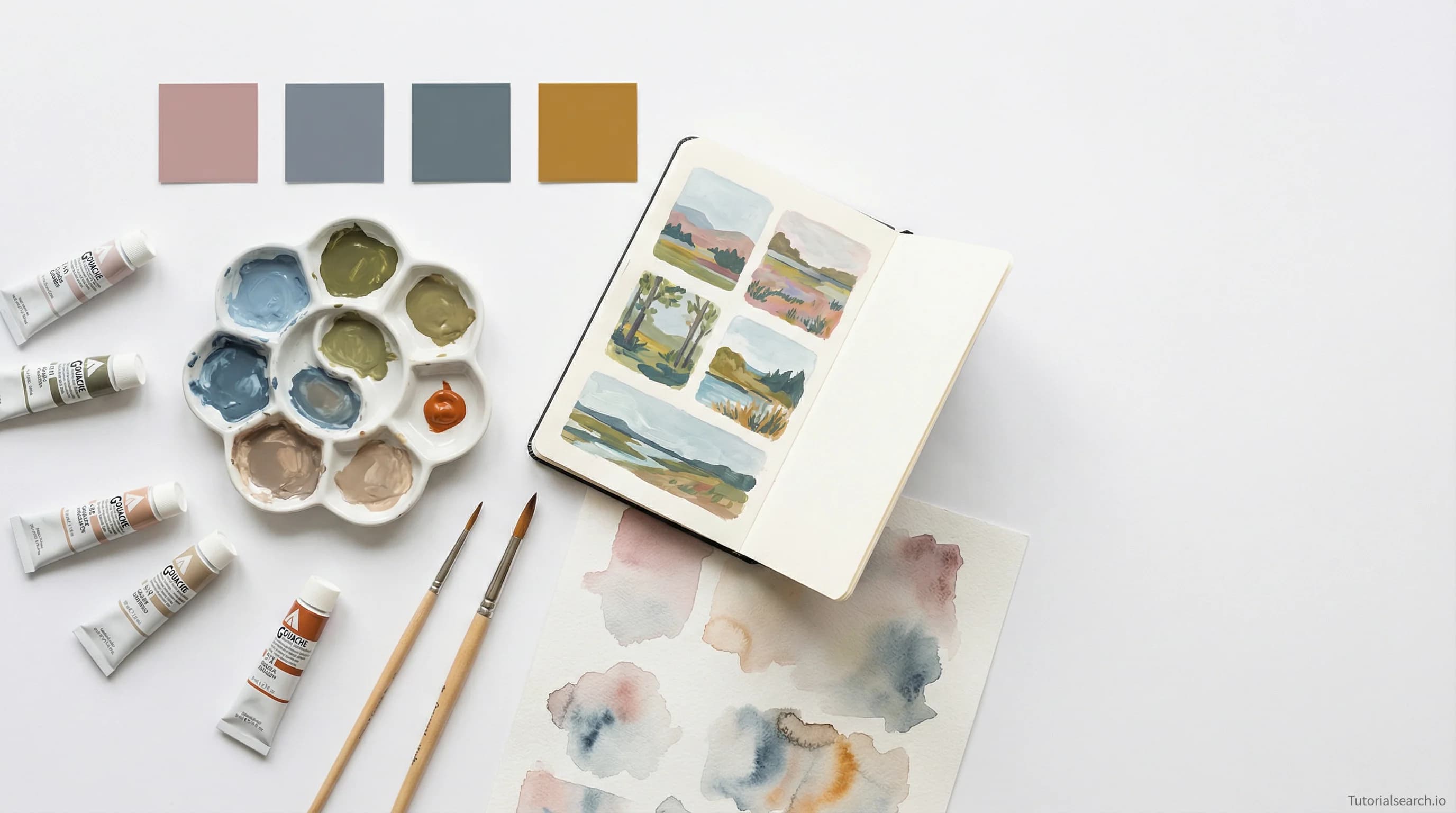
The Gouache Painting Resources I'd Recommend to a Friend
Gouache painting is one of the most forgiving mediums to learn — if you know what to practice first. Here are the courses, free resources, YouTube channels, and books worth your time.
Hire the developers behind TutorialSearch.io
We built this site — full-stack web apps, AI integration & automation. Tell us what you need and we'll build yours.
Gouache painting is one of the most satisfying ways to start making art — and most people have never heard of it.
If you've ever seen those bold, flat illustrations in children's books or vintage travel posters, you've probably seen gouache at work. It's a water-based paint with one feature that separates it completely from watercolor: opacity. You can paint a bright yellow on top of deep navy and the yellow shows up. That changes everything about how you work, how you fix mistakes, and what you can create.
You can browse 194+ gouache painting courses right now. But before you pick one, it's worth knowing what makes this medium tick — and which resources are genuinely worth your time versus which ones just look impressive.
Key Takeaways
- Gouache painting is opaque, so you can apply light colors over dark ones — unlike watercolor.
- You don't need many supplies to start: a small paint set, watercolor paper, and two or three brushes is enough.
- The best gouache painting courses focus on color mixing, layering, and learning to control paint consistency.
- Free YouTube content from James Gurney and Jenna Rainey can take you far before spending money on a structured course.
- Getting the water-to-paint ratio right is the single biggest challenge for beginners — too much water turns opaque paint transparent.
In This Article
- Gouache Painting Courses Worth Starting With
- Free Gouache Painting Resources That Are Surprisingly Good
- The Gouache Painting YouTube Channels I Keep Watching
- Gouache Painting Books Worth Picking Up
- Related Gouache Skills Worth Exploring
- Frequently Asked Questions About Gouache Painting
Gouache Painting Courses Worth Starting With
Most beginners default to Udemy because the courses are cheap. That's not wrong, but for gouache painting, Skillshare is where the better content lives. Gouache attracts artists who teach in a process-focused, expressive way — and Skillshare's short-lesson format suits that style well.
Here are the courses I'd point someone toward:
1. Gouache Paintings with Black and White — Learn to Paint Magical Night Skies [Editors' Choice]
Instructor: Zaneena Nabeel | Platform: Skillshare | Rating: 4.89 | Students: 2,018
This is the best starting point for beginners who want a dramatic-looking result without a complicated palette. Zaneena limits the color range to black and white, which forces you to think about value — the lightness and darkness of a tone — instead of getting distracted by color mixing. That's a smart constraint.
The night sky format is genuinely beginner-friendly: soft gradients, stars added with white paint splatters, and moody atmospheric effects that look impressive but don't require fine motor precision. By the end, you'll understand how gouache builds in layers. That's the foundation everything else rests on.
2. Expressive Gouache Landscapes: Exploring a Limited Color Palette [Editors' Choice]
Platform: Skillshare | Rating: 4.91
If there's one mistake beginners make consistently with gouache, it's buying too many paint colors. Working with a limited palette — five or six colors at most — forces you to mix more and understand color relationships at a deeper level. This course is built entirely around that idea.
The "expressive" part matters too. These aren't photorealistic landscapes. They're bold, loose, and confident-looking — the style most people are drawn to when they first encounter gouache illustration. The rating of 4.91 should tell you something.
3. EASY GOUACHE Painting for Beginners — Tips and Tricks (Gouache 101) [Editors' Choice]
Instructor: Sharon Leung | Platform: Skillshare | Rating: 4.25 | Students: 162
This is the most practical "mechanics" course on the list. Sharon focuses on consistency, paper behavior, how to avoid streaks, and what to do when your paint dries out faster than expected. It's the kind of foundational knowledge that other courses assume you already have.
If you're starting from zero and want to understand the medium before jumping into projects, start here. Most courses teach you to paint something pretty. This one teaches you to understand what you're working with.
4. Escape To Nature: A Beginner's Guide to Gouache Landscapes
Platform: Skillshare | Rating: 4.67
This course takes a gentle, nature-focused approach. The projects range from rolling hills to misty forests, and the instruction is patient enough for complete beginners while still holding the interest of artists with some painting experience. The focus on naturalistic color — greens that don't go muddy, skies that breathe — is useful for anyone who's painted digitally and wants to translate that into physical media.
5. Gouache Painting: The Ultimate Landscape Painting Course
Instructor: Letstute | Platform: Udemy | Rating: 4.18 | Students: 1,442
If you prefer Udemy's pay-once format, this is the strongest gouache course on the platform right now. It covers a wider range of topics than most Skillshare classes — from sky painting techniques to perspective fundamentals — making it a good option if you want something more structured and comprehensive.
Honest opinion: the teaching style is more textbook than creative, which doesn't suit everyone for an art medium. But the content is solid and the price is reasonable for what you get.
6. Gouache Painting: Learn To Paint Indoor Plants
Instructor: Mohini Sinha | Platform: Skillshare | Rating: 5.0
Mohini's courses are among the most consistently-rated on TutorialSearch.io. This one is perfect if landscapes don't appeal to you. Indoor plants are an ideal gouache subject: structured shapes, forgiving color, and real opportunities to practice both flat washes and layered detail.
She also has a 15-day landscape painting challenge that's worth bookmarking if you want to build a daily painting habit. Painting small things every day does more for your progress than any single long course.
Quick Guide: Which Gouache Painting Course Fits You?
| If you want... | Try this |
|---|---|
| Dramatic results as a beginner | Night Sky with Zaneena Nabeel |
| Color theory built into the lessons | Expressive Landscapes (Limited Palette) |
| Mechanics first, projects second | Sharon Leung's Gouache 101 |
| Udemy / pay-once format | Letstute Landscape Course |
| A daily painting habit | Mohini Sinha's 15-Day Challenge |
| Botanical and floral subjects | Indoor Plants with Mohini Sinha |
Free Gouache Painting Resources That Are Surprisingly Good
You don't need to buy a course to understand gouache basics. There's genuinely good free content out there — some of it better than paid material.
Jenna Rainey's Complete Beginner's Guide to Gouache is the first place I'd send anyone. It covers every question beginners have: what paper to use, how much water to add, how to layer colors, and what's actually different from watercolor. It's written in plain language and it's thorough in a way that most artist guides aren't.
Jackson's Art: Getting Started with Gouache is an art supply retailer's guide, but don't let that put you off. They explain the types of gouache (traditional vs. acrylic gouache), how paint consistency changes the outcome, and which brushes work best. Because they sell supplies, they have a real incentive to be accurate.
Art Prof: Intro to Gouache Painting is a free structured lesson that goes deep. Teaching Artist Alex Rowe walks through thumbnail sketches, color studies, underpaintings, and transparent glazes. This is closer to a real class than a casual tutorial.
Gathered.how: In-Depth Gouache Guide was updated in March 2026 and is one of the most thorough free guides online right now. It covers supplies, layering strategy, color mixing, and includes photos of every step. Worth bookmarking.
Domestika: Free Gouache Texture Exercises offers downloadable PDF exercises focused on brushstroke practice. Most free guides send you straight to projects. These exercises build the muscle memory that makes projects actually go well.
Sandy Allnock: Getting Started with Gouache includes five free video lessons. Sandy focuses on practical advice: paper absorbency, how to prevent colors from lifting when you layer, and what the right "buttery" consistency actually feels like in practice.
The Virtual Instructor: How to Paint with Gouache provides a focused video tutorial on technique. It's a good companion to the written guides above.
Finearttutorials.com: Gouache Beginner's Guide rounds out the set with detailed advice on supplies, techniques, and common pitfalls. It's written from a fine art perspective rather than illustration, which gives you a useful second angle.
Here's one thing I'd push back on about most free guides: they don't spend enough time on the water-to-paint ratio. That's the one thing that trips up every beginner. The short answer is this — gouache should be about the consistency of yogurt for most painting work. Too wet and it loses opacity and behaves like watercolor. Too thick and it cracks when it dries. Once you calibrate that feel, almost everything else becomes easier.
If you're already comfortable with watercolor, check out the watercolor techniques courses on TutorialSearch.io — many bridge directly into gouache, especially around color mixing and wet-on-wet layering. There's also strong overlap with watercolor illustration courses if you're interested in the illustration side of things.
The Gouache Painting YouTube Channels I Keep Watching
Hire the developers behind TutorialSearch.io
We built this site — full-stack web apps, AI integration & automation. Tell us what you need and we'll build yours.
YouTube is genuinely excellent for learning gouache. The medium is visual — watching someone control paint consistency in real time teaches you more than reading about it for an hour.
James Gurney is a professional illustrator best known for the Dinotopia book series. He uses gouache for plein air painting (painting outdoors, directly from observation), and watching him work is like sitting next to a master. His videos are under ten minutes each but dense with technique. He'll demonstrate underpainting, explain why he blocks in specific colors first, and describe what he's noticing about changing light conditions. His en plein air gouache series is where I'd start.
Jenna Rainey [Editors' Choice] is the best YouTube channel for absolute beginners. She anticipates questions beginners don't know they have and answers them before you can feel confused. Her color mixing tutorials are especially strong, and she's unusually good at explaining why a technique works rather than just showing what to do.
Jess Chung focuses on helping beginners avoid the specific pitfalls of gouache. The paint dries lighter than it looks when wet. It lifts if you go back into a layer too soon. Jess explains these behaviors clearly and gives you real strategies for working around them. Her atmospheric seascape tutorial is an excellent first project.
Shayda Campbell is the place to go for botanical painting. If you're drawn to floral illustration, her channel has the best free gouache botanical content available anywhere. Her Midwinter botanicals tutorial shows how to build lush detail with small, controlled brushwork.
makoccino has a different energy — more casual, more experimental, and more fun to watch. Her galaxy painting tutorial demonstrates how to use white gouache with a bristle brush to splatter star formations across a dark background. It looks advanced but takes about five minutes to learn.
The Virtual Instructor covers gouache as part of a broad art education channel. If you want to understand where gouache fits among other painting mediums — and whether it makes sense to learn it alongside acrylics or oils — this channel gives you the context to make that call.
Gouache Painting Books Worth Picking Up
Books are worth the investment if you want a deeper foundation in the medium. These are the ones I'd actually recommend.
Get Started with Gouache by Emma Block is the one I'd choose first. It's practical and unpretentious. Emma teaches you to start with a small set of paints and mix everything you need — which is the right approach for building real skill. The thirty projects go from beginner to intermediate territory, and the illustrations are beautiful enough to keep the book on your desk.
Gouache in 4 Easy Steps by Anna Koliadych takes a different approach: fifty hands-on exercises with brief theory at the start and then straight into practice. If you learn better by doing than by reading, this is the one. The exercises build deliberately, so each one prepares you for the next.
The Art of Gouache by Jeremy Ford is for artists who want to understand gouache at a deeper level — its history, how it compares to other painting traditions, and how professional illustrators use it today. Ford's approach is step-by-step but assumes some painting background.
Anywhere, Anytime Art: Gouache by Agathe Singer is compact and portable by design. It suits the quick-drying, spontaneous nature of gouache well. If you want to paint outdoors or on the go, this one fits the lifestyle.
One free resource worth bookmarking: the Altenew Ultimate Guide to Gouache Techniques is available online at no cost. It covers history, technique, and inspiration. It won't replace a book, but it's a solid free reference for when you're mid-painting and need a quick answer.
Related Gouache Skills Worth Exploring
Gouache sits in an interesting spot between watercolor, acrylic, and illustration. Expanding into adjacent skills tends to make your gouache work noticeably better — because so many of the underlying principles overlap.
Illustration Techniques — Gouache is one of the most popular mediums for illustration. These 1,354+ courses cover composition, figure drawing, and the skills that make painted illustrations actually work as finished pieces.
Watercolor Illustration — The transparent side of water-based painting. Many artists mix gouache and watercolor in the same piece. With 1,095+ courses, this is a natural companion category.
Watercolor Techniques — Wet media fundamentals. Color theory, wet-on-wet technique, and layering skills all transfer directly into gouache work.
Mixed Media Art — Gouache works beautifully with ink, pencil, and collage. Mixed media courses will show you where gouache fits in a broader practice.
Procreate Illustration — Many Procreate artists use brushes that simulate gouache behavior, and the technique overlap is strong. Worth exploring if you move between digital and traditional media.
Creative Expression — More about concept than medium. These courses are worth exploring if technical skills aren't the bottleneck and creative confidence is.
Beginner Art — If you're genuinely new to making art, starting here before jumping into gouache specifically can give you a more solid foundation to build from.
Frequently Asked Questions About Gouache Painting
How long does it take to learn gouache painting?
You can produce something presentable within your first session. Getting comfortable with consistency and layering typically takes a few weeks of regular practice. Reaching genuine fluency — where you're making creative decisions, not just technical ones — takes a few months of consistent painting. The medium is more forgiving than watercolor, so most people progress faster than they expect.
For structured learning, check out the gouache painting course collection — options range from single-session projects to 15-day intensive challenges, so you can match the pace to your schedule.
What's the difference between gouache and watercolor?
Watercolor is transparent. You build color by layering thin washes, and the white of the paper shows through. Gouache is opaque. You can paint light colors over dark ones, correct mistakes by painting over them, and achieve a flat, matte finish that's distinct from watercolor's luminous quality.
Traditional gouache also re-wets when water touches it — even after drying — which means you can blend dried layers back. That's both useful and something you need to learn to control. If you already work in watercolor techniques, switching to gouache will feel familiar but will also require unlearning some habits.
Do I need drawing skills to learn gouache painting?
No — but some basic drawing skills do help. Most beginner courses teach you to start with simple shapes and block-in compositions before adding detail. Drawing accurately and painting well are separate skills that develop together if you stick with both. The good news is that gouache's forgiving nature — you can paint over almost anything — makes it less intimidating to put marks down in the first place.
What materials do I need to get started with gouache painting?
A small set of gouache paints (6–12 colors), watercolor paper (140 lb / 300 gsm cold-press), and two or three brushes (a large flat, a medium round, and a small detail brush) are all you need to start. Water and a palette for mixing complete the setup. You don't need an easel or a large workspace — a table and good natural light work fine.
Is gouache painting good for complete beginners?
Yes — and it's worth saying clearly that gouache is arguably the most beginner-friendly paint medium for learning to think in color. Because you can paint over mistakes, the stakes feel lower than with watercolor. Because it dries fast, you can layer within minutes rather than waiting hours. Because it's water-based, cleanup is a non-event. The biggest adjustment for total beginners is learning paint consistency, but that's a manageable learning curve with a bit of practice.
Start with one of the beginner courses listed above. You'll produce real, finished work faster than you'd expect.
Pick one course. Gather three to five paint colors. Paint something the size of a postcard. That's your first session covered. The medium rewards people who just start rather than plan indefinitely.
You can explore the full range of gouache painting and illustration courses whenever you're ready to go deeper.