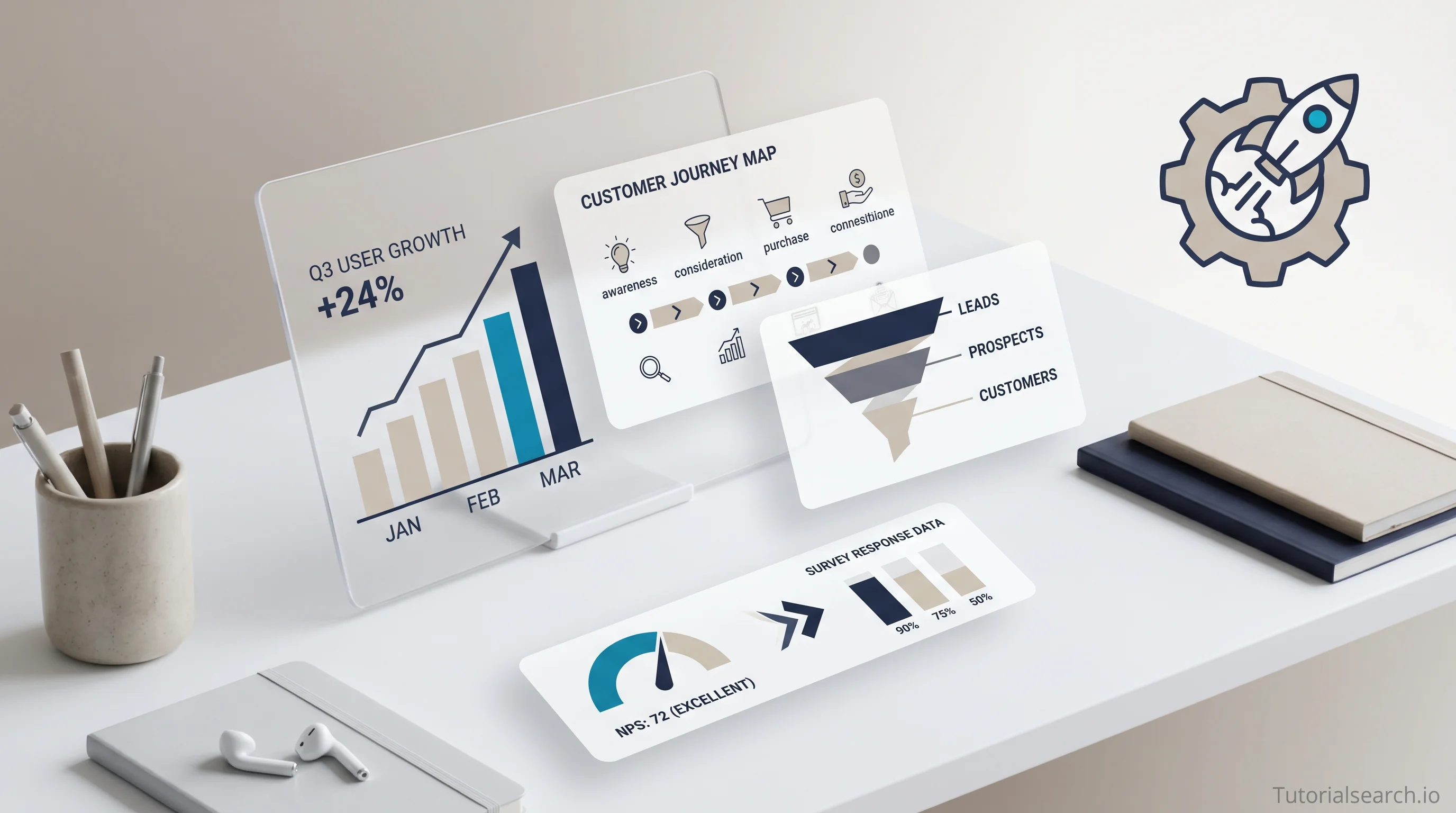
The Customer Insights Guide I Wish I Had Starting Out
A practical guide to customer insights in 2026 — covering the best courses, free resources, YouTube channels, books, and communities to build real analytical skills.
Hire the developers behind TutorialSearch.io
We built this site — full-stack web apps, AI integration & automation. Tell us what you need and we'll build yours.
Customer insights — the practice of turning raw customer data into decisions that actually move the needle — has become one of the most valuable skills in marketing and product development. As of 2026, companies that build systematic feedback loops grow twice as fast as those still running quarterly surveys and guessing the rest. This post pulls together the best courses, free tools, YouTube channels, books, and communities to help you start learning customer insights today.
Key Takeaways
- Customer insights isn't just research — it's a repeatable system for connecting data to decisions
- The best customer insights skills combine qualitative feedback analysis with quantitative behavioral data
- You don't need expensive software to start; free tools like Google Analytics and Hotjar cover most of the basics
- Customer insights professionals who learn NPS, cohort analysis, and segmentation have the clearest career paths
In This Article
This guide covers everything you need to build real customer insights skills — from beginner-friendly courses to GitHub repos and books.
- The Customer Insights Skills That Actually Get You Hired
- Customer Insights Courses Worth Taking
- Free Customer Insights Resources That Hold Up
- YouTube Channels for Learning Customer Insights
- GitHub Repos for Hands-On Customer Insights Practice
- Books That Changed How I Think About Customer Data
- Paid vs. Free: How to Choose Your Customer Insights Stack
- Where Customer Insights Professionals Hang Out Online
- Related Customer Insights Skills Worth Exploring
- FAQ
The Customer Insights Skills That Actually Get You Hired
Here's a contrarian opinion: most "customer insights" job descriptions are lies. They list 12 tools, ask for five years of experience in a methodology invented three years ago, and call it "entry level." The real skill isn't knowing every platform — it's knowing how to ask the right question and then find data that answers it.
The practitioners I've seen build real careers in customer insights share three things. First, they understand that behavioral data (what customers do) and attitudinal data (what customers say) almost never agree — and the gap between them is where the actual insight lives. Second, they can translate a spreadsheet of NPS scores into a product decision a CEO will act on. Third, they're comfortable being wrong about their initial hypothesis.
If you're building these skills right now, you're entering a field that's genuinely changing fast. By 2026, an estimated 73% of B2B product teams use at least one AI tool for feedback analysis, up from 31% in 2023. The tools are multiplying, but the underlying analytical thinking stays the same. The Chattermill report on customer insights software maps out the current tool landscape well if you want a quick overview.
Customer Insights Courses Worth Taking
These are the courses I'd recommend to someone building a real foundation — not a credential portfolio, but actual working knowledge.
1. Master Customer & User Interviews | Know Exactly What To Ask (Udemy) — Gary Broekhoven
[Editors' Choice] This is the customer insights course I'd send someone to before any other. Most people learning "customer insights" skip straight to dashboards and analytics platforms, which is backwards. Insights start with conversations, and conversations start with knowing how to ask questions without leading the witness.
Broekhoven teaches a systematic approach to customer interviews that works whether you're a product manager at a startup or a market researcher at an agency. The section on avoiding confirmation bias alone is worth the price. Rating: 4.6/5 with 1,477 students.
2. Buyer Persona with AI: Build Your Ideal Customer Profile (Udemy) — Diego Davila
[Editors' Choice] Free and well-structured, this course bridges the gap between raw customer data and the buyer personas that actually shape campaigns. Davila covers AI-assisted persona building in a practical way — not just "feed your data into ChatGPT" but how to validate what comes out. With 853 students and a 4.7 rating, it's one of the more accessible starting points on the topic.
3. Generative AI for Customer Experience Analyst (Udemy)
Rating: 4.85 — one of the highest on this list. The course covers how generative AI tools are changing the role of customer analysts, with practical applications for sentiment analysis, feedback summarization, and insight reporting. If you want to understand where this field is heading, this is the course that explains it clearly.
4. Uncover Cognitive Biases in the Customer Journey (Udemy) — Customer Experience 24/7
[Editors' Choice] This one isn't just about insights — it's about why your insights will mislead you if you're not careful. The curriculum maps specific cognitive biases to specific stages of the customer journey, which gives you a framework for double-checking your own analysis. A 4.67 rating from 190 students backs up the quality.
5. Google Analytics Beginner to Intermediate | Hands-On Lessons (Udemy) — Travis Chow
[Editors' Choice] With 14,100 students and a 4.6 rating, this is the most popular course on this list. Google Analytics remains the foundational tool for behavioral customer data, and this course takes a hands-on approach rather than just walking through menus. The intermediate sections on custom reports and audience segmentation are where the real insights work happens.
6. Marketing Research: Support Your Marketing Decisions (Udemy)
Rating: 4.5. This course covers the research design fundamentals that most analytics courses skip: when to use surveys versus interviews, how to structure quantitative studies, and how to avoid sampling bias. Pairs well with any of the data analysis courses above.
Free Customer Insights Resources That Hold Up
Not everything worth learning costs money. These are the free resources I'd bookmark on day one.
Coursera: Customer Analytics (Wharton) — Wharton's customer analytics course is genuinely rigorous for something free-to-audit. Professor Fader's treatment of customer lifetime value and RFM analysis is referenced in textbooks. Enroll for free and pay only if you want the certificate.
Microsoft Learn: Work with Dynamics 365 Customer Insights — If you're entering an enterprise environment, Microsoft Dynamics Customer Insights is everywhere. This free module walks through the platform hands-on. Useful even if you end up using Salesforce or HubSpot, because the underlying data unification concepts translate.
Customer Insights - Second Edition (Open Textbook) — A free, downloadable open textbook covering market segmentation, survey design, and behavioral analysis. Better for building conceptual foundations than for tool-specific training, but the conceptual foundation is what holds everything else together.
GetThematic: Voice of Customer Analytics Guide — One of the most practical free guides on building a VoC (Voice of Customer) program. Covers how to collect, analyze, and act on open-ended feedback at scale. A good companion to the interview-focused courses above.
Qualaroo: Customer Insight Types, Benefits, Strategies — A thorough overview of the different types of customer insights (behavioral, transactional, attitudinal, psychographic) and when each is useful. Good orientation reading before you start any course.
YouTube Channels for Learning Customer Insights
Hire the developers behind TutorialSearch.io
We built this site — full-stack web apps, AI integration & automation. Tell us what you need and we'll build yours.
Rand Fishkin / SparkToro — Marketing Audience Insights
Rand Fishkin is the founder of Moz and creator of SparkToro. His YouTube content on audience research and customer insights is some of the most analytically rigorous content available for free. His work on "zero-click" search behavior and what it means for understanding your actual audience has directly changed how I think about behavioral data. Start with his talk on turning audience insights into marketing wins.
Alex Hormozi on Customer Data and Retention
[Editors' Choice] Hormozi's content isn't framed as "customer insights" but it functionally is. His frameworks for understanding customer acquisition cost vs. lifetime value, why customers churn, and how to structure feedback loops to improve offers are among the most practical free content on the topic. The production quality is high and the examples are concrete.
Customer Insights YouTube Playlist
A curated playlist of customer insights tutorials covering research methodology, analysis frameworks, and tool walkthroughs. Good for filling in gaps after you've taken a foundational course.
GitHub Repos for Hands-On Customer Insights Practice
Reading about customer analytics is one thing. Running the code yourself is another.
Awesome-Customer-Analytics (98 stars)
A curated list of customer analytics content aimed at non-technical business users who want to understand the methods without drowning in data science jargon. Covers behavioral segmentation, churn analysis, CLV modeling, and text analysis — with links to case studies, tutorials, and Kaggle datasets for each. Good reference to keep open alongside any course you're taking.
Awesome Data Analysis by PavelGrigoryevDS (500+ curated resources)
Broader than customer analytics specifically, but includes strong sections on Python, SQL, and data visualization that are directly relevant to building your own insights pipelines. Worth bookmarking for when you hit a wall on a specific technique.
Books That Changed How I Think About Customer Data
Hooked by Nir Eyal — Available on Amazon
The "Hook Model" (Trigger → Action → Variable Reward → Investment) is one of the most useful frameworks I've encountered for understanding why customers engage the way they do. Reading this changed how I interpret retention data — instead of asking "why did users churn," I started asking "which of these four loops broke."
Insights on the Brink by Brett Townsend and Tim Hoskins — Consumer insights book roundup via Zappi
This one is specifically for people building or working inside an insights function. Townsend and Hoskins make the case that consumer insights teams are often too focused on answering the questions they're asked, rather than challenging whether those are the right questions. The personal anecdotes are specific enough to be useful rather than merely inspirational.
Customer Analytics For Dummies by Jeff Sauro — On Amazon
The "Dummies" title undersells this one. Sauro's quantitative background gives the book an unusual level of rigor — particularly the sections on survey design, statistical significance, and NPS interpretation. If you've been doing customer analytics for a while and have nagging doubts about whether your methodology holds up, this is the book that will either confirm or resolve them.
Paid vs. Free: How to Choose Your Customer Insights Stack
The market for customer insights tools has exploded since 2023. Here's a realistic breakdown:
| Need | Free Option | Paid Option |
|---|---|---|
| Behavioral analytics | Google Analytics 4 | Mixpanel, Amplitude |
| Survey / NPS | Google Forms | Typeform, Delighted |
| Session recording | Hotjar free tier | FullStory, Heap |
| Customer feedback analysis | Dovetail (free tier) | Chattermill, Qualtrics |
| CRM / customer data | HubSpot CRM free | Salesforce, Dynamics 365 |
Honest take: most early-stage product teams and small businesses get 80% of the value they need from the free column. The paid tools earn their cost when you're processing feedback at scale (thousands of responses per month) or when you need to unify data from multiple sources automatically. Before you spend money, spend time learning to squeeze everything out of Google Analytics 4 and Hotjar — most teams haven't.
Where Customer Insights Professionals Hang Out Online
r/marketing on Reddit — The most active general marketing community on Reddit, with regular threads on research methodology, tool comparisons, and case studies. Search specifically for "customer insights" or "voice of customer" threads for relevant discussions.
GreenBook Community — The go-to professional community for market researchers and insights practitioners. More rigorous than most marketing communities, with published research, conference coverage, and practitioner discussions. The behavioral science content is particularly strong.
Synthesio on Consumer Insights — Using online communities like Reddit and Discord as a source of customer intelligence is increasingly mainstream. Start by reading discussions in your industry's active subreddits before investing in paid social listening tools. The signal-to-noise ratio is actually quite high once you know which communities your customers congregate in. Many product teams now include a monthly "Reddit listening session" as part of their insights practice.
Related Customer Insights Skills Worth Exploring
If customer insights interests you, these related skills pair well and round out a complete marketing analytics foundation:
- AI Marketing — AI tools are transforming how customer data gets collected, analyzed, and actioned. Understanding both is becoming table stakes for insights roles.
- Digital Strategy — Customer insights without strategic context is just trivia. Digital strategy courses teach you how insights translate into roadmap decisions.
- Content Strategy — Customer insights directly feeds content strategy — knowing what your audience cares about shapes what you create.
- Brand Building — Long-term customer insights work naturally connects to brand perception, positioning, and differentiation.
FAQ
How long does it take to learn customer insights?
You can get to functional competency — enough to run customer interviews, analyze survey results, and produce actionable reports — in 2 to 3 months of consistent study. Deep expertise in quantitative methods like cohort analysis, CLV modeling, and statistical testing takes longer, typically 6 to 12 months of practice on real data. The Wharton Customer Analytics course on Coursera is a good benchmark — it's designed to take about 8 hours and gives you a solid conceptual foundation to build on.
Do I need a background in data science or statistics to learn customer insights?
No, but some comfort with numbers helps. The most effective customer insights practitioners I've seen aren't data scientists — they're people who can ask precise questions, collect feedback without introducing bias, and communicate what the numbers mean to non-technical stakeholders.
How do I gather customer insights for marketing?
Start with the channels you already have access to: support tickets, sales call notes, review sites, and any surveys you've run. Most teams are sitting on insights they haven't properly analyzed. Once you've mined existing data, layer in structured collection: customer interviews (5 to 8 per quarter is enough to spot patterns), NPS surveys with follow-up questions, and behavioral analytics from your website or product.
Can I get a job with customer insights skills?
Yes — and the demand is growing. Customer insights roles exist across market research, product management, CX (customer experience), and growth marketing. The most in-demand combination right now is someone who can run qualitative research and analyze quantitative behavioral data. Pure researchers without analytics skills and pure analysts without research skills both have narrower job markets than people who can do both. Titles to search: customer insights analyst, consumer insights manager, UX researcher, and product analyst. The edX customer insights programs include credentials that can help signal these skills to employers.
Why are customer insights important for sales teams?
Sales teams are often the richest and most under-tapped source of customer data in a company. They hear objections, pricing concerns, competitor comparisons, and feature requests in real time. A good customer insights practice captures this systematically — through CRM tagging, regular sales-to-product feedback loops, and win/loss analysis.
What tools are used to analyze customer insights?
The core toolkit most practitioners use: Google Analytics 4 or Mixpanel for behavioral data, Hotjar for session recording and heatmaps, a survey tool (Typeform or Google Forms for smaller teams, Qualtrics at scale), and a CRM for longitudinal customer data. For synthesizing qualitative feedback, tools like Dovetail, Notion AI, or even a well-organized spreadsheet work fine when you're starting out.