Yoga Routine That Actually Works for Beginners
Build a daily yoga routine that actually sticks. Learn the exact 5-10 foundational poses, breathing techniques, and consistency strategies that transform beginners into regular practitioners.
Hire the developers behind TutorialSearch.io
We built this site — full-stack web apps, AI integration & automation. Tell us what you need and we'll build yours.
Building a yoga routine that actually sticks takes three things: a plan that fits your life, poses you can breathe through without collapsing, and a reason to show up tomorrow. Most people start with YouTube and quit because they're doing advanced flows on day one. This guide cuts through that and gives you exactly what works.
Key Takeaways
- Start with 20-30 minutes, 3 times per week to build consistency without burnout
- Master 5-10 foundational poses first before adding transitions and advanced movements
- Practice early morning around sunrise for best energy and mental clarity benefits
- Include pranayama breathing in every yoga routine for stress relief and nervous system reset
- Expect 3-6 months to see real flexibility and strength gains, but mood benefits start in week one
- Modify poses without shame—correct form in an easier pose beats perfect form in a hard one
- Contrarian insight: Longer yoga sessions aren't better for beginners; consistency beats duration every single time
Table of Contents
- Why a Daily Yoga Routine Changes Everything
- Beginner Yoga Routine Fundamentals
- The Best Yoga Routine Structure for Flexibility
- Strength-Building Yoga Routine Foundations
- Morning Yoga Routine for Energy and Focus
- Pranayama: Essential Breathing in Your Yoga Routine
- Common Mistakes in Your First Yoga Routine
- Yoga Routine Timeline: What to Expect When
- Creating Your Personal Yoga Routine Plan
- Advanced Yoga Routine Progression
- Frequently Asked Questions
- Related Topics to Explore
Why a Daily Yoga Routine Changes Everything
A yoga routine is just structured movement. But structured movement done consistently does something psychology can't explain. Your nervous system starts to recognize the pattern. Your body remembers it's supposed to be flexible. Your mind learns it can focus for 20 minutes without checking your phone.
The research backs this up. Regular yoga practice lowers cortisol (the stress hormone), increases GABA (the calm chemical), and actually changes your brain structure. Studies show that people who practice yoga have more volume in their hippocampus—the brain region for learning and memory. Your brain gets literally bigger.
But here's the thing most people miss: these changes don't require perfection. They require showing up. A 15-minute yoga routine done five times per week beats a 60-minute session you do twice per month. Your nervous system responds to pattern, not intensity.
You don't need a fancy studio. You don't need expensive gear. You need a spot on your floor, 20 minutes, and three reasons to come back. Learn about yoga well-being and how it connects to your overall health journey here.
Beginner Yoga Routine Fundamentals
Every yoga routine starts in the same place: Child's Pose. Not because it's easy, but because it teaches you the most important thing—how to breathe.
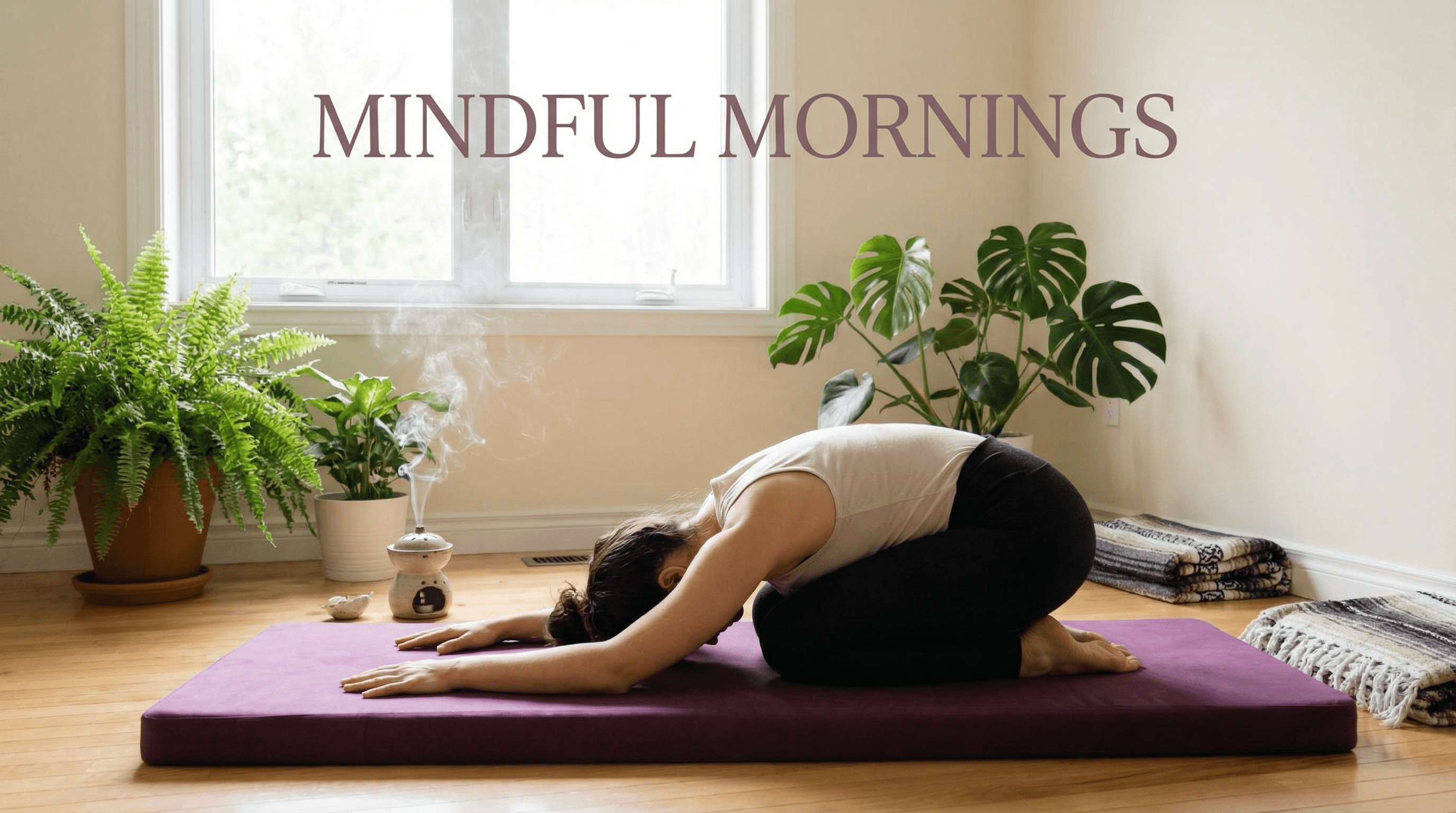
When you're in Child's Pose (Balasana), your forehead touches the mat, your knees spread wide, and your arms extend forward. You're in a position that automatically calms your nervous system. This is where you learn that yoga isn't about touching your toes. It's about reconnecting with your body through breath.
The five foundational poses every yoga routine needs:
Mountain Pose (Tadasana) teaches correct standing alignment. Feet together, arms at your sides, shoulders back. You're not doing anything, but you're doing everything. This pose is the baseline for all standing yoga poses.
Child's Pose (Balasana) gives your back and hips gentle release while you practice conscious breathing. Hold it for 60 seconds and actually notice each breath. Discover how to build healthy habits that include consistent yoga practice.
Downward Dog (Adho Mukha Svanasana) stretches your shoulders, hamstrings, calves, and feet while strengthening your arms and legs. It's the bridge pose that appears everywhere. Most beginners do it wrong—weight should be 50/50 between arms and legs, not all in your wrists.
Warrior I (Virabhadrasana I) strengthens your legs and opens your hips and chest. This pose teaches you what "grounded" actually feels like.
Triangle Pose (Trikonasana) gives you a strong sense of stability while opening your sides. It's the pose that makes you realize yoga builds strength, not just flexibility.
A beginner yoga routine uses these five poses. Just these. Hold each for 60 seconds, move slowly, breathe. Five minutes total. Do that three times a week for two weeks before adding anything else.
The Best Yoga Routine Structure for Flexibility
Flexibility comes from consistency and slight discomfort—not pain. Yoga people say "sensation" instead of "pain." There's a difference.
A yoga routine built for flexibility looks like this:
Warm-up (3-5 minutes): Gentle movement. Cat-Cow stretches. Shoulder circles. You're waking up your body, not pushing it.
Standing poses (10-12 minutes): Mountain Pose, Warrior I, Triangle, Warrior II. Hold each 60-90 seconds. These build the stability your flexibility needs. Flexible but unstable is how people get injured.
Hip openers (8-10 minutes): Pigeon Pose (Eka Pada Rajakapotasana prep), Low Lunge (Anjaneyasana), Butterfly Pose. Your hips hold tension like they're storing all your stress. They probably are.
Forward folds (5-7 minutes): Seated Forward Fold, Standing Forward Fold. No bouncing. You're teaching your hamstrings they're allowed to relax.
Closing (3-5 minutes): Supine twist, Corpse Pose (Savasana). Your nervous system needs downtime. This is where the magic happens.
Total time: 30-40 minutes. Do this routine 3-4 times per week. Most people see noticeable flexibility gains in 8-12 weeks.
The contrarian thing nobody says: forcing deeper stretches doesn't work. Deeper stretches sometimes make things worse. A 30-second gentle hold where you actually relax beats a 60-second aggressive push every single time. Your body has a nervous system that's protecting you. Fighting it is counterproductive.
Strength-Building Yoga Routine Foundations
Yoga builds strength differently than weights. You're using your bodyweight against gravity and leverage. It's slower but your joints get stronger too.
A strength-building yoga routine emphasizes:
Plank holds and variations: Basic Plank is foundational. Plank with one leg lifted. Side Plank. Forearm Plank. Hold each for 30-60 seconds. Your core will burn in a good way.
Downward Dog to push-up transitions: These build shoulder and arm strength. Move slowly. Control every inch.
Chair Pose (Utkatasana): Look simple, feel devastating. Thighs parallel to ground, weight in heels. 45 seconds of this and you understand why yoga works.
Warrior poses held longer: 90-120 seconds in Warrior I, II, and III. Your legs will shake. That's the point.
Chaturanga transitions: The yoga push-up. Core tight, elbows hugging your ribs, lower slowly. These build serious upper body strength.
If you want a strength-focused routine, add these to your foundational poses. Do 3-4 rounds, rest 30 seconds between rounds. This is more active yoga (Vinyasa or Flow style). Your heart rate goes up. You sweat. You're building muscle.
Morning Yoga Routine for Energy and Focus
Early morning around sunrise is ideal for pranayama practice. The second-best time is evening around sunset. But morning just works better for most people. Your mind is clearer. Your body hasn't accumulated the day's tension yet.
A morning yoga routine wakes you up instead of making you sleepy:
5-minute pranayama warm-up: Start with Ocean Breath (Ujjayi). Narrow your throat slightly and breathe. You'll hear an oceanic sound. This activates your parasympathetic nervous system—weird that it wakes you up, but it does.
Sun Salutations (5-10 minutes): This is the classic warm-up. 5-8 rounds of flowing from Mountain Pose through Downward Dog, forward folds, and back. You're building heat and alertness simultaneously.
Standing poses with longer holds (10-15 minutes): Your body is warm now. Push into deeper versions of Warrior I, Warrior II, Triangle. Add Reverse Warrior. Add Extended Side Angle.
Core work (5-7 minutes): Plank variations, boat pose holds, bicycle crunches. You want to feel awake now.
Quick closing (2-3 minutes): Seated Forward Fold, Savasana. Not long—this is energizing yoga, not sleep yoga.
Morning intention (1 minute): Sit quietly. Set one intention for your day. This makes the yoga stick in your brain beyond the mat.
Total: 28-36 minutes. Do this 4-5 times per week and your morning cortisol will normalize naturally. You'll feel awake without coffee (though coffee is great too).
Pranayama: Essential Breathing in Your Yoga Routine
Pranayama is Sanskrit for "breath expansion." It's not just deep breathing—it's controlling breath in specific patterns to affect your nervous system directly.
Most yoga routines completely skip this. That's leaving 60% of yoga's benefits on the table.
Basic pranayama techniques for beginners:
Ujjayi (Ocean Breath): Narrow your throat, breathe through your nose. You sound like Darth Vader. This activates the vagus nerve and calms your mind instantly. Use this in every yoga routine.
Nadi Shodhana (Alternate Nostril Breathing): Close one nostril, inhale through the other. Hold. Switch. Exhale opposite side. Do 10 rounds. This balances your nervous system and reduces anxiety dramatically.
Kapalabhati (Skull Shining Breath): Forceful exhales through your nose, passive inhales. This is internal cleansing. 30-60 seconds. This energizes and clears mental fog.
Box Breathing: Inhale 4 counts. Hold 4. Exhale 4. Hold 4. Repeat 8-10 times. This is the Navy SEAL stress-reduction technique. It works.
Add 5-10 minutes of pranayama to your yoga routine and your stress levels drop immediately. Research shows even one session reduces anxiety measurably.
Explore yoga well-being practices that integrate breathing with movement for deeper benefits.
Common Mistakes in Your First Yoga Routine
Hire the developers behind TutorialSearch.io
We built this site — full-stack web apps, AI integration & automation. Tell us what you need and we'll build yours.
Everyone makes these. It's not a character flaw.
Mistake 1: Comparing yourself to Instagram yoga people. They've been practicing for years. Your body isn't broken because you can't do a one-armed headstand on day five. Neither can 99% of people ever.
Mistake 2: Pushing past discomfort into pain. Sensation and pain are different. Sensation is good. Pain means stop. Your joints are telling you something. Listen.
Mistake 3: Skipping warm-up to save time. Cold muscles don't stretch safely. Five minutes of gentle movement prevents most injuries. The yoga routine takes 30 minutes anyway—five more minutes is fine.
Mistake 4: Practicing on a full stomach. Wait two hours after eating. Your digestive system doesn't do yoga well.
Mistake 5: Choosing the wrong style. Ashtanga and hot yoga are intense. Hatha is better for beginners. Start gentle, progress later. Vinyasa flow is in the middle.
Mistake 6: Expecting perfect form immediately. Your body is learning. Imperfect consistency beats perfect inconsistency. Do the routine with good enough form, show up regularly, form improves naturally.
Mistake 7: Assuming you need a studio. You don't. A mat and your floor work fine. The best yoga routine is the one you actually do.
Yoga Routine Timeline: What to Expect When
Week 1-2: Everything hurts. Your brain is confused. You're probably doing some poses wrong and feel frustrated. This is normal. Keep showing up.
Week 3-4: You notice you can breathe through difficult poses now. Your balance improves slightly. You still can't touch your toes but something has shifted.
Week 5-8: You can feel yourself getting stronger. Poses that felt impossible now feel possible. Your mind settles during yoga. You notice you're sleeping better.
Week 9-16: Real flexibility gains start. You can fold deeper. Your friends notice you stand differently. Stress doesn't hit you the same way. A yoga routine has become habit.
Month 4-6: This is where consistency pays off. You've built strength and flexibility that's real. Your nervous system has normalized. Anxiety doesn't show up like it used to. You probably thought "I should skip this" and didn't. That's everything.
6+ months: You're not a beginner anymore. You're understanding the deeper principles. You probably want to go deeper into specific styles or take a class. Your body has changed. Your mind definitely has.
The timeline isn't magic. It's neuroscience and biology. Consistency creates change. There's no shortcut. And that's actually good news because it means everyone can get there.
Creating Your Personal Yoga Routine Plan
Start here:
Step 1: Pick a time. Mornings are ideal. Evenings work. Just pick one and commit. Build this habit into your healthy habits framework.
Step 2: Pick a duration. 20 minutes is minimum. 30 minutes is ideal. 60 minutes is for people who have the time (most don't).
Step 3: Pick a frequency. Three times per week minimum. Four-five is better. Every day is ambitious—start at three and add more later.
Step 4: Pick your space. Doesn't have to be big. Quiet matters. A 6x8 foot space is enough.
Step 5: Gather props (optional). A yoga mat (not essential but nice). A block for modifications. A strap for deeper stretches. These are optional but helpful.
Step 6: Pick your style. Hatha for beginners. Vinyasa for moving flow. Yin for deep holds. Ashtanga for structured sequences. Start with Hatha or Vinyasa.
Step 7: Get a resource. YouTube (Yoga with Adriene is excellent), an app (Down Dog is great), or a class. Pick one and commit to it.
Step 8: Set a reminder. Your phone. Your calendar. Tell someone. Accountability is real.
Step 9: Start for just one week. Just commit to one week. Everything is easier when you're not thinking about the long-term.
Step 10: Adjust after week one. What worked? What didn't? Make changes. Then do week two with the improved version.
This is your yoga routine. It's personalized because you designed it.
Advanced Yoga Routine Progression
After six months, you're ready for progression:
Add arm balances: Crow Pose. Side Crow. These require core strength and balance you've built.
Add deeper backbends: Urdhva Mukha Svanasana (Upward Dog). Bhujangasana (Cobra). Wheel Pose eventually.
Add inversions: Shoulderstand. Headstand. These reverse blood flow and have serious benefits but require stability you've now earned.
Add longer holds: 2-3 minutes in advanced poses. This is where the nervous system really changes.
Add more pranayama complexity: Bhastrika (bellows breath). Bhramari (bee breath). These have specific effects on your mind and body.
Join a class: Online or in-person. A teacher sees things you don't. Having another person invested in your practice changes everything.
Consider teacher training: If yoga becomes central to your life. This isn't required. But many people who fall in love with yoga end up here eventually.
Yoga Routine FAQs
What is a good yoga routine for beginners?
A beginner yoga routine includes gentle stretches, basic poses, and mindful breathing in 20-30 minute sessions, 3 times per week. Focus on Mountain Pose, Child's Pose, Downward Dog, Warrior I, and Triangle Pose. Hold each for 60 seconds and breathe. Form matters less than consistency.
How long should a yoga routine be?
A typical yoga routine lasts 20-60 minutes depending on your goals. Shorter routines (15-20 minutes) work for busy schedules. Longer sessions (45-60 minutes) offer deeper relaxation. The best length is whatever you'll actually do consistently.
What muscles does a yoga routine strengthen?
A comprehensive yoga routine strengthens your core, improves posture, and builds strength in your legs, shoulders, and arms. Specific poses target different muscle groups. Plank variations strengthen core. Warrior poses strengthen legs. Downward Dog strengthens shoulders and arms.
Is a yoga routine safe for people with back pain?
A modified yoga routine can help back pain, but consult your doctor first. Avoid excessive twisting, forward bends that pull the lower back, and deep backbends initially. Focus on core strengthening, gentle stretches, and Cat-Cow movements. Child's Pose and Supported Bridge are usually safe.
What are the benefits of a daily yoga routine?
Daily yoga routines improve flexibility, reduce stress, enhance mental clarity, improve sleep quality, build strength, and promote overall well-being. Research shows regular practice lowers cortisol levels, increases GABA (associated with calm), and improves brain function. The benefits go beyond physical—your mood and resilience improve significantly.
Can I modify poses in my yoga routine?
Absolutely. Modification is yoga, not failure. Prop up your hips in forward folds. Bend your knees. Use blocks. Take Child's Pose whenever you need it. A modified pose done correctly beats an "advanced" pose done with bad form. Your body is unique. Your yoga routine should be too.
Related Topics to Explore
Deepen your yoga practice by exploring these connected areas:
- Holistic Wellness Practices to integrate yoga into your whole life
- Healthy Habits for building consistency into daily routines
- Fitness Foundations to understand movement principles
- Yoga Well-being for deeper mind-body connection
- Holistic Healing to address root causes of stress
External Resources
For deeper learning on yoga routines, these resources are worth your time:
- Yoga for Beginners 2026: Complete Home Guide - Mindfully Yoga
- 20-Minute Yoga Routine for Beginners - Yoga Rove
- 18 Yoga Poses for Your Ideal Morning Routine - Healthline
- Yoga Poses to Improve Flexibility - Cleveland Clinic
- Best Yoga Moves for Strength and Flexibility - GoodRx
- Pranayama: Yoga Breathing Exercises Guide - The Art of Living
- Pranayama Benefits and Techniques - WebMD
- Yoga for Better Mental Health - Harvard Health
- Benefits of Yoga for Mental Health - Calm Blog
- Brain Function and Yoga Practice - PMC
- 27 Yoga Poses for Daily Stretch Routine - Pliability
- Beginner Yoga Sequences - Tummee
- 10 Morning Yoga Poses to Start Your Day - Baptist Health
- Morning Yoga Routine for Beginners - Bodhi Surf Yoga
- 6 Morning Yoga Asanas for Focus and Calmness - The Health Site