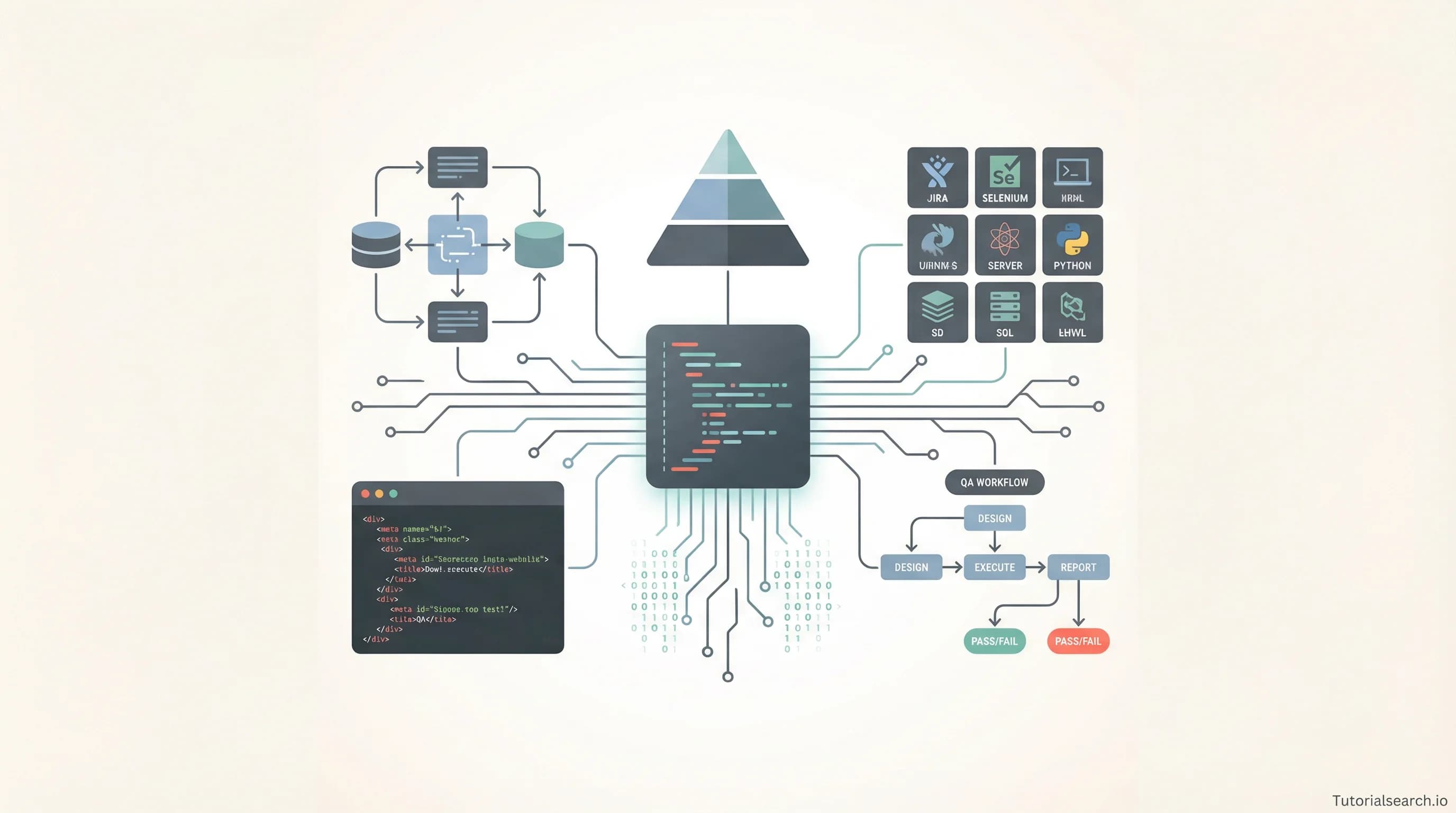
Where Should You Actually Learn Test Design in 2026? I Dug Through Everything
A curated guide to the best test design courses, free tutorials, books, GitHub repos, and YouTube channels in 2026 — from someone who learned the hard way that guessing isn't testing.
Need a web app built? Hire the team behind TutorialSearch.io
We ship fast, production-grade full-stack apps (Next.js, React, edge infra) — the same stack that powers this site.
Most testers I've worked with can tell you what to test. Surprisingly few can explain how they decide what to test — and that gap is exactly where test design lives.
I spent years early in my career writing test cases that felt thorough but were actually full of redundancy and blind spots. I'd test the same equivalence class twelve different ways while completely missing an edge case that would blow up in production. The problem wasn't effort or intelligence — it was that nobody had taught me test design as a deliberate discipline. I was guessing, and calling it testing.
If you're in that same boat, or you're a QA professional who wants to move from "clicking around and hoping for the best" to systematically designing tests that actually catch defects, this guide is for you. I've pulled together the courses, books, repos, and free resources that teach test design properly — not just the theory, but the practical application of techniques like equivalence partitioning, boundary value analysis, decision tables, and state transition testing.
The Technique That Changed How I Test
Before we get into resources, a quick reality check. Test design isn't one skill — it's a family of techniques, and knowing which one to apply when is the actual skill. The ISTQB Foundation Level Syllabus breaks them into three categories: black-box techniques (equivalence partitioning, boundary value analysis, decision table testing, state transition testing), white-box techniques (statement and decision coverage), and experience-based techniques (exploratory testing, error guessing).
Most beginners fixate on black-box techniques, which makes sense — they're the most immediately applicable. But the real growth happens when you learn to combine techniques. A decision table for the business logic, boundary value analysis for the inputs, and exploratory testing for the stuff nobody thought to specify. That combination is where test design becomes genuinely powerful.
If you're exploring the broader world of software testing, test design is the skill that separates someone who runs tests from someone who designs them. With 791+ test design courses and resources available, finding the right ones can feel overwhelming. So I've done the filtering for you.
Structured Programs That Actually Teach You to Think Like a Test Designer
Not all testing courses emphasize design. Many focus on tools, automation frameworks, or certification prep without spending meaningful time on how to decide what to test. These are the ones that do.
ISTQB Certified Tester Foundation Level Training (CTFL) by Helping Tester (Udemy) — [Editors' Choice]
With over 46,000 students and a strong 4.3 rating, this is the single most popular ISTQB course on Udemy, and for good reason. What sets it apart from other ISTQB courses is that it's taught by a working professional, not an academic — so the examples feel grounded in real projects. Chapter 4 on test design techniques is particularly well-done. If you're planning to get ISTQB certified and actually understand test design, start here.ISTQB Test Analyst Advanced Level (CTAL-TA) 2025 by Maged Koshty (Udemy) — [Editors' Choice]
Nearly 16,000 students have taken this advanced course, and it goes deep where the Foundation level stays broad. Equivalence partitioning, boundary value analysis, decision table testing, and pairwise testing get serious, detailed treatment. This is the course for someone who already knows the basics and wants to move from "I know what BVA is" to "I can apply BVA effectively on a complex system." Rating: 4.4.Software Testing Mastery: From Basics to Advanced Techniques by EDUCBA (Udemy)
A solid all-rounder with a 4.6 rating. It covers test design techniques within a broader testing curriculum, which is useful if you want context — understanding where test design fits within the full testing process. Good for intermediate testers who need to fill gaps.Selenium Webdriver with Java & TestNG Testing Framework by Parag Jambhulkar (Udemy)
Wait — a Selenium course in a test design guide? Hear me out. With a 4.9 rating and 16,000+ students, this course teaches you to implement test designs in automation. You can design the most elegant test cases on paper, but if you can't translate them into executable tests, the value is limited. This bridges that gap. If you're interested in automation testing alongside test design, this is the course.A4Q Practical Tester - ISTQB Add-On by Tarek Roshdy (Udemy) — [Editors' Choice]
A 4.84 rating from 1,800 students makes this one of the highest-rated testing courses out there. The A4Q Practical Tester certification is specifically about applying test techniques to real scenarios — which is exactly what test design is. If you've done ISTQB Foundation and felt like it was too theoretical, this is the practical counterpart.Software Testing Made Easy for Beginners by Arun Motoori (Udemy)
7,000+ students, 4.3 rating, and it includes hands-on projects with Jira and API testing. The test case writing sections are particularly strong for beginners who need to understand how test design translates into actual test documentation. Not as deep on formal techniques, but excellent for getting started.
Quick Comparison: Which Course Fits You?
| If you are... | Start with | Why |
|---|---|---|
| Brand new to testing | Software Testing Made Easy for Beginners | Project-based, practical, beginner-friendly |
| Preparing for ISTQB Foundation | ISTQB CTFL Training (Helping Tester) | Most popular, taught by practitioner |
| Already ISTQB Foundation certified | CTAL-TA by Maged Koshty | Deep dive into advanced test design |
| Want practical certification | A4Q Practical Tester | Hands-on application of test techniques |
| Want to automate your test designs | Selenium WebDriver with TestNG | Bridges design → automation |
Your Zero-Budget Starting Kit
You absolutely don't need to spend money to learn test design well. Some of the best resources are free — and a few are better than paid courses.
Guru99 Software Testing Tutorial — [Editors' Choice]
This is the resource I wish someone had handed me on day one. Guru99's free testing tutorial is massive, well-organized, and updated regularly. The sections on test case design, equivalence partitioning, and boundary value analysis are explained with real examples — not just textbook definitions. It's the single best free starting point for test design, period.
ToolsQA Software Testing Tutorial is another excellent free resource, specifically structured around the ISTQB syllabus. Their page on testing techniques walks through how to choose the right technique for different scenarios — which is the actual hard part of test design.
ISTQB Foundation Level Syllabus v4.0.1 — The official syllabus is free to download, and Chapter 4 on test design techniques is genuinely well-written. Most people only read it for certification prep, but it's actually a solid reference document. Pair it with the ISTQB Glossary for precise definitions.
Software Testing Material offers a complete manual testing tutorial with specific, detailed sections on each test design technique. Their explanations tend to be more practical than academic — they show you how to apply equivalence partitioning, not just define it.
BBST Test Design Course — The Association for Software Testing's Black Box Software Testing (BBST) course on test design is university-level content, Creative Commons licensed, and completely free. It includes video lectures, slides, and articles. This is legitimately the most rigorous free test design education available anywhere. It's harder than most paid courses — but you'll learn more.
If you're exploring adjacent topics, the software quality resources on TutorialSearch.io complement test design nicely, since good test design is ultimately about measuring and ensuring quality.
YouTube Creators Who Actually Understand Test Design
Most testing YouTube content focuses on tools — Selenium tutorials, Cypress walkthroughs, Postman demos. Finding channels that teach test design thinking requires digging past the automation content.
Raghav Pal — 449K+ subscribers, and while his channel leans toward automation, his testing fundamentals playlists cover test design techniques with clear, step-by-step examples. He has a talent for making abstract concepts concrete. Start with his Software Testing playlist if you're new.
The Test Therapist — A smaller channel that punches above its weight. Demonstrates both traditional test design techniques and modern approaches. The content is more thoughtful and less "follow along with my screen" — which is exactly what test design learning needs.
Guru99's YouTube Channel — The video companion to their excellent written tutorials. Their Software Testing Tutorials for Beginners playlist is comprehensive and covers test case design in detail. Not flashy, but effective.
Naveen AutomationLabs — 318K subscribers. Primarily automation-focused, but his TestNG and framework design content is excellent for understanding how test design principles translate into automated test architecture. If you want to see how good test design enables good automation, this channel bridges that gap.
SDET- QA — Covers testing interview questions, which might sound irrelevant, but test design questions are among the most common in QA interviews. Understanding how to explain your test design approach is almost as important as knowing how to do it.
Repos Worth Starring Right Now
Need a web app built? Hire the team behind TutorialSearch.io
We ship fast, production-grade full-stack apps (Next.js, React, edge infra) — the same stack that powers this site.
GitHub has some genuinely excellent testing resources that most testers never find because they don't think to look there.
TheJambo/awesome-testing — [Editors' Choice]
The definitive curated list of testing resources on GitHub. Organized by category, regularly maintained, and includes everything from books to tools to communities. Bookmark this and check back monthly — it's how I discover most new testing resources.
mfaisalkhatri/awesome-learning — Specifically aimed at test automation engineers, but the fundamentals sections cover test design principles that apply regardless of whether you automate. Strong on learning paths and structured progression.
PaulWaltersDev/FreeLearningResourcesForSoftwareTesters — A curated collection of free resources organized by topic. The manual testing and test design sections are particularly valuable for beginners who don't want to pay for courses yet.
upgundecha/awesome-testing-courses — A curated list focused specifically on courses and tutorials. Useful if you want to compare multiple learning options beyond what I've covered here.
testified-oss/awesome-testing-resources — Specifically focused on practice resources — places where you can actually apply test design techniques on real-world-like applications. Includes Automation Exercise for API testing practice and similar hands-on sites.
Read Your Way In
Books teach test design differently than courses — with more depth, more nuance, and more room for the "why" behind each technique. These are the ones that actually changed how I approach test design.
"A Practitioner's Guide to Software Test Design" by Lee Copeland — This is the book on test design. Full stop. It walks through every major test design technique — equivalence classes, boundary values, decision tables, pairwise testing, state transitions — with detailed examples and exercises. If you only read one book from this list, make it this one. It's been around since 2004 and nothing has replaced it because nothing needs to.
"Foundations of Software Testing" by Graham, Van Veenendaal, and Evans — Aligned with the ISTQB syllabus, this book provides the formal foundation for test design techniques. More academic than Copeland's book, but more thorough on the theoretical underpinnings. Get this if you're pursuing ISTQB certification or want a reference-style text.
"The Art of Software Testing" by Glenford Myers — The original. First published in 1979, updated several times since. Myers's chapter on test case design is legendary in the testing community. It's where the concept of test design as a deliberate engineering discipline really started. Shorter and more philosophical than the others — read it for perspective and principles.
"Lessons Learned in Software Testing" by Kaner, Bach, and Pettichord — Not a test design textbook, but a collection of 293 lessons about testing. Many directly address test design decisions — when to use which technique, how to prioritize, when good enough is good enough. This book shaped how I think about testing more than any other.
Where Conventional Wisdom Gets It Wrong
Everyone says "learn all the test design techniques, then apply the right one." Sounds logical. But in practice, most testers learn equivalence partitioning and boundary value analysis, and then use only those two for everything. Decision tables? State transition testing? Pairwise testing? "Too complicated for our project."
This is backwards. Equivalence partitioning and BVA are the simplest techniques, and they're genuinely insufficient for systems with complex business logic or stateful behavior. If your application has a multi-step workflow — say, an order processing system with states like pending, confirmed, shipped, delivered, returned — state transition testing will catch bugs that BVA literally cannot express. If your feature has a matrix of interacting conditions (user role × subscription level × geographic region × device type), pairwise testing gives you systematic coverage that random testing never will.
My controversial take: if you're only using EP and BVA, you're not doing test design. You're doing test sketching. Real test design means choosing the technique that matches the structure of what you're testing. That's the skill these resources teach.
For a broader perspective on data analysis techniques that complement test design, TutorialSearch has a solid collection of courses that help you think analytically about software behavior.
Join the Conversation
Testing can feel isolated — especially if you're the only tester on your team. These communities connect you with people who care about test design as much as you do.
Ministry of Testing (The Club) — The largest and most active software testing community. Their forum has dedicated threads on test design techniques, and the quality of discussion is high. Free to join, with a Pro membership (£24.99/month) for extended features.
r/QualityAssurance and r/softwaretesting — Reddit's testing communities are more casual but surprisingly helpful for specific questions. Post your test design dilemma and you'll usually get thoughtful responses from experienced testers.
Software Testing Club on Slack — Real-time discussions about testing challenges. Good for quick questions about which technique to apply in a specific scenario.
StickyMinds / TechWell — Articles, webinars, and conference presentations on testing topics. Their archive has excellent pieces on test design from recognized experts. More curated than Reddit, less interactive than Ministry of Testing.
Your Next Move
If I were starting from scratch with test design today, here's exactly what I'd do:
- Week 1-2: Work through Guru99's testing tutorial to get the vocabulary and basic techniques
- Week 3-4: Take the ISTQB CTFL Training course for structured learning
- Month 2: Read Lee Copeland's "A Practitioner's Guide to Software Test Design" alongside your daily work — try each technique on your actual projects
- Month 3: Take the A4Q Practical Tester course to solidify practical application
- Ongoing: Join Ministry of Testing, star the awesome-testing repo, and browse our full collection of test design resources
Test design is one of those skills where the gap between "knows the theory" and "applies it instinctively" is enormous. The only way to close that gap is practice. Pick one technique, apply it to your current project this week, and see what it catches. I think you'll be surprised.
Frequently Asked Questions
What are the key steps in test design?
Test design starts with defining your test objectives — what are you trying to verify? From there, you identify test conditions based on the specification, select appropriate test design techniques (equivalence partitioning, boundary value analysis, decision tables, etc.), derive specific test cases, and determine the test data needed to execute them. The critical step most people skip is technique selection — choosing which technique matches the structure of what you're testing.
Which test design technique should I learn first?
Start with equivalence partitioning and boundary value analysis — they're the most widely applicable and the easiest to understand. Once you're comfortable with those, move to decision table testing (essential for business logic) and state transition testing (essential for workflows). Pairwise testing and use case testing round out the core set.
Do I need ISTQB certification to work in test design?
No, but it helps. ISTQB certification demonstrates that you understand formal test design techniques, and many employers (especially in Europe) value it. The real benefit is the structured learning — the syllabus forces you to study techniques you might otherwise skip. Whether you take the exam or not, studying the ISTQB Foundation syllabus is worth your time.
How does test design differ from test execution?
Test design is the thinking phase — deciding what to test, how to test it, and what data to use. Test execution is the doing phase — running the tests and recording results. Many testers jump straight to execution without proper design, which leads to ad-hoc testing that's neither systematic nor reproducible. Good test design makes test execution more efficient and more effective.
What skills are needed for test design roles?
Strong analytical thinking is non-negotiable — you need to decompose complex systems into testable conditions. Understanding of the test design techniques themselves (EP, BVA, decision tables, state transitions) is essential. Domain knowledge matters more than people realize — knowing what can go wrong in your specific industry dramatically improves your test design. Communication skills matter too, because test design decisions often need to be justified to developers and product managers.