Where Should You Actually Learn Cloud Platforms in 2026? AWS, Azure & GCP Compared
A practical, opinionated guide to the best cloud platform courses, free labs, YouTube channels, GitHub repos, and books across AWS, Azure, and GCP — with an honest comparison of where to start.
Need a web app built? Hire the team behind TutorialSearch.io
We ship fast, production-grade full-stack apps (Next.js, React, edge infra) — the same stack that powers this site.
Pick a Cloud, Any Cloud — But Pick the Right One
Most people start learning cloud computing the wrong way. They pick AWS because it's the biggest, grind through certification prep videos, and three months later they can pass an exam but can't actually deploy anything meaningful. I've watched this cycle repeat with dozens of colleagues and mentees, and it always ends the same way: burnout, confusion, and a shiny credential that doesn't translate to confidence.
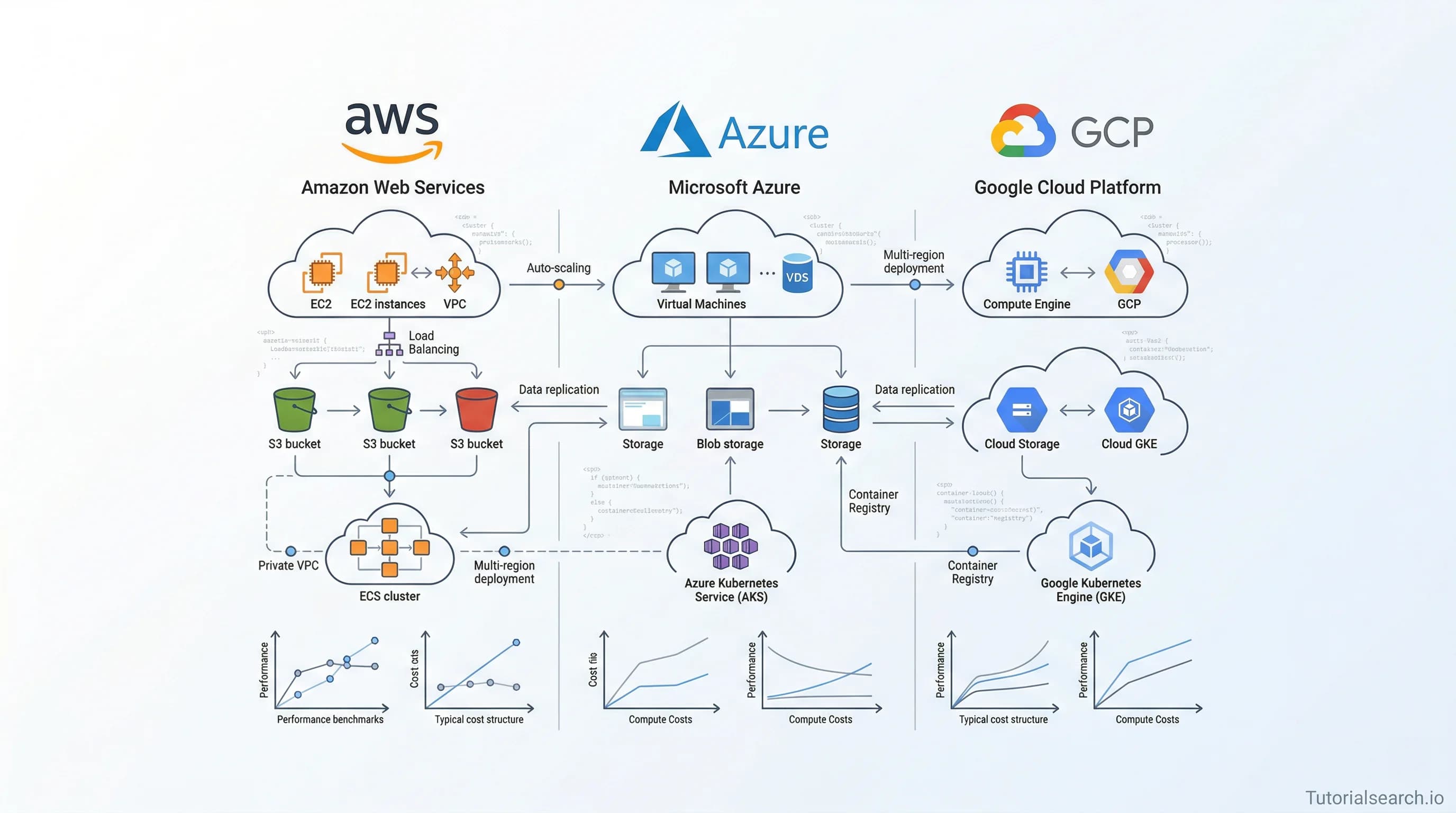
The smarter move? Start with the concepts — compute, storage, networking, identity — and then learn how each platform implements them differently. Once you understand that an EC2 instance, an Azure VM, and a Compute Engine instance are all just virtual machines with different dashboards, the whole cloud landscape clicks into place. And the good news is that TutorialSearch.io has 700+ cloud platform courses to help you do exactly that, regardless of which provider you start with.
Here's what I've put together after digging through courses, repos, channels, and documentation across all three major platforms.
Before You Touch a Console: The Concept Layer
You don't need to memorize every AWS service name before you can be productive in the cloud. But you do need to understand a handful of foundational concepts that transfer across every platform.
Networking (VPCs, subnets, firewalls), identity and access management (who can do what), compute (virtual machines vs. containers vs. serverless), and storage (object, block, file) — these four pillars show up everywhere. The naming changes, the underlying ideas don't.
If you're completely new, the Cloud Computing category on TutorialSearch.io is the best place to orient yourself before diving into platform-specific material. And if you're wondering whether you need to learn all three platforms — no, you don't. Not yet. Pick one, get good at it, and the second one comes much faster.
For a structured, vendor-neutral foundation, the Linux Foundation's Introduction to Cloud Infrastructure Technologies on edX is excellent. It grounds your understanding in open-source infrastructure concepts rather than locking you into a single provider's terminology from day one.
Courses That Actually Teach You to Build Things
Not every cloud course is worth your time. Some are glorified documentation read-alongs. Others spend 40 hours on theory before you ever create a resource. The ones below stood out because they emphasize doing over watching.
The Multi-Cloud Picks
Cloud Out Loud - Multi-Cloud with AI/ML and Big Data by Michelle Sollicito (Udemy) — [Editors' Choice]
Rating: 4.8/5. This is the rare course that genuinely covers multiple platforms without being superficial about any of them. Michelle connects cloud infrastructure to real AI/ML workloads, which is where the industry is heading. If you want to understand why companies go multi-cloud (not just how), start here.ETL on Cloud Platforms Azure, AWS & GCP by Phuzo Soko (Udemy)
Rating: 4.4/5. Focused on data engineering across all three platforms. If you're heading toward a data role, this gives you the cross-platform ETL perspective that employers increasingly want. It's practical and project-driven.Linux Cloud Mastery: AWS, Azure, GCP Exam Test Series by Bodhisattwa Das (Udemy) — [Editors' Choice]
Rating: 5.0/5 with 2,500+ students. Yes, the perfect rating caught my eye too — but the reviews back it up. This focuses on the Linux fundamentals that underpin all cloud platforms, then bridges to platform-specific knowledge. The exam prep format keeps you accountable.
Platform-Specific Standouts
Introduction to AWS Cloud Computing (Udemy)
Rating: 4.5/5 with 43,000+ students. For sheer popularity and beginner-friendliness, this is the on-ramp most people take to AWS. Covers VPC, EC2, S3, Lambda, and CloudFormation — the core services you'll actually use in your first cloud job.Google Cloud Platform (GCP) Fundamentals for Beginners (Udemy) — [Editors' Choice]
Rating: 4.5/5 with 149,000+ students. The highest-enrolled GCP course out there, and for good reason. Updated with generative AI and Vertex AI content. Instructor Janakiram MSV is a Google Certified Cloud Architect with a decade of multi-cloud experience. The hands-on demos after every section are what set this apart from theory-heavy alternatives.Data Engineer Foundations: Build Modern Data Systems (Udemy)
Rating: 4.5/5 with 6,700+ students. Not a pure "cloud platforms" course, but data engineering is cloud engineering in practice. This connects the dots between cloud services and real data pipelines.Hands-on with Amazon Redshift (Udemy)
Rating: 4.2/5 with 6,500+ students. If you're going deep on AWS data services, Redshift is unavoidable. The "hands-on" label is accurate — this is project-driven, not slide-driven.
If you're specifically interested in cloud certifications (and they are worth it for breaking into the field), check out the Cloud Certifications page — there are 900+ certification prep courses organized by provider and level.
The Free Stuff That's Genuinely Good
Everyone recommends the free tiers. They're fine. But the real gems are the structured learning programs each provider offers for free — and they're dramatically better than they were even two years ago.
Provider-Run Free Training
AWS Skill Builder is Amazon's central training portal with hundreds of free courses. The catch: it's a lot, and the navigation is confusing. My advice is to start with the "Cloud Essentials" learning plan rather than browsing the full catalog.
Microsoft Learn for Azure has the best free interactive labs in the industry. That's not a controversial opinion — the sandbox environments where you get actual Azure resources to practice with are genuinely ahead of what AWS and GCP offer for free. The AZ-900 Fundamentals learning path in particular is polished and complete.
Google Cloud Skills Boost (formerly Qwiklabs) gives you temporary credentials to real GCP resources. Their learning paths are guided journeys organized by role and use case, with 3,000+ resources ranging from quick labs to multi-module courses. The free tier is more limited than it used to be, but the quality is high.
Independent Free Resources
Codecademy's Cloud Computing catalog offers interactive cloud courses that work well for visual learners who prefer typing over watching.
AlgoCademy's Cloud Computing 101 is a beginner-friendly walkthrough of all three platforms with clear explanations of when to use what. Bookmarkable reference material.
If you want a broader search across free and paid options, the Cloud Concepts section covers 520+ courses focused on fundamentals. And for hands-on infrastructure practice, the Cloud Infrastructure topic has 450+ options.
YouTube Channels Worth Subscribing To
There's a difference between YouTube channels that talk about cloud computing and ones that teach it. Here are the ones that teach.
TechWorld with Nana — [Editors' Choice]
Nana is exceptional at explaining complex DevOps and cloud concepts with clear diagrams and real-world context. Her Kubernetes, Docker, and cloud platform overviews are some of the best free content on the internet. If you watch one channel, make it this one.
Abhishek Veeramalla — His "AWS Zero to Hero" series covers everything from cloud computing fundamentals to microservices patterns. The pacing is fast enough to not waste your time but thorough enough to actually learn from.
FreeCodeCamp — Their full-length cloud computing courses (often 5-10 hours) are essentially free Udemy courses on YouTube. Quality varies by instructor, but the AWS and Azure fundamentals courses are solid.
A Cloud Guru (now part of Pluralsight) — Still publishes free overview content on YouTube, though the deep-dive material is behind a paywall now. Worth subscribing for the certification exam tips and cloud news updates.
Google Cloud's official channel — Not the most exciting production, but the technical tutorials are accurate and up-to-date. Useful for when you need to understand a specific GCP service.
Go Cloud Architects — Specifically focused on cloud architecture career paths. Good for people who already know the basics and want to level up strategically.
Repos Worth Starring Right Now
Need a web app built? Hire the team behind TutorialSearch.io
We ship fast, production-grade full-stack apps (Next.js, React, edge infra) — the same stack that powers this site.
GitHub has some genuinely excellent cloud learning resources that don't get enough attention. These aren't just lists of links — they're structured programs.
Learn to Cloud (L2C) — [Editors' Choice]
This is a full courseware program built on the premise that anyone can learn cloud engineering with the right roadmap. It's structured like a bootcamp syllabus: Linux → Networking → a cloud platform → programming → DevOps → IaC → CI/CD. Completely free, community-maintained, and genuinely well-organized. If you're self-directing your cloud education, this is your backbone.
DevOps Roadmap by Milan M — A comprehensive 2026 roadmap with learning resources linked at every stage. Not cloud-specific, but cloud is woven through every phase. The visual roadmap format makes it easy to track where you are.
DevOps Roadmap by Piyush Sachdeva — Designed for students, career switchers, and recent graduates with a 6-12 month timeline. More prescriptive than Milan's roadmap, which some people prefer.
Google Cloud Service Comparison — Not a GitHub repo, but Google's official cross-platform service comparison table is one of the most useful reference documents in cloud computing. Bookmark it. You'll use it constantly when translating between providers.
For those interested in cloud security specifically — which you should be, since every cloud role involves security now — the Cloud Security topic page has 350+ dedicated courses.
Read Your Way In
Not everyone learns best from video. If you prefer the depth and pace that books provide, these are the ones I'd recommend.
"Cloud Computing: Concepts, Technology & Architecture" by Thomas Erl — The standard reference. It's from 2013, but cloud fundamentals haven't changed as much as people think. The architectural patterns in this book still drive how enterprise systems are built today. Start here if you want to understand why things work the way they do.
"Cloud Computing For Dummies" — I know the title feels patronizing, but it's genuinely well-written for absolute beginners. Covers the benefits, challenges, service selection, and what getting it up and running actually involves. No prior technical knowledge required.
"AWS Fundamentals" — Platform-specific, but the best structured intro to AWS services I've found in book form. Heavy on practical examples and use cases, with a good intro to Infrastructure as Code.
"Google Cloud for Beginners" by Amitoj Singh — Does for GCP what the AWS book above does for Amazon's platform. Explores key services, deployment patterns, and management practices with a beginner-friendly approach.
For those going deeper into architecture and design, the Cloud Architecture topic features 730+ courses on designing systems that actually scale.
The Comparison Nobody Asked For (But Everyone Needs)
Here's my quick take on when each platform makes the most sense for learning:
| Factor | AWS | Azure | GCP |
|---|---|---|---|
| Job market demand | Highest (still #1) | Strong, especially enterprise | Growing fast, especially data/AI |
| Free tier generosity | Good, but confusing | $200 credit + 12 months free | $300 credit + always-free tier |
| Learning curve | Moderate (so many services) | Easier if you know Microsoft tools | Cleanest UI of the three |
| Certification value | Gold standard | Valued in enterprise | Gaining recognition |
| Best free training | AWS Skill Builder | Microsoft Learn (best labs) | Cloud Skills Boost |
| Community size | Largest | Large, Microsoft-centric | Smallest but most technical |
My contrarian take: start with GCP if you're learning cloud for the first time. Yes, AWS has the most jobs. But GCP's interface is cleaner, the free tier is more generous, and the concepts transfer perfectly to AWS when you're ready. Learning AWS first is like learning to drive in a Formula 1 car — technically possible, but why make it harder than it needs to be?
If you already work at a Microsoft shop, Azure is the obvious choice. If you just want to maximize job opportunities immediately, AWS is still king. But for learning, GCP is underrated.
Join the Conversation
Cloud computing isn't a solo sport. The community aspect matters more here than in most tech fields because the platforms change constantly, and what worked six months ago might not be the recommended pattern today.
Reddit: r/cloudcomputing for general discussion, plus r/aws, r/azure, and r/googlecloud for platform-specific help. The certification-focused subreddits (r/AWSCertifications especially) are goldmines for exam prep advice.
Discord: The Cloud Resume Challenge Discord is excellent — both experienced professionals and newcomers helping each other through hands-on cloud projects. The DevOps, Platform, and Cloud server is another active hub with infrastructure-focused channels.
The Cloud Resume Challenge itself (cloudresumechallenge.dev) deserves a special mention. It's a hands-on project that has you build a resume website using cloud services — and it's become the unofficial entry point for breaking into cloud careers. The community around it is supportive and practical.
A Cloud Guru forums remain useful for certification questions and exam strategy, even after the Pluralsight acquisition.
Your Three Next Moves
Don't try to learn everything at once. Here's what I'd actually do this week:
Move 1: Work through the Google Cloud Fundamentals course or the AWS Cloud Computing intro — pick whichever platform calls to you. Just finish one, start to finish.
Move 2: Star the Learn to Cloud repo and use it as your roadmap. It'll keep you on track when the sheer number of services starts to feel overwhelming.
Move 3: Join one community (the Cloud Resume Challenge Discord is my recommendation) and start the Cloud Resume Challenge project. Nothing cements cloud knowledge like actually building something with it.
The cloud platforms aren't going anywhere, and neither is the demand for people who understand them. The only wrong move is spending months watching videos without opening a console. Pick a platform, build something, break it, fix it. That's how this works.
Browse all 700+ cloud platform courses on TutorialSearch.io to find the right starting point for your level.
Frequently Asked Questions
What are the main differences between cloud platforms?
The three major cloud platforms — AWS, Azure, and GCP — all offer compute, storage, databases, and networking, but they differ in pricing models, ecosystem strength, and specialization. AWS leads in breadth of services and market share. Azure integrates deeply with Microsoft tools and dominates enterprise environments. GCP excels in data analytics, machine learning, and containerization (Kubernetes was born at Google, after all). Your choice should depend on your career goals and existing technology stack.
How do I choose the best cloud platform for my business?
Start by assessing your team's existing skills, your application requirements, and your budget. If you're a Microsoft shop, Azure reduces friction. If you're data-heavy, GCP's BigQuery and AI services are best-in-class. If you need the widest selection of managed services and the largest talent pool, AWS is the safe bet. Many organizations go multi-cloud eventually, but starting with one platform and learning it well is smarter than spreading thin across three.
What skills do I need to work with cloud platforms?
Strong fundamentals in Linux, networking, and at least one scripting language (Python or Bash) form the foundation. From there, learn your chosen platform's core services — compute, storage, IAM, and networking. Containerization (Docker, Kubernetes) is increasingly essential. Certifications like AWS Solutions Architect, Azure Administrator, or Google Cloud Associate Cloud Engineer demonstrate competency and are valued by employers. Explore Cloud Practitioner resources if you're just getting started with certification prep.
Why are cloud platforms important for startups?
Cloud platforms eliminate the need for upfront infrastructure investment, letting startups scale resources up or down based on actual demand. Pay-as-you-go pricing means you only pay for what you use. Free tiers and startup credit programs (AWS Activate, Google for Startups, Microsoft for Startups) can cover your first year of infrastructure costs entirely. This lets engineering teams focus on building product rather than managing servers.
What is the role of containerization on cloud platforms?
Containerization with Docker packages your application and its dependencies into portable units that run consistently across any environment. Kubernetes (available as EKS on AWS, AKS on Azure, and GKE on GCP) orchestrates these containers at scale. Together, they solve the "works on my machine" problem and enable microservices architectures that most modern cloud applications use. If you're learning cloud in 2026, container skills are non-negotiable. The Cloud Data Solutions topic covers courses that integrate containerization with data workflows.