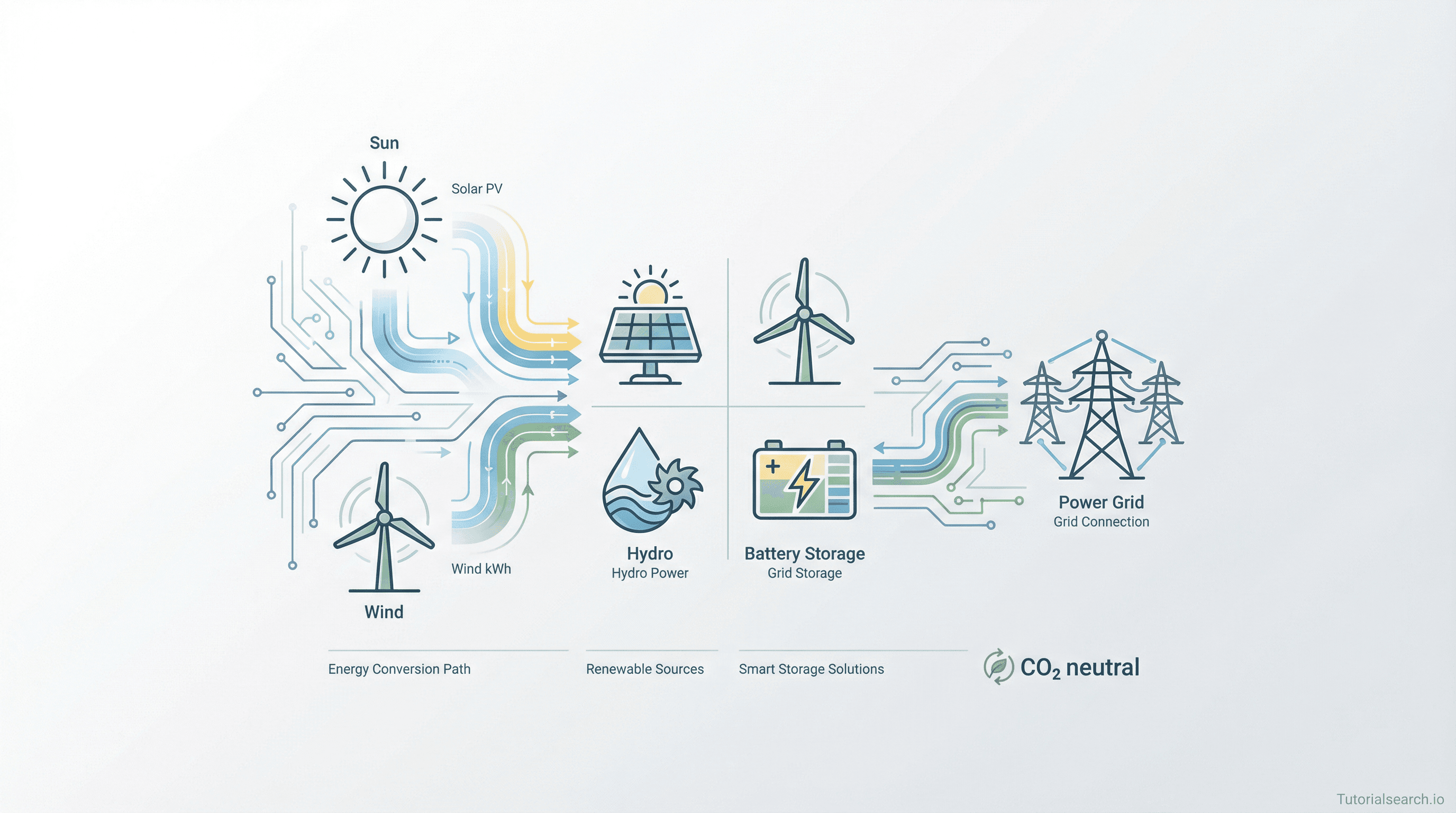
What's the Fastest Way to Learn Renewable Energy?
Renewable energy covers solar, wind, hydro, storage, and more — but you don't need to learn it all at once. Here are the best courses, free resources, YouTube channels, and books to find your path.
Hire the developers behind TutorialSearch.io
We built this site — full-stack web apps, AI integration & automation. Tell us what you need and we'll build yours.
Renewable energy is one of the most important fields you can study right now — and one of the most confusing to enter. Most beginners assume they need a physics degree to understand how solar panels work or why wind turbines spin at that particular speed. They don't. The real barrier isn't complexity. It's knowing where to start when the field covers six different energy technologies before you've opened a single textbook.
Solar. Wind. Hydro. Geothermal. Biomass. Hydrogen. Try to learn them all at once and you'll go in circles. Pick one entry point and everything starts to connect.
This guide helps you find that entry point. It covers the best renewable energy courses — paid and free — along with YouTube channels, research tools, books, and communities worth your time. You can also browse all 121+ renewable energy courses on TutorialSearch.io to explore the full picture.
Key Takeaways
- Renewable energy is accessible to beginners — you don't need an engineering background to start
- Solar photovoltaics is the best entry point for most learners because resources are plentiful and the field is growing fast
- The best renewable energy courses connect individual technologies to real grid and storage challenges
- Free resources from the IEA, IRENA, and MIT OpenCourseWare cover the science at serious depth
- Most beginners skip energy storage — don't. It's where the hardest and most important problems live
In This Article
- Choosing Your Renewable Energy Learning Path
- The Renewable Energy Courses That Actually Deliver
- Free Renewable Energy Resources You'll Actually Use
- Renewable Energy on YouTube: Channels That Teach You Something Real
- Renewable Energy GitHub Repos Worth Bookmarking
- Renewable Energy Books Worth Your Time
- Renewable Energy Communities: Where to Ask Questions and Stay Current
- Related Renewable Energy Skills Worth Exploring
- Frequently Asked Questions About Renewable Energy
Choosing Your Renewable Energy Learning Path
Spend five minutes on this before touching any course. It will save you weeks.
Are you here out of curiosity, or because you want to work in the field?
Curious learners can start almost anywhere. A good survey course or a YouTube channel that covers solar, wind, and storage in broad strokes is plenty. The goal is building an informed mental map — not a career credential.
Career-focused learners need a slightly different approach. Renewable energy jobs break into three main clusters: engineering and design (solar PV system sizing, wind farm layout), policy and finance (energy markets, carbon pricing, sustainability reporting), and installation and maintenance (grid technicians, solar installers, turbine service). Each cluster has its own learning track, and they don't overlap much.
Which energy source interests you most?
| Starting Interest | Where to Begin |
|---|---|
| Solar panels and rooftop systems | Solar PV basics — photovoltaics and system design |
| Wind energy and turbines | Aerodynamics + energy conversion fundamentals |
| Grid and energy systems | Power systems or energy systems design courses |
| Environmental policy or finance | Environmental science + energy economics |
| Hands-on installation | Solar installer certification or practical DIY courses |
One honest take: most beginners start with solar, and that's usually the right call. Solar PV is the fastest-growing renewable technology, and the learning resources are years ahead of other areas. The cost of solar panels dropped 90% between 2010 and 2023. That kind of movement creates jobs, creates courses, and creates a community of people willing to teach. If you're genuinely unsure where to start, start there.
The Renewable Energy Courses That Actually Deliver
These are the highest-rated and most-enrolled options from TutorialSearch.io's collection. Search the full library for specialized areas like tidal, geothermal, or hydrogen.
1. Renewable Energy from Beginner to Expert Taught by Scientist
⭐ [Editors' Choice] | Instructor: Dr. Börge Göbel | Rating: 4.6 | 10,396 students | Paid
This is the course I'd point to first. Dr. Göbel is an actual research scientist, and it shows in the way he explains energy conversion — precise, thorough, but never dry. The course covers solar, wind, hydro, biomass, and geothermal in a sequence that builds real understanding rather than surface-level exposure.
What separates it from most renewable energy courses is the context it provides. You don't just learn how a solar panel works — you learn how it fits into a grid, what happens when supply exceeds demand, and why intermittency (the fact that the sun doesn't shine at night) is such a hard problem. That system-level thinking is rare in beginner courses, and it's exactly what you need to go deeper later.
- Covers all five major renewable sources plus storage fundamentals
- Explains the physics of energy conversion clearly, without dumbing it down
- Connects individual technologies to grid-level challenges
- Good for beginners, but substantive enough for intermediate learners
2. Renewable Energy Specialist: Solar, Wind, Hydrogen & CCS
⭐ [Editors' Choice] | Instructor: ProjectEngPro | Rating: 4.6 | 748 students | Paid
This one skews more career-oriented. It adds hydrogen and CCS (carbon capture and storage — a process that traps CO₂ from industrial emissions before it reaches the atmosphere) to the standard solar-wind curriculum. Those are areas where investment and hiring are growing fast, and most introductory courses ignore them completely.
The course comes from an engineering project management firm, which gives it a professional tone that some learners will appreciate. It's less "university lecture" and more "industry briefing." If you're coming from a project management, oil and gas, or engineering background, this framing clicks faster.
- Covers hydrogen energy and CCS alongside solar and wind
- Career-focused with a practical, industry-informed tone
- Good for learners with some professional technical background
3. Renewable Energy and Sustainable Development
Instructor: Telly Frias Jr | Rating: 4.5 | 4,260 students | Beginner | Paid
This one pairs the technical side of renewable energy with sustainability economics — energy policy, environmental impact, and what a real-world clean energy transition actually requires. It's the right fit if you're coming from a business, policy, or environmental science background rather than engineering.
The course doesn't go as deep on the physics as Dr. Göbel's does. But that's not always the goal. If you want to understand how renewable energy fits into a broader sustainability agenda — carbon markets, SDGs, ESG reporting — this course frames it better than anything else in this list.
- Connects energy technology with sustainability policy and economics
- Accessible for non-engineers and policy-focused learners
- Good for those interested in ESG, sustainability reporting, or climate policy
4. Renewable Energy Technology: Green & Sustainable Development
Instructor: Dr. Muhammad Naeem | Rating: 4.4 | 5,178 students | Paid
A solid mid-level course covering the major technologies with practical applications. It goes deeper on engineering fundamentals than Frias Jr's course and works well as a second step after you've covered the basics. The "green and sustainable development" framing keeps it from being too narrowly technical.
5. Renewable Energy Sources
Free | Instructor: Rakesh Yeole | Rating: 4.1 | 2,951 students | Beginner
Free and genuinely useful for complete beginners. It covers the major renewable sources — solar, wind, hydro, biomass, geothermal — without going too deep into any one of them. Good for building a mental map of the field before choosing where to go deeper.
6. Renewable Energy and Solar Photovoltaics (PV) for Beginners
⭐ [Editors' Choice] | Free | Instructor: Biswarup Sahu | Rating: 4.2 | 2,391 students | Beginner
The best free option if solar is your primary interest. This course explains the photovoltaic effect (how sunlight knocks electrons loose in a semiconductor to create an electrical current) in a way that actually sticks. It then walks through the basics of solar system sizing and design — genuinely useful material for something that costs nothing.
For learners interested in the broader Energy Systems field, TutorialSearch.io has 257+ courses covering grid design, energy storage, and power engineering.
7. Renewable Energy: Practical Introduction to Biogas and AD
Instructor: Michael Köttner | Rating: 4.4 | 70 students | Paid
A niche pick — but a good one for anyone interested in biomass and anaerobic digestion (AD — the biological process that turns organic waste into biogas). This area gets almost no attention in broad renewable energy curricula, which is strange given how important it is for agricultural and developing-country energy contexts.
Free Renewable Energy Resources You'll Actually Use
Paid courses are a great structure. But the field has excellent free material sitting on government websites and research portals that most courses simply reference without linking to. Here's the stuff that's actually worth your time.
IEA Renewables Report — The International Energy Agency's annual renewables report is the most authoritative look at where the field is heading. Dense in places, but every section has executive-level summaries. The 2025 edition projects renewables will supply 35% of global electricity by 2028. Free to read online.
IRENA Publications Library — The International Renewable Energy Agency publishes detailed reports on solar costs, offshore wind capacity, green hydrogen roadmaps, and renewable energy employment. More technical than the IEA reports, and invaluable if you're doing serious research.
MIT OpenCourseWare — Energy Courses — MIT publishes full course materials from its engineering curriculum, including energy systems and solar energy courses. This is genuine university-level content at zero cost. The reading lists alone are worth bookmarking.
U.S. Department of Energy Energy Saver — Better than it sounds. The DOE's consumer resource covers solar panel installation costs, battery storage options, net metering (the policy that lets you sell excess solar power back to the grid), and home energy efficiency in clear, practical terms.
NEED Project Curriculum — The National Energy Education Development Project was designed for K-12 educators but is useful for adult self-learners too. Their energy source modules are well-organized and factually accurate — a good complement to video courses.
Sustainable Energy Without the Hot Air by David MacKay — Free online. This book does something unusual: it uses real numbers to show which energy solutions can actually scale and which ones can't. Written in 2008, so some figures are dated, but the methodology holds up completely. MacKay was a physicist and chief scientific adviser to the UK Department of Energy and Climate Change. His take on the math behind renewable transitions is more honest than most things published since.
Here's a contrarian view worth considering: most introductory renewable energy courses spend 70% of their time on how individual technologies work — solar cells, wind turbines — and almost nothing on the grid integration and storage problems that actually limit deployment. Those are the hard, expensive, unsolved parts of the energy transition. If you find yourself breezing through PV fundamentals, redirect your learning toward storage and grid topics. That's where the interesting work is happening, and where the jobs are growing fastest.
Renewable Energy on YouTube: Channels That Teach You Something Real
Hire the developers behind TutorialSearch.io
We built this site — full-stack web apps, AI integration & automation. Tell us what you need and we'll build yours.
Just Have a Think (YouTube) — ⭐ [Editors' Choice] — The most consistently good renewable energy channel on YouTube. Host Dave Borlace covers grid-scale batteries, green hydrogen, offshore wind, and nuclear-renewables comparisons with actual data and measured skepticism. He doesn't hype. He also doesn't panic. Topics like long-duration energy storage and direct air carbon capture get clear, quantified treatments rather than vague enthusiasm. If you follow one channel from this list, make it this one.
Fully Charged Show (YouTube) — Best known for electric vehicles, but the energy coverage is excellent. Host Robert Llewellyn interviews engineers, researchers, and policy makers in a conversational style that makes complex topics accessible. Good for staying current on what's actually happening in the industry — offshore wind builds, battery gigafactories, grid storage deployments.
DIY Solar Power with Will Prowse (YouTube) — Entirely hands-on. Will covers off-grid solar setups, van life battery systems, and home backup power in a way that's genuinely practical. Not academic at all, which is exactly the point. If you want to understand how a solar system actually gets built and wired, this channel fills a gap that formal courses rarely address.
NREL — National Renewable Energy Laboratory (YouTube) — The official channel of the U.S. government's primary renewables research lab. More technical and slower-paced than the others, but authoritative. Good for understanding what the research frontier actually looks like, as opposed to what's already commercial.
If renewable energy connects to your interest in Environmental Science, TutorialSearch.io has 385+ courses on the climate and ecosystem context that makes the energy transition necessary.
Renewable Energy GitHub Repos Worth Bookmarking
OpenEnergyPlatform/awesome-sustainable-technology (GitHub) — A curated index of open-source tools for sustainable energy and climate technology. Well-organized, maintained actively, and covers everything from grid simulation to carbon accounting tools. If you want to work with real energy data or models, start here.
rebase-energy/awesome-energy-models (GitHub) — A catalogue of open-source Python-based energy models, organized by problem type (simulation, optimization, prediction) and energy asset (solar, wind, battery, hydro). Essential for anyone coming at renewable energy from a data science or engineering modeling angle.
mathworks/MATLAB-Simulink-Challenge-Project-Hub (GitHub) — MathWorks maintains active challenge projects for sustainability and renewable energy modeling. If you're an engineering student who learns by building, these project prompts are a structured way to get hands-on with real simulations.
These repos assume some comfort with Python or MATLAB. If you want to strengthen the underlying science first, the Materials Science courses on TutorialSearch.io cover the semiconductor and composite materials that make modern solar panels and wind turbine blades work.
Renewable Energy Books Worth Your Time
Sustainable Energy Without the Hot Air by David MacKay — Already mentioned in the free resources section, but it deserves a second mention. It's available free online, it's genuinely well-written, and no other book gives you a more honest sense of what the numbers actually mean at national scale. Read it alongside a course.
Renewable Energy: Power for a Sustainable Future (Oxford University Press) — The standard university textbook for this field. It covers solar, wind, hydro, biomass, and geothermal with the depth that short courses deliberately skip. Expensive new, but libraries usually carry it and secondhand copies are cheap. Worth owning if you're serious about the field.
Renewable Energy: A First Course by Robert Ehrlich and Harold A. Geller — Good for science and engineering students who want the physics without it feeling like a dry reference text. Balances equations with policy context in a way most textbooks don't. A genuine first course in the academic sense, not just a friendly introduction.
For anyone wanting to strengthen the physics foundation behind energy conversion, TutorialSearch.io's Physics Fundamentals courses — 237+ in the catalog — cover thermodynamics and electromagnetism, which are the two areas you'll encounter most in renewable energy engineering.
Renewable Energy Communities: Where to Ask Questions and Stay Current
r/renewable and r/solar (Reddit) — Two different subreddits worth following. The renewable subreddit skews toward news and analysis. The solar subreddit is more hands-on — home installations, DIY system design, equipment comparisons. If you're ever stuck on a solar sizing question, someone there has done it.
DIY Solar Power Forum — Forum-style community focused on practical solar installation. Compared to Reddit, it has a slower pace and a higher signal-to-noise ratio for technical questions. Long threads on battery chemistry, inverter selection, and grid-tied vs. off-grid tradeoffs.
Solar Energy Discord — Over 1,300 members, with active text and voice channels. Good for quick questions and connecting with other learners. Lower barrier to entry than the forums.
The Physics Concepts courses page (226+ courses) is also a useful companion if you want to strengthen the science intuitions behind what these communities discuss.
Related Renewable Energy Skills Worth Exploring
If renewable energy interests you, these fields connect directly to it:
- Environmental Science — 385+ courses on the climate and ecosystem context that makes renewable energy transitions necessary and urgent
- Energy Systems — 257+ courses on grid design, energy storage, and power systems engineering — the field closest to renewable energy deployment
- General Chemistry — 405+ courses — essential for understanding battery chemistry, electrolysis (how green hydrogen gets made), and fuel cell technology
- Materials Science — 333+ courses covering the semiconductors, composites, and advanced materials that make high-efficiency solar panels and lightweight wind turbine blades possible
- Physics Fundamentals — 237+ courses — thermodynamics, electromagnetism, and fluid dynamics are all foundational to understanding how energy gets converted and moved
Frequently Asked Questions About Renewable Energy
How long does it take to learn renewable energy?
It depends on your goal. Building a solid foundational understanding — enough to speak credibly about solar, wind, storage, and grid integration — takes roughly 30 to 50 hours of focused study. Getting to a professional level for a job in engineering, project development, or policy takes 6 to 12 months of structured learning, usually including hands-on work or a certification. Start with one of the renewable energy courses on TutorialSearch.io and calibrate from there.
Do I need a science or engineering background to start learning renewable energy?
No. Many learners start with no technical background at all. The beginner-level Udemy courses, the DOE Energy Saver resources, and YouTube channels like Just Have a Think are all designed for general audiences. If you eventually want to work in engineering or system design, you'll need to build some physics and math. But that's a bridge you can cross after you know which direction you're going — not before you start.
Can I get a job with renewable energy skills?
Yes, and the market is growing quickly. The International Renewable Energy Agency estimated the sector employed over 13.7 million people globally in 2022, with numbers rising each year. Roles range from solar installers and wind turbine technicians to energy analysts, project developers, and grid engineers. The Energy Systems and power engineering tracks are the most job-dense areas right now.
What are the main types of renewable energy sources?
The main types are solar (photovoltaic and thermal), wind (onshore and offshore), hydropower, geothermal, biomass, and — increasingly — green hydrogen. Each has different cost profiles, geographic constraints, and technical challenges. Solar and wind have seen the steepest cost declines since 2010 and are now the cheapest sources of new electricity generation in most of the world.
What is the role of energy storage in renewable energy?
Energy storage — primarily batteries, but also pumped hydro (moving water uphill to store energy, then releasing it to generate electricity) and other technologies — solves the intermittency problem. Solar only generates power when the sun shines. Wind output fluctuates with weather. Storage lets you shift that power to when it's actually needed. It's the piece most beginners underestimate, and it's where a lot of the most important technical and economic problems in the clean energy transition are still being solved.
If you're just getting started, Renewable Energy from Beginner to Expert by Dr. Börge Göbel is the clearest path in. If you want to test the waters for free first, grab Sustainable Energy Without the Hot Air — it costs nothing and gives you a sharper picture of the real challenges than most paid courses do.
The energy transition is the biggest infrastructure project in human history. It's also one of the most open fields you can enter right now. The knowledge is largely public, the tools are mostly free, and the people working on it are generally glad to help newcomers catch up.