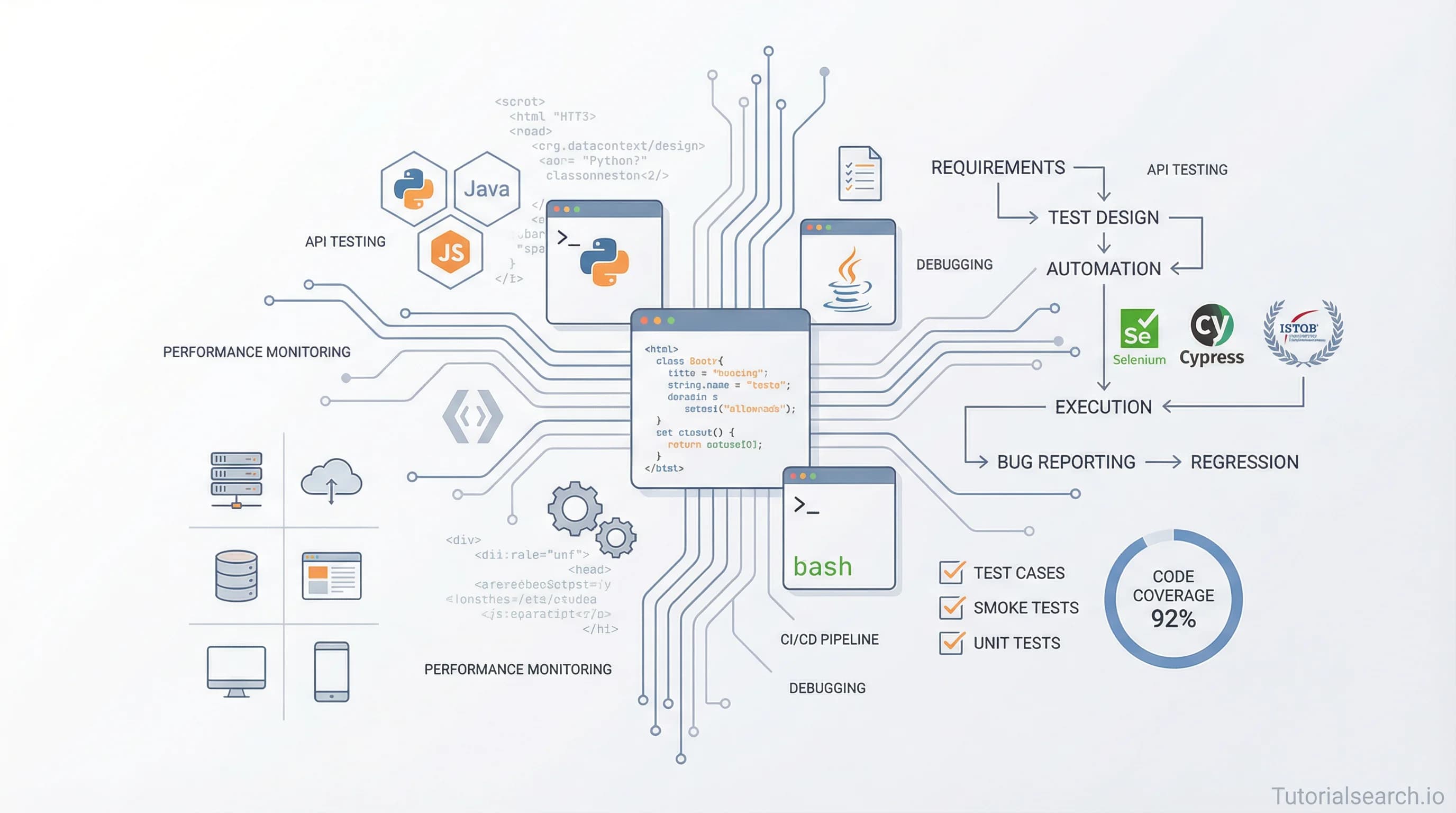
Want to Learn Software Quality? Here's Your Complete Roadmap
Looking to break into software quality? This roadmap covers the best SQA courses, free resources, ISTQB certification guides, and YouTube channels — everything you need to start your QA career.
Need a web app built? Hire the team behind TutorialSearch.io
We ship fast, production-grade full-stack apps (Next.js, React, edge infra) — the same stack that powers this site.
Software quality is one of those disciplines where the conventional path leads most beginners completely astray. Everyone tells you to grab Selenium, pick an automation framework, or jump straight into a bootcamp — but that's backwards. Start with the fundamentals of what quality actually means in software, and everything else clicks into place.
I see it constantly: developers-turned-testers who can write sophisticated test scripts but can't explain why a test suite is missing critical coverage. Or QA newcomers who spend weeks on tool tutorials and then freeze during a real bug triage. The tools matter, but understanding what you're testing — and why — matters more.
If you're here because you want a real software quality career, this is the roadmap I'd hand you. You can also browse the full software quality course library — 504+ options across every skill level — once you know where to start.
Key Takeaways
- Software quality assurance covers test planning, defect tracking, and metrics — not just automation
- The ISTQB Foundation Level is the most widely recognized entry certification for software quality roles
- Free resources from FreeCodeCamp and the ISTQB syllabus itself can get you job-ready without paying for courses
- Software quality skills pair naturally with automation testing, test design, and data analysis
- The best software quality courses mix theory with hands-on practice — look for projects, not just lectures
In This Article
- Choosing Your Software Quality Path
- The Software Quality Courses I'd Actually Recommend
- Free Software Quality Resources That Are Surprisingly Good
- Software Quality YouTube Channels That Teach What Matters
- ISTQB: Your Software Quality Certification Starting Point
- Software Quality GitHub Repos Worth Starring
- Books That Changed How I Think About Software Quality
- Related Software Quality Skills Worth Exploring
- Frequently Asked Questions About Software Quality
Choosing Your Software Quality Path
Before you buy any course or watch a single tutorial, you need to answer one question: what kind of software quality work do you actually want to do?
This matters because the field splits into a few very different tracks. Manual QA focuses on test case design, exploratory testing, and defect documentation — it's less technical but requires sharp analytical thinking. Automation QA requires programming skills and involves building test frameworks. Quality engineering sits upstream of testing, focusing on processes, metrics, and preventing defects before they happen. And ISTQB-certified QA professionals often operate across all three.
Here's a quick decision tree to find your starting point:
Pick your path:
| Your Background | Best First Step | Then Move To |
|---|---|---|
| No tech background | Software Testing Simple (free course) | ISTQB Foundation syllabus |
| Developer switching to QA | Masterclass Software Quality Engineering | Automated Testing: End to End |
| Already know basic testing | ISTQB certification study | Automation Testing browse page |
| Agile/Scrum environment | Software Quality Assurance: Agile Testing with AI | Continuous Monitoring course |
Once you know your track, the software quality browse page lets you filter by level, platform, and price to find exactly what fits.
And if you want to understand how monitoring fits into quality practices, the Continuous Monitoring: The Big Picture course on Pluralsight covers continuous integration quality at a high level — good context for the "quality engineering" track.
One thing worth knowing upfront: you don't need a computer science degree to get into software quality. Structured thinking, attention to detail, and clear communication matter more than an academic background. Some of the best testers I've worked with came from project management or business analysis.
The Software Quality Courses I'd Actually Recommend
There are over 500 software quality courses out there, which is honestly too many. Most of them recycle the same content. Here are the ones worth your time.
1. Software Testing Simple (Software Quality Assurance QA) — [Editors' Choice]
Software Testing Simple by Denis Platonov is the best free starting point on Udemy, and it's not close. Over 51,000 students have taken it, which tells you something. Platonov strips the subject down to what actually matters — test case design, bug reporting, and the fundamentals of the software development lifecycle.
What I like: it doesn't oversell automation. Half the courses out there make it sound like manual testing is dead. Platonov is honest that understanding manual processes is the foundation. Don't skip this one because it's free.
2. Masterclass Software Quality Engineering | AI Testing — [Editors' Choice]
Masterclass Software Quality Engineering by Dan Andrei Bucureanu has the highest rating of the paid options (4.54 stars), and for good reason. It covers quality engineering with a modern angle — including how AI tools are changing the testing landscape. If you want something current and comprehensive, this is it.
The AI testing angle isn't gimmicky here. Bucureanu shows practical applications: using AI for test case generation, intelligent test selection, and pattern detection in defect data. It's the kind of content that's going to be relevant five years from now, not just this year.
3. Software Quality Assurance (SQA) for Beginners from Scratch
SQA for Beginners by Syed Rahman is a solid choice if you want a structured walkthrough of QA from the ground up. It covers test planning, test case design, defect life cycles, and the basics of QA documentation. Rating sits at 4.15, which is respectable for an entry-level course.
I'd recommend this over more famous courses if you're completely new. It doesn't assume you know anything, and it doesn't rush to get to the "impressive-looking" automation content before you understand why you're testing in the first place.
4. Quality Assurance Tester Course from Scratch to Finish
Quality Assurance Tester Course on Udemy has a remarkably high rating at 4.80 stars. It's a thorough course that takes you from absolute beginner all the way through to practical testing workflows. If you want a single end-to-end course that covers everything in order, this is a strong contender.
5. Software Quality Assurance: Agile Testing with AI in 2025
Agile Testing with AI by Adil Qayyum is the course for anyone working in (or moving into) agile environments. Most software teams are agile now, and software quality practices in agile differ meaningfully from traditional waterfall QA. This course addresses that gap directly.
6. Automated Testing: End to End (Pluralsight) — [Editors' Choice]
Automated Testing: End to End by Jason Roberts on Pluralsight is where you go after you understand manual testing fundamentals. Roberts builds from first principles, explaining why automated tests are structured the way they are — not just how to write them.
Pluralsight's quality content tends to be more polished than Udemy's equivalent, and this course is no exception. It assumes some programming background, so it's best suited for developers who want to move into QA, or testers with some coding experience.
A Note on What's Overrated
Everyone recommends the generic "Complete Software Testing Bootcamp" style courses. You know the type — 40+ hours, covers everything, rated 4.5 stars with 100k+ students. They're fine, but they try to be everything and end up being average at everything. The courses above are more focused and more honest about what they cover.
Free Software Quality Resources That Are Surprisingly Good
You can get genuinely job-ready in software quality without paying for a single course. These are the free resources worth your time:
freeCodeCamp Quality Assurance Certification is one of the most underused free resources in software testing. It's hands-on — you write actual tests using Chai (a JavaScript assertion library), build projects, and get a certification at the end. It leans toward developers, so you'll need some JavaScript comfort. But the quality of the projects is high.
Coding Temple's Free QA Bootcamp offers 360+ hours of content covering manual testing, automated testing, and industry-standard tools including Selenium, Cypress, Appium, and JMeter. This is a serious volume of material for free. The structured bootcamp format helps if you learn better with a clear progression than an à la carte approach.
Software Testing Help is a website, not a course, but it's one of the best reference sites in the field. Their SQA guide covers everything from writing test plans to understanding quality metrics. When you're stuck on a concept mid-course, this is where you go to clarify it.
Guru99's Testing Tutorials take a different approach: short, focused articles with examples. If you learn better by reading than by watching, Guru99 is your go-to. They also have solid ISTQB prep material, which connects directly to certification.
Class Central aggregates 700+ quality assurance courses from MOOCs and platforms, with strong filtering for free content. It's useful when you want to compare options without visiting 10 different platforms.
The official ISTQB Syllabus is also free to download and is itself excellent study material — more on this in the certification section.
If you're interested in the data analysis side of software quality (defect metrics, quality dashboards), the data analysis courses on TutorialSearch are worth a look.
Software Quality YouTube Channels That Teach What Matters
Need a web app built? Hire the team behind TutorialSearch.io
We ship fast, production-grade full-stack apps (Next.js, React, edge infra) — the same stack that powers this site.
YouTube has an unusual amount of high-quality software testing content. Here are the creators who actually know what they're talking about:
Mr. Pravan has built one of the most comprehensive free QA libraries on YouTube — over 900 videos covering automation tools, Selenium, JavaScript frameworks, and manual testing concepts. The sheer volume means you can find specific tutorials for almost anything. Start with his testing fundamentals playlist before jumping into the automation content.
LambdaTest on YouTube produces consistent, well-structured content about cross-browser testing, CI/CD integration, and modern testing practices. Their webinars with industry practitioners are particularly good. If you want to understand how QA works at scale in real companies, their channel gives you that window.
Guru99's YouTube Channel mirrors their written content but adds demonstrations. Short (5-15 minute) focused videos that don't waste your time. Good for filling in specific knowledge gaps rather than as a primary learning source.
Alan Richardson (Evil Tester) has 25+ years in testing and his YouTube content reflects that experience. He's less about tool tutorials and more about testing thinking — how to explore a system, how to find bugs others miss, how to communicate quality risks. His content is different from everyone else on this list, and that's exactly why it's valuable.
For a curated list of the best testing channels, PractiTest's guide to top software testing YouTube channels is a solid reference point.
ISTQB: Your Software Quality Certification Starting Point
The ISTQB Foundation Level (CTFL) is the closest thing software quality has to a universal entry credential. It's recognized in 120+ countries, and most QA job postings list it as either required or preferred.
The exam has 40 questions and covers the full software testing lifecycle — from planning and analysis through execution and defect management. Six months of industry experience is recommended but not required to sit the exam.
Here's what most people don't tell you: the official ISTQB syllabus itself is free and excellent study material. Download it from istqb.org, work through it chapter by chapter, and you're covering 70% of what the exam tests. The syllabus is written clearly — it's not dense academic text.
For supplementary study:
- Guru99 ISTQB prep has free mock tests and structured study guides. Run through the mock tests multiple times.
- TryQA offers both free and premium ISTQB Foundation study materials, with a focus on practice questions.
- ASTQB is the official US certification body — useful if you're in North America and want to understand the registration process.
The certification won't teach you how to test. You still need the courses and practice. But it signals to employers that you understand the field's foundational concepts, and that matters when you're breaking into your first QA role.
The automation testing browse page is a natural next step after ISTQB — automation is where most QA careers develop after the foundations are set.
Software Quality GitHub Repos Worth Starring
The open source QA community maintains some excellent curated resources:
awesome-testing by TheJambo is the go-to GitHub repo for software testing resources. It covers testing tools, frameworks, books, blogs, and communities — all curated and maintained. Star this and use it as your reference hub when you're researching specific tools or approaches.
awesome-test-automation by atinfo goes deep on automation frameworks across multiple programming languages — Python, Java, JavaScript, Ruby, and more. If you're a developer adding testing skills, this helps you find automation tools that fit your existing language stack.
awesome-testing-courses by upgundecha focuses specifically on learning resources: courses, tutorials, and training paths. It's the most directly useful repo for someone learning rather than someone already working in QA.
These three repos together give you a comprehensive map of the ecosystem. The test design courses on TutorialSearch pair well with the theory you'll encounter in these repos.
Books That Changed How I Think About Software Quality
The Art of Software Testing by Glenford Myers is the classic. It was written in 1979, updated twice since, and still holds up. Myers introduced the concept that testing is the process of finding bugs, not confirming that software works — a distinction that seems obvious now but transformed how the field thought about quality. Read it once early in your learning, then again after six months. You'll get different things from it both times.
The Way of the Web Tester by Jonathan Rasmusson is the most accessible automation testing book for beginners. It's got cartoons, concrete examples, and a tone that doesn't assume you already know everything. Rasmusson walks you through setup, writing your first scripts, and building toward a real test suite — with honest commentary on what's hard and what isn't.
Software Testing by Ron Patton (2nd Edition) covers both fundamentals and advanced topics in a textbook format. The expanded security testing chapter is worth it alone — as more software quality roles incorporate security testing, having that foundation matters.
For a comprehensive book list, Software Testing Material maintains an updated guide to 24+ titles across beginner, intermediate, and specialist categories.
Related Software Quality Skills Worth Exploring
Software quality doesn't exist in isolation. These related skills build naturally on QA foundations:
- Automation Testing — The natural progression after manual QA. 902+ courses on TutorialSearch, from Selenium to Cypress to Playwright.
- Test Design — How you structure test cases for maximum coverage. 791+ courses. Critical for anyone who wants to move from execution to strategy.
- Data Analysis — Quality metrics, defect trend analysis, and reporting all require data skills. 522+ courses.
- SAP Quality — Enterprise software testing, especially relevant if you're working in large organizations that run SAP. 441+ courses.
- Excel Proficiency — Don't underestimate this one. QA reports, defect tracking, and test matrices often live in spreadsheets. 363+ courses.
You can also search across all software quality courses at TutorialSearch using the full software quality catalog — 504+ courses with filters for platform, level, and price.
Frequently Asked Questions About Software Quality
How long does it take to learn software quality?
Most people can get to job-ready in 3-6 months with consistent effort. Manual testing fundamentals and ISTQB certification prep can be completed in 2-3 months. Adding automation skills typically takes another 3-6 months depending on your programming background.
Do I need to know how to code to work in software quality?
No — not for manual QA roles. Coding becomes important if you want to move into automation testing or quality engineering. Starting with manual testing and picking up scripting skills (Python or JavaScript are the most common) over time is a completely viable path.
Can I get a job with ISTQB certification and no experience?
ISTQB Foundation Level helps, but most entry-level QA roles want to see some hands-on work alongside the certification. Build a portfolio by contributing to open source projects, doing personal projects that you document with test plans, or taking courses with real projects included. The automation testing courses on TutorialSearch include several with project-based learning.
How does software quality differ from software testing?
Software testing is one component of software quality. Quality assurance (QA) is broader — it covers the entire process by which software is built, not just verifying the output. QA teams influence requirements, development practices, code review standards, and deployment processes. Testing is what happens at specific checkpoints. Quality is what you build in from the start.
What are the key metrics for measuring software quality?
The main ones are: defect density (number of bugs per size of code), code coverage (what percentage of the codebase is tested), defect escape rate (how many bugs reach production), and mean time to detect (MTTD). None of these metrics are perfect in isolation — the best QA teams use them together and track trends over time rather than optimizing for any single number.
Is automated testing replacing manual software quality testers?
No, though the role is shifting. Automation handles regression testing and repetitive verification well. But exploratory testing, usability evaluation, requirements analysis, and edge case thinking still require human judgment. Testers who add automation skills to manual testing foundations are in a strong position — they're not being replaced, they're becoming more valuable.
Software quality is one of the most stable career paths in tech. Every software project needs it. The skills transfer across industries and company sizes. And there's a genuine shortage of people who understand both the testing craft and the quality engineering mindset that prevents defects upstream.
Start with one of the free resources above. Get through the ISTQB syllabus. Build something you can show. That's your roadmap.