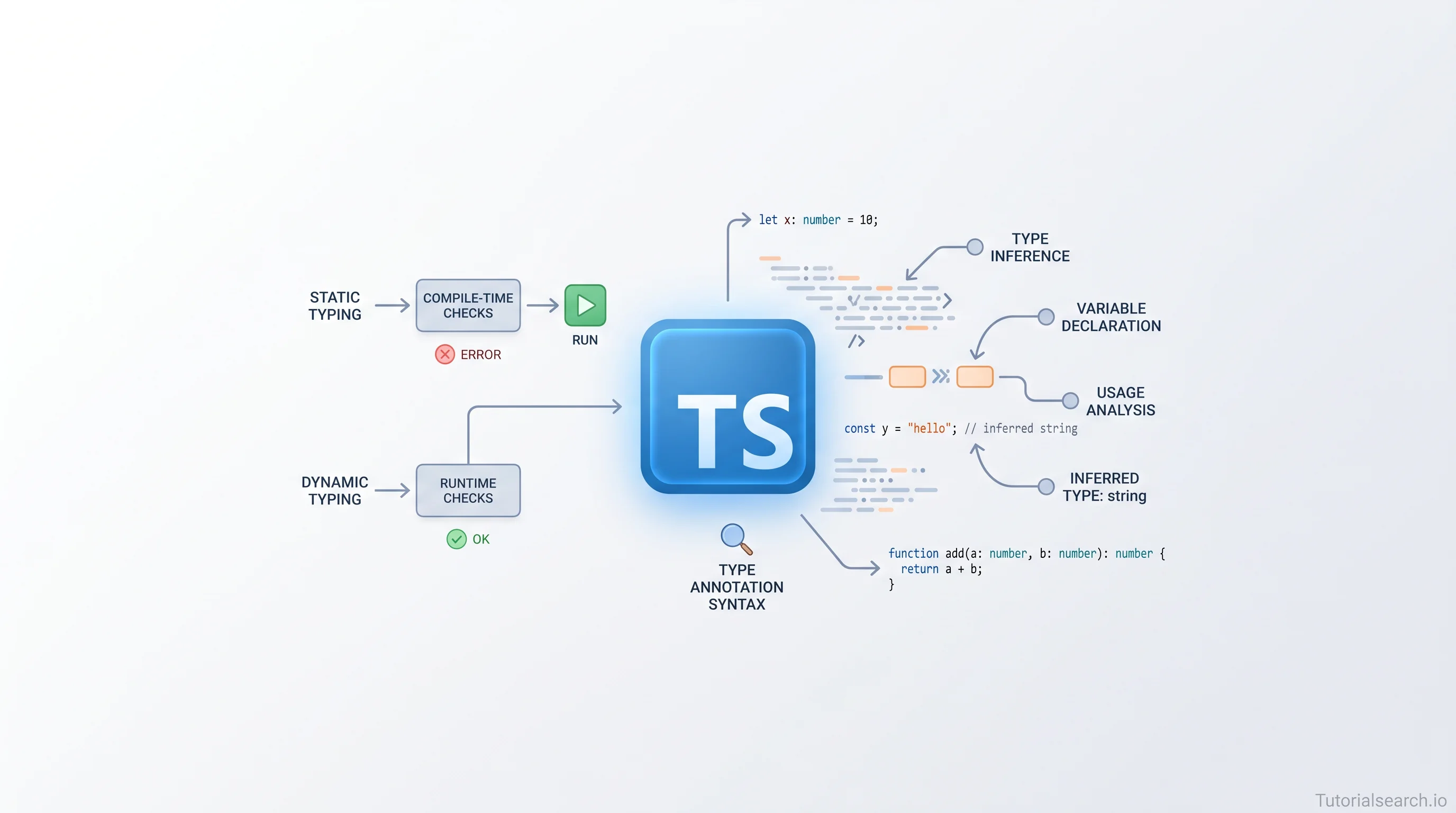
From Weakly Typed to Type-Safe: A Practical Guide to Type Systems
Most developers use a type system every day without understanding how it works. This guide covers the best type systems courses, free resources, GitHub repos, YouTube channels, and books to fix that — from static vs. dynamic typing to type inference.
Need a web app built? Hire the team behind TutorialSearch.io
We ship fast, production-grade full-stack apps (Next.js, React, edge infra) — the same stack that powers this site.
Type systems are one of the most misunderstood concepts in programming — most developers use one every single day without knowing how it actually works, and that gap costs them in debugging time, runtime surprises, and code that's harder to maintain than it should be. Whether you're trying to understand why TypeScript complains about your code, why Haskell's compiler feels like a superpower, or why Rust won't let you do something that "should" just work, it all comes back to type systems and the rules they enforce. This guide, updated for 2026, pulls together the best type systems courses, free resources, YouTube channels, books, and repos to actually get you there.
What follows isn't a list of every resource I've ever seen. It's what I'd hand a developer who told me: "I know I should understand this better, where do I start?"
Key Takeaways
- Type systems define the rules a programming language uses to categorize and validate data — understanding them makes you a better programmer in any language
- Static type systems catch errors at compile time; dynamic type systems catch them at runtime — neither is strictly "better," but knowing the tradeoffs helps you choose wisely
- Type inference means the compiler figures out types for you, giving you safety without the boilerplate — it's how Haskell, Rust, and modern TypeScript work
- The best way to understand type systems isn't to memorize theory but to build things in a few languages with different approaches
In This Article
Jump to any section, or read straight through — this guide covers type systems from first principles to practical courses.
- What Type Systems Actually Do (and Why You Should Care)
- Type Systems Courses Worth Your Time
- Free Type Systems Resources That Hold Up
- YouTube Channels for Learning About Type Systems
- GitHub Repos for Getting Hands-On with Type Systems
- Books on Type Theory Worth Reading
- Static vs. Dynamic: A Practical Comparison
- Type Systems Communities Worth Joining
- Related Type Systems Skills Worth Exploring
- FAQ
What Type Systems Actually Do (and Why You Should Care)
Before I burned an afternoon tracking down a null reference error in a Python service, I thought type systems were mostly about ceremony. Java had you typing HashMap<String, List<Integer>> while Python "just worked." I had it backwards.
Type systems are the rules a programming language uses to determine what kinds of data can be used in what contexts — and when violations of those rules get caught. That's the whole thing. But the when turns out to matter enormously. In a statically typed language like Rust or TypeScript, the compiler checks types before your code ever runs. In a dynamically typed language like Python or JavaScript, those checks happen at runtime — which means bugs can reach production.
The static/dynamic axis gets most of the attention, but there are other dimensions worth knowing: strong vs. weak typing (how aggressively the language prevents implicit type coercions), nominal vs. structural typing (whether compatibility is decided by name or by shape), and type inference (whether the compiler deduces types or you have to annotate everything). As of 2026, the trend is clear — even historically dynamic languages are adding optional static type checking, and languages with type inference like Rust and Kotlin are gaining ground precisely because they give you safety without the boilerplate.
Type Systems Courses Worth Your Time
Building a Typechecker from Scratch (Udemy, Dmitry Soshnikov) [Editors' Choice]
This is the course I wish had existed when I first tried to understand how type checking actually works. Dmitry Soshnikov — a compiler engineer who teaches programming language theory — walks you through building a real typechecker for a small language from first principles. You'll implement static vs. dynamic type checking, strong vs. weak typing distinctions, and type inference in JavaScript. It's rated 4.83 and aimed at intermediate developers. The thing that separates it from every other resource on this list: it doesn't describe how type systems work, it shows you how they're built. After this course, you won't just understand type checking — you'll understand why it's designed the way it is in every language you use. Highly recommended for anyone who wants to go past surface-level intuition.
Type-Driven Development: Designing with Types (Pluralsight) [Editors' Choice]
This Pluralsight course shifts the frame from "the compiler has a type system you must satisfy" to "use the type system to drive your design." That's a subtly different mindset, and a more productive one. The course covers how to encode invariants in types so invalid states become unrepresentable — a pattern that eliminates entire categories of bugs. It's intermediate level, and if you're working in TypeScript, Rust, or any functional language, the ideas here transfer directly. It pairs particularly well with the related topic of modern programming languages, where these ideas are baked in from the start.
TypeScript Foundations (Pluralsight)
TypeScript is most developers' first encounter with a serious static type system, and this course covers the fundamentals without getting lost in abstractions. It's a clean, practical starting point: type annotations, interfaces, union and intersection types, and how TypeScript's structural type system differs from nominal systems like Java's. Good for developers coming from JavaScript who want to understand why TypeScript works the way it does, not just how to make the red squiggles go away.
TypeScript 5 Fundamentals (Pluralsight, 4.8 rating)
If you already know TypeScript basics and want to understand the newer features in the type system — template literal types, satisfies operator, const type parameters — this course is the most current and well-rated option. Covers TypeScript 5.x features thoroughly. [Editors' Choice] for TypeScript learners who want current and production-ready knowledge.
Creating and Using Generics in TypeScript 4 (Pluralsight, 4.8 rating)
Generics are the point where most TypeScript developers stall. This course breaks them down clearly, covering constrained generics, conditional types, and mapped types. Brice Wilson is a consistent Pluralsight author, and the quality shows. If you're coming from a frontend background, generics are the bridge between JavaScript's flexibility and TypeScript's safety.
Advanced TypeScript — A Production-Grade TypeScript Course (Udemy, 4.45 rating)
Once you've got the basics, this course focuses on the kind of type-level programming that makes your codebase genuinely harder to misuse. Covers infer keyword, recursive types, template literal types, and conditional types in depth. Not for beginners, but if you're writing library code or building large TypeScript applications, this is worth the time.
Free Type Systems Resources That Hold Up
The free ecosystem for type systems is surprisingly good. Here's what's worth your time:
The TypeScript Handbook (official docs) is the best free introduction to a production type system in existence. The team at Microsoft has done exceptional work making it accessible — it covers everything from basic types through generics, conditional types, and template literal types. If you're learning TypeScript's type system, start here before any course. It's genuinely well-written.
Software Foundations by Benjamin Pierce et al. is a free, machine-verified online textbook on the mathematical underpinnings of type systems and programming languages. It's not a weekend read — the entire text is a Coq proof script — but if you want to understand type theory at the level that lets you read academic papers, this is where to start. Free, rigorous, and comprehensive.
Introduction to Type Systems — Ada Beat takes a functional programming angle, covering Hindley-Milner type inference and how it works in ML-family languages. If you're approaching type systems from Haskell, OCaml, or Elm rather than TypeScript, this is a better starting point than most.
Stanford CS 242 — Dynamic Typing lecture notes are freely available online and cover the theory behind dynamic typing with academic rigor. Worth reading alongside the TypeScript docs to understand what tradeoffs your language of choice is actually making.
Real Python — Dynamic vs Static provides a clear, practical comparison focused on Python developers. Short and to the point.
YouTube Channels for Learning About Type Systems
Need a web app built? Hire the team behind TutorialSearch.io
We ship fast, production-grade full-stack apps (Next.js, React, edge infra) — the same stack that powers this site.
Dmitry Soshnikov's YouTube Channel is the most underrated programming language theory channel I've found. His series "Building a Typechecker from Scratch" starts with an introduction to type theory and walks through 20+ lectures covering static vs. dynamic type checkers, sound vs. unsound type systems, and type checking vs. type inference. The lectures are animated and concise — no 45-minute rambles. [Editors' Choice] for anyone who wants to actually understand how type systems are built.
Matt Pocock — Total TypeScript is the best channel for TypeScript type system content at an intermediate to advanced level. Matt Pocock is a TypeScript educator who worked at Vercel and maintains popular open-source packages. His YouTube channel covers TypeScript tips, advanced type patterns, and breakdowns of what each new TypeScript release actually changes. He's known for the kind of content that makes you think "I've been doing this wrong for two years." His full course at Total TypeScript is excellent if you want structured learning.
Fireship is useful for fast overviews and conceptual grounding. His TypeScript in 100 Seconds has over a million views and is still one of the cleanest quick explanations of what a static type system actually does. The channel covers most major languages with type systems — good for breadth.
You can also search TutorialSearch for structured paid options across Udemy and Pluralsight.
GitHub Repos for Getting Hands-On with Type Systems
tomprimozic/type-systems is the repo to bookmark if you want to understand type inference from the ground up. It contains minimal, clear OCaml implementations of several type systems including Algorithm W (the Hindley-Milner inference algorithm used by Haskell, OCaml, and Elm), extensible rows, first-class polymorphism, and gradual typing. The code is intentionally simple — this is about learning, not production use. If you've ever wondered how let x = 5 in Haskell causes the compiler to know x is an Int without you saying so, the Algorithm W implementation here makes that concrete.
GitHub Topic: type-system is a good browsable collection of repos related to type systems, type checkers, and type inference implementations. Useful for finding smaller experimental languages with interesting type systems — there are several toy languages in the list that serve as excellent learning vehicles.
GitHub Topic: type-systems covers the broader academic and practical landscape — including implementations in multiple languages beyond OCaml. Worth browsing if tomprimozic's repo gives you an appetite for more.
Books on Type Theory Worth Reading
Types and Programming Languages by Benjamin C. Pierce (MIT Press) is the canonical text on the subject. Pierce is a professor at the University of Pennsylvania and this book — known universally as "TAPL" — covers the untyped lambda-calculus, simple type systems, type reconstruction, polymorphism, subtyping, and recursive types. It's dense, it's academic, and it's genuinely one of the best computer science books written. The official page at UPenn has more detail. If you read this, you'll understand type systems at the level that lets you design your own language. For video learners, Dmitry Soshnikov's course covers similar ground interactively.
Software Foundations by Pierce et al. is the free, proof-checked companion volume mentioned above. More approachable than TAPL for people who get bogged down in traditional proofs, because every claim is machine-verified in Coq. The series has 6 volumes; the first two cover the core of type theory. Prefer video over proof scripts? Dmitry Soshnikov's typechecker course covers overlapping ground with a hands-on, code-first approach.
Static vs. Dynamic: A Practical Comparison
The static-vs-dynamic debate generates a lot of noise. Unosquare's practical guide has a useful breakdown for teams deciding between languages. Here's what the actual tradeoffs look like in practice:
| Static Typing | Dynamic Typing | |
|---|---|---|
| When types are checked | Compile time | Runtime |
| Bug detection | Early (before running) | Late (when the bad path is hit) |
| Boilerplate | More (mitigated by inference) | Less |
| Refactoring support | Excellent — IDE can track types | Harder — more test coverage needed |
| Flexibility | Lower by default | Higher |
| Performance | Generally faster (no runtime checks) | Slower (type checks at runtime) |
| Examples | TypeScript, Rust, Haskell, Java | Python, Ruby, JavaScript, Lua |
| Sweet spot | Large codebases, library APIs, safety-critical | Scripting, rapid prototyping, DSLs |
One thing rarely said clearly: Python with mypy type annotations is closer to TypeScript than to untyped Python. The static/dynamic boundary is increasingly a spectrum, not a binary.
Type Systems Communities Worth Joining
r/ProgrammingLanguages on Reddit is the most active online community for type theory and programming language design. The discussions range from "explain this Haskell type error to me" to peer review of academic papers. It's active, generally civil, and includes a mix of practitioners and researchers.
The /r/ProgrammingLanguages Discord has dedicated channels for programming language beginners, theory discussions, and implementation help. There's a #beginners-theory channel specifically for people new to type theory and PLT. If you're working through TAPL or building your own type checker, this is a useful place to ask questions.
Related Type Systems Skills Worth Exploring
If type systems interest you, these related topics connect naturally:
- Python Basics — Python's gradual typing via mypy is one of the most practical introductions to adding static type checking to an existing codebase
- Java Objects — Java's nominal type system and class hierarchy design is where many developers first encounter subtyping and interface contracts
- Object Programming — OOP and type systems are deeply intertwined; subtyping, interfaces, and generics all originate in the intersection of the two
FAQ
How long does it take to learn type systems?
Getting a solid working understanding of static vs. dynamic typing and how to use TypeScript's or Rust's type system effectively takes 2-4 weeks of focused study. Understanding the underlying theory — type inference algorithms, lambda calculus foundations, formal type rules — is a longer journey, measured in months of part-time work. Most developers get a lot of value from the practical level without needing the full theory. The Building a Typechecker from Scratch course is a good bridge: it's practical but covers real theory.
What are the different kinds of type systems?
The major axes are: static (checked at compile time) vs. dynamic (checked at runtime); strong (strict about coercions) vs. weak (permissive); nominal (compatibility by name) vs. structural (compatibility by shape); and inferred (compiler deduces types) vs. annotated (you write types explicitly). Real languages combine these — TypeScript is structural, gradually typed, and largely inferred. Haskell is static, strong, nominally typed, and fully inferred.
Do I need to learn Haskell to understand type systems?
No, but Haskell makes the ideas unusually visible because its type system is unusually expressive. You'll encounter concepts in Haskell — typeclasses, monads, higher-kinded types — that took years to filter into mainstream languages. It's worth learning the basics if you're serious about type systems, but you can get very far with TypeScript first.
Can I get a job with type systems knowledge?
Type systems expertise makes you meaningfully better at any statically typed language — TypeScript, Rust, Scala, Kotlin, C# — which covers most of the high-paying development roles. It's rarely a job title itself, but understanding type systems well separates senior engineers from mid-level ones when it comes to designing APIs that are hard to misuse and catching bugs at compile time rather than in production.
Why are strong type systems beneficial?
Strong type systems prevent unexpected runtime errors by enforcing type compatibility at compile time. They also make refactoring dramatically safer — if you change a function's signature and the type system is strong, every callsite that breaks will fail to compile rather than failing silently at runtime. That kind of feedback loop changes how you write code, and usually for the better.
How do type systems relate to type inference?
Type inference is a feature within a type system where the compiler automatically deduces the types of variables and expressions without you annotating them. Haskell, OCaml, Elm, and modern Rust all have powerful inference. It means you can write let x = 5 and the compiler knows x is an integer — you get the safety of static typing without much of the boilerplate. The tomprimozic/type-systems GitHub repo mentioned in the GitHub section has a readable implementation of Algorithm W, the core inference algorithm, if you want to see exactly how it works.