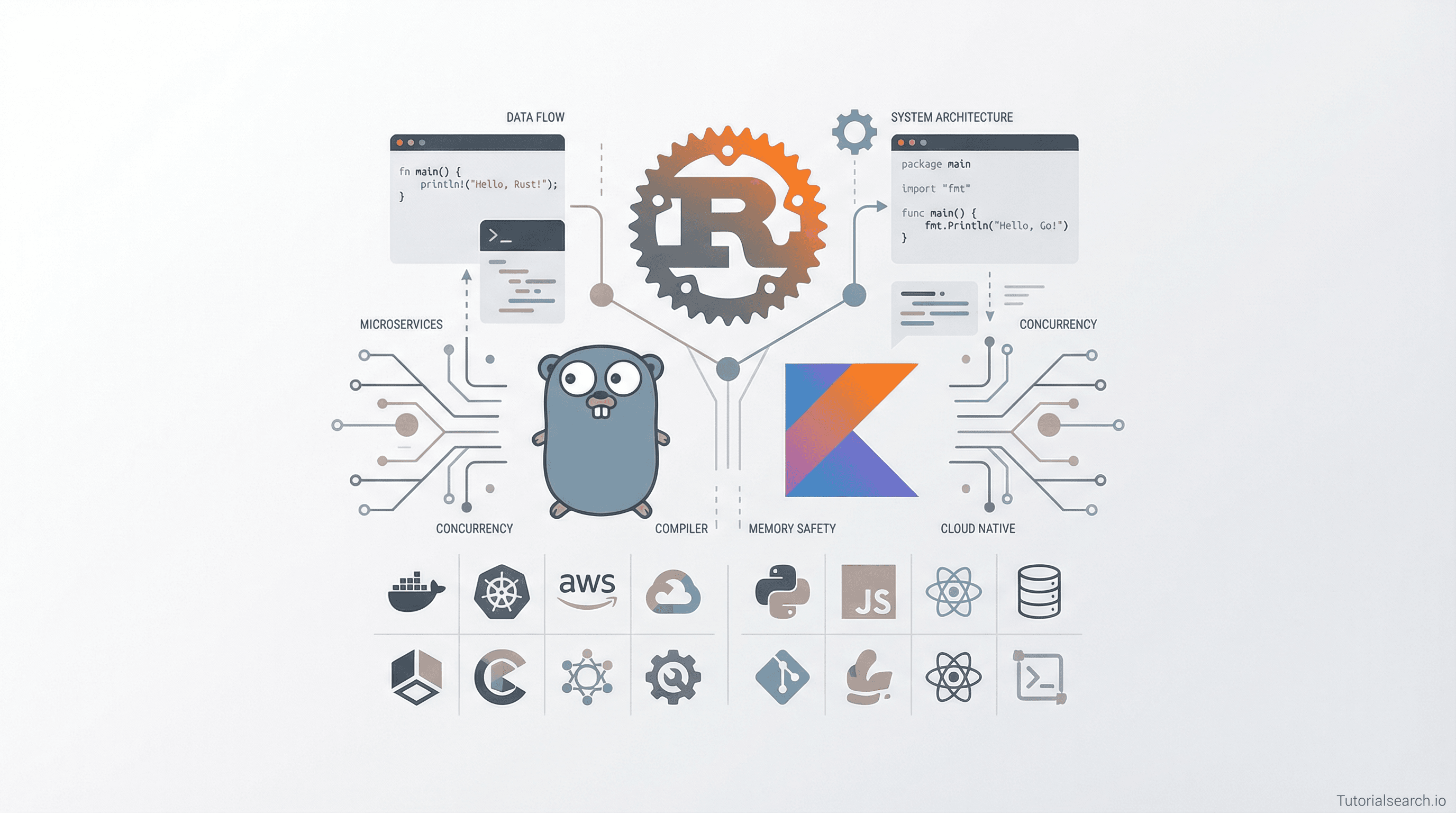
Top Resources To Learn Modern Programming Languages in 2026
Discover the best tutorials, courses, books, and free resources to learn Rust, Go, Kotlin, and other modern programming languages in 2026. Curated recommendations from someone who's actually tried them all.
Need a web app built? Hire the team behind TutorialSearch.io
We ship fast, production-grade full-stack apps (Next.js, React, edge infra) — the same stack that powers this site.
Why Modern Programming Languages Deserve Your Attention Right Now
Look, if you're still only writing code in Java or C++ and haven't at least dabbled in Rust, Go, or Kotlin — you're missing out. I'm not saying those legacy languages are dead (far from it), but there's a whole generation of programming languages that were designed specifically to fix the headaches those older languages give you. Memory leaks? Gone. Verbose boilerplate? Slashed. Concurrency nightmares? Actually manageable now.
Modern languages like Rust, Go, Kotlin, Swift, and TypeScript have exploded in popularity over the past few years — and for good reason. Companies like Google, Mozilla, Dropbox, Cloudflare, and JetBrains are betting heavily on these languages for production systems. Discord rebuilt critical infrastructure in Rust. Uber and Twitch run massive Go services. And Kotlin is literally the official language for Android development.
This guide is for anyone who wants to level up. Whether you're a beginner trying to pick your first "real" language or an experienced developer looking to stay relevant, I've put together the best tutorials, courses, books, and resources to learn modern programming languages in 2026. I've personally gone through a ridiculous number of these, and I'm gonna be honest about which ones are actually worth your time.
You can explore all 3,420+ modern language courses on TutorialSearch.io to find exactly what fits your learning style.
Getting Started: Which Modern Language Should You Pick?
Before diving into resources, let's talk strategy. This is where most people get stuck — they spend weeks researching instead of actually writing code. Here's my quick take:
- Rust if you want systems programming, blazing performance, and you enjoy a good challenge. The learning curve is real, but the payoff is massive.
- Go if you want simplicity, fast compile times, and you're interested in backend/cloud/DevOps work. Seriously, Go's syntax is so clean it almost feels like cheating.
- Kotlin if you're doing anything Android or JVM-related. It's like Java but without wanting to throw your laptop out the window.
- TypeScript if you're in the JavaScript ecosystem and want actual type safety.
My friend who's a senior dev at a FAANG company recommended learning Go first if you're new to modern languages — it has the gentlest learning curve and the concepts transfer well. Honestly, that advice changed my whole approach.
For a broader view of language options, check out our Programming Fundamentals collection with 1,100+ courses covering the basics across all languages.
Official Documentation & Getting Started Guides
Always start with the official docs. I know that sounds boring, but these modern languages actually have good documentation — not the cryptic man pages you might be used to.
Rust
- The Rust Programming Language ("The Book") — This is THE starting point. It's free, comprehensive, and surprisingly well-written for official docs. You'll build projects as you go and genuinely understand ownership by the end.
- Rust By Example — If reading hundreds of pages isn't your thing, this site shows you Rust through annotated code examples. Less talk, more code.
- Getting Started with Rust — The official installation and setup guide. Takes about 10 minutes.
Go
- A Tour of Go — An interactive tour right in your browser. This is honestly one of the best official tutorials I've ever used for any language. You can write and run Go code without installing anything.
- Go Documentation — The central hub for everything Go-related.
- Go by Example — Hands-on introduction to Go using annotated example programs. Think of it as the Go equivalent of Rust By Example.
- Effective Go — Once you know the basics, this teaches you idiomatic Go. Essential reading.
Kotlin
- Kotlin Documentation — JetBrains really knocked it out of the park here. Clean, well-organized, with interactive examples.
- Kotlin Tour — A guided introduction that takes you from zero to writing real Kotlin code.
- Kotlin Playground — Write and run Kotlin code in your browser. Perfect for quick experiments.
Best Paid Courses for Modern Languages
Ok this is where it gets fun. I've reviewed dozens of courses across platforms and here are the ones that are genuinely worth paying for.
Rust Courses
The Rust Programming Language by Dmitri Nesteruk (Udemy) — [Editors' Choice] With 21,000+ students and a 4.2 rating, this is the most popular Rust course on Udemy for a reason. Dmitri has a talent for making complex concepts click. He covers everything from ownership to advanced concurrency patterns. If you're gonna buy one Rust course, make it this one.
Rust Programming Language: The Complete Course by Abhishek Kumar (Udemy) — A solid comprehensive course that takes you from absolute beginner to building real projects. Covers memory management, concurrency, and all the Rust fundamentals you need. Good production quality and clear explanations.
Go Courses
Web Development w/ Google's Go Programming Language by Todd McLeod (Udemy) — [Editors' Choice] This is hands down the best Go course I've found. Todd McLeod is a university professor and it shows — the pacing is perfect, the explanations are clear, and with nearly 60,000 students and a 4.7 rating, the reviews speak for themselves. You'll build real web applications while learning Go from the ground up.
Master Go (Golang) Programming: From Basics to Advanced by Selfcode Academy (Udemy) — A 4.6-rated course that takes you through Go systematically. What I like about this one is it doesn't skip the "boring" fundamentals — and trust me, in Go, the fundamentals are where the magic is.
Go Lang for Tourists by Verrol Adams (Udemy) — A beginner-friendly intro if you want to get the lay of the land before committing to a longer course. Think of it as the "appetizer" before the main meal.
Kotlin Courses
The Android-Kotlin Development Guide by Hassan Fulaih (Udemy) — [Editors' Choice] 77,000+ students. 4.7 rating. This course is massive and covers everything from Kotlin basics to building complete Android apps. Hassan's teaching style is patient and thorough — exactly what you need when learning a new language and platform simultaneously. Even if you're not doing Android, the Kotlin fundamentals section alone is worth it.
Kotlin for Beginners: Learn Programming With Kotlin by Peter Sommerhoff (Udemy) — 22,000+ students, 4.5 rating. Peter focuses purely on the Kotlin language without the Android complexity, which makes this perfect if you're coming from Java or want to use Kotlin for backend work.
Honorable Mentions
- Elixir for Beginners by Ben Emson (Udemy) — If you're curious about functional programming in modern languages, Elixir is fascinating. 4,300+ students have taken this one and it's a solid introduction to the BEAM ecosystem.
You can search for more specific courses at TutorialSearch.io — we've got filters for platform, skill level, and price that make finding the right course way easier than scrolling through Udemy for hours.
Best Free Resources & Interactive Tutorials
Here's the thing about free resources — most of them are incomplete or outdated. But these ones? Actually good. Really, really good.
Rustlings — [Editors' Choice] This is how I learned Rust, and I recommend it to everyone. It's a collection of small exercises that guide you through Rust's concepts interactively. You fix broken code, fill in the blanks, and gradually build up your understanding. It runs locally and the error messages actually help you learn. Absolutely brilliant.
100 Exercises to Learn Rust by Mainmatter — A self-paced course with 100 exercises going from zero to writing real programs. Great complement to The Book if you want more hands-on practice.
Exercism Rust Track — 99 exercises with community mentoring. What makes Exercism special is the mentors — real humans review your code and give feedback. And it's 100% free.
Comprehensive Rust by Google — This is the actual Rust course Google uses to train their Android team. It's been open-sourced and it's incredibly well-structured. Goes from basics all the way to Android-specific Rust usage.
A Tour of Go — Already mentioned this above, but it deserves a spot here too. Interactive, browser-based, and you can literally start learning Go in the next 30 seconds.
Go by Example — Annotated example programs covering everything from basic types to channel directions to rate limiting. Bookmark this one — you'll come back to it constantly.
Kotlin Koans — Interactive exercises that teach you Kotlin syntax through a series of progressively harder challenges. JetBrains built this and it's polished as you'd expect.
Learn Kotlin – Codecademy — A 15-hour free course with interactive coding. No prior programming experience needed. Great for absolute beginners.
For more free options, browse our Python Basics section too — many concepts transfer directly to modern languages, especially if you're brand new to programming.
Learn From GitHub
Need a web app built? Hire the team behind TutorialSearch.io
We ship fast, production-grade full-stack apps (Next.js, React, edge infra) — the same stack that powers this site.
GitHub is honestly an underrated learning resource. Some of the best curated lists live there.
awesome-rust — [Editors' Choice] The mother of all Rust resource lists. Libraries, frameworks, tools, tutorials — if it exists in the Rust ecosystem, it's probably listed here. I check this repo at least once a month to see what's new.
rust-learning — A curated collection of blog posts, articles, videos, and other learning material specifically focused on learning Rust. Less overwhelming than awesome-rust if you just want learning content.
LearnRust — Another excellent curated list of Rust learning resources, organized by topic and difficulty.
RustBooks — A comprehensive list of Rust books, both free and paid. Super helpful when you're trying to figure out which book to read next.
golang/tour — The official Go tour repository. You can run it locally which is nice when you're on a plane or somewhere without great internet.
For developers interested in automation and tooling with these languages, check out our Automation Development and Git Automation collections too.
Learn From YouTube
YouTube has some seriously amazing programming content — you just need to know where to look. I spent way too long watching mediocre tutorials before finding these gems.
Let's Get Rusty — Beginner-friendly Rust tutorials with clear, chapter-based explanations that follow along with The Book. This channel is probably the single best YouTube resource for learning Rust. The creator has a knack for making ownership and lifetimes actually make sense.
The Primeagen — A Netflix (now Turso) programmer who makes systems programming entertaining. His Rust streams are educational and hilarious. Not the most structured content, but the enthusiasm is infectious and you'll pick up a ton of practical knowledge.
freeCodeCamp.org — They have full-length courses for both Rust and Go that are completely free. The "Learn Rust Programming – Complete Course" is a comprehensive walkthrough. The Go content is equally solid. These are typically 5-10 hour marathon courses.
Traversy Media — Brad Traversy's crash courses are legendary. His "Rust Crash Course" and Go tutorials give you a solid foundation in a couple of hours. Not deep dives, but perfect for deciding if you want to go further.
The Net Ninja — Shaun Pelling's Rust and Go playlists are well-structured, typically 10-15 episodes each, averaging 15-20 minutes per video. Great pacing for daily learning sessions.
Fireship — Jeff Delaney's "100 Seconds of X" series is perfect for quick language overviews. His Rust in 100 Seconds video has millions of views. Not a learning resource per se, but great for understanding why these languages matter.
Todd McLeod — The same instructor behind that amazing Udemy Go course also has free Go content on YouTube. Incredibly thorough teaching style.
Tensor Programming — Deep dives into Rust and Go projects. Less mainstream but the content quality is excellent. Great for intermediate developers who want to build real things.
Best Books for Modern Languages
I'm a book person — there's something about reading code in a book that makes it stick differently than watching videos. Here are the best ones.
The Rust Programming Language by Steve Klabnik, Carol Nichols, and Chris Krycho — [Editors' Choice] Free online. This is "The Book" in the Rust community and every Rust developer has read it (or should have). It's beginner-friendly, well-structured, and kept up to date. There's also a print edition if you're old school like me.
Programming Rust by Jim Blandy, Jason Orendorff, and Leonora Tindall — The deeper dive once you've finished The Book. O'Reilly quality, covers advanced topics like unsafe code and macros. Not free, but worth every penny.
Learning Go by Jon Bodner (2nd edition, 2024) — The most current and comprehensive Go book available. Reflects modern Go features and idioms. If you want one book to learn Go properly, this is it.
Concurrency in Go by Katherine Cox-Buday — Go's concurrency model is one of its killer features, and this book explains goroutines and channels better than anything else I've read. Essential once you're past the basics.
Kotlin in Action by Roman Elizarov, Svetlana Isakova, and Dmitry Jemerov — The definitive Kotlin book from JetBrains team members themselves. If you want to understand not just how to write Kotlin but why the language was designed the way it is, this is your book.
Also check out Kotlin Notes for Professionals — it's compiled from Stack Overflow documentation and completely free. Not as well-organized as a traditional book, but great as a reference.
Additional Useful Links & Community
No learning journey is complete without community. Here's where the modern language communities hang out:
Rust:
- Rust Users Forum — Friendly, welcoming, great for beginner questions
- r/rust on Reddit — Active community with daily discussions
- Rust Discord — Real-time help and chat
Go:
- Go Forum — The main community forum
- r/golang on Reddit — News, tutorials, and discussions
- Gophers Slack — One of the most active programming Slacks
Kotlin:
- Kotlin Slack — Official Kotlin community
- r/Kotlin on Reddit — Growing community
- Kotlin Discussions — Official discussion forum
Cross-Language:
- Dev.to — Great articles and discussions across all modern languages
- Hacker News — Where new language features and releases get discussed
- Stack Overflow — Obviously
For deeper dives into specific areas, explore our collections on JavaScript Development, Java Objects, or Python Applications — many developers learn modern languages alongside these established ones.
Wrapping Up
Here's my honest recommendation for where to start in 2026: pick one language, go through the official tour/tutorial, then take one good paid course while building a side project. Don't try to learn Rust, Go, AND Kotlin simultaneously — that's a recipe for learning none of them well.
If I had to bet on one language having the biggest impact over the next decade, I'd put my money on Rust. But Go is probably the most practical choice if you want to be productive quickly. And Kotlin is a no-brainer if mobile development is your thing.
Whatever you choose, the resources in this guide should get you from zero to building real projects. And remember — the best language is the one you actually use. So stop researching and start coding.
Drop a comment below with your favorite modern language and why — I'm always curious what other developers are gravitating toward. And if I missed a resource you love, let me know so I can add it to the list!
Browse all modern language courses on TutorialSearch.io to find your perfect starting point.