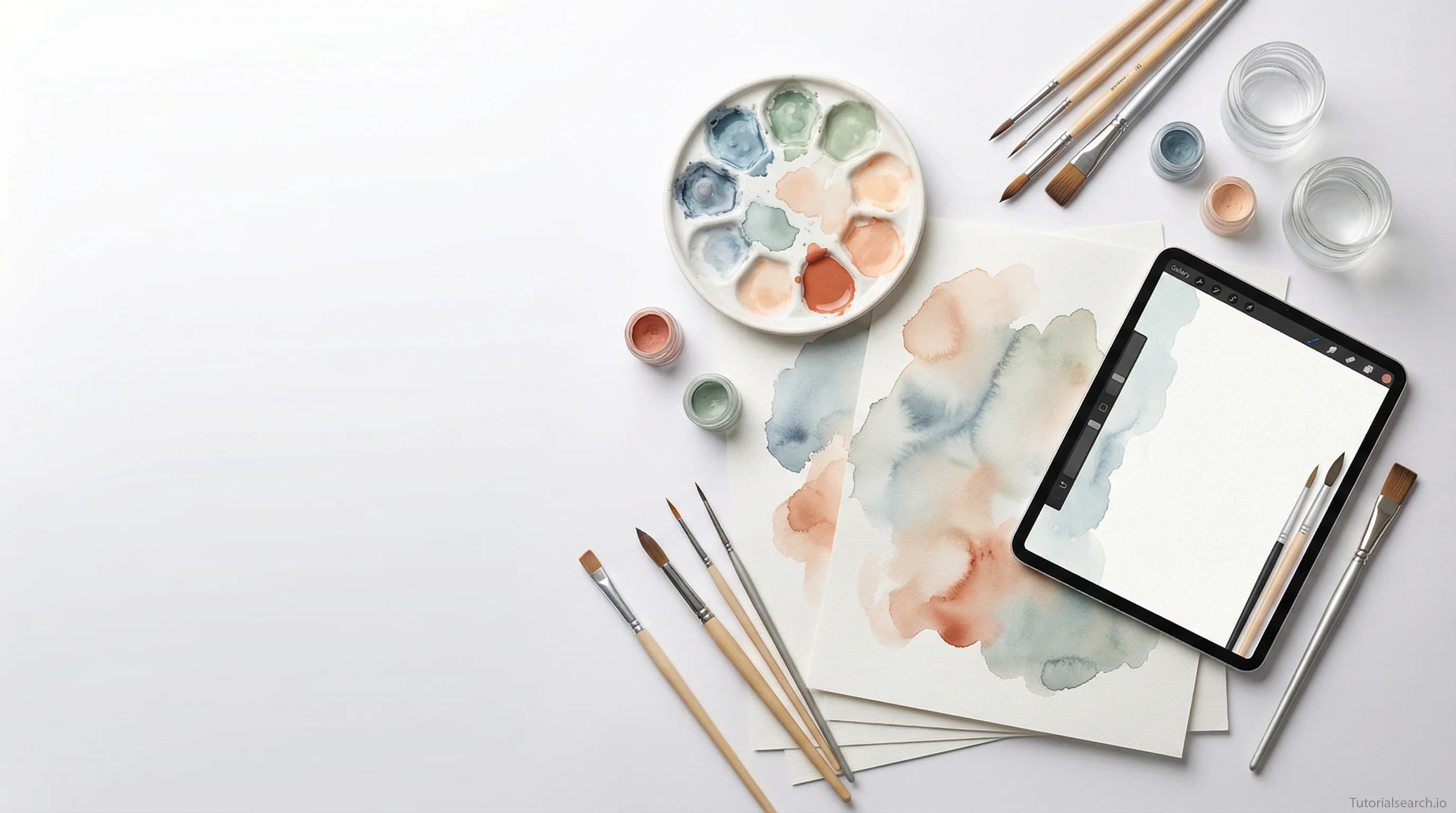
The Watercolor Painting Guide I Wish Existed Earlier
Watercolor painting rewards patience and punishes shortcuts. Here are the courses, free resources, and YouTube channels that actually teach you the medium.
Hire the developers behind TutorialSearch.io
We built this site — full-stack web apps, AI integration & automation. Tell us what you need and we'll build yours.
Watercolor painting is one of the most beautiful and most unforgiving mediums you'll ever try. Picture this: you're sitting at a kitchen table with a new set of paints, a brush, and a crisp sheet of paper. You mix a soft blue-green. You lay it down carefully. And then — the paper buckles, the pigment blooms into the wrong area, and the smooth gradient you pictured ends up a muddy, wrinkled mess.
Every watercolor painter has been here. The medium rewards patience and deep familiarity with its quirks. But with the right starting point, you can skip months of frustration. This guide covers the best watercolor painting courses to build real skills, the free resources worth your time, and the books and YouTube channels that genuinely teach you something.
Key Takeaways
- Watercolor painting has a real learning curve — a good beginner course saves months of frustrating trial and error.
- Good paper matters more than expensive paints when you're starting out.
- The wet-on-wet technique is what most beginners struggle with first, and it's also the most rewarding to master.
- Free resources like Jennifer Branch's site and American Watercolor rival many paid options for technique.
- Watercolor painting pairs naturally with illustration — many artists combine the two disciplines.
In This Article
- Your First Day With Watercolor Painting
- Watercolor Painting Courses Worth the Investment
- Free Watercolor Painting Resources That Surprise
- Watercolor Painting YouTube Channels Worth Subscribing To
- Watercolor Painting Books That Go Deep
- Where Watercolor Painting Communities Gather
- Related Watercolor Painting Skills Worth Exploring
- Frequently Asked Questions About Watercolor Painting
Your First Day With Watercolor Painting
Watercolor painting behaves differently from any other medium. Acrylics and oils sit where you place them. Watercolor moves — it spreads, blooms, and reacts to how wet the paper already is. That unpredictability is part of the magic, but it's also what trips up beginners who expect control before they've earned it.
Here's something most guides skip: the paper matters more than the paint. Student-grade paints on 300gsm cotton paper will outperform professional watercolors on cheap copy paper every single time. If your sessions feel chaotic and uncontrollable, check your paper before blaming your technique.
Two core techniques separate beginners from intermediate painters. Wet-on-wet means dropping wet paint into a wet surface — the result is soft, blooming, atmospheric effects that watercolor does better than any other medium. Wet-on-dry means painting on dry paper for crisp, controlled edges. You'll spend your first weeks figuring out when each one serves your subject.
Most beginners fall for wet-on-wet immediately. It looks like painting in clouds, and it partly is.
The beginner watercolor painting courses in the next section all cover these fundamentals before moving on. That's not an accident — it's the right order to learn.
Watercolor Painting Courses Worth the Investment
Most watercolor courses fall into two types: "paint along with me" videos that teach nothing transferable, and structured courses that explain the why behind each technique. The second type is worth paying for. Here's what's actually good.
1. Watercolor Painting For Beginners | By Award Winning Artist — Broderick Wong (Udemy) [Editors' Choice]
This is the course to start with. Broderick Wong is an award-winning artist, and his instruction is methodical in a way that self-taught beginners rarely encounter. Over 30,000 students have taken it. The pacing suits someone with no prior art background and doesn't bore someone who sketches casually.
- Covers wet-on-wet and wet-on-dry in depth before anything else
- Strong emphasis on understanding color relationships, not just mixing by instinct
- Returns to fundamentals throughout, not just in lesson one
Rating: 4.6/5. This is the watercolor painting course I'd hand to a friend first.
2. Watercolor Painting For Intermediates | Techniques & Effects — Broderick Wong (Udemy)
The natural follow-up to the beginner course above. This one covers lifting (removing wet or dry pigment from the paper), masking fluid, and layering glazes for depth. If the beginner course answered "how does this work," this one answers "what can I actually do with it." Rating: 4.6/5.
3. Watercolor Painting Flowers by Award Winning Artist — Broderick Wong (Udemy) [Editors' Choice]
If botanical subjects draw you to watercolor in the first place, this is outstanding. Over 8,000 students, 4.7/5 rating — the highest-rated course in Wong's series. Soft, transparent petals are genuinely difficult to paint. The layering instruction here is precise enough that the course would justify its price on that section alone.
4. Watercolor Painting Landscapes | By Award Winning Artist — Broderick Wong (Udemy)
Landscapes require a different set of skills than botanicals. Sky washes, atmospheric perspective, and foreground texture all work differently in the distance vs. the foreground. This course handles that progression systematically. Rating: 4.6/5, 10,500+ students. If landscapes are your primary interest, start here rather than the general beginner course.
5. Watercolor Painting from the Basics! Learn by Doing Projects — Adolfo Olivo (Udemy)
A strong alternative to the Wong courses, and worth mentioning specifically because the format differs. Olivo is project-based from the start — you're painting actual subjects, not isolated exercises. Some learners respond much better to this approach. About 6,000 students, 4.5/5 rating.
6. Watercolor Painting: Misty Mountains Landscape — Trupti Karjinni (Skillshare) [Editors' Choice]
If you have Skillshare, this is worth an afternoon. Karjinni's technique for mist and atmospheric effects in mountain landscapes is striking. This is intermediate material — don't start here — but if you've done the basics and want to try something beautiful, this delivers. Rating: 4.6/5.
7. Watercolor Essentials: Theory, Mindset and Techniques (Udemy)
Most beginner courses skip the theory. This one doesn't. If you want to understand why watercolor behaves the way it does — the role of binders, paper grain, pigment weight — this is the missing piece. Pair it with any practical course from above.
Quick Comparison: Which Course for Which Learner?
| Learner Type | Best Course |
|---|---|
| Complete beginner, no art background | Watercolor Painting For Beginners (Broderick Wong) |
| Beginner who loves flowers and botanicals | Watercolor Painting Flowers (Broderick Wong) |
| Project-based learner who hates isolated exercises | Watercolor Painting from the Basics (Adolfo Olivo) |
| Intermediate wanting depth and technique | Watercolor For Intermediates (Broderick Wong) |
| Landscape enthusiast | Watercolor Painting Landscapes (Broderick Wong) |
You can also browse all 452+ watercolor painting courses on TutorialSearch.io to find something more specific to your style.
Free Watercolor Painting Resources That Surprise
The conventional wisdom says you need to pay for quality instruction. In watercolor painting, that's not entirely true. Some of the most useful resources are completely free.
Jennifer Branch's Free Tutorial Library
Jennifer Branch is a professional artist with over 20 years of experience, and her free tutorial library covers dozens of subjects — birds, botanicals, animals, landscapes. Each tutorial walks through the full process step by step. No upsell, no paywall. This is one of the most underrated free watercolor resources on the internet.
American Watercolor — Free Technique Articles
American Watercolor publishes free articles on texture, composition, perspective, and technique. The writing is thoughtful and goes beyond beginner-level advice. If you learn better by reading than watching, start here.
Jerry's Artarama Free Video Tutorials
Jerry's Artarama hosts a large library of free watercolor videos ranging from beginner to advanced. Topics cover florals, portraits, abstract work, and landscapes. Worth bookmarking when you exhaust your current course content.
Watercolor Mastery Free Classes
Watercolor Mastery offers free starter classes that cover the basics. Even the free tier has solid instruction on washes and color mixing.
Domestika: 23 Free Watercolor Painting Tutorials
Domestika has curated a list of free tutorials covering basic techniques, different styles, and tips for overcoming creative blocks. Worth a browse if you want curated beginner content without a subscription.
GitHub: myfoxtail/watercolor-painting
An unconventional entry: this GitHub repository provides a structured learning plan for complete beginners — color mixing charts, simple object practice, compositional exercises. It's an unusual format for art instruction, but the structured progression is genuinely helpful if you prefer self-directed learning.
GitHub: tombetthauser/watercolor-basics
Another open-source resource: ten-plus years of teaching observations, aimed at developing an everyday watercolor practice. More opinionated than a textbook and more useful for that reason.
Free Udemy: Watercolor Painting Step-by-Step — Poppy Field (by Vitalii Dets)
There's a genuinely free Udemy course that takes you from blank paper to a finished poppy field painting. It's focused on one project rather than broad fundamentals, but as a taste of working from reference to finished piece, it's a real learning experience — and costs nothing.
If you find yourself drawn to more illustrative work, watercolor illustration courses are a natural next step — the same fundamentals applied to character, editorial, and pattern work.
Watercolor Painting YouTube Channels Worth Subscribing To
Hire the developers behind TutorialSearch.io
We built this site — full-stack web apps, AI integration & automation. Tell us what you need and we'll build yours.
There are two kinds of watercolor YouTube channels. The first is the aesthetic channel — beautiful hands, calming music, no actual instruction. The second teaches you something. Skip the first type entirely.
Mind of Watercolor — Steve Mitchell [Editors' Choice]
With over 250,000 subscribers, this is one of the largest watercolor channels on YouTube. Mitchell is a serious artist and a precise teacher. His videos cover color theory, brush handling, and subject matter — and he doesn't simplify things to the point of uselessness. If you subscribe to one watercolor channel, make it this one.
Jenna Rainey's content is best for beginners who want to start with something approachable. Her style is modern and botanical — florals, leaves, loose abstract forms. She also wrote Everyday Watercolor, one of the books discussed below. Her best beginner tutorials roundup is a useful starting point even before you pick a course.
Scarlett Damen (WATERCOLOR by Scarlett Damen)
Damen describes her channel as "your private online watercolour art school." She focuses entirely on beginners — simple step-by-step projects and clear explanations of why each technique works. Her pace is slower than Mitchell's, and that's precisely what beginners often need.
Alison Fennell
Fennell covers paper wetting and paint mixing in a way that many instructors skip. She's a freelance artist who explains every step in detail. Her pace is methodical — you can follow along while painting rather than just watching.
Watercolor Misfit — Carrie Luc
Carrie Luc's channel has a distinctive, cartoony aesthetic that shows watercolor painting's more whimsical side. If traditional landscape painting bores you, her tutorials demonstrate a completely different range of what the medium can do. Her videos are well-designed and easy to follow.
Many watercolor artists eventually explore creative expression courses alongside their painting practice — finding their own voice matters as much as mastering technique.
Watercolor Painting Books That Go Deep
YouTube shows you what to do. Books teach you how to think. The best watercolor books slow you down enough to absorb theory you'd otherwise skip.
Everyday Watercolor by Jenna Rainey
This is the book most new watercolor painters should read first. Rainey covers materials, fundamental techniques, and color theory — then guides you through 30 days of projects. It assumes no prior art background. The physical book is beautifully designed, which matters when you're looking at color mixing examples.
You can find Everyday Watercolor on BookAuthority alongside several other highly-rated beginner options.
Modern Watercolor by Kristin Van Leuven
If Rainey's book feels slightly dense, Van Leuven's Modern Watercolor is a gentler introduction. It covers similar ground with fewer pages and more visual space between concepts. This is the right starting point for the complete beginner who gets intimidated by traditional art books.
Creative Watercolor by Ana Victoria Calderón
More advanced than the two above. Calderón gets into color harmony, composition, and developing a personal style — the things most beginners skip and then wish they hadn't. Best read after 3-6 months of practice, when you've moved past basic technique questions.
A word on where watercolor goes: many artists naturally drift toward mixed media art after a year or two — combining watercolor with ink, collage, or pencil. It's a progression worth knowing about, because the boundary between pure watercolor and mixed media is where a lot of original work happens.
Where Watercolor Painting Communities Gather
Learning alone is harder than it needs to be. These communities offer feedback, motivation, and the occasional reminder that your "failed" painting is actually pretty good.
The largest watercolor community on Reddit. Members share work, give and receive critiques, and post technique resources. Beginners are welcome and the feedback is generally thoughtful.
A subreddit specifically for beginners learning to paint with watercolors. Lessons and discussion range from absolute basics to early intermediate work. Less intimidating than the main subreddit if you're just starting.
Doodlewash runs watercolor and sketching forums where artists share daily paintings and discuss technique. The community skews warmer and more encouraging than anonymous forums tend to be.
Painting With Watercolors Forum
A dedicated watercolor forum with technique discussions, critique threads, and resource sharing.
Related Watercolor Painting Skills Worth Exploring
If watercolor painting interests you, these related skills pair naturally with it:
- Watercolor Techniques — Go deeper into specific methods like glazing, masking fluid, granulation, and backruns. 650+ courses.
- Watercolor Illustration — Applies watercolor to illustrative work: character design, editorial art, and surface pattern-making. 1,000+ courses.
- Illustration Techniques — Broadens your skills beyond watercolor into broader illustration fundamentals. 1,300+ courses.
- Mixed Media Art — Combine watercolor with ink, collage, and acrylic for layered, textural results. 980+ courses.
- Beginner Art — Foundational art skills worth building alongside your watercolor practice.
- Procreate Illustration — Many watercolor artists use Procreate to plan compositions or create digital watercolor effects.
- Photoshop Techniques — Useful for editing, presenting, and preparing your watercolor work for print or digital use.
Frequently Asked Questions About Watercolor Painting
How long does it take to learn watercolor painting?
Most people see real progress within 3-6 months of consistent practice — meaning a few hours per week, not painting every day. But "learning watercolor" is a bit like asking how long it takes to learn cooking. You can make something good in a week, and spend a lifetime refining the craft. A good beginner course can shorten that curve significantly. Browse the watercolor painting courses on TutorialSearch.io to find one that matches where you are right now.
What materials do I need to start watercolor painting?
Three things: watercolor paints (a basic pan set works fine for the first year), a couple of brushes (a round size 6 and a flat wash brush cover most situations), and watercolor paper at a minimum of 140lb/300gsm. The paper is the most important investment — cheap paper causes most of the problems beginners blame on their technique. A water container and painter's tape are useful extras but not essential.
Is watercolor painting difficult to learn?
Watercolor has a real learning curve, but it's not as steep as people expect. The medium is unforgiving of specific mistakes — overworking wet paint is the most common one — but forgiving of others. Many beginners find that their accidents look more interesting than what they planned. The key is learning to work with the medium's behavior rather than against it. That shift usually happens around month two or three.
Can I get freelance or professional work with watercolor painting skills?
Yes. Watercolor artists find consistent work in book illustration, surface pattern design (for fabrics, stationery, and gifts), greeting cards, editorial illustration, and commissioned portraits. The path to commercial work requires a recognizable style and a portfolio, not just technical skill. Many working artists combine watercolor with illustration techniques to open more commercial doors.
What's the difference between watercolor and gouache?
Watercolor relies on transparency — the white of the paper shines through the paint to create luminosity. Gouache (pronounced "gwash") is opaque — it covers what's underneath, more like a matte version of acrylic. Many artists use both in the same painting. Gouache is more forgiving for corrections; watercolor creates luminous effects that gouache simply can't replicate. The watercolor techniques courses on TutorialSearch.io cover this comparison in practical detail.
How can I stop my watercolor paper from buckling?
Stretch it before you start. Soak the paper in clean water for 2-5 minutes, then tape it to a board with gummed tape while wet and let it dry completely before painting. A stretched sheet stays flat even through heavy washes. The alternative is buying blocks (pre-stretched pads sealed on all sides), which serve the same purpose without the prep work.
Pick up a brush. Put color down. Let it do something you didn't plan for — then figure out how to use that. That's the real first lesson in watercolor painting, and no course teaches it as well as the first 20 minutes you spend making a mess.
When you're ready for structure, the Broderick Wong beginner course is the best place to start. You can also explore the full range of watercolor painting courses on TutorialSearch.io to find the fit that works for where you are right now.