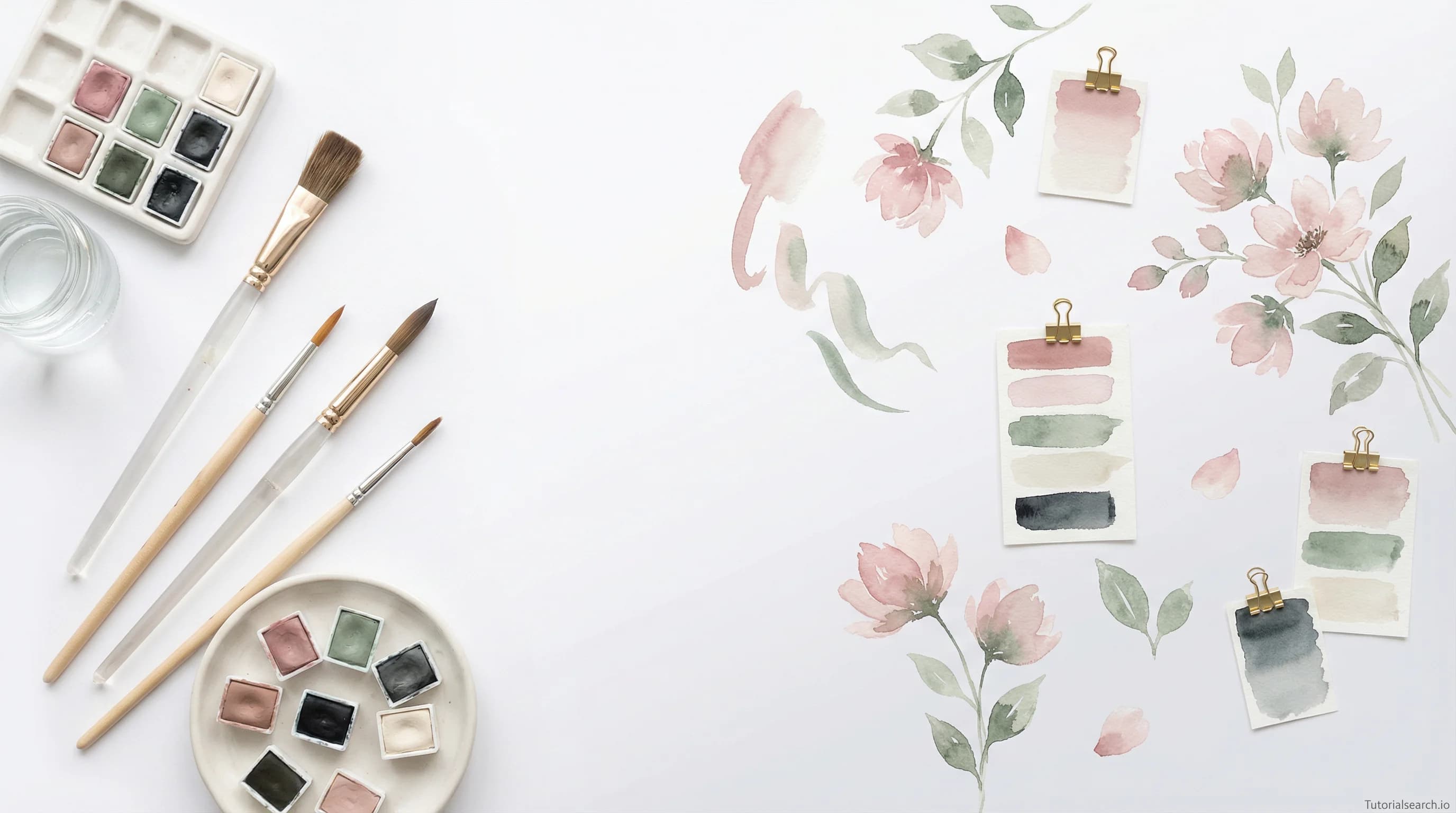
The Watercolor Florals Guide I Wish I Had Earlier
Watercolor florals reward loose, confident brushwork — and these courses, free resources, and YouTube channels will get you there faster than you think.
Hire the developers behind TutorialSearch.io
We built this site — full-stack web apps, AI integration & automation. Tell us what you need and we'll build yours.
Watercolor florals have a way of humbling even confident artists. The medium punishes control-seekers — and most tutorials don't warn you about that.
When I first sat down with watercolor and a reference photo of roses, I sketched every petal in careful detail, then tried to fill each shape precisely. The result was stiff, muddy flowers that looked like a coloring book on a bad day. What I didn't understand yet: watercolor florals aren't about controlling the paint. They're about having a conversation with it.
This guide covers what actually helps — the best courses (paid and free), YouTube channels worth bookmarking, books that go deeper than any tutorial, and the communities where your work will improve fastest. No padded lists. Just what genuinely works.
Key Takeaways
- Watercolor florals reward looseness — fighting the medium's natural flow leads to stiff, overworked paintings
- Dhritikana Nath's 7-day masterclass is the best structured watercolor florals course for fast, serious improvement
- Cold-pressed 140lb (300gsm) paper is non-negotiable — flimsy paper buckles and ruins your work before you start
- Free resources like Jenna Rainey's beginner guides are genuinely excellent starting points for watercolor florals
- Mastering watercolor florals opens doors to illustration, surface design, greeting cards, and art licensing careers
In This Article
- Your Watercolor Florals Starting Point: What Really Matters
- Watercolor Florals Courses I'd Recommend Without Hesitation
- Free Watercolor Florals Resources That Are Actually Good
- Watercolor Florals YouTube Channels Worth Your Attention
- Go Deeper: Books and Repos for Serious Watercolor Florals Work
- Watercolor Florals Communities Where You'll Actually Improve
- Skills That Pair Well With Watercolor Florals
- Frequently Asked Questions About Watercolor Florals
Your Watercolor Florals Starting Point: What Really Matters
Watercolor florals work differently from every other drawing or painting medium. The paint moves on its own. Water dilutes and spreads. Colors bleed into neighboring shapes. And all of that is the point — not a problem to fix.
Before you open any course, get these fundamentals sorted.
Paper first. Cold-pressed watercolor paper at 140lb (300gsm) is the standard. It handles water without buckling. Regular sketchbook paper or thin printer paper will warp immediately, creating ridges that pool paint in all the wrong places. Arches 140lb Cold Press is the gold standard, but Strathmore 400 Series and Canson XL both work well at lower price points.
A few good brushes, not many. A round brush in size 8 handles most petal shapes. A size 4 works for fine details and stems. A size 12 or a flat wash brush covers backgrounds and large washes. That's genuinely enough to start. Natural hair brushes (squirrel, kolinsky) hold water beautifully, but quality synthetics like the Princeton Neptune series perform surprisingly well.
Decent pigments. Student-grade paints like Winsor & Newton Cotman are fine when starting out. But if you're serious, a small set of artist-grade paints — Daniel Smith, Winsor & Newton Professional, or Schmincke — will show you what the medium can actually do. The color vibrancy difference is stark.
Now, a contrarian take on where to begin: everyone says start with simple pansies or daisies. That advice is technically sound, but I disagree with it. Paint the flower you actually love — a peony, an iris, a magnolia — right from the start. Motivation matters more than logical progression. You'll push through early frustration much faster when the subject excites you.
If you're completely new to art in general, browse the Beginner Art section first — 558+ courses cover foundational skills like mark-making and color theory that will speed up your watercolor florals journey.
You can also explore 138+ watercolor florals courses on TutorialSearch.io to find the right starting point for your skill level.
Watercolor Florals Courses I'd Recommend Without Hesitation
These are courses I'd send to a friend asking where to start — or where to break through a plateau.
For Beginners
1. Fun & Loose Watercolor Florals, Leaves, & Butterflies by Yasmina Creates (Skillshare)
Over 17,000 students have taken this class. That number alone tells you something. Yasmina's whole approach is about painting loosely — she actively pushes you away from the tight, controlled style that frustrates most beginners. You'll paint flowers, leaves, and butterflies while building real observation skills. The pacing is relaxed, and she makes messy brushstrokes feel like intentional technique rather than mistakes.
Rating: 4.45 | 17,370 students | Beginner level
2. Watercolor Florals for Beginners: Autumn Theme by Joly Poa (Skillshare)
[Editors' Choice] Joly Poa's autumn-themed class has a 4.83 rating for good reason. The seasonal focus gives you a cohesive palette to work with — burnt oranges, deep reds, warm yellows — which removes one of the biggest early decisions for beginners: what colors to mix together. She covers layering, wet-on-wet technique, and how to let flowers read as painterly rather than stiff.
Rating: 4.83 | 1,313 students | All levels
3. Beginner Watercolor Florals: 5 Easy Flowers Anyone Can Paint (Skillshare)
Exactly what it says. Five flowers, clear structured lessons, strong fundamentals. If you want a quick win before committing to a longer course, this one delivers it.
Rating: 4.73 | 1,413 students | Beginner level
For Intermediate Painters
4. Dance with Your Brush: Paint Expressive Watercolor Florals (Skillshare)
[Editors' Choice] The title sounds poetic, but it earns it. This course focuses on expressive technique — how brush pressure, speed, and water ratios create movement in petals. Over 4,300 students enrolled, and reviews consistently describe a "lightbulb moment" when loose painting finally clicks. This is the course that takes you from technically competent to genuinely expressive.
Rating: 4.81 | 4,330 students | All levels
5. Watercolor Florals in Two Ways by Dhritikana Nath (Skillshare)
Dhritikana Nath is one of the most consistent watercolor instructors on Skillshare. This course teaches the same flower two ways — tight botanical approach and loose impressionistic approach. Seeing both side by side is genuinely educational. You understand why each technique creates different results, not just what the results look like.
Rating: 4.82 | 1,352 students | Intermediate
6. Effortless Watercolor Flowers: Loose Florals Using Filbert Brushes (Skillshare)
This one focuses specifically on filbert brushes — a rounded, oval-tipped brush that many floral painters swear by. If you've been struggling with round brushes, switching brush shapes can unlock a completely different painting style. Worth trying.
Rating: 4.86 | 625 students | All levels
For Serious Commitment
7. Watercolor Florals Master Class: 7 Days, 7 Paintings, 7 Styles by Dhritikana Nath (Skillshare)
[Editors' Choice] The highest-rated course on this list. Seven consecutive painting days means you build habits, not just knowledge. Each day introduces a different style — from botanical precision to impressionistic looseness — so by the end you have real range. The 4.91 rating across 1,000+ students makes it hard to argue against. If you're investing serious time in one course, make it this one.
Rating: 4.91 | 1,092 students | All levels
8. Watercolor Painting Flowers by Award-Winning Artist (Udemy)
Over 8,000 students have taken this Udemy course — one of the most popular watercolor florals classes outside Skillshare. The instructor brings a formal fine art background, which shows in the composition and color theory sections. If you want more rigorous structure than Skillshare's class format, this delivers.
Rating: 4.73 | 8,080 students | Multiple levels
9. Watercolor Florals: Learn to Capture and Paint the Essence of a Flower by Jenny Flores Art (Skillshare)
[Editors' Choice] The highest raw rating of any course here: 4.94. Jenny's approach is conceptual — she focuses on capturing the feeling of a flower rather than reproducing it exactly. For artists who feel technically competent but want more soul in their work, this is the one to take. Meditative in the best way.
Rating: 4.94 | 297 students | All levels
Browse more options at the watercolor florals search page.
Free Watercolor Florals Resources That Are Actually Good
Here's a quick comparison of the best free starting points:
| Resource | Best For | What You Get |
|---|---|---|
| Jenna Rainey's Beginner Guide | Absolute beginners | Step-by-step flower tutorials, brush technique |
| Domestika Free Tutorials | Technique variety | 23 curated projects from professional instructors |
| Concept Art Empire | Volume practice | 40+ free video tutorials across all skill levels |
| Jerry's Artarama Video Library | Medium-specific skills | Free lessons focused on how watercolor behaves |
| Artsydee Beginner Tutorials | Quick wins | Easy step-by-step with downloadable templates |
Jenna Rainey's Complete Beginner's Guide to Watercolor Flowers is the first free resource I'd send anyone. Jenna is a professional watercolor artist and published author, and her guides read like a smart friend walking you through the process. She covers sketching basic shapes, painting petals, and progressing through specific flowers like anemones, irises, and delphiniums. The writing is clear without being condescending.
Domestika's 23 Free Watercolor Tutorials are worth bookmarking. Domestika typically charges for full courses, so having curated free content from professional instructors is genuinely valuable. Projects range from simple loose flowers to complete botanical compositions.
Concept Art Empire's 40+ Watercolor Tutorials cover everything from beginner basics to complex multi-flower compositions. The sheer volume means you can build a loose learning path without paying for a structured course.
Jerry's Artarama's Free Watercolor Lessons focus on the medium itself — how watercolor behaves on different papers, how to control blooms (those unwanted watermarks), and how to fix common mistakes. Less project-based, more technique-focused. Perfect when you keep making the same error and need to understand why.
Artsydee's Easy Watercolor Tutorials come with downloadable templates, which makes them especially useful if you're not confident about sketching beforehand. Step-by-step guidance from simple florals to more complete compositions.
One budget tip: Skillshare offers a free trial. Many people complete three or four of the paid courses above in a single trial period.
Watercolor Florals YouTube Channels Worth Your Attention
Hire the developers behind TutorialSearch.io
We built this site — full-stack web apps, AI integration & automation. Tell us what you need and we'll build yours.
YouTube has a strong and generous watercolor community. These channels consistently produce good content for floral painters specifically.
Yasmina Creates — The same instructor as the popular Skillshare beginner course. Her YouTube channel offers free tutorials in the same loose, expressive style she's known for. Good for practicing technique between more structured lessons. Search "Yasmina Creates watercolor florals" and you'll find plenty to work through.
Jenna Rainey — Jenna posts a mix of tutorials, supply reviews, and process walkthroughs. The technique is clean, the production quality is high, and she explains the why behind each decision rather than just showing you what to do. Strong for color theory and brush control specifically.
The Frugal Crafter (Lindsay Weirich) — Lindsay's channel has over a million subscribers because she makes watercolor accessible without dumbing it down. Her floral tutorials are especially good for beginners who want quick, achievable results. She's also refreshingly honest about when cheap supplies work just fine versus when quality matters.
Louise De Masi Watercolour — A professional Australian artist whose channel focuses heavily on florals and loose technique. Her slow, deliberate style is great for understanding water ratios and brush loading — two things that trip up most beginners but rarely get explained clearly in faster-paced tutorials.
Andrew Geeson — A British artist specializing in colorful loose florals and landscapes. His work shows the expressive end of watercolor florals — big confident brushwork, vibrant color, minimal fussing over details. Good to watch when you feel yourself overthinking things.
Go Deeper: Books and Repos for Serious Watercolor Florals Work
At some point, tutorials aren't enough. You need to read and think about the medium. These books make that shift happen.
Everyday Watercolor by Jenna Rainey — The book companion to her online tutorials, structured as a 30-day course. Each day builds on the last. It's the most beginner-friendly book on this list. Available at most bookstores and through Goodreads' watercolour shelf for reviews and more recommendations.
Modern Watercolor by Kristin Van Leuven — Slightly easier entry point than Everyday Watercolor for people who feel completely overwhelmed by the medium. Less structured, more exploratory. Works well alongside a video course.
Creative Watercolor by Ana Victoria Calderón — The most visually inspiring book here. Calderón's style is colorful and organic, and her written explanations of color mixing and composition are unusually clear. Highly recommended if you're drawn to the surface design and illustration applications of watercolor florals. Check Art Ltd Magazine's watercolor book reviews for context on how it compares to other options.
Watercolor School by Hazel Harrison — The most complete technical introduction available. Covers paper types, brush techniques, color theory, and composition in real depth. Not as beautiful as the others to look at, but genuinely thorough. Worth having as a reference.
GitHub Learning Resources:
tombetthauser/watercolor-basics — Personal notes from 10+ years of making, learning, and teaching art professionally. Not a polished course, but the practical observations about what actually helps developing artists are candid and useful.
myfoxtail/watercolor-painting — A free structured learning plan for people who want to start watercolor without paying for a course. Walks you from basic technique charts through to finished compositions. Good if you're self-directed and like structured progressions.
If you enjoy the illustration side of watercolor florals, there's strong overlap with Illustration Techniques — over 1,354 courses covering composition, perspective, and visual storytelling for artists ready to think beyond individual flowers.
Many watercolor floral artists also complement their traditional work with Photoshop Techniques to prepare scanned artwork for print, licensing, and digital sale — a natural progression once you're producing work you want to monetize.
Watercolor Florals Communities Where You'll Actually Improve
Painting is solitary work. But you improve faster when you share your work, see feedback, and watch how other people approach the same problems.
r/Watercolor — The main Reddit community for watercolor artists. Tens of thousands of members share work, ask for critique, and discuss technique. The community is genuinely welcoming to beginners — no gatekeeping, no "that's not real watercolor" dismissiveness.
Doodlewash Art Forums — A community specifically for watercolor and sketching artists. The forums are quieter than Reddit but often more focused, with dedicated discussions for florals, botanicals, and specific painting problems.
Louise De Masi's Discord — The same artist whose work is mentioned in the YouTube section hosts a Discord with monthly painting challenges. You get a reference photo and a line drawing, paint independently, then share results. Structured accountability without the pressure of formal critique.
Art Prof Discord — A free, active Discord where you can get feedback from instructors and connect with artists across all mediums including watercolor. Good for people who want more structured mentorship alongside peer feedback.
If you're also interested in digital illustration — a natural companion to traditional watercolor — there's a growing community around Procreate Illustration. Many watercolor artists use Procreate to digitize originals or create work in a watercolor style on iPad.
Skills That Pair Well With Watercolor Florals
Watercolor florals don't exist in isolation. These related skills strengthen your painting and open up new creative directions:
Watercolor Techniques — The fundamentals behind everything in this guide: wet-on-wet, dry brush, granulation, blooms, and color lifting. Spending focused time on pure technique will accelerate your florals work noticeably. 653+ courses available.
Watercolor Illustration — Taking your floral work into full illustrations: borders, pattern design, greeting cards, editorial art. The natural next step for most floral painters who want to create finished, usable pieces. 1,095+ courses.
Mixed Media Art — Many watercolor floral artists add pen and ink outlines, collage elements, or gold leaf accents to their work. Mixed media gives you new options without abandoning what you love about watercolor. 981+ courses.
Creative Expression — For artists who want to move beyond technique and develop a distinct personal style. Most useful once you've built a foundation and want to find your own voice. 661+ courses.
Illustration Techniques — Broader illustration skills including composition, perspective, and visual narrative. Over 1,354 courses here for artists thinking beyond individual flower studies.
You can browse all of these and more at the Art & Illustration category page.
Frequently Asked Questions About Watercolor Florals
How long does it take to learn watercolor florals?
Most people can paint recognizable, pleasing watercolor florals within 4 to 6 weeks of consistent practice. Developing a personal style typically takes 6 to 12 months. The key variable is how often you paint — daily practice of even 20 minutes beats weekend marathon sessions by a wide margin.
Do I need drawing skills before learning watercolor florals?
No — and this surprises most people. Watercolor florals rely more on brush control, water management, and color mixing than on accurate drawing. Many instructors teach you to sketch loose guides directly on watercolor paper before painting. You don't need to be a skilled illustrator to paint beautiful flowers. Start with a beginner course and you'll develop the sketching skills you need as you go.
Can I get a job with watercolor florals skills?
Yes. The commercial demand for hand-painted watercolor florals is real. Surface designers (for fabric, wallpaper, and stationery) regularly use this style. Greeting card companies, wedding stationery designers, editorial illustrators, and art licensing businesses all work with watercolor floral artists. Explore watercolor florals courses that include sections on turning your work into sellable products and licensing artwork commercially.
What's the difference between watercolor florals and botanical art?
Watercolor florals focus on artistic expression — mood, color, looseness, feeling. Botanical art is scientifically accurate: every stamen is in the right place, every leaf vein is correctly rendered. Botanical illustration requires serious study of plant anatomy. Most artists who love watercolor florals lean toward expression over accuracy, which is part of what makes the style so freeing to learn.
What is the best paper for watercolor florals painting?
Cold-pressed watercolor paper at 140lb (300gsm) is the standard recommendation. It handles water well, doesn't buckle easily, and has enough texture (called "tooth") to hold pigment. Arches 140lb Cold Press is the gold standard. Strathmore 400 Series and Fabriano Artistico are strong alternatives at different price points. Hot-pressed paper (smoother) suits fine detail work; rough paper suits expressive textural painting.
Watercolor florals sit at the intersection of technique and letting go — which is what makes them both frustrating and deeply satisfying. Start with the course that excites you most, use the free resources to practice between structured lessons, and find a community where you can share your work without judgment.
The paintings get better fast once you stop fighting the paint.