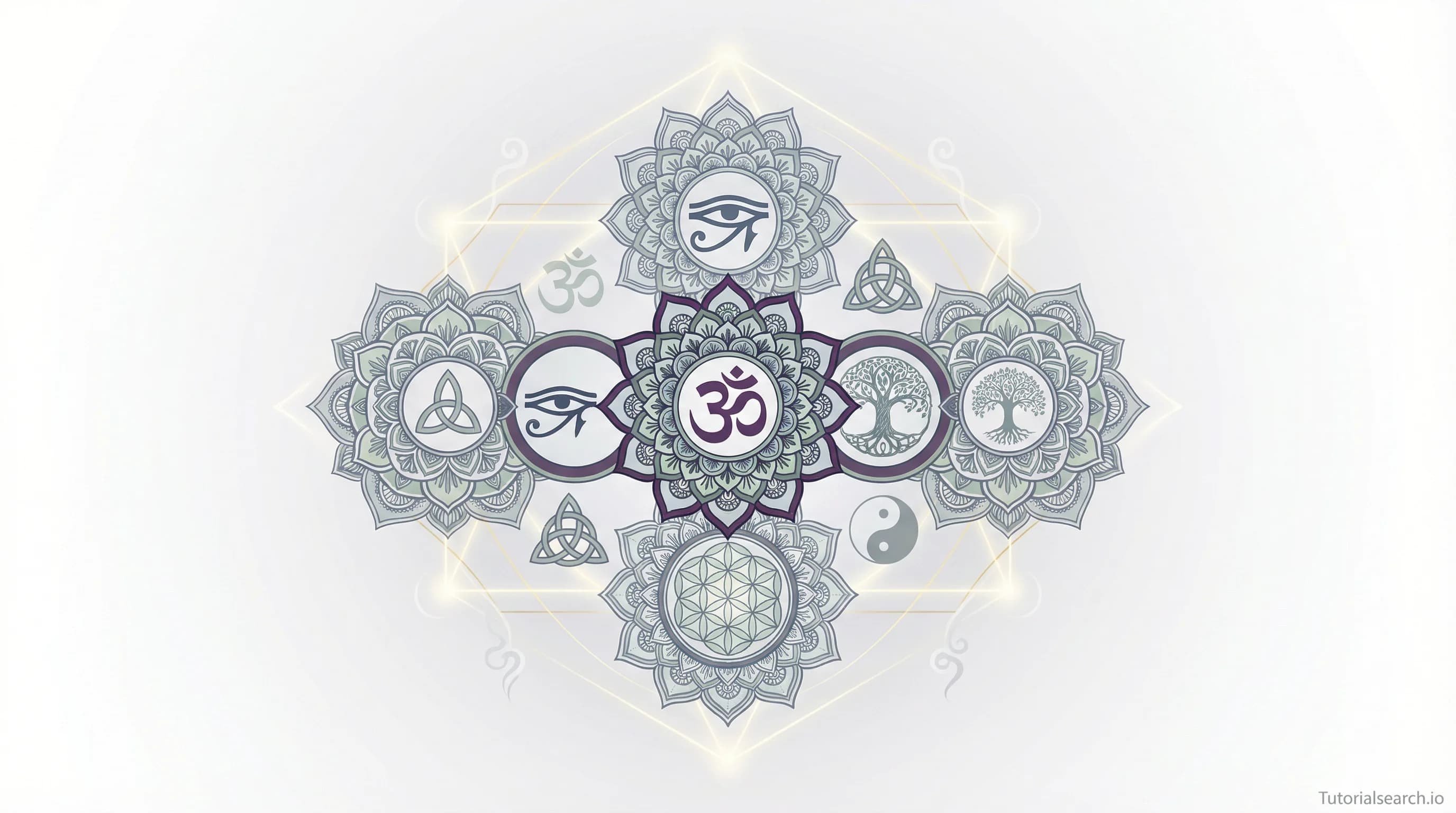
The Spiritual Symbolism Guide I Wish Existed
Spiritual symbolism is one of the oldest forms of human communication. This guide covers the best courses, free sites, YouTube channels, books, and communities to help you learn to read symbols across cultures and traditions.
Hire the developers behind TutorialSearch.io
We built this site — full-stack web apps, AI integration & automation. Tell us what you need and we'll build yours.
Spiritual symbolism is one of the oldest forms of human language — tens of thousands of years older than writing itself.
The cave paintings at Lascaux, France, are roughly 17,000 years old. The red ochre symbols found in South Africa's Blombos Cave are older still — nearly 75,000 years. Before humans could write a word, they drew symbols. Before we built temples, we carved meaning into stone.
That's the fact that caught me off guard when I first started studying this. Not the idea that symbols are decorative. The recognition that symbols are how humans have always processed what can't easily be said out loud — grief, awe, the sacred, the unknowable.
If you've found yourself drawn to spiritual symbolism — through dreams, art, meditation, or simple curiosity — you're continuing a tradition older than civilization. This guide collects the best courses, free resources, books, and communities to help you understand it.
Key Takeaways
- Spiritual symbolism spans every culture — learning it builds real cultural literacy and deepens your inner life.
- The best spiritual symbolism courses teach you to interpret symbols, not just memorize a list of meanings.
- Free resources like Universe of Symbolism and Whats-Your-Sign.com cover thousands of symbols at no cost.
- Sacred geometry is a distinct branch of spiritual symbolism worth exploring if you're visually inclined.
- You'll understand spiritual symbolism faster by combining a structured course with personal journal work.
In This Article
- Starting Your Spiritual Symbolism Journey
- Which Type of Spiritual Symbolism Calls to You?
- The Spiritual Symbolism Courses That Actually Teach You to See
- Free Spiritual Symbolism Sites Worth Bookmarking
- Spiritual Symbolism on YouTube: Channels That Go Deeper
- Spiritual Symbolism Books Worth the Time
- Sacred Geometry: The Visual Language of Spiritual Symbolism
- Where Spiritual Symbolism Seekers Gather Online
- Related Traditions Worth Exploring
- Frequently Asked Questions About Spiritual Symbolism
Starting Your Spiritual Symbolism Journey
Most people arrive here in one of two ways. They encounter a symbol they can't shake — a recurring image in dreams, a pattern in a piece of art, a mark on jewelry — and want to understand what it means. Or they've been studying a spiritual tradition and realize the symbols are doing half the heavy lifting.
Both starting points are valid. But they lead to different learning paths.
If you're drawn to a specific tradition's symbols — say, Norse runes or Hindu yantras — go into that tradition directly. You'll understand the symbols better with cultural context around them.
If you want a broader grasp of how symbolism works across cultures, start with a general course before narrowing down. You'll see how the same images — spirals, crosses, trees, serpents — appear independently across distant cultures. That's not coincidence. It tells you something deep about how the human mind creates meaning.
One distinction worth knowing upfront: spiritual symbolism is not the same as iconography. Iconography depicts figures (the Virgin Mary, the Buddha). Symbolism uses objects, shapes, and images to represent abstract concepts — enlightenment, protection, cycles of death and rebirth. The distinction shapes what you study and how.
You can browse all 254 spiritual symbolism courses on TutorialSearch.io to get a feel for the full range of what's available.
Which Type of Spiritual Symbolism Calls to You?
Before diving into courses, a quick orientation. Spiritual symbolism covers a lot of ground. Here's a plain-language map:
| Your Interest | What to Explore | Where to Start |
|---|---|---|
| Shapes, patterns, geometry | Sacred geometry, mandalas, yantras | Sacred Geometry & Spiritual Symbols 101 |
| Dreams and the unconscious | Jungian archetypes, dream symbols | The Book of Symbols (book) + Whats-Your-Sign.com |
| A specific tradition (Christian, Buddhist, etc.) | That tradition's iconographic symbols | The Biblical & Mystical Meanings of the Tarot; Ancient Christian Art |
| Nature, animals, plants | Totem symbolism, animist traditions | Forest Magic (course); Universe of Symbolism (site) |
| Intuition and psychic work | Personal symbol dictionaries, colour symbolism | Oracle Colours course; The Spiritual Symbols Workbook |
| Cultural anthropology | Cross-cultural comparative symbolism | Cultural Studies courses; Cirlot's Dictionary of Symbols |
Pick the row that resonates and use it as your first thread to pull.
The Spiritual Symbolism Courses That Actually Teach You to See
Not all courses on this topic deliver the same thing. Some are encyclopedias — they list symbols and definitions. That's useful as reference, but it doesn't teach you how to interpret. The best courses train your perception. Here are the ones worth your time.
1. Sacred Geometry & Spiritual Symbols 101 (Udemy) [Editors' Choice]
Instructor Tammy Brugger takes a dual approach: she covers the geometry behind sacred symbols alongside their spiritual meanings. This is actually the smarter way to teach it. When you understand why a spiral looks the way it does — its mathematical properties — the spiritual meaning sticks in a different way. Rated 4.2 with nearly 200 students, this is a solid first course for anyone approaching spiritual symbolism visually.
What it covers:
- The Flower of Life, Metatron's Cube, the Vesica Piscis
- How sacred geometry shapes appear in nature and architecture
- Using symbols in meditation and personal practice
2. The Biblical & Mystical Meanings of the Tarot (Udemy) [Editors' Choice]
This one surprises people. Addam — who holds an M.A. in Theology — teaches Tarot not as a fortune-telling tool but as a symbolic system rooted in biblical tradition and mystical philosophy. It's rated a perfect 5.0. If you come from a Christian or Jewish background and feel uncertain about Tarot's spiritual legitimacy, this course directly addresses that tension. It's honest scholarship, not mystical fluff.
3. Oracle Colours Pt1: Read with Colour Intuition (Udemy)
Vivienne McAlister-Geertz teaches something most symbolism courses skip: how colours themselves function as symbols. The chromatic language of spiritual traditions is everywhere — saffron robes, white mourning clothes, red doors in Chinese culture. This course opens your eyes to a layer of meaning you've been walking past your whole life. Rated 4.9. Intermediate level, so some prior exposure to symbolism helps.
4. Forest Magic: The Healing Power of Trees & Woodland Spirits (Udemy)
Jeanie Marie Mossa covers the symbolic world of trees across European and animist traditions — the World Tree (Yggdrasil), the oak's associations with strength, the elder tree's connection to fae folklore. Rated 4.7 with 177 students. A lovely focused course if nature symbolism is your entry point. Beginners are welcome.
5. How to Make Spiritual Healing Tools & Vodou Spiritual Crafts (Udemy)
This one takes a different angle: learning symbolism through making. Sufani Garza teaches Vodou sacred crafts with real attention to what each element means — not just what to do, but why each material, colour, and shape carries specific significance. Rated 4.8. If you learn better with your hands than your eyes, this hands-on approach will stick.
6. When The Saints Go Marching In (Udemy)
Rev. Deandra Averhart explores the symbolic role of saints in Christian and syncretic traditions — what their iconography communicates, how their images function in devotional practice, and what they reveal about the cultures that venerated them. Rated 4.8. A strong pick for anyone drawn to Catholic, Orthodox, or syncretic religious symbolism.
7. Mala Making & Art Meditation Workshop (Udemy)
Suzi Maldonado covers the symbolism embedded in mala beads — the significance of 108 beads in Hindu and Buddhist cosmology, the meaning of different materials (rudraksha seeds vs. crystal), and how to work with symbols intentionally in meditation. Rated 4.6. Beginner-friendly and taught through creative practice.
8. How To Read Tarot: An Intuitive Tarot Reading Masterclass (Udemy)
Rated 4.8 with strong enrollment, this course takes a more intuitive approach to Tarot's symbolic system than the theological angle of course #2. The two actually pair well: start with the Addam course to understand why these images are what they are, then use this one to develop fluency in reading them in practice.
9. Feng Shui Remediation Secrets (Udemy)
Qiong Wang teaches how spatial arrangement and directional symbolism work in Feng Shui — a tradition where every position, colour, and shape in a space carries specific energetic meaning. Rated 4.7. A good example of how spiritual symbolism moves from abstract interpretation into lived environment design.
10. Astral Travel Passport Program (Udemy)
Devatma Saraswati teaches yoga nidra and out-of-body experience practices with significant attention to the symbols and imagery that arise in altered states. Rated 4.6 with 477 students. If dream symbolism and consciousness exploration are your focus, this adds a practical dimension to the symbolic vocabulary you're building.
A note on learning approach: Everyone recommends starting with the symbols of your own cultural background. That's sensible. But there's real value in starting outside your tradition too. You see symbols more clearly when you're not already inside a belief system, because you can ask "why does this shape mean that?" without inherited assumptions. Don't be afraid to begin somewhere unfamiliar.
Free Spiritual Symbolism Sites Worth Bookmarking
You don't need to spend money to build a solid foundation in spiritual symbolism. These sites cover thousands of symbols across cultures and are genuinely well-done.
Whats-Your-Sign.com is probably the most comprehensive free reference out there. It covers animal symbolism, cultural symbols, dream interpretation, and seasonal symbolism — all freely accessible. The articles explain context and meaning, not just definitions. Good for ongoing reference as you study.
Universe of Symbolism focuses on hidden messages in nature, animals, and everyday life. It takes a more intuitive, spirit-guide-oriented approach than the academic sites. If you're drawn to totemic symbolism — understanding what it means when a specific animal keeps appearing in your life — this is a useful resource.
Mindvalley's Spiritual Symbols Guide covers 21 core symbols — lotus, Hamsa, Tree of Life, Yin-Yang, Mandala, and more — with clear visual context. Good starting overview for complete beginners.
Healing Sounds' Spiritual Awakening Symbols Guide focuses specifically on symbols associated with awakening experiences. Useful if you've had a major spiritual experience and are trying to understand the recurring images that came with it.
Centre of Excellence — Spiritual Symbols and Their Meanings is a clean, well-organized overview. Good for someone completely new to the topic.
Spiritual Meaning Portal covers angel numbers, dream symbols, and cultural symbols alongside traditional spiritual symbolism. It was updated as recently as early 2026 and is a living reference — which matters in a field where interpretations keep evolving.
BahaiTeachings.org on Symbolic Reading offers a theological angle — how the Bahai tradition interprets nature and scripture symbolically. Even if you're not Bahai, it's a sharp example of how a living tradition actively uses symbolic interpretation as a spiritual practice.
Spiritual Symbolism on YouTube: Channels That Go Deeper
Hire the developers behind TutorialSearch.io
We built this site — full-stack web apps, AI integration & automation. Tell us what you need and we'll build yours.
YouTube has genuinely excellent content on spiritual symbolism — and a lot of noise. Here are the channels worth your time.
Next Level Soul (YouTube) [Editors' Choice]
Alex Ferrari's channel sits at 1.1 million subscribers and covers near-death experiences, quantum consciousness, and symbolic meaning from interviews with researchers, authors, and practitioners. It's not a "symbols 101" channel — it goes much deeper into why certain images, archetypes, and symbols seem to arise universally in human experience. If you want to understand the theory behind spiritual symbolism rather than just the catalog, this channel will change how you think about it.
in5d (YouTube)
At 147K subscribers, in5d covers spiritual awakening, meditation, and metaphysical symbolism. More esoteric in approach than Next Level Soul, but if you're already exploring the spiritual field, you'll find the content resonant. They address the intersection of symbols with consciousness and energy work directly.
Both channels work best as complements to course work — watch them after you've built some foundational vocabulary, so the ideas land in context.
Spiritual Symbolism Books Worth the Time
If you're going to read seriously about spiritual symbolism, these four books cover different angles well.
The Book of Symbols: Reflections on Archetypal Images — Ami Ronnberg & Kathleen Martin (Editors)
This is the one book to recommend to anyone studying spiritual symbolism with real intention. It contains 800+ full-color images, essays on hundreds of symbols from a Jungian-archetypal perspective. It reads beautifully for something that is, at its core, a reference work. Fair warning: it's expensive. But if you want one permanent resource, this is the one.
Signs, Symbols & Omens — Raymond Buckland
Over 800 symbols from magical traditions, indigenous cultures, and world religions in one accessible illustrated guide. Buckland writes clearly and without excessive mystical language. Good practical reference for ongoing use.
The Spiritual Symbols Workbook — Rev. Joanna Bartlett [Editors' Choice]
This one is different from the others. It's interactive. Bartlett's premise is that your personal associations with symbols are as important as traditional meanings. The workbook covers over 1,500 symbols organized by category, with space to write your own definitions and meditation prompts to develop intuitive associations. If you journal or learn by doing, this book pairs brilliantly with any of the courses above.
A Dictionary of Symbols — Juan Eduardo Cirlot
The academic classic. Cirlot was a poet and art critic, and his dictionary draws on Jungian psychology, alchemy, mythology, and art history. It's denser than Buckland's book, but the depth of analysis is unmatched. Check your local library first — it's widely available through university library systems, and you may not need to buy it.
Sacred Geometry: The Visual Language of Spiritual Symbolism
There's a thread running through almost all spiritual symbolism that gets its own category because it's so visually striking: sacred geometry — the study of geometric patterns believed to underlie the structure of reality.
The Flower of Life, the Sri Yantra, the Vesica Piscis, Metatron's Cube — these shapes appear in Egyptian temples, Islamic architecture, medieval cathedrals, and Hindu mandalas. They didn't travel from one culture to another. They appear independently because certain geometric relationships keep showing up in nature, and humans have always noticed them.
GeometryCode.com's Sacred Geometry Tutorial by Bruce Rawles is a free, comprehensive introductory text. Rawles covers the mathematics and the symbolism side-by-side, which is the right approach.
In2Infinity's Ultimate Guide to Sacred Geometry goes deeper into mathematical relationships with visual, interactive content. Good for visual learners.
Gaia's 7 Sacred Geometry Symbols covers the seven core symbols with clear explanations of what they represent and where they appear across cultures. Good free overview to orient yourself quickly.
If you want structured course coverage, the Sacred Geometry & Spiritual Symbols 101 course covers this ground in a guided format that takes you through the relationships step-by-step.
Where Spiritual Symbolism Seekers Gather Online
Learning spiritual symbolism is more interesting in community. Other people's interpretations challenge and expand your own.
All Things Spiritual Discord has over 6,000 members and covers spirituality, witchcraft, dreams, and symbols. If you have a symbol you're trying to interpret — especially from a recurring dream or vision — this community is useful because you get multiple cultural perspectives in one place.
Reddit's r/spirituality, r/occult, and r/Jung are active forums where symbol interpretation comes up constantly. The Jung subreddit is particularly good for archetypal symbolism — people bring dreams and images and analyze them with real depth.
The Spiritual Naturalist Society publishes essays on the philosophy of symbolism for readers who want an intellectually rigorous, secular approach to spiritual experience. Good reading alongside the more practice-focused resources.
Related Traditions Worth Exploring
Spiritual symbolism doesn't exist in isolation. Once you build a foundation, these related areas open up naturally:
- Mythology Exploration — Mythology is the narrative form of spiritual symbolism. The same figures and images appear as myths tell the stories behind the symbols. 413 courses available.
- Cultural Studies — Understanding where symbols come from means understanding the cultures that created them. 315 courses available.
- Spiritual Practices — Where symbolism becomes lived practice: ritual, ceremony, prayer, meditation. 272 courses available.
- Spiritual Insights — Deeper philosophical and mystical perspectives on spirituality. 238 courses available.
- Cultural Expression — Art, music, and creative forms that carry symbolic meaning. 227 courses available.
- Spiritual Development — If symbolism is the map, spiritual development is the journey. 216 courses available.
- Spiritual Exploration — A broader look at contemplative and esoteric traditions. 170 courses available.
- Philosophical Thought — The philosophical roots of symbolic thinking, from Plato's allegory of the cave to Jungian archetypes. 139 courses available.
Frequently Asked Questions About Spiritual Symbolism
How long does it take to learn spiritual symbolism?
There's no fixed endpoint, but you can develop working fluency in 2-3 months of regular study. Most introductory courses take 4-8 hours to complete. After that, you'll spend weeks or months deepening your knowledge through reading and practice. Symbolic interpretation is a skill that compounds — the more symbols you recognize, the faster you pick up new ones.
Do I need a religious background to study spiritual symbolism?
No. Many excellent students of spiritual symbolism come from outside the traditions they study, because they bring fresh eyes. You don't need to believe in a tradition to understand its symbolic language. That said, if you do belong to a tradition, studying its symbols deeply tends to enrich your practice in unexpected ways. You can search all spiritual symbolism courses regardless of your starting point.
Can I use spiritual symbolism in my art or creative work?
Yes — and many artists do exactly this. Understanding what a lotus, a serpent, or a labyrinth means across traditions gives you a much richer visual vocabulary than working with aesthetic shapes alone. The Mala Making & Art Meditation Workshop is specifically designed for this overlap between symbolic meaning and creative practice.
How does spiritual symbolism differ across cultures?
The same core images — circles, crosses, spirals, trees, serpents — appear across nearly every culture, but their specific meanings shift. The serpent in Genesis is evil. In Kundalini yoga, it's awakening energy. In Aztec tradition, it's Quetzalcoatl, a god of creation. Learning these differences is part of what makes the field so rich. Cirlot's Dictionary of Symbols and Buckland's Signs, Symbols & Omens are both excellent references for cross-cultural comparison.
Is spiritual symbolism the same as dream interpretation?
They overlap but aren't identical. Dream interpretation draws heavily on symbolic meaning but focuses on your personal associations with images, while spiritual symbolism deals more with collective or traditional meanings. Carl Jung's concept of the collective unconscious is the bridge between the two. His work is the theoretical foundation behind much of modern symbolic interpretation — the Philosophical Thought browse page covers Jungian approaches in more depth.
What's the difference between a symbol and a sign?
A sign has a fixed, agreed-upon meaning — a stop sign means stop. A symbol carries layers of meaning that shift with context, culture, and the individual interpreting it. The cross means different things in Christianity, Celtic tradition, and mathematical notation. That layering is what makes spiritual symbolism a lifelong study rather than a lookup table.
Wherever you're starting from — a dream that won't leave you alone, a symbol spotted in a temple, a meditation practice that keeps surfacing the same images — spiritual symbolism gives you a language for what you're already experiencing.
Start with one course or one book. Build a small journal of the symbols that keep appearing in your life. Then let the field expand as your curiosity pulls it. The tradition is 75,000 years old. You have time.