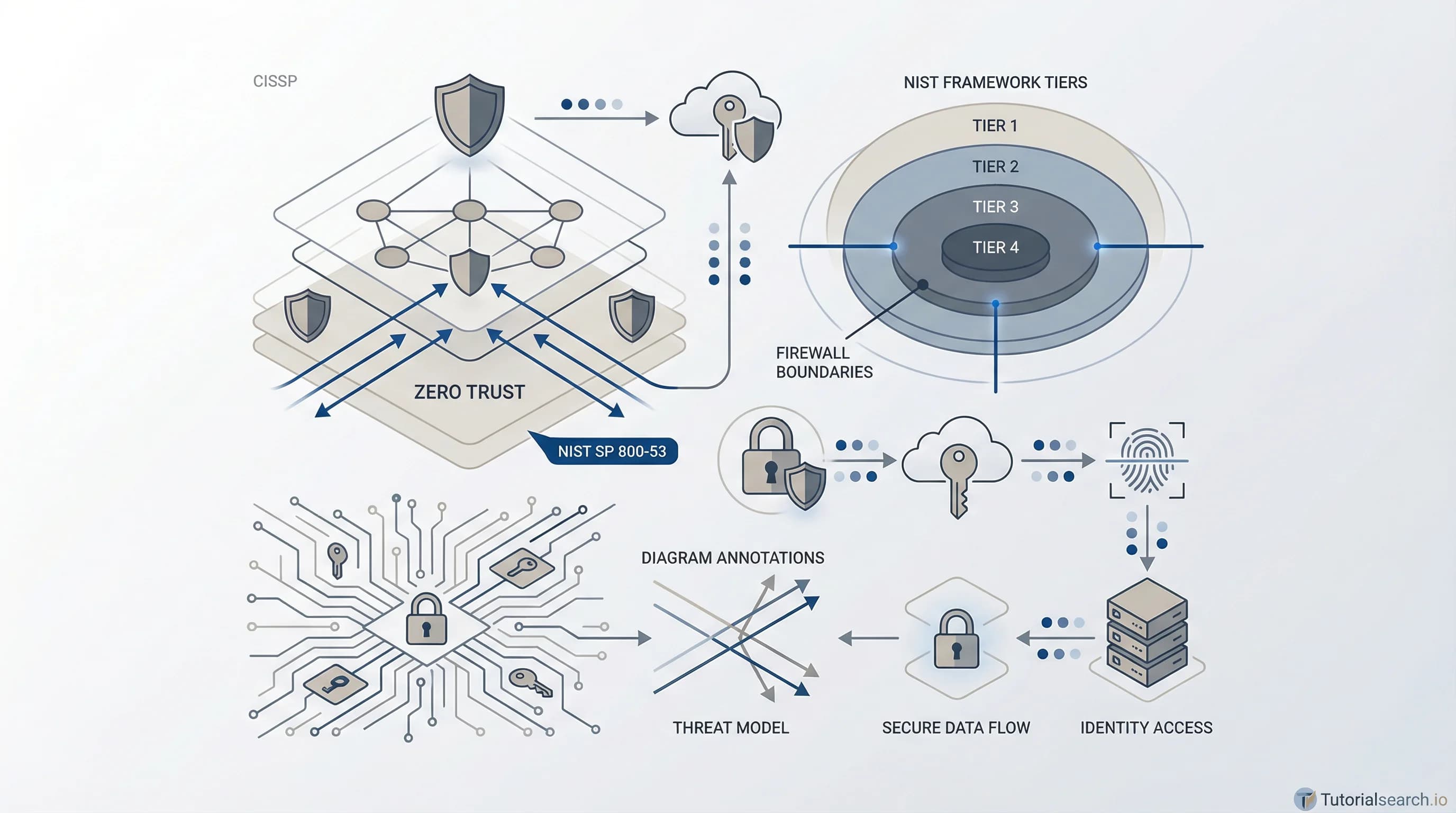
The Security Architecture Path Most People Miss
Most people start learning security architecture by chasing certifications. That's the wrong move. Here's a practical path covering the best courses, frameworks, free resources, and books to build real security architecture skills.
Need a web app built? Hire the team behind TutorialSearch.io
We ship fast, production-grade full-stack apps (Next.js, React, edge infra) — the same stack that powers this site.
Security architecture is one of the most sought-after skills in cybersecurity right now — and one of the hardest to learn well. The 259+ courses in this topic on TutorialSearch.io are proof of how many professionals are trying to crack this area. Most beginners think the path starts with certifications. It doesn't. Here's how I'd actually approach learning security architecture from scratch.
Everyone tells you to "get CISSP first." But CISSP is a mile wide and an inch deep. You can pass it knowing nothing about how to actually design a secure system. Real security architecture is a different skill — it's about making design decisions that hold up under real attack conditions. Certifications can come after. Understanding should come first.
Key Takeaways
- Security architecture means designing systems so security is built in, not bolted on later.
- The field splits into enterprise, cloud, application, and network security architecture — pick your focus before diving into courses.
- Free resources like NIST CSF 2.0, the Coursera fundamentals course, and GitHub's cybersecurity-architecture repo are solid starting points.
- The best security architecture courses focus on threat modeling and real design decisions, not just exam prep.
- Joining communities like r/cybersecurity and attending Black Hat sessions on YouTube will accelerate your learning faster than any single course.
In This Article
- Choosing Your Security Architecture Path
- Security Architecture Courses Worth Serious Consideration
- The Security Architecture Frameworks That Actually Matter
- Free Security Architecture Resources That Deliver
- Security Architecture YouTube Channels That Teach the Real Stuff
- Security Architecture GitHub Repos Worth Bookmarking
- Security Architecture Books for Going Deeper
- Related Security Architecture Skills to Explore
- Frequently Asked Questions About Security Architecture
Choosing Your Security Architecture Path
Security architecture isn't one job — it's several. Before you spend money on courses, figure out which direction fits your goals.
Here's a quick breakdown:
| Area | What You're Doing | Best For |
|---|---|---|
| Enterprise Security Architecture | High-level design. You define frameworks, risk strategy, and how security fits the whole org. | CISOs-in-training, GRC pros, consultants |
| Cloud Security Architecture | Securing AWS, Azure, GCP infrastructure. Lots of demand, growing fast. | DevOps-adjacent folks, cloud engineers |
| Application/Software Security Architecture | Secure design patterns, threat modeling, SDLC integration. | Developers moving into security |
| Network Security Architecture | Firewalls, segmentation, zero trust networking. | Network engineers, SOC analysts |
Most courses mix these together — and that's fine for building a foundation. But knowing which area pulls you most will help you choose certifications later and target the right job postings.
If you're not sure where to start, browse the security architecture courses on TutorialSearch.io to see what topics resonate with you. There are over 259 courses in this category, so it's worth filtering by what sounds interesting rather than what sounds important.
Security Architecture Courses Worth Serious Consideration
Good security architecture courses do one thing well: they make you think about design decisions, not just memorize concepts. Here's what I'd actually recommend.
For Beginners: Start With the Big Picture
Security Architecture and Design: The Big Picture (Pluralsight) — Christopher Rees built this as a genuine entry point. It covers security models (Biba, Bell-LaPadula — don't worry about the names yet), security frameworks, and why architecture matters before any technical deep-dive. Rating: 4.7. This is the course I'd hand someone on day one.
Cyber Security Architecture Fundamentals (Udemy) — Alexander Oni teaches this to 6,400+ students. He explains concepts in plain language and builds toward real design decisions. Good for people coming from non-security backgrounds.
For Intermediate Learners: Add Depth and Practice
- Security Architecture & Review with Threat Modeling — Hands On (Udemy) [Editors' Choice]
This is the course I'd pick if I could only choose one. Raghu covers the full cycle — not just how to design architectures, but how to review them and find weaknesses using threat modeling. The hands-on labs make the difference. Most security architecture courses stay theoretical. This one makes you do things. Rating: 4.24, over 4,000 students enrolled.
Threat modeling (the process of asking "how could an attacker break this?") is one of the most under-taught skills in security. Learning it early will change how you think about every system you touch.
- Practical Security Architecture — Hands On! (Udemy) [Editors' Choice]
Alexsandro Souza designed this as a practitioner's course, not an exam-prep tool. You'll work through real scenarios covering defense-in-depth, Zero Trust implementation, and cloud security design. Rating: 4.64, which is impressive for a course this hands-on. Highly recommended for anyone who learns by doing.
- Cybersecurity Architecture & Design Masterclass (Udemy) — This newer course aligns everything with NIST, ISO 27001, SABSA, and Zero Trust. What sets it apart is the AI-generated architecture diagrams and scenario walkthroughs that reduce cognitive load while explaining complex concepts. Good for visual learners.
For CISSP Candidates and Advanced Learners
- Security Architecture and Engineering: Build Defenses for CISSP® (Pluralsight) [Editors' Choice]
Kevin Henry has the highest-rated course in this space — a 4.9 rating on Pluralsight. This is aimed at CISSP Domain 3 (Security Architecture and Engineering), but honestly it works as a standalone architecture course even if you're not pursuing the cert. Henry explains the why behind security models and design principles clearly. This is the one I'd use after building a foundation with the Big Picture course.
- Security Architecture and Engineering: Understand the Design Principles for CISSP® (Pluralsight) — Kevin Henry's companion course. Rated 4.7. Together these two Pluralsight courses form a thorough CISSP prep path focused specifically on architecture and engineering.
For Cloud-Focused Learners
- Cloud Security Architecture — An Introduction (Udemy) [Editors' Choice]
Aksel Bruun's course is free and has nearly 9,000 students enrolled. That combination is rare. It covers cloud security design concepts well enough to give you a solid foundation before moving to paid advanced training. If you're cloud-focused and on a tight budget, start here.
You can find all of these and more through the cybersecurity category on TutorialSearch.io.
The Security Architecture Frameworks That Actually Matter
People new to security architecture often drown in framework acronyms. Here's a plain-language breakdown of the ones worth understanding.
NIST Cybersecurity Framework (CSF) 2.0 is the practical starting point for most professionals. Released in February 2024, version 2.0 added "Govern" as a sixth core function (alongside Identify, Protect, Detect, Respond, and Recover). This reflects the reality that security is now a business governance issue, not just a technical one. The official NIST CSF page is free to access and surprisingly readable.
SABSA (Sherwood Applied Business Security Architecture) is the framework most serious enterprise security architects eventually encounter. It's business-driven — you start with business requirements and derive security requirements from there. The SABSA Institute offers free introductory materials. Note that SABSA certification courses are expensive, so explore the free resources first to see if it's the right direction for you.
Zero Trust isn't really a framework — it's a philosophy. The core idea: never assume trust based on network location. Verify every access request. Microsoft and Google have both published detailed Zero Trust architecture guides, and Coursera offers a free introductory course on information system security architecture that covers Zero Trust fundamentals alongside SABSA.
A word of warning about framework overload: you don't need to master all three before taking action. Pick NIST CSF as your anchor. Learn just enough about the others to speak intelligently in job interviews and design reviews. Go deep when a specific project demands it.
Free Security Architecture Resources That Deliver
Need a web app built? Hire the team behind TutorialSearch.io
We ship fast, production-grade full-stack apps (Next.js, React, edge infra) — the same stack that powers this site.
Not everything worth learning costs money. Here are the free resources I'd actually use.
Coursera — Fundamentals of Information System Security Architecture: Free to audit. This course covers SABSA, Zero Trust, and defense-in-depth in a structured, university-style format. It's one of the better free introductions to the topic.
NIST Special Publication 800-53: This is the comprehensive control catalog that security architects reference constantly. It's dense, but the NIST RMF resources page helps you navigate it.
SANS SEC530 preview materials: SANS's Defensible Security Architecture course is expensive to take in full, but SANS publishes free blog posts and white papers from the same instructors. Worth following their research team.
No More Ransom / MITRE ATT&CK: Both free. MITRE ATT&CK (attack.mitre.org) is the gold standard for understanding how real attackers behave, which informs better architectural design. Every security architect should bookmark this.
InfoSec Reference Architecture (Open Source): The nocomplexity.com Security Architecture guide is a free, open-source reference that walks through security frameworks in plain language.
If you're interested in the adjacent skill of cloud security, many of the same free resources apply — cloud providers like AWS and Azure also publish comprehensive free security architecture whitepapers.
Security Architecture YouTube Channels That Teach the Real Stuff
YouTube is genuinely underrated for learning security architecture concepts. Here's where I'd spend time.
Black Hat (youtube.com/c/BlackHatOfficialYT) — Recordings of security research presented at Black Hat conferences. This is where researchers share real architectural vulnerabilities and attack patterns. Watching talks from the last two to three years gives you a sense of what threat modeling needs to account for in practice. Essential viewing.
SANS Institute (YouTube) — SANS instructors regularly publish talks and short courses. The content aligns well with enterprise security architecture, including presentations on Zero Trust and NIST frameworks.
Computerphile — The "Cybersecurity & Cryptography" playlist (61 videos) covers foundational concepts clearly. Not architecture-specific, but strong on cryptography, authentication, and network security — all things that feed into architectural decisions.
NetworkChuck — More practical and energetic. His videos on network security fundamentals, firewalls, and VPNs are genuinely good for building the networking foundation that cloud and network security architecture require.
If you're also interested in ethical hacking, many of the same YouTube creators cover offensive and defensive concepts that directly inform security design.
Security Architecture GitHub Repos Worth Bookmarking
paulveillard/cybersecurity-architecture — The most focused resource on this list. It's an ongoing, curated collection of software and systems architecture resources specifically for cybersecurity — including AWS and Azure cloud design patterns, security architecture frameworks, and design principles. Star this one.
sbilly/awesome-security — Broader in scope but well-organized. Covers architecture, IAM (identity and access management), cryptography, and secure configuration. A good reference list to come back to.
jassics/awesome-cybersecurity-learning-resources — All-in-one hub for learning cybersecurity. Includes YouTube, books, labs, certifications, and articles. More useful as a navigation tool than a deep resource.
paragonie/awesome-appsec — Application security focused. If software security architecture is your path, this is a must-bookmark. Covers secure coding resources, threat modeling tools, and architecture patterns for software systems.
Honestly, the paulveillard/cybersecurity-architecture repo is where I'd start. The others expand from there.
Security Architecture Books for Going Deeper
Practical Cybersecurity Architecture by Ed Moyle and Diana Kelley (O'Reilly) — This is the book that fills the gap between theory and real-world design. It walks you through the process of creating and implementing security architectures step by step. Available on O'Reilly Online Learning, which has a free trial.
Zero Trust Security: An Enterprise Guide by Jason Garbis — The most practical guide to Zero Trust implementation available. If cloud security architecture is your direction, read this before touching a cloud provider's architecture documentation.
Cloud Security Handbook by Eyal Estrin — Covers cloud security architecture across public and private clouds. Good complement to the Zero Trust book for cloud-focused practitioners.
For those preparing for the CISSP exam specifically, the ISC2 Official CISSP Study Guide remains the standard reference — particularly Domain 3 (Security Architecture and Engineering). Pair it with Kevin Henry's Pluralsight courses for the best exam preparation.
One book I'd skip for beginners: anything trying to cover "all of cybersecurity" in one volume. The field is too large. Better to go deep on architecture specifically — your chosen area will thank you.
Related Security Architecture Skills to Explore
Security architecture doesn't exist in isolation. These related skills pair naturally with it and appear regularly in job descriptions for security architect roles:
- Security Certification — CISSP, CISM, and CISSP-ISSAP are the most relevant credentials for enterprise security architects. Over 1,063 courses available.
- Cloud Security — Cloud-specific architecture is its own specialization with 982 courses. If you're heading into cloud security architecture, this is your next deep-dive.
- Ethical Hacking — Understanding how attackers think is core to architectural decision-making. 935 courses covering offensive techniques that directly inform defensive design.
- Network Security — Foundational for network security architects. 566 courses.
- Security Management — The governance side of security architecture. How you communicate design decisions upward in an organization. 713 courses.
- Security Fundamentals — If you're new to cybersecurity, build this foundation first before tackling architecture. 527 courses.
- Data Protection — Data security is a core component of any enterprise security architecture. 495 courses.
- InfoSec Certification — Broader certification landscape if you want options beyond CISSP. 487 courses.
Frequently Asked Questions About Security Architecture
How long does it take to learn security architecture?
With consistent study, you can build a solid foundation in 6 to 12 months. That means understanding frameworks like NIST CSF, completing 2-3 focused courses, and working through hands-on labs. Getting to a job-ready level typically takes 1-3 years, depending on your starting point and whether you're working in adjacent security roles while learning.
Do I need a CISSP to learn security architecture?
No — and this is a common misconception worth pushing back on. CISSP certification is useful for enterprise roles, but the knowledge it tests doesn't require you to hold the cert first. Many security architects never pursue CISSP at all, particularly those focused on cloud or application security. Start learning the fundamentals and the design skills. Certifications can follow when they're required for the role you're targeting.
Can I get a job with security architecture skills?
Yes, and the demand is growing. Security architects are among the highest-paid roles in cybersecurity — average salaries run $130,000-$180,000+ in the US. The catch is that most positions require 5+ years of related experience. The realistic path is to build security engineering or consulting experience first, then move into architecture roles. Check the security architecture jobs via TutorialSearch.io for a sense of what employers are asking for.
What's the difference between a security architect and a security engineer?
Security architects design the blueprint — they define what controls go where, how systems should be structured, and what frameworks govern the organization. Security engineers build and maintain what the architects design. Both roles are important, and many people work as both early in their careers. If you enjoy solving design problems and communicating strategy to non-technical stakeholders, architecture is likely a better fit.
What is SABSA and do I need it?
SABSA stands for Sherwood Applied Business Security Architecture. It's a methodology for designing security architectures that start with business requirements rather than technical controls. It's popular in large enterprises and consulting firms. You don't need SABSA certification to work in security architecture, but understanding its business-driven approach will make you a better architect regardless of your certification path.
The path into security architecture doesn't require you to collect certifications first. It requires you to understand how secure systems are designed, why they fail, and how to make better decisions under real-world constraints. Start with the fundamentals, add threat modeling early, and let your specialization (cloud, enterprise, application, or network) guide what comes next.
The CISSP-ISSAP Masterclass is worth a look if you're already CISSP-certified and want to formalize your architecture specialization. For everyone else: pick a course from the structured learning section above and start building.