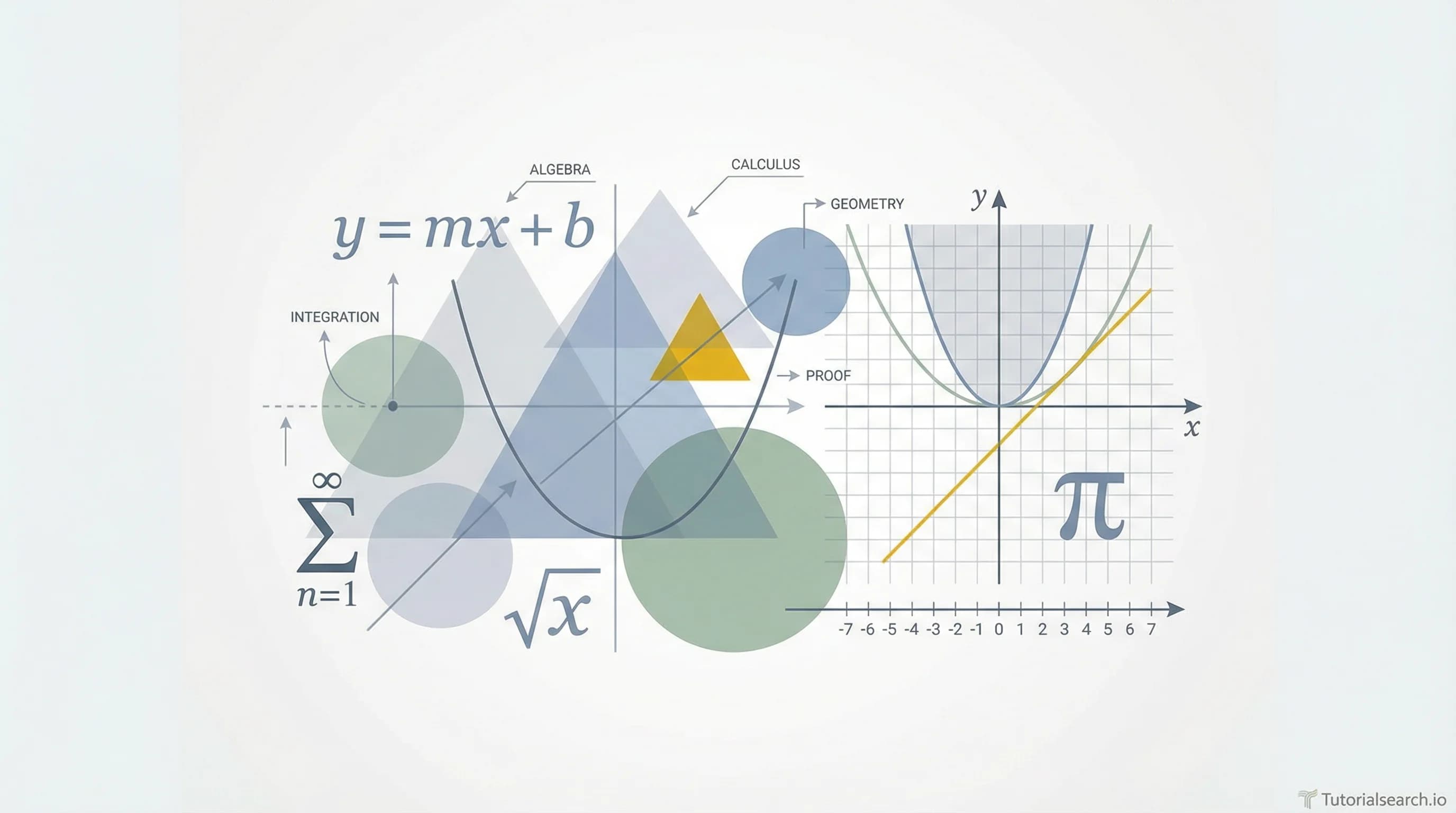
The Mathematics Fundamentals Roadmap (Free + Paid Resources)
Mathematics fundamentals are the invisible floor beneath every advanced topic — and most learners skip them. This is a complete roadmap with courses, free platforms, YouTube channels, and communities.
Hire the developers behind TutorialSearch.io
We built this site — full-stack web apps, AI integration & automation. Tell us what you need and we'll build yours.
Mathematics fundamentals are the invisible floor beneath every advanced topic — and most learners skip them, then wonder why everything uphill feels impossible.
The pattern is familiar. You decide to learn data science or engineering. You jump into a statistics or physics course. Halfway through, you hit a wall. You blame yourself or the subject. But the wall wasn't statistics or physics. It was algebra. Or fractions. Or a gap that should have been filled long before you took that first step up.
This guide is a complete roadmap through mathematics fundamentals — structured courses, free interactive platforms, YouTube channels that actually explain things, GitHub repos worth bookmarking, and communities where people help without judgment. You can search 353+ mathematics fundamentals courses on TutorialSearch.io to find additional options beyond what's covered here.
Key Takeaways
- Most mathematics fundamentals learners struggle not from lack of ability but from starting too advanced.
- The best mathematics fundamentals courses pair explanations with practice, not just video lectures.
- Khan Academy and Brilliant are the strongest free-to-start interactive platforms for math foundations.
- You can build a complete mathematics fundamentals study path using only free resources.
- Communities like r/learnmath and the Mathematics Discord provide real help when you get stuck.
In This Article
- Where Most Mathematics Fundamentals Learners Go Wrong
- Mathematics Fundamentals Courses Worth the Investment
- Build Your Mathematics Fundamentals With Free Tools
- Mathematics Fundamentals YouTube Channels That Actually Teach
- Mathematics Fundamentals GitHub Repos Worth Starring
- Mathematics Books to Deepen Your Foundation
- The Mathematics Fundamentals Communities Where People Actually Help
- Related Mathematics Skills to Explore Next
- Frequently Asked Questions About Mathematics Fundamentals
Where Most Mathematics Fundamentals Learners Go Wrong
The single biggest mistake is skipping ahead.
Someone decides they want to learn machine learning. They find a course that covers the math as a week-long module. They get through it — barely — and then spend the rest of the course feeling lost. The problem wasn't the machine learning material. Their algebra and linear algebra foundations had gaps. Those gaps compound fast.
This happens everywhere. Game developers hit walls in physics simulations because their trigonometry is shaky. Finance professionals struggle with financial models because their algebra isn't fluent. Programmers find computer science theory confusing because they never really worked through discrete math.
The fix isn't talent. It's sequencing.
Start with arithmetic — and actually start there, even if it feels too basic. Get comfortable with fractions, decimals, negative numbers, and percentages. Then build through pre-algebra into algebra. Then geometry. Then pre-calculus if your goals require it. Each layer has to be solid before the next one makes sense.
If you're unsure whether your foundations are solid, try a few Khan Academy pre-algebra quizzes right now. If anything trips you up, that's your real starting point — not somewhere further up the ladder.
Pick Your Path: Which Resources Fit Your Situation?
| Your Situation | Where to Start |
|---|---|
| High school student catching up | Khan Academy (free) + Fundamentals of Mathematics course |
| Adult learner returning to math | Brilliant.org + Practical Algebra book |
| STEM college prep | Precalculus 1: Basic Notions course + Professor Leonard (YouTube) |
| Completely free path only | Khan Academy + Open Textbook + awesome-math GitHub repo |
| 20–30 minutes per day | Brilliant's daily challenges + PatrickJMT videos |
Mathematics Fundamentals Courses Worth the Investment
You don't need to pay for everything — but a well-structured course covers ground faster than piecing things together from free sources. Here are the best paid options, plus one strong free course.
1. Fundamentals of Mathematics [Editors' Choice]
Fundamentals of Mathematics by Moein Ud Din (Udemy) has over 10,900 enrolled students and a 4.4-star rating. That's one of the largest student counts in this category. The course covers arithmetic, number theory, fractions, decimals, algebra basics, and problem-solving in a logical sequence where each section builds on the previous one.
What makes it worth recommending: the instructor explains the why behind each rule, not just the mechanical steps. Most math struggles trace back to learning procedures without understanding the reasoning. This course doesn't do that.
Topics covered:
- Arithmetic and number systems
- Fractions, decimals, and percentages
- Variables and basic algebraic operations
- Exponents and roots
- Problem-solving strategies
If you want a single course that takes you from scratch through a genuine foundation, this is the one.
2. Precalculus 1: Basic Notions [Editors' Choice]
Precalculus 1: Basic Notions has nearly 6,000 enrolled students and a 4.85 rating — one of the highest in this entire subject area. The instructor covers mathematical notation, number systems, equations, inequalities, and functions with real depth.
This course bridges high school and university-level math more explicitly than most. If you already have arithmetic down and want to move toward calculus or college-level courses, this is the course I'd pick first. It's thorough, methodical, and covers material that other courses rush past.
Everyone recommends just jumping into calculus when they feel "almost ready." Don't. Spend time here first. If your goal is to reach the calculus fundamentals track, this course is the right entry point.
3. IB Mathematics Fundamentals — Last Review Before Exams
IB Mathematics Fundamentals by Akbar Shahkaramov (Udemy) has a 4.4 rating and is built specifically for IB students preparing for exams. It's more focused and exam-oriented than a general fundamentals course. If you're an IB student crunched for time, this is more useful than a broader course. If you're not an IB student, the two options above are better fits.
4. Pre-Calculus Mathematics — Fundamentals of Functions
Pre-Calculus Mathematics — Fundamentals of Functions by Dániel Csíkos focuses on one of the most important and most under-taught concepts in mathematics: functions.
Understanding functions changes how everything else clicks. Once you see how a function maps inputs to outputs, algebra stops feeling like symbol shuffling and starts making structural sense. This course has 739 enrolled students and a 4.0 rating. Not flashy, but fills a genuine gap.
For those who want to develop their algebraic foundation alongside functions, the algebraic mastery topic on TutorialSearch.io has 107+ courses to explore.
5. Algebra Foundations Boot Camp (Free)
Algebra Foundations Boot Camp is free on Udemy, with 570 enrolled students. It covers the algebra basics — variables, equations, and polynomials — at an accessible level. The rating (3.8) is decent rather than excellent. But for a no-cost starting point that covers core algebra, it's worth trying before committing to a paid course.
Build Your Mathematics Fundamentals With Free Tools
Some of the best math resources in the world are free. Here are the ones that genuinely work.
Khan Academy [Editors' Choice]
Khan Academy is the most complete free math resource available. It covers everything from basic arithmetic through differential equations — all at no cost. Each concept gets a short video, worked examples, and interactive practice problems with immediate feedback.
What sets Khan Academy apart from random YouTube playlists is the mastery system. The platform tracks what you know and what you don't. If fractions keep tripping you up, it keeps presenting fraction problems until you've actually got it. That's closer to how real tutoring works than passive video watching.
The honest take: most people underuse Khan Academy. They watch the videos and skip the practice exercises. The exercises are where the actual learning happens. If you're using Khan Academy, do every practice set.
Brilliant.org
Brilliant takes a different approach. Instead of videos, it uses interactive problems that guide you to discover concepts yourself. Their Math Fundamentals track has 7 courses covering everything from pre-algebra through geometry and introductory probability.
The free tier gives you access to a few problems per day. The paid plan (~$15/month) unlocks everything. For learners who find traditional lectures dull, Brilliant often works when nothing else has — especially for visual and hands-on thinkers.
One honest note: Brilliant builds intuition well, but doesn't always provide enough repetition to cement skills. Use it alongside Khan Academy's practice exercises for best results. Think of Brilliant as the part that makes things interesting, and Khan Academy as the part that makes them stick.
Open Textbook: Fundamentals of Mathematics by Burzynski & Ellis
The Open Textbook Library's Fundamentals of Mathematics is a complete free textbook covering pre-algebra through introductory algebra. Each chapter ends with a proficiency exam so you can test yourself as you go.
If you learn better from reading than from watching videos, this textbook is one of the best free resources that exists for mathematics fundamentals. It's clear, well-organized, and doesn't assume any prior background beyond basic numeracy.
For learners who want to explore specifically the algebraic side of the foundations, the algebra essentials topic has 53+ courses focused on exactly that.
Mathematics Fundamentals YouTube Channels That Actually Teach
Hire the developers behind TutorialSearch.io
We built this site — full-stack web apps, AI integration & automation. Tell us what you need and we'll build yours.
These aren't channels that just cover math topics. They explain in ways that make things click.
Professor Leonard
Professor Leonard runs the most complete free math course sequence on YouTube. His playlists for pre-algebra, algebra, precalculus, and calculus are full university-lecture length — 40 minutes to over an hour per video — and structured like actual courses, not disconnected tips.
He's a community college professor, and it shows in a good way. He doesn't rush. He explains from multiple angles. He acknowledges the places where students commonly get confused. If you work through his pre-algebra and algebra playlists in sequence, you'll finish with a stronger foundation than many people who paid for in-person courses.
3Blue1Brown
3Blue1Brown doesn't teach procedures. He teaches understanding. His video series on mathematical intuition — the "Essence of Linear Algebra," "Essence of Calculus," and standalone videos on geometry and number theory — are the clearest visual explanations of mathematical ideas I've found anywhere.
Watch these alongside your primary course, not as a replacement. 3Blue1Brown is what turns "I can do the steps" into "I actually see why this works."
PatrickJMT
PatrickJMT has 58+ million views and is a community college math professor. His videos are short and specific — if you're stuck on one thing (simplifying radicals, factoring trinomials, solving linear inequalities), search "PatrickJMT [that specific topic]" and there's almost certainly a clear, no-nonsense video waiting. He's the best "I'm stuck on this one thing" resource in mathematics on YouTube.
Brian McLogan
Brian McLogan specializes in high school and early college mathematics. His strength is breaking down the exact spots where students get confused. He doesn't skip steps. If you're in pre-algebra through precalculus and need step-by-step walkthroughs, his channel is reliable.
Mathematics Fundamentals GitHub Repos Worth Starring
rossant/awesome-math ⭐ 12,700+
The rossant/awesome-math repository is the most comprehensive collection of free mathematics learning resources on GitHub. It organizes resources by topic — foundations, number theory, algebra, geometry, calculus, linear algebra, probability, and more. Almost every linked resource is free.
This repo works best as a reference after you've started learning. When you're done with the algebra basics and want curated resources to go deeper into geometry or move toward linear algebra, this is where to look. It's not a learning path — it's a well-organized library.
llSourcell/learn_math_fast
learn_math_fast by Siraj Raval is an opinionated curriculum for learning mathematics fast, with a specific focus on what you need for machine learning and data science. If that's your end goal, this repo gives you a clear sequence through the math that actually matters for that path, rather than a survey of everything.
HimoriK/modern-math-collection
modern-math-collection prioritizes modern resources over classic ones. Instead of pointing you to 40-year-old textbooks, it focuses on newer books, updated video courses, and current sites. Worth checking if you find the resources in other lists feel dated.
Mathematics Books to Deepen Your Foundation
Practical Algebra by Peter Selby and Steve Slavin [Editors' Choice]
Practical Algebra is the book I'd recommend to someone who says they're "bad at math" and has tried before and bounced off. It's designed specifically for self-study. Every concept is broken into small steps with checkpoints throughout. It covers fractions, the number system, polynomials, monomials, and algebraic fractions in plain, non-intimidating language.
The key difference from most algebra textbooks: it doesn't assume you remember anything from middle school. It checks your understanding continuously and adjusts the pacing accordingly. It never leaves you lost.
Algebra: Structure and Method, Book 1 by Richard G. Brown
A classic for a reason. This book is clear, logical, and covers algebra fundamentals using real-world applications. If you learn better from a traditional textbook structure than from videos or interactive platforms, Algebra: Structure and Method is a strong choice. It's widely available used for a few dollars.
Discovering the Art of Mathematics (Free)
The DAoM library includes 11 free inquiry-based mathematics books covering geometry, number theory, patterns, and mathematical thinking. They're written for self-learners and designed to build mathematical intuition rather than just mechanical skills. The geometry volume is especially good for visual thinkers who find algebra abstract.
If you want to build deep spatial reasoning alongside your core foundations, the mathematical geometry topic on TutorialSearch.io has 142+ courses dedicated to that area.
The Mathematics Fundamentals Communities Where People Actually Help
r/learnmath (Reddit)
r/learnmath is one of the most welcoming math communities online. It's specifically for learners — not for mathematicians to show off. You can post questions at any level, from "I don't understand fractions" to "I'm confused about limits," and get genuine answers from people who remember what it's like to be stuck. The community actively welcomes absolute beginners.
Mathematics Discord
The Mathematics Discord server has over 316,000 members and channels for every level, including dedicated beginner sections. It's the right place for live back-and-forth discussion when you're working through a problem and need to think out loud with someone. Unlike forums, conversations can happen in real time.
Mathematics Stack Exchange
Mathematics Stack Exchange is structured Q&A — more formal than Discord or Reddit. It skews toward undergraduate level and above, but well-formed beginner questions are welcomed. The real value is the archive: most mathematics fundamentals questions have already been answered thoroughly, often with multiple explanations from different angles.
r/math
r/math is broader than r/learnmath and less focused on homework help. It's good for discovering what's interesting and beautiful in mathematics beyond the fundamentals — which is actually a useful motivator when you're in the grind of drilling algebra.
Related Mathematics Skills to Explore Next
Once your mathematics fundamentals are solid, these adjacent areas are natural next steps:
- Math Foundations — 308+ courses that extend core concepts further, with more depth on number theory and proof-based thinking. A broader view of what you've already been building.
- Algebra Essentials — 53+ courses focused on algebraic thinking. A natural follow-up to arithmetic and pre-algebra.
- Algebraic Mastery — 107+ courses for those who want to push deeper into algebra before advancing to calculus.
- Mathematical Geometry — 142+ courses on geometry and spatial reasoning, which pair naturally with algebraic skills.
- Calculus Fundamentals — 105+ courses for when you're ready to move into derivatives and integrals.
- Linear Algebra — 51+ courses. If your destination is data science, machine learning, or engineering, linear algebra is the highest-value topic to reach after the fundamentals.
- Integral Calculus — 46+ courses for building on calculus basics with deeper integration skills.
- Differential Equations — 52+ courses for advanced STEM learners in physics, engineering, and applied math.
Frequently Asked Questions About Mathematics Fundamentals
How long does it take to learn mathematics fundamentals?
Most people can build a solid foundation in 3 to 6 months with consistent daily practice. That assumes 30 to 60 minutes per day working through a structured course plus exercises. If your goal is to reach pre-calculus, expect 4 to 8 months depending on your starting point. The Fundamentals of Mathematics course gives a good sense of the pacing and coverage involved.
Do I need to know calculus before studying mathematics fundamentals?
No — mathematics fundamentals come before calculus. Calculus is built on top of a solid algebra and pre-calculus base. If your goal is eventually to learn calculus, start with the arithmetic and algebra fundamentals covered here, then move to the calculus fundamentals track when you're ready.
What topics are covered in mathematics fundamentals?
Mathematics fundamentals typically covers arithmetic (fractions, decimals, percentages, negative numbers), pre-algebra (variables, exponents, basic equations), algebra (linear equations, polynomials, functions), geometry (shapes, angles, coordinate systems), and sometimes basic trigonometry. Once you're solid on all of these, you're ready for pre-calculus and beyond.
Can learning mathematics fundamentals help my career?
Yes — directly in many fields. Finance, data analysis, engineering, and computer science all depend on a fluent mathematical foundation. Even in less obviously math-heavy fields, strong mathematical reasoning improves problem-solving and logical thinking broadly. Explore the mathematics section on TutorialSearch.io for more career-targeted course options.
Why are mathematics fundamentals important for college?
College-level STEM courses assume fluency in arithmetic and algebra. Students who arrive with gaps often struggle in first-year courses — not because those courses are impossibly hard, but because they require tools that weren't fully mastered earlier. Strong fundamentals put you ahead of most incoming students and reduce the grinding adjustment period.
What skills do I need before starting mathematics fundamentals?
Basic numeracy is enough. If you can add, subtract, multiply, and divide whole numbers, you have everything you need to begin. Khan Academy and the Fundamentals of Mathematics course above are both designed to take you from that starting point forward.
Start with whichever resource fits where you are right now. If you're rebuilding from scratch, Khan Academy plus the Fundamentals of Mathematics course is the right combination. If you already have some algebra and want to push toward calculus, Precalculus 1: Basic Notions is the fastest path forward. Either way, the support in r/learnmath and the Mathematics Discord means you never have to be stuck alone for long.