The General Chemistry Guide I Wish Existed Earlier
General chemistry is the foundation every science student needs. Here are the courses, free resources, and communities that make it click.
Hire the developers behind TutorialSearch.io
We built this site — full-stack web apps, AI integration & automation. Tell us what you need and we'll build yours.
General chemistry is the foundation every science student needs, and these courses, tools, and free resources are the ones worth your time.
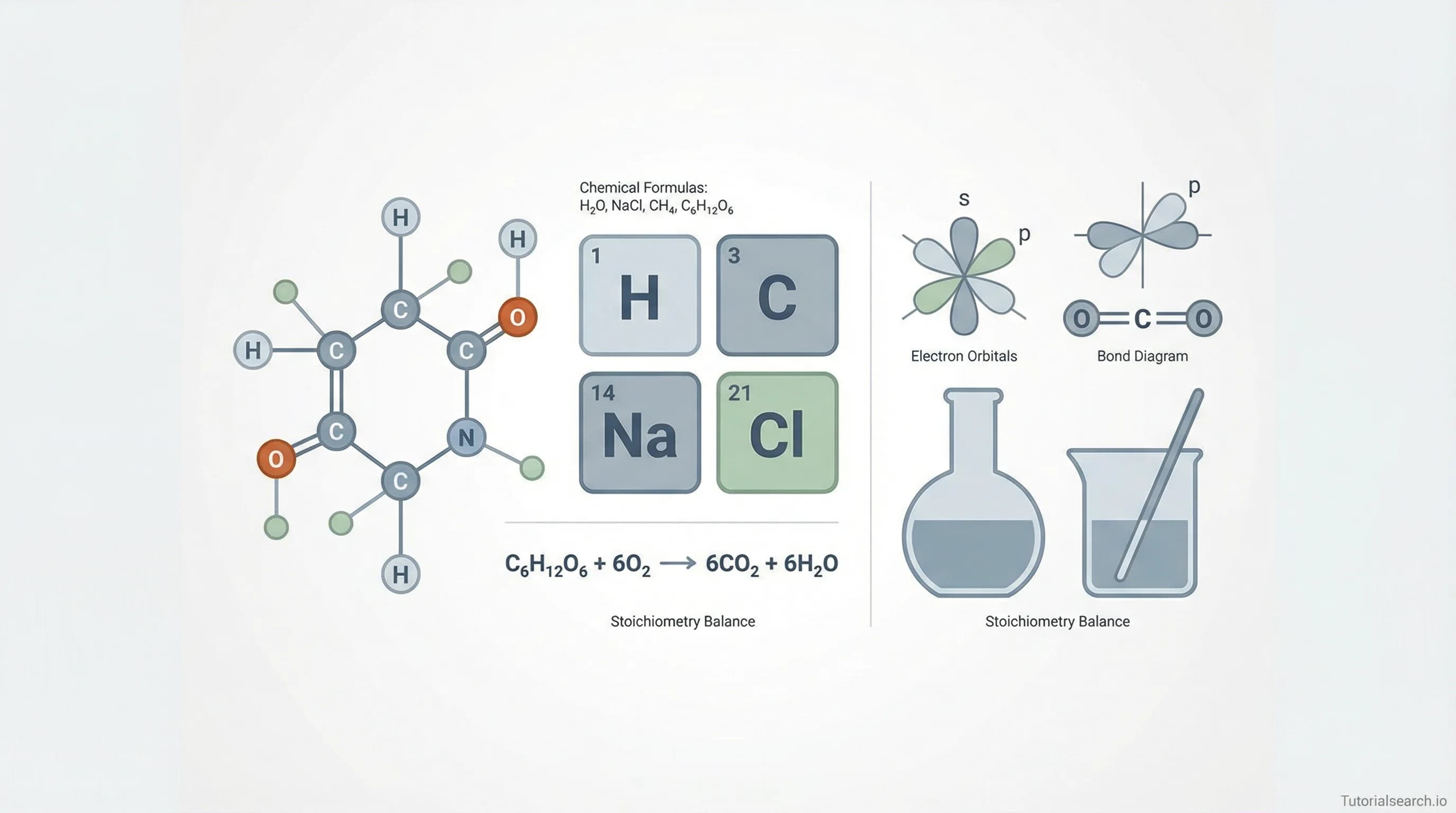
If you've ever opened a general chemistry textbook and felt immediately lost, you're not alone. Most people don't struggle with chemistry because they're bad at science. They struggle because they tried to memorize before they understood. Formulas look like noise until the concepts behind them click. Once they do? The whole subject opens up.
This guide collects the courses, YouTube channels, books, and free tools that actually help people cross that line — from confused to capable. You can browse all 405+ general chemistry courses on TutorialSearch.io or use the resources below to build your own path.
Key Takeaways
- General chemistry covers atomic structure, bonding, stoichiometry, and reactions — the core language of science
- You can start learning general chemistry for free with Khan Academy, LibreTexts, and MIT OpenCourseWare
- The biggest mistake beginners make is skipping math review — algebra fluency makes everything easier
- A mix of structured courses and free practice problems gives the fastest results
- Once you finish general chemistry, you're ready for organic chemistry, biochemistry, and beyond
In This Article
- Before You Crack Open a General Chemistry Textbook
- General Chemistry Courses Worth Your Study Hours
- Start Learning General Chemistry for Free
- General Chemistry YouTube Creators Who Actually Teach
- General Chemistry GitHub Repos Worth Bookmarking
- General Chemistry Books That Pull Their Weight
- The General Chemistry Communities Where Help Is Real
- Related Science Topics to Pair With General Chemistry
- Frequently Asked Questions About General Chemistry
Before You Crack Open a General Chemistry Textbook
There's one thing most general chemistry guides skip: the math prerequisite.
You don't need calculus. You do need algebra — solving for unknowns, working with fractions, handling scientific notation. That's it. If high school algebra felt shaky, spend a week on Khan Academy's algebra review before jumping in. It's worth it.
Chemistry also has a different logic from most subjects. It's not about memorizing the periodic table (though you'll learn it). It's about understanding why elements behave the way they do. Why does sodium react explosively with water? Why do covalent bonds form between certain atoms but not others? The answers come from a small set of core ideas — electronegativity, electron configurations, energy states — and once you understand those, a lot of specific facts fall into place on their own.
One more thing before you start: don't underestimate stoichiometry (the math of chemical reactions). Many students rush through it and hit a wall in every topic that follows. The General Chemistry - Stoichiometry course on TutorialSearch.io is a dedicated deep-dive into this exact subject — if you want to make it a priority early.
General Chemistry Courses Worth Your Study Hours
These are the courses from the general chemistry section of TutorialSearch.io that stand out, based on ratings, student counts, and what each one actually covers.
The Big Picture Options
1. Complete General Chemistry: 20+ Hours of Lectures & Examples (Udemy) [Editors' Choice]
This is the most enrolled general chemistry course in the list, with over 10,000 students. Taught by Rahsoft's Chemical Engineering Department, it covers everything from atomic structure through thermodynamics in a methodical, lecture-style format. Think of it as a full semester in one package. It's not fast — 20 hours is 20 hours — but it's thorough in a way that condensed courses aren't. If you want to cover everything once without hunting across multiple resources, this is the right choice.
2. General Chemistry Condensed Course (College or High School) (Udemy)
Michael Peterson's condensed course is for people who already have some chemistry background and want to fill gaps fast. It's pitched at intermediate level, which means it moves quickly and assumes you remember what a mole is. If you're reviewing before an exam or refreshing before a class, this is more efficient than starting from scratch.
3. Chemistry: An Inquiry-Based Approach (Course 1 of 4) (Udemy)
More than 3,500 students have enrolled in this four-part series. The inquiry-based approach is different from standard lecture formats — you're asked to reason through observations before the explanation is given. It builds deeper understanding than passive watching, but it takes longer. This is part one of four, so it's a real commitment if you go all the way through.
Specialized and Focused Courses
4. Dr. K's General Chemistry I ACS Final Exam Study Guide (Udemy) [Editors' Choice]
Gregory Kowalczyk (Dr. K) has built a strong reputation for exam-focused chemistry instruction. This guide targets the ACS Final Exam specifically — the standardized test used in many college general chemistry courses. A 4.84 rating from students who needed to actually pass something is a strong signal. If your goal is passing an exam rather than exploring chemistry broadly, start here.
5. Dr. K.'s Complete Guide to Chemical Stoichiometry (Udemy) [Editors' Choice]
Another Dr. K course, rated a perfect 5 stars. Everyone recommends "just practice mole calculations" when students get stuck on stoichiometry — and that advice is fine as far as it goes. But having a single, focused course that builds the concept from the ground up instead of burying it in 20 other topics is genuinely more effective. Do this one before you hit mole calculations for the first time, not after.
6. General Chemistry Practice Tests: 300+ Exam Questions (Udemy)
Rated 5 stars by Dr. Mohammad Abualrub's students. Practice testing is one of the most evidence-backed study strategies — working problems is what makes concepts stick. This isn't a lecture course at all. It's 300+ questions, which means 300+ chances to find gaps in what you thought you understood.
7. Introductory General Chemistry — 4-Part Series (Udemy)
Dr. Jim Gifford's series breaks the full general chemistry curriculum into smaller pieces. Part 1 is the natural starting point for true beginners. Part 2 holds a perfect 5-star rating. Parts 3 & 4 cover electrochemistry and reaction dynamics. Rated 4.77 for good reason — the later content is where the series really shines.
8. General Chemistry - Electrochemistry and the Galvanic Cell (Udemy)
Electrochemistry shows up late in most general chemistry courses and often confuses students who rushed the earlier material. Justin Ketcham's focused course is a solid supplement if you hit that wall. Rated 4.5.
9. General Inorganic Chemistry: 14H Course + Solved Problems (Udemy)
14 hours of lectures with solved problems throughout. This leans into the inorganic chemistry side — elements, compounds, and reactions before biochemistry takes over. Over 800 students, rated 4.49.
A Quick Decision Table
| If you… | Start with… |
|---|---|
| Want full coverage of everything | Complete General Chemistry (Rahsoft) |
| Need to pass a specific exam | Dr. K's ACS Study Guide |
| Keep getting lost in stoichiometry | Dr. K's Stoichiometry Guide |
| Prefer inquiry-based learning | Chemistry: An Inquiry-Based Approach |
| Want only practice problems | 300+ Practice Tests (Abualrub) |
| Need a structured 4-part series | Dr. Jim Gifford's Introductory Series |
Start Learning General Chemistry for Free
Here's what most people don't realize: you can cover almost the entire general chemistry curriculum without spending anything.
Khan Academy Chemistry is the most recommended starting point for good reason. The videos are short, the practice problems are built in, and it covers everything from atomic structure through acids and bases. It won't replace a university course, but it's the best free orientation to the subject available.
Chemistry LibreTexts is a massive open-access library of chemistry content. If you prefer reading over watching, this is your resource. It's more comprehensive than any single textbook and organized by topic so you can jump directly to what you need. If general chemistry is your entry into the sciences, the wider Science category on TutorialSearch.io pairs well — with courses in physics, biology, environmental science, and more.
MIT OpenCourseWare Chemistry is free content from actual MIT courses. You get lecture notes, problem sets, and exams. The level is genuinely university-level — don't expect hand-holding — but if you want to know what rigorous general chemistry looks like, this is it.
OLI General Chemistry 1 from Carnegie Mellon is a proper structured course with assessments and real feedback on whether you understood the material. It covers the full first-semester general chemistry curriculum and is completely free.
Saylor Academy CHEM101 is a complete, self-paced General Chemistry I course under a Creative Commons license. If you want a defined syllabus and learning path — without paying anything — this delivers it.
General Chemistry for Students (Chem1.com) doesn't look impressive, but it's a surprisingly good reference site. Notes, concept explanations, and self-tests maintained by a chemistry professor. Useful when a concept isn't clicking from other sources.
Coursera – General Chemistry: Concept Development and Application (Rice University) offers a full year of general chemistry content free to audit. You lose the certificate, but you get the course content — which is what matters if you're learning, not credentialing.
General Chemistry YouTube Creators Who Actually Teach
Hire the developers behind TutorialSearch.io
We built this site — full-stack web apps, AI integration & automation. Tell us what you need and we'll build yours.
Not all chemistry YouTube is created equal. These channels earn their recommendations.
The Organic Chemistry Tutor (YouTube) [Editors' Choice]
Despite the name, this channel covers general chemistry extensively — over 5 million subscribers shows it's doing something right. Julio Gonzales works through problems step by step, like a good TA would. He solves calculations in real time and explains each step as he goes. His stoichiometry and thermodynamics playlists are particularly strong. If you're stuck on a calculation and need to see it solved, search here first.
Tyler DeWitt (YouTube)
Tyler DeWitt is the chemistry teacher many people wish they'd had in high school. He approaches complex topics with real enthusiasm and makes abstract concepts feel concrete. His videos on electron configurations, atomic models, and chemical bonding are some of the clearest explanations on the internet. He's especially good at the "why" questions that textbooks often dodge.
Crash Course Chemistry (YouTube)
Crash Course uses heavy animation and moves fast — great for visual learners or as a review after you've already covered a topic. Don't start here cold. The pace is too quick for first exposure. Use it after you've read or watched a slower explanation of the same material, and it clicks in a different way.
Professor Dave Explains (YouTube)
Professor Dave covers general chemistry systematically, building from atomic theory through thermochemistry. He's one of the better explainers for quantum mechanics (as it relates to electron orbitals) and intermolecular forces — topics that get glossed over in faster courses but matter a lot for everything that follows.
General Chemistry GitHub Repos Worth Bookmarking
GitHub isn't the first place people look for chemistry help, but some useful repositories are here.
awesome-chemistry — A curated list spanning theory, computation, laboratory tools, open datasets, and learning materials across organic, inorganic, physical, and analytical chemistry. A broad starting point if you want to explore computational chemistry later.
awesome-learning-digital-chemistry — Resources for AI and computational chemistry, with a lot of hands-on exercises. This is more advanced than general chemistry, but it gives you a sense of where the field is heading — a useful motivator when memorizing polyatomic ions starts feeling pointless.
Study Roadmap for Chemistry — A structured roadmap mapping how the different branches of chemistry connect. Useful for understanding how general chemistry fits into the bigger picture of what you might study later.
General Chemistry Books That Pull Their Weight
OpenStax Chemistry 2e — Free. Peer-reviewed. Covers the full two-semester general chemistry sequence. This is the best free textbook available, and many community colleges are switching to it from commercial alternatives. Available as a PDF or free online. If you're going to use one textbook, use this one.
Chemistry LibreTexts: General Chemistry Bookshelves — Not one book but a curated collection of free chapters and texts organized by topic. Better for targeted reading and reference than cover-to-cover study.
General Chemistry: Principles, Patterns, and Applications (Averill & Eldredge) — A free open textbook covering the standard two-semester curriculum. More detailed and technical than some alternatives, which makes it good for students who want rigor rather than simplicity.
Zumdahl's "Chemistry" — This one costs money, but it's the textbook used in many AP and college courses. If you're studying for an AP exam or want a reference that aligns with standardized curricula, it's worth the cost. Used editions are inexpensive. It explains the "why" behind reactions more thoroughly than most general chemistry texts.
The General Chemistry Communities Where Help Is Real
r/chemistry and r/chemhelp — Two Reddit communities worth bookmarking. r/chemistry skews toward professionals and current researchers. r/chemhelp is specifically for students asking questions. If you're stuck on a problem or concept, r/chemhelp will usually get you a response within a few hours.
Official Chemistry Discord Server — Active and moderated, described as covering everything from homework help to paper discussion. Good for real-time help when you're mid-problem-set and stuck on something specific.
The Sciencemadness Discussion Board is older and more specialized, with deep archives of chemistry discussions that are useful for edge cases and unusual reaction questions.
Related Science Topics to Pair With General Chemistry
Once general chemistry is under your belt, these related fields are natural next steps:
- Life Sciences — Biology and life sciences build directly on chemistry, especially biochemistry, which is applied general chemistry in living systems.
- Materials Science — Understanding atomic bonding and crystal structures (covered in general chemistry) is the foundation of how materials are designed and analyzed.
- Physics Fundamentals — Chemistry and physics overlap significantly in thermodynamics and quantum mechanics. If you want to go deeper on electron behavior and energy, this is the natural companion.
- Physics Concepts — Broader physics topics, including waves and electromagnetism, connect to chemistry in ways that become more apparent as you advance.
- Environmental Science — Atmospheric chemistry, pollution, and climate models all rely on general chemistry principles. A natural applied extension.
- Energy Systems — Electrochemistry (part of gen chem) is the science behind batteries and fuel cells. If energy interests you, your chemistry foundation is directly relevant.
- Electrical Engineering — Semiconductors, corrosion, and material properties all connect back to chemistry. More overlap than most engineering students expect.
- Structural Analysis — Understanding how molecular bonds affect material strength bridges chemistry and structural engineering.
Frequently Asked Questions About General Chemistry
How long does it take to learn general chemistry?
For a structured first pass, expect 3–6 months of consistent study at 10–15 hours per week. A full college course covers two semesters. You can move faster with focused resources, but rushing stoichiometry or thermodynamics usually means relearning them later. Check out the general chemistry courses on TutorialSearch.io for options at different paces.
Do I need to know calculus to learn general chemistry?
No. Algebra is enough for standard general chemistry. You'll need it for stoichiometry calculations, gas law problems, and equilibrium math. Calculus shows up in physical chemistry (a later subject), but the general chemistry curriculum stays algebra-based. Logarithms are helpful for nuclear chemistry and pH calculations.
Can learning general chemistry help me get a job?
Yes, directly in many fields. Chemistry knowledge is required for careers in medicine, pharmacy, chemical engineering, materials science, food science, and environmental science. It's also useful as a foundation for lab work, research, and data science roles in the life sciences. If you're considering any STEM career, general chemistry is rarely wasted time.
What topics are covered in General Chemistry courses?
General chemistry covers atomic structure, chemical bonding (ionic, covalent, metallic), stoichiometry, chemical reactions and equations, thermodynamics (energy in reactions), states of matter, solutions and acids and bases, chemical equilibrium, and electrochemistry. Most courses split this across two semesters — the first focused on structure and stoichiometry, the second on thermodynamics and equilibrium.
Is a math background required for General Chemistry?
Yes, but a modest one. Algebra fluency is the main requirement — especially solving for variables and using ratios. Scientific notation and some comfort with logarithms (for pH and kinetics) will also come up. You don't need trigonometry or calculus. You can search for chemistry prep courses on TutorialSearch.io if you want dedicated math-for-chemistry resources.
How does General Chemistry relate to biochemistry?
General chemistry provides the foundation. Biochemistry is chemistry applied to living systems — proteins, DNA, enzymes, and metabolic reactions all operate on the same principles you learn in general chemistry. If biochemistry is your goal, a solid general chemistry foundation isn't optional. The thermodynamics, acid-base chemistry, and reaction mechanisms you study in gen chem are the exact tools biochemists use every day.
Your next general chemistry move: pick one structured course from the section above, pair it with Khan Academy or LibreTexts for free practice, and don't skip the stoichiometry. That's the part that makes everything else easier.