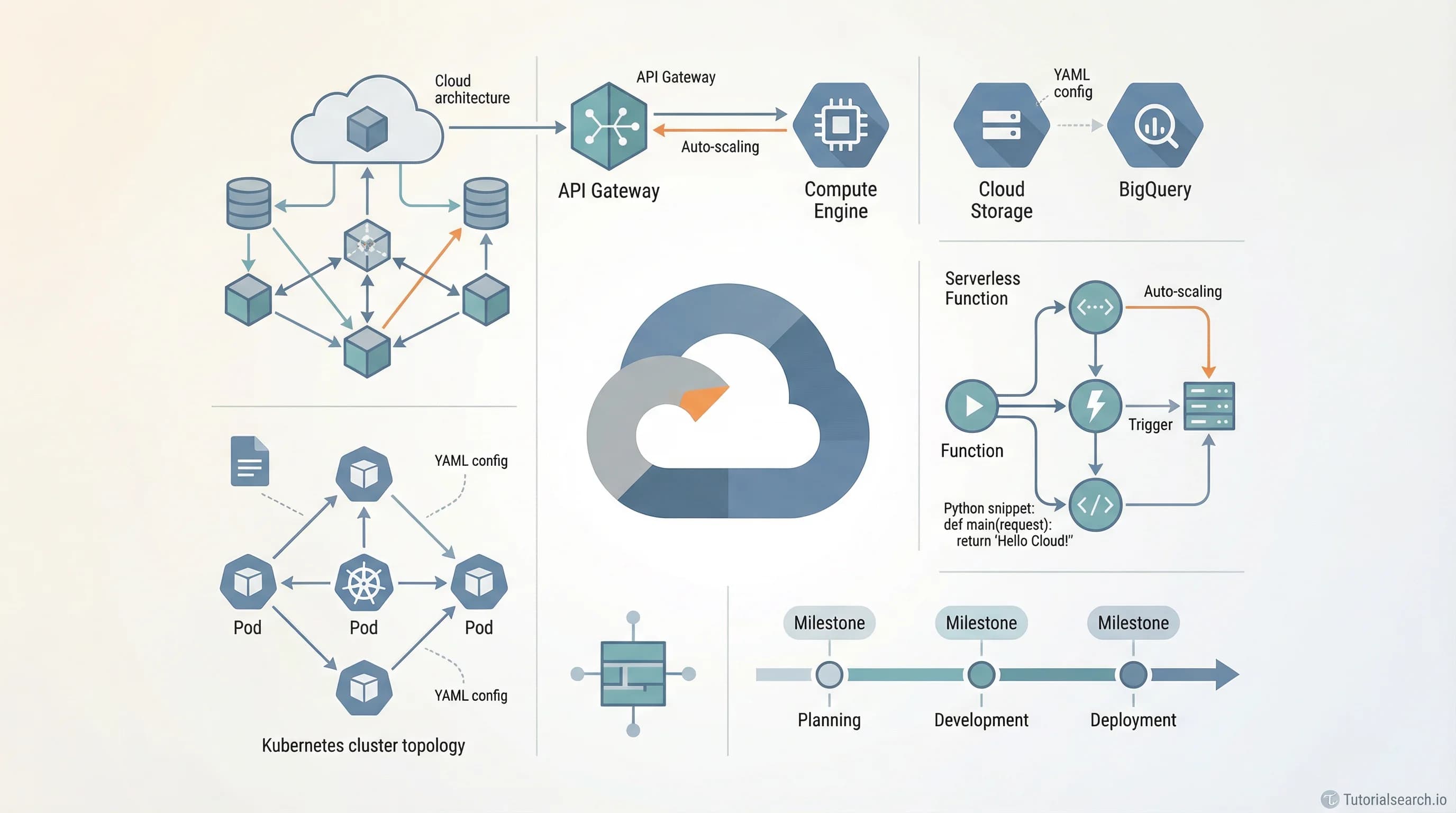
The Cloud Developer Roadmap That Actually Works
Cloud developer is one of the fastest-growing roles in tech. Here are the best courses, free platforms, YouTube channels, and communities to build your skills in 2026.
Need a web app built? Hire the team behind TutorialSearch.io
We ship fast, production-grade full-stack apps (Next.js, React, edge infra) — the same stack that powers this site.
The demand for cloud developer skills has never been higher — and the supply of qualified candidates hasn't caught up. The cloud computing market is on track to hit $947.3 billion in 2026. Yet only 25.2% of developers list cloud skills on their profiles. That gap isn't a crisis. It's an opening.
Cloud developers are among the most in-demand technologists right now. The average salary sits at $130,000+ per year in the U.S., with certified Google Cloud Developers averaging $152,438. The skills shortage is real, and the window to get ahead of it is still open.
This guide covers the best cloud developer courses, free hands-on platforms, YouTube channels, and community resources for 2026. Start here, and browse all 117 cloud developer resources on TutorialSearch.io to keep building your list.
Key Takeaways
- Cloud developer jobs are growing fast — salaries average over $130,000/year in the U.S. with significant upside for certified professionals
- The Google Professional Cloud Developer certification is one of the most respected credentials in the field
- You can build real cloud developer skills for free using Google Cloud Skills Boost and learntocloud.guide
- Pick one cloud platform first (GCP, AWS, or Azure) — trying to learn all three at once rarely works
- Cloud developers build and deploy apps; DevOps engineers automate pipelines — the roles overlap but the focus differs
In This Article
- Cloud Developer Courses Worth Your Money
- AWS vs Azure vs GCP: Pick Your Platform
- Free Cloud Developer Resources That Actually Deliver
- Cloud Developer YouTube Channels Worth Subscribing To
- GitHub Repos Every Aspiring Cloud Developer Should Know
- Cloud Developer Books That Go Beyond the Basics
- Cloud Developer Communities: Where to Get Unstuck
- Related Cloud Computing Skills Worth Exploring
- Frequently Asked Questions About Cloud Developer Skills
Before diving into the courses, a quick note on what a cloud developer actually does — because this role gets muddled with DevOps constantly. A cloud developer builds and deploys applications on cloud platforms. They write code, design scalable services, integrate APIs, and handle data. A DevOps engineer automates the delivery pipeline. Both use cloud, but their daily work is different. If you want to write cloud-native apps, you're in the right place.
Cloud Developer Courses Worth Your Money
Most people searching for "cloud developer courses" end up with exam dumps. That's a mistake. The best courses teach you how cloud-native applications are designed, not just how to answer multiple-choice questions. The ones below lean toward practical skill-building first, certification prep second.
[Editors' Choice] Google Cloud Developer — GCP Professional Certification
The Google Cloud Developer - GCP Professional Certification course by in28Minutes Official on Udemy is the single strongest structured course for aspiring GCP cloud developers. It has over 25,000 enrolled students — and that number doesn't lie, especially in a niche where most courses barely break 1,000.
What sets it apart isn't just coverage. It's that in28Minutes builds courses the way engineers think. You get conceptual depth on cloud architecture, real walkthroughs of App Engine, Cloud Run, and Kubernetes Engine, plus CI/CD pipeline setup. By the end, you're not just ready for the exam — you're actually building things.
Rating: 4.2/5 from thousands of reviews. It's the closest thing to a gold standard for GCP developer prep.
Google Professional Cloud Developer (PCD) — Mock Exams
Once you've built foundational knowledge, you need to simulate the real exam. The Google Professional Cloud Developer (PCD) - Mock Exams by Paweł Krakowiak is the most trusted mock exam course for this certification.
With nearly 19,000 enrolled students, it's the second most-used resource in this space. Krakowiak's explanations for wrong answers are genuinely useful — not just "the correct answer is B," but why B is correct and where the alternative approaches break down. That's rare in practice test courses.
GCP Google Cloud Developer Skills for Success
For something more skills-focused than exam-focused, the GCP Google Cloud Developer Skills for Success course by Muhammad Usman Anwar punches above its weight. Despite a smaller student base, it holds a 4.54 rating and has strong reviews for clarity. Good supplementary material to reinforce what in28Minutes covers.
A Word on Salesforce Marketing Cloud Developer Courses
If you're specifically targeting Salesforce Marketing Cloud (a different beast from GCP/AWS/Azure), the Salesforce Marketing Cloud Developer Exam course by Driss Motbir has solid reviews at 4.52/5. Be clear about which "cloud" you're building toward — Salesforce Marketing Cloud and Google Cloud are entirely different platforms.
Here's an honest observation that goes against common advice: everyone recommends starting with AWS because it has the largest market share. But for developers specifically, GCP has more developer-friendly tooling and the Professional Cloud Developer certification is tightly scoped to actual application development patterns. AWS certifications tend to skew toward ops and infrastructure. If you're a developer who writes code for a living, GCP is worth a serious look.
AWS vs Azure vs GCP: Pick Your Platform
This comparison is for developers choosing their first cloud platform to specialize in.
| Factor | AWS | Azure | GCP |
|---|---|---|---|
| Market share | Largest (~32%) | Second (~23%) | Third (~12%) |
| Job listings | Most | Second most | Growing fast |
| Developer experience | Strong (Lambda, ECS) | Good (Azure Functions) | Excellent (Cloud Run, GKE) |
| Certification focus | Broad (ops + dev) | Role-based | Developer-specific |
| Free tier | Generous | Generous | $300 credit |
| Best for | Enterprise, general cloud | Microsoft shops | App development, ML/AI |
There's no wrong answer. But pick one and go deep before exploring the others. A developer who is expert in one platform is far more valuable than someone with shallow knowledge across three.
Free Cloud Developer Resources That Actually Deliver
Paid courses aren't the only way in. Several free platforms offer hands-on learning in real cloud environments — not sandboxes, actual cloud consoles.
[Editors' Choice] Google Cloud Skills Boost
Google Cloud Skills Boost (formerly Qwiklabs) is the most underrated free learning platform for cloud developers. You work directly in real GCP environments, not simulated ones. Spin up Compute Engine instances. Deploy to Cloud Run. Build with BigQuery.
The "Getting Started with Google Cloud" learning path is free and takes roughly 8 hours. It's where most beginners should start if GCP is their platform of choice. learntocloud.guide recommends it explicitly as part of their structured curriculum.
Visit: cloud.google.com/training
AWS Skill Builder and Cloud Quest
AWS Skill Builder offers the Cloud Practitioner Essentials course free of charge. It's a reliable entry point for understanding how AWS organizes its services and where the boundaries of responsibility fall.
AWS Cloud Quest takes it further — it's gamified. You solve real-world challenges in a 3D environment, deploying EC2 instances and configuring S3 buckets through interactive scenarios. It sounds gimmicky but works well for hands-on learners. If you're exploring Cloud Platforms more broadly, this is a good free starting point.
Visit: skillbuilder.aws
Microsoft Learn
Microsoft Learn provides 1,000+ free, self-paced modules for Azure with hands-on labs in sandboxed environments. If Azure is your platform, this is the official starting point. No cost, no upsell.
Visit: learn.microsoft.com
Learn to Cloud (learntocloud.guide)
Learn to Cloud is the resource I'd point someone to if they asked "where do I even start?" It's a structured, phased curriculum that takes you from Linux basics through cloud deployment, containers, Kubernetes, and CI/CD. It's free, open source, and built by practitioners. The GitHub repo has 5.4k stars — a meaningful signal in this space.
The curriculum assumes 2 hours per day and gets you job-ready in roughly 6 months. That's a concrete promise, and the community behind it has helped many people actually make it happen.
Visit: learntocloud.guide
Roadmap.sh
Roadmap.sh is the 6th most-starred project on GitHub and one of the most visited learning resources for developers globally. Their DevOps and AWS roadmaps are particularly useful for cloud developers who want a visual map of what skills to build and in what order.
Visit: roadmap.sh
If you're also building cloud architecture skills alongside your development work, roadmap.sh has a dedicated path for that too.
Cloud Developer YouTube Channels Worth Subscribing To
Need a web app built? Hire the team behind TutorialSearch.io
We ship fast, production-grade full-stack apps (Next.js, React, edge infra) — the same stack that powers this site.
Google Cloud Tech
Google Cloud Tech is the official GCP YouTube channel, and it's better than most official tech channels. Tutorials cover real product walkthroughs from getting started with basic services to advanced Cloud Run configurations and multi-region deployments. The signal-to-noise ratio is unusually high for an official channel.
Visit: youtube.com/@googlecloudtech
TechWorld with Nana
TechWorld with Nana focuses on DevOps and cloud engineering. Nana's teaching style is methodical and visual — she doesn't rush through concepts. Her Kubernetes and Docker tutorials are some of the most-watched in the space, and they directly connect to skills cloud developers need for containerized deployments. If you're working toward Cloud Infrastructure skills alongside development, start with her Docker and Kubernetes full courses.
Visit: youtube.com/@TechWorldwithNana
[Editors' Choice] ExamPro (Andrew Brown)
ExamPro (run by Andrew Brown) offers completely free certification prep courses through unlisted YouTube playlists. His AWS Cloud Practitioner and AWS Developer Associate courses are among the highest-quality free certification resources online. He also covers GCP and Azure. The lack of paywalls is deliberate — Brown is a genuine advocate for accessible cloud education.
Visit: youtube.com/@ExamProChannel
freeCodeCamp Cloud Courses
freeCodeCamp's YouTube channel hosts several multi-hour cloud computing courses — AWS, Azure, and GCP — all completely free. The production quality varies by instructor, but the depth doesn't. A 10-hour AWS course from freeCodeCamp is comparable to paid alternatives.
Visit: youtube.com/freeCodeCamp
GitHub Repos Every Aspiring Cloud Developer Should Know
[Editors' Choice] learntocloud/learn-to-cloud (5.4k Stars)
The learn-to-cloud GitHub repository is the structured backbone of the learntocloud.guide curriculum mentioned above. The repo itself is useful because it includes resource recommendations at each phase, challenge checkpoints, and a community wiki. Start here for a clear path from zero to cloud-ready.
kamranahmedse/developer-roadmap
The developer-roadmap repository is the 6th most-starred repo on GitHub. It contains interactive visual roadmaps for AWS, DevOps, Linux, and general backend development. The AWS roadmap in particular is useful for cloud developers who want a comprehensive view of what skills exist in the ecosystem.
milanm/DevOps-Roadmap
The DevOps Roadmap by milanm covers configuration management (Terraform, Ansible), container orchestration (Docker, Kubernetes), and monitoring stacks (Prometheus, Grafana). Cloud developers who want to understand the deployment side of their work will find this valuable.
Also worth starring: piyushsachdeva/DevOps-Roadmap, which is specifically designed for career-switchers with an estimated 6–12 month completion timeline.
Cloud Developer Books That Go Beyond the Basics
Cloud Computing: Concepts, Technology & Architecture — Thomas Erl
This is the textbook-level resource for cloud developers who want to understand why cloud systems are designed the way they are. More than 260 figures, 29 architectural models, and 20 mechanisms. It's dense, but it's the book you'll reference for years. Vendor-neutral, which means the patterns apply regardless of whether you end up on AWS, GCP, or Azure.
Infrastructure as Code — Kief Morris
Infrastructure as Code by Kief Morris is arguably the most practical book for cloud developers who want to manage cloud resources properly. It covers Terraform, CloudFormation, and the broader discipline of treating infrastructure as software. Essential reading if you're working toward Cloud Architecture or Cloud Infrastructure skills.
Available at O'Reilly and most bookstores.
Cloud Native Patterns — Cornelia Davis
Cloud Native Patterns walks you through the design patterns used in modern cloud-native applications — service independence, dynamic configuration, distributed systems design. It's written for developers who already code and want to think in cloud-native terms. Davis writes clearly and uses concrete examples throughout.
Available free to read at Manning for subscribers.
Cloud Computing for Dummies
Don't let the name put you off. Cloud Computing for Dummies by Hurwitz, Halper, Bloor, and Kaufman covers real-world applications of cloud computing in plain English. It's the right starting point if you're coming from a non-technical background and want to understand cloud concepts before diving into code.
Cloud Developer Communities: Where to Get Unstuck
The most useful subreddits for cloud developers are r/googlecloud, r/aws, and r/cloudcomputing. They're active communities with a mix of beginners getting help and professionals sharing deep technical dives. The Cloud Certifications community discussion threads on Reddit are particularly useful for exam prep strategy.
Google Developer Community Discord
The Google Developer Community Discord has over 102,000 members and dedicated channels for GCP topics. It's the most direct line to other GCP developers. Join here.
AWS Community Discord
There's an active AWS Discord with channels for #ask-for-technical-help, #cloud-automation, #cloud-security, and #getting-hired. Well-moderated, helpful for beginners.
CNCF Slack
The Cloud Native Computing Foundation (CNCF) Slack is where serious cloud engineers hang out. If you're working with Kubernetes, Prometheus, or other CNCF projects, this is the community for deep technical help. Join at slack.cncf.io.
If cloud security is becoming part of your work, the Cloud Security community on TutorialSearch has 352 courses to help you build that layer of expertise alongside your development skills.
Related Cloud Computing Skills Worth Exploring
Cloud development doesn't exist in isolation. These related skills pair directly with cloud developer work and are worth building in parallel:
- Cloud Certifications — 917 courses to help you earn the credentials that validate your skills. The GCP Professional Cloud Developer cert is a natural next step after foundational learning.
- Cloud Architecture — 730 courses covering scalable system design, one of the most valued skills for senior cloud developers.
- Cloud Infrastructure — 452 courses on the infrastructure layer that underlies everything you build.
- Cloud Data Solutions — 372 courses for developers working with data pipelines and analytics in the cloud.
- Cloud Security — 352 courses covering IAM, compliance, and securing cloud applications.
- Cloud Platforms — 703 courses for deeper platform-specific knowledge across AWS, Azure, and GCP.
- Cloud Concepts — 520 courses for solidifying the foundational theory behind cloud computing.
- Cloud Practitioner — 789 courses for entry-level cloud foundations if you're just getting started.
Frequently Asked Questions About Cloud Developer Skills
How long does it take to learn cloud development?
Most people reach a job-ready level in 6–12 months with consistent daily practice. The Learn to Cloud curriculum estimates 6 months at 2 hours per day. Earning a certification (like the GCP Professional Cloud Developer) takes most candidates an additional 2–3 months of focused study. Your timeline depends heavily on your programming background — developers who already know Python or Java typically move faster. You can search for cloud developer courses filtered by your experience level.
Do I need programming experience to become a cloud developer?
You need at least basic programming skills. Python, Java, Go, and Node.js are the most commonly used languages in cloud development, with Python being the most accessible starting point. Cloud platforms are not purely click-through tools — you'll write infrastructure-as-code, build serverless functions, and script automation. If you're new to programming, build that foundation before focusing on cloud-specific skills.
What's the difference between a cloud developer and a DevOps engineer?
A cloud developer focuses on building and deploying applications using cloud services. A DevOps engineer focuses on automating and streamlining the software delivery pipeline. Both roles use cloud platforms heavily, but a cloud developer writes application code and integrates cloud APIs, while a DevOps engineer configures CI/CD pipelines, manages infrastructure provisioning, and monitors system reliability. In smaller teams, one person often does both. At larger companies, these are distinct roles. Browse Cloud Infrastructure courses if you want to build stronger DevOps fundamentals alongside your development skills.
Is the Google Professional Cloud Developer certification worth it?
Yes, especially if GCP is your primary platform. The certification is tightly focused on application development patterns — not generic cloud operations. Certified GCP developers earn an average of $152,438/year. That's a meaningful premium over the general developer average, and the certification signals deep, tested knowledge to employers. Pair the in28Minutes certification course with the Paweł Krakowiak mock exams for the most complete exam prep.
Can I get a cloud developer job without a degree?
Yes. Cloud certifications (GCP, AWS, Azure) carry significant weight in hiring. Many cloud developers are self-taught or transitioned from other technical roles. What matters is demonstrable skill — a portfolio of deployed cloud projects, a passing certification score, and the ability to explain your design decisions in an interview. The Cloud Certifications resource library has 917 courses to help you build the credentials that open doors.
The cloud developer market is growing faster than it's being filled. The resources above — structured courses, free hands-on platforms, GitHub learning paths, and active communities — give you everything you need. Pick your platform, go deep on one cloud first, and build something real alongside your studying. That combination, more than any single course, is what actually gets you hired.