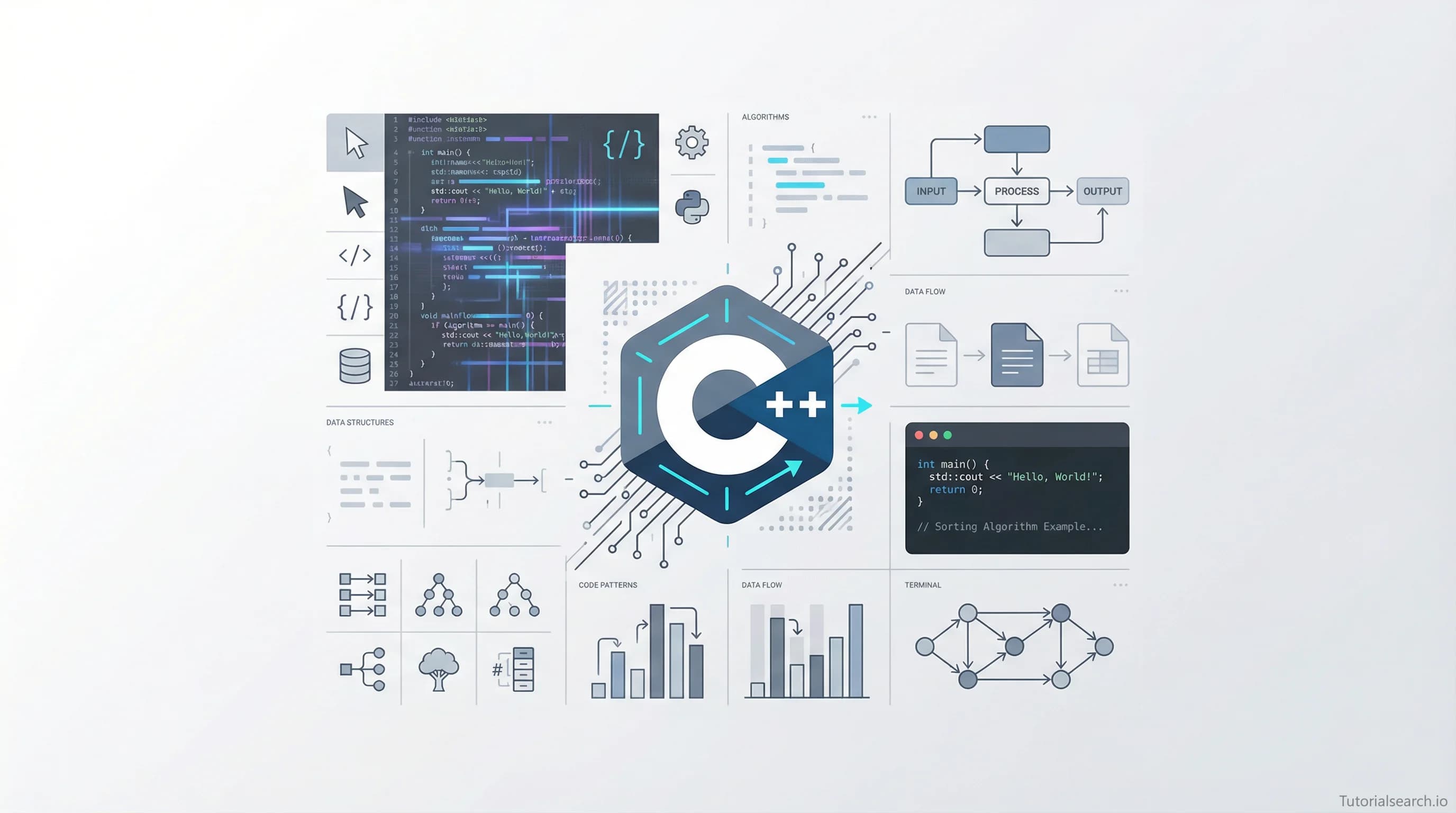
The C++ Algorithms Guide I Wish Existed Earlier
C++ algorithms are at the heart of competitive programming and technical interviews. This guide covers the best courses, free resources, GitHub repos, YouTube channels, and books — all curated for developers at every level.
Need a web app built? Hire the team behind TutorialSearch.io
We ship fast, production-grade full-stack apps (Next.js, React, edge infra) — the same stack that powers this site.
C++ algorithms are at the heart of competitive programming, technical interviews, and high-performance software. Yet most learners spend weeks feeling lost before they write their first useful sort or binary search. This guide cuts through the noise with the courses, free tools, repos, and communities that actually move the needle.
Key Takeaways
- C++ algorithms live in the
<algorithm>header and work across all STL containers — you don't need to write them from scratch.- Kate Gregory's Pluralsight courses are the clearest structured C++ algorithm training available right now.
- Free resources like cppreference.com and learncpp.com cover the full topic at zero cost.
- Practice on LeetCode or Codeforces is the fastest way to internalize C++ algorithms you've learned.
- Understanding both how to use the STL and how to implement algorithms manually is what interviewers actually test.
In This Article
- Before You Write a Single C++ Algorithm
- Getting Your Hands Dirty With C++ Algorithms
- C++ Algorithm Courses That Move Fast
- Free C++ Algorithm Resources That Actually Work
- C++ Algorithm Repositories Worth Starring on GitHub
- Watch C++ Algorithms in Action: Channels That Teach
- C++ Algorithm Books for Going Deeper
- C++ Algorithm Communities: Where to Get Unstuck
- Related Skills Worth Exploring
- Frequently Asked Questions About C++ Algorithms
Before You Write a Single C++ Algorithm
Here's the question most beginners get wrong: they think "learning C++ algorithms" means memorizing recursive quicksort from scratch.
It doesn't.
C++ ships with a full algorithms library — <algorithm> — that covers sorting, searching, partitioning, transforming, and more. It's been battle-tested for decades. The actual skill is knowing what's there, when to use each function, and how to customize behavior with lambdas and comparators.
That shift in mindset changes everything. You're not reinventing wheels. You're learning to use powerful, pre-written tools that let you write cleaner code in less time.
That said, you still need to understand what's happening underneath. Interview questions don't ask you to call std::sort — they ask you to implement it. The goal is both: understand the theory, then use the library.
One more thing before we get into resources. TutorialSearch.io's C++ algorithms topic page lists 343 courses in one place. Worth bookmarking as you explore options.
Getting Your Hands Dirty With C++ Algorithms
The most useful reference for this topic is cppreference.com. It documents every standard algorithm — signatures, complexity, behavior, edge cases. It's dense, but it's accurate and experts maintain it.
For a more visual approach, hackingcpp.com's algorithm overview maps out the entire <algorithm> header as a visual chart. Each function links to a usage example. This is the cheat sheet you'll return to constantly.
If you want something interactive right now, learn-cpp.org and learncpp.com [Editors' Choice] are both free and written for humans. learncpp.com is comprehensive — it goes from basics through templates and the STL without requiring you to buy anything. Start there before spending money on a course.
Quick orientation: what you'll encounter most often
C++ algorithms fall into a few key categories:
- Non-modifying (counting, searching):
std::find,std::count,std::any_of - Modifying (transforming, copying):
std::transform,std::copy,std::fill - Sorting (ordering elements):
std::sort,std::stable_sort,std::partial_sort - Binary search (on sorted ranges):
std::lower_bound,std::upper_bound,std::binary_search
Spend time with these before jumping to courses. If you can call std::sort with a custom comparator and use std::binary_search on a sorted vector, you have a solid starting point.
C++ Algorithm Courses That Move Fast
Here are the courses worth structured time — picked for quality and depth, not just enrollment numbers.
1. Beautiful C++ 14: STL Algorithms — Kate Gregory [Editors' Choice]
Kate Gregory's Pluralsight course is the best C++ algorithms course around. Kate has a rare ability to explain things clearly without dumbing them down. She walks through the STL algorithm library systematically, showing not just how to call each function but why you'd pick it over a manual loop.
It's rated 4.8/5.0 on Pluralsight — which tells you most people finish it feeling like they actually learned something. Intermediate-level, so you should know basic C++ before starting.
2. C++20 Algorithms Playbook — Kate Gregory
This follow-up course covers what's new in C++20. The ranges library is the big story here — it rewrote how you compose algorithms. Rated 4.7/5.0. If you're learning C++ for production code, C++20 ranges are where the language is headed. This course explains what std::ranges::sort means and why it's cleaner than the old iterator pair syntax.
3. Recursion, Algorithms and Data Structures Bootcamp in C++ — Holczer Balazs [Editors' Choice]
Over 10,000 students have taken Balazs's Udemy bootcamp. It's a strong all-levels option because it starts with recursion — the thing that trips up most people on algorithmic problems — then builds systematically from there.
Balazs covers sorting, searching, trees, graphs, and dynamic programming with C++ implementations. If you're preparing for technical interviews, this structure mirrors what interviewers actually test.
4. Competitive Programming Basics for Beginners Using C++ — Shivam Nikam (Free)
This free Udemy course is underrated. At about 4 hours, it covers time complexity analysis and key algorithms like Kadane's Algorithm and the Sieve of Eratosthenes. Nikam keeps each video focused on one concept with a working code example. A structured starting point for competitive programming without spending a dollar.
5. C++ Practice Intensives: Sharpen Skills — ProTech Ed
This Udemy course takes a testing-first approach. Instead of lecturing, it drops you into exercises and explains through practice. Rated 4.63/5.0 with 3,365 students. Good for people who learn better by doing than watching.
Which course is right for you?
| Your situation | Best pick |
|---|---|
| Know C++ basics, want STL mastery | Kate Gregory — Beautiful C++ 14 |
| Preparing for technical interviews | Holczer Balazs — Recursion & Algorithms Bootcamp |
| Brand new, no budget | Shivam Nikam — Free competitive programming course |
| Want C++20 features | Kate Gregory — C++20 Algorithms Playbook |
| Learn by doing exercises | ProTech Ed — C++ Practice Intensives |
You can explore the full catalog at TutorialSearch.io's C++ algorithms search.
Free C++ Algorithm Resources That Actually Work
If you prefer to self-study before spending money, these are solid options:
learncpp.com — Free, comprehensive, written by someone who actually knows the language. The chapters on the STL are detailed and well-organized. This is a full C++ curriculum, not just a quick reference.
W3Schools C++ Algorithms — Quick syntax reference with a live browser editor. Use it for looking things up, not deep learning.
HackingCPP Algorithms Introduction — The written companion to the visual overview. Concise and well-explained, with just enough depth to understand each algorithm's purpose.
Scaler Topics — Data Structures and Algorithms in C++ — A free, beginner-friendly structured course with a certificate. Worth trying if you want more structure than scattered tutorials.
LeetCode — Solving LeetCode problems in C++ is how you actually internalize algorithms. Filter by topic, start with Easy problems, and solve them in C++ using STL algorithms first. Then try implementing the logic yourself.
Microsoft's <algorithm> docs — Worth bookmarking if you're using MSVC on Windows. They include practical examples that cppreference sometimes skips.
While you're exploring, the broader programming languages category on TutorialSearch.io has thousands of courses covering everything adjacent to C++ algorithms.
C++ Algorithm Repositories Worth Starring on GitHub
Need a web app built? Hire the team behind TutorialSearch.io
We ship fast, production-grade full-stack apps (Next.js, React, edge infra) — the same stack that powers this site.
TheAlgorithms/C-Plus-Plus [Editors' Choice] — Clean, documented implementations of hundreds of algorithms in C++. Covers sorting, searching, mathematics, machine learning, and more. Every file is a self-contained example. If you're studying an algorithm and want working code alongside the theory, keep this tab open.
fffaraz/awesome-cpp — The curated list for anything C++. Libraries, frameworks, learning resources, and algorithm-specific tools in one place. It has tens of thousands of stars for good reason.
RedSkittleFox/Cpp-Learning-Resources — A hidden gem. It collects high-quality C++ materials including CppCon talks specifically on the STL and algorithms. The talk "105 STL Algorithms in Less Than an Hour" is linked here and worth 60 minutes of your time.
HappyCerberus/book-cpp-algorithms — An open-source book on Standard C++ Algorithms with full code samples. Readable as a reference or a structured self-study resource.
There's also an active GitHub topic for cpp-algorithms where you can find smaller, community-built projects worth exploring.
Watch C++ Algorithms in Action: Channels That Teach
The Cherno's C++ Series on YouTube is the most-watched C++ tutorial series around — nearly 12 million views. His episodes on STL containers and algorithms are practical and paced well. Watch the STL-focused episodes once you have basic syntax down.
Abdul Bari's Algorithms playlist at his YouTube channel is the clearest explanation of algorithm theory on video. He uses diagrams and examples to explain time complexity, sorting, dynamic programming, and graph traversal. Language-agnostic in theory, but every concept translates directly to C++.
CppCon on YouTube is essential once you're past beginner level. The "Back to Basics" series covers STL algorithms for non-experts. There are also dedicated talks on C++20 ranges and parallel algorithms that you won't find explained this clearly anywhere else.
MIT OpenCourseWare — 6.006 Introduction to Algorithms is free university material. Prof. Erik Demaine's lectures explain why algorithms work the way they do — not just how to implement them. This is for when you want depth, not shortcuts.
mycodeschool's Data Structures in C/C++ playlist covers linked lists, trees, and graphs in a way that directly supports C++ algorithm study. Good for building the data structure foundation before focusing on algorithms that operate on them.
If programming fundamentals are still a work in progress, mycodeschool is a great place to solidify them alongside algorithm study.
C++ Algorithm Books for Going Deeper
Algorithms in C++ by Robert Sedgewick is the classic textbook. It covers sorting, searching, and graph algorithms with C++ examples. Dense and complete. Ideal for programmers who already have C++ experience and want a comprehensive reference.
Grokking Algorithms by Aditya Bhargava is the opposite of dense. It's illustrated, approachable, and genuinely fun to read. It's not C++-specific — examples use Python — but the concepts transfer directly. Start here if algorithm theory feels abstract and hard to visualize.
Data Structure and Algorithm Analysis in C++ by Mark Allen Weiss goes deeper on complexity analysis than most practitioner-focused resources. It's widely used in university courses. Good choice if you want to understand not just which algorithm to use but why it performs the way it does.
If you're also branching into modern languages like Rust or Go, the algorithmic thinking from these books transfers directly.
C++ Algorithm Communities: Where to Get Unstuck
r/cpp leans toward experienced developers — good for specific technical questions. r/learnprogramming is better for beginner questions and general learning advice. Both are active.
Codeforces is the go-to platform for competitive programming. The blog section is full of useful posts on algorithm implementation tricks and contest analysis. The community is highly technical.
The Competitive Programming Community Discord has over 23,000 members across channels like #beginner-questions and #general-cp. Good for live discussions on specific problems and algorithm approaches.
The Better C++ Discord focuses on the language itself, with active discussions on modern C++ practices including the STL and algorithm design.
If object programming is also on your list, the same communities discuss OOP in C++ extensively — you'll find the overlap immediately.
Related Skills Worth Exploring
C++ algorithm skills become more valuable paired with adjacent knowledge:
- Programming Fundamentals — the prerequisites that make C++ algorithms click if you're newer to coding
- Modern Languages — Rust and Go, where algorithmic thinking from C++ transfers directly
- Python Basics — many algorithm explanations and interview prep resources use Python even when the job uses C++
- Java Objects — for technical interview prep, Java knowledge is often interchangeable with C++
- JavaScript Development — algorithm skills transfer here for front-end interview prep
- Python Applications — a good complement if you want to prototype algorithm ideas quickly before optimizing in C++
- Automation Development — where C++ algorithm skills combine with scripting and tooling
- Object Programming — the OOP patterns underlying how C++ containers and algorithms are designed
Frequently Asked Questions About C++ Algorithms
How long does it take to learn C++ algorithms?
Expect 3–6 months of consistent practice. You can get comfortable with the STL <algorithm> library in a few weeks. True fluency — where you can implement algorithms from scratch under pressure — takes longer and comes from solving problems regularly, not just watching videos.
Do I need advanced C++ knowledge to learn algorithms?
No, but you need the basics. Variables, loops, functions, pointers, and STL containers like vectors and maps should feel familiar. If those are shaky, spend a few weeks on programming fundamentals first, then circle back.
Can I get a job with C++ algorithms skills?
Yes. Game development, systems programming, embedded software, and high-frequency trading all favor C++ algorithm knowledge. Technical interviews at top companies consistently test sorting, searching, graph traversal, and dynamic programming in C++. It's one of the most in-demand skill combinations in software engineering.
What's the difference between STL algorithms and writing my own?
STL algorithms — like std::sort and std::binary_search — are pre-written, optimized functions from the standard library. Writing your own means implementing the same logic from scratch. In production, you use STL algorithms. In interviews and competitive programming, you often need to write your own. Learn both. They reinforce each other. Browse all C++ algorithm courses to find material on both tracks.
What's the best starting point for a total beginner?
Start with learncpp.com for language fundamentals, then move to Shivam Nikam's free competitive programming course. That sequence gets you from zero to writing working algorithms in a matter of weeks without spending anything.
If one resource stands out across this entire list, it's Kate Gregory's Pluralsight courses. They're focused, clear, and built by someone who uses C++ professionally every day. Start there for structured paid learning. Pair with cppreference.com as your day-to-day reference. The rest fills in based on how you learn best.