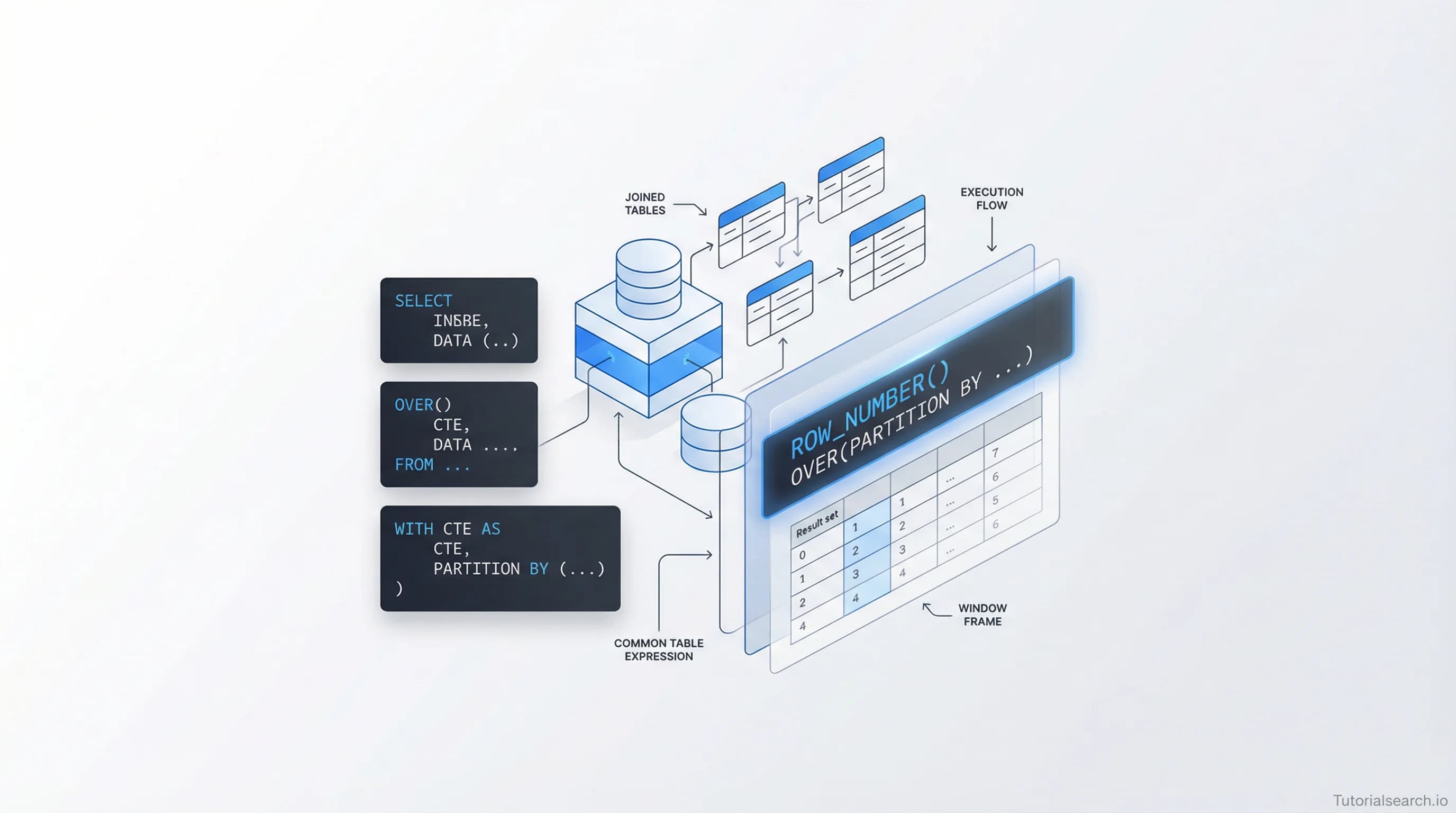
The Advanced SQL Guide I Wish Existed Earlier
Advanced SQL is where database work gets interesting — and where most tutorials stop. Here's the curated guide to window functions, CTEs, query optimization, and the courses and free resources that actually take you from competent to expert.
Hire the developers behind TutorialSearch.io
We built this site — full-stack web apps, AI integration & automation. Tell us what you need and we'll build yours.
The Advanced SQL Guide I Wish Existed Earlier
Advanced SQL is where the real database work happens — and it's also where most beginner tutorials quietly stop. This guide covers the best courses, free resources, YouTube channels, and books to take your SQL from functional to genuinely expert-level.
Key Takeaways
- Advanced SQL skills like window functions and CTEs can replace messy subqueries with cleaner, faster queries.
- The best advanced SQL courses focus on real-world performance problems, not just syntax drills.
- Free resources — including "Use The Index, Luke" — cover most advanced SQL topics as well as any paid course.
- Learning one database platform deeply beats surface-level knowledge of four.
- The advanced SQL skill gap is mostly about query optimization and understanding execution plans, not memorizing more functions.
In This Article
- The Advanced SQL Courses That Actually Teach Something
- Free Advanced SQL Resources That Are Surprisingly Deep
- Advanced SQL on YouTube: Channels That Go Beyond Basics
- GitHub Repos for Advanced SQL Worth Starring
- Advanced SQL Books Worth Reading
- Pick Your Advanced SQL Path: A Quick Comparison
- Related SQL Skills Worth Exploring
- Frequently Asked Questions About Advanced SQL
Most people think they know SQL the moment they can write a JOIN and group some rows. That's not knowing SQL — that's knowing enough SQL to look busy.
The real skill gap shows up when you're handed a query that takes 40 seconds to run and told to fix it. Or when you need to calculate a 30-day rolling average per user across 50 million rows without crashing the database. Or when your CTE logic gets three levels deep and suddenly a window function would have done it in six lines.
I learned window functions in the wrong order. I spent weeks trying to find where they "fit" in my workflow before someone showed me a before-and-after example: a 22-line subquery turned into 6 lines with PARTITION BY. After that, I went back and rewrote a month's worth of queries. It wasn't optional — the old ones were embarrassing.
If you're past the basics and want to go deeper, browse the SQL Advanced topic — there are 144 courses cataloged there across Udemy, Pluralsight, and Skillshare. This guide picks the best ones, plus the free resources worth your time.
The Advanced SQL Courses That Actually Teach Something
Finding a genuinely advanced SQL course is harder than it should be. Most courses that call themselves "advanced" are really intermediate at best — they cover subqueries and multiple JOINs and call it a day. The ones below actually go further.
1. SQL Advanced by Amarnath Reddy (Udemy)
[Editors' Choice]
This is the most straightforwardly useful course on the list. Amarnath Reddy covers real SQL Server patterns — not just syntax explanation, but the reasoning behind when to use each technique. With over 10,700 students and a 4.4 rating, it holds up well for a genuinely advanced course that doesn't pad its runtime.
Topics covered:
- Window functions in depth (RANK, DENSE_RANK, ROW_NUMBER, LEAD, LAG, NTILE)
- Common table expressions — recursive and non-recursive
- Performance tuning and query optimization strategies
- Stored procedures, triggers, and transaction management
This is a paid course, but it's one of the few that earns the "Advanced" label on the tin.
2. T-SQL Training with Real World Scenarios by Vikas Munjal (Udemy)
[Editors' Choice]
The highest-rated course on this list at 4.6 stars. Vikas Munjal builds from real problems that SQL Server developers and DBAs actually encounter — not textbook exercises designed to explain a feature, but the kind of messy, context-dependent problems you hit on the job.
The "tricks of the trade" framing is honest. This isn't theory. It's how people who work with T-SQL every day actually approach solutions. If you work in a Microsoft SQL Server environment, this should be your first pick.
3. Oracle SQL - The Ultimate Course by Carlos DL (Udemy)
With 26,000+ enrolled students, this is the most popular course on this list by a wide margin. Carlos DL focuses on Oracle SQL — a dialect with its own quirks and advanced features that differ meaningfully from standard SQL.
Oracle SQL is common in enterprise environments (banking, healthcare, government). If that's your context, this course covers the territory: analytical functions, hierarchical queries, PL/SQL basics, and Oracle-specific execution planning.
4. Mastering Window Functions in SQL by Bluelime Learning Solutions (Udemy)
Window functions trip up almost everyone. The syntax is readable but the behavior — especially frame clauses and UNBOUNDED PRECEDING — takes a while to feel intuitive.
This course devotes its entire runtime to window functions: ROW_NUMBER, LAG, LEAD, NTILE, cumulative distributions, and frame specification. If you've tried to learn window functions from a general SQL course and it didn't click, a focused course on just this topic isn't overkill. It's often exactly what's needed.
5. Snowflake Essentials - A Comprehensive Masterclass by Kasper Peysepar (Udemy)
Here's the opinion most SQL courses won't give you: a lot of the SQL work being done right now doesn't happen in PostgreSQL or MySQL. It happens in Snowflake, BigQuery, and Redshift — cloud data warehouses where query optimization works differently, caching is explicit, and the cost model is tied to compute credits, not server time.
Kasper Peysepar covers Snowflake's variant of SQL and how its performance characteristics differ from traditional relational databases. This is advanced in a different way — less about harder SQL, more about SQL in a modern data stack where the rules change.
You can search all 144 SQL Advanced courses on TutorialSearch.io, filtered by rating, platform, or price.
Free Advanced SQL Resources That Are Surprisingly Deep
A quick note about free SQL content: unlike some technical domains, some of the deepest material on query optimization exists online at no cost. The resources below are not watered-down introductions.
Use The Index, Luke — This is the free resource I'd give every developer who touches a database. Written by Markus Winand, it's the web edition of his book SQL Performance Explained and covers B-tree index structure, WHERE clause optimization, JOIN performance, sorting, and pagination in depth. It covers PostgreSQL, MySQL, Oracle, SQL Server, and Db2 — and it explains why queries behave the way they do, not just how to make them faster. Read it before you buy any course on query performance.
Airbyte's 15 Advanced SQL Concepts (2026 Edition) — A well-maintained guide covering CTEs, window functions, pivot operations, recursive queries, and advanced joins. Each concept includes a worked example and notes on where different database platforms diverge in their implementation. Good for reference and as a study checklist.
GeeksforGeeks: Window Functions in SQL — A reliable, reference-style walkthrough of every major window function. Covers OVER(), PARTITION BY, frame clauses, and ordering rules without a lot of padding. Worth bookmarking for quick syntax reference while you're practicing.
Crunchy Data Interactive Playground — This is underrated. Crunchy Data runs a free PostgreSQL environment in the browser where you can write and run actual queries to practice CTEs and window functions. No signup required. If you learn by doing rather than watching, start here before you open any course.
windowfunctions.com — A practice site dedicated entirely to SQL window function exercises. It runs queries in your browser and gives you increasingly complex problems to solve. The difficulty progression is well-paced, and it covers frame clauses and PARTITION BY edge cases that most courses gloss over.
PostgreSQL Documentation: Window Functions Tutorial — The PostgreSQL docs are unusually readable for official documentation. The window functions tutorial is concise and precise, explaining frame definitions more clearly than most courses. If you're on Postgres (a strong default choice for learning), the official docs should be part of your rotation.
Towards Data Science: Two Advanced SQL Techniques That Can Drastically Improve Your Queries — A focused article on CTEs and window functions with before-and-after query comparisons. Seeing the same query written two ways makes the value of these techniques concrete fast.
For SQL Server-specific free content, SQLServerCentral has been accumulating free T-SQL deep dives for over 20 years. It's worth searching before buying a platform-specific course.
Advanced SQL on YouTube: Channels That Go Beyond Basics
Hire the developers behind TutorialSearch.io
We built this site — full-stack web apps, AI integration & automation. Tell us what you need and we'll build yours.
Most SQL YouTube content is aimed at absolute beginners. These channels actually push further.
TechTFQ — The best channel on this list for practical, advanced SQL. Each video picks a real problem — a complex ranking challenge, a gaps-and-islands problem, a running total edge case — and walks through multiple solution approaches. The focus is on interview-style SQL that reflects what senior data roles actually ask. With over 90,000 subscribers, the community is active and the comments section often has alternative solutions worth reading. Covers window functions, CTEs, and recursive queries in real depth.
Ankit Bansal — Another strong channel for data engineering-focused SQL. Ankit covers complex analytical queries and window function problems with clear explanation of each step. Good complement to TechTFQ — different teaching style, overlapping content area.
Database Star (Ben Brumm) — Ben's background as a working DBA and developer shows in his content. His videos on query execution plans, index behavior, and normalization are more technically thorough than most. If you want to understand why a query runs slowly rather than just running EXPLAIN and hoping for insights, his explanations are unusually grounded.
Kudvenkat — [Editors' Choice] for SQL Server-specific content. Kudvenkat's channel goes systematically deep into stored procedures, triggers, error handling, and SQL Server performance topics. The teaching style is methodical — he doesn't skip steps, and he explains the why behind T-SQL behavior. Long-form content that rewards patient learners.
freeCodeCamp SQL Playlists (YouTube) — The freeCodeCamp YouTube channel has several full-length SQL courses available free, ranging from 4 to 8 hours. These aren't broken into 5-minute clips. The advanced content covers subqueries, analytical functions, and database design in more depth than many paid courses. Search "freeCodeCamp SQL" on YouTube and filter by duration.
GitHub Repos for Advanced SQL Worth Starring
awesome-sql (mbiesiad) — A curated list of SQL tutorials, tools, formatters, and educational resources across all major databases. Not all of it is advanced-level, but the breadth is useful and it surfaces resources you won't find through typical search queries.
DataWithBaraa / sql-ultimate-course — A GitHub repository accompanying an advanced SQL course from a real-world data expert. The scripts are usable: actual SQL you can run, modify, and learn from directly. More practical than a curated list — this is working code with explanations.
The Ultimate List of Free SQL Resources — 153 stars, well-organized, focuses specifically on free resources. Includes free books, cheat sheets, interactive practice platforms (SQL Murder Mystery, HackerRank, DataLemur), and YouTube channels. Good entry point for building a self-study curriculum.
awesome-database-learning (pingcap) — This one goes deeper than SQL syntax. It covers database internals: transaction theory, isolation levels, concurrency control, and storage engine behavior. If you want to understand why databases behave the way they do — not just how to query them — this is worth the detour.
If Database Design is on your list alongside query skills, there are 204 courses on schema design, normalization, and data modeling that are worth exploring.
Advanced SQL Books Worth Reading
SQL Performance Explained by Markus Winand — The same author as Use The Index, Luke. This is the print companion that goes even deeper into index design and query optimization. One of the few SQL books where performance is the primary lens, not an afterthought chapter at the end. Worth buying if you work with databases daily.
"Learning SQL" by Alan Beaulieu (O'Reilly) — This functions as a bridge book between intermediate and advanced SQL. It covers outer joins, subqueries, set operations, and query mechanics with enough depth to be genuinely useful. Clear prose, well-organized. Available through O'Reilly subscription or for purchase.
SQL Indexing and Tuning (free online edition) — It bears repeating: this is free, comprehensive, and better than most paid resources on the same topic. The print version adds depth, but the free web edition covers everything most developers need.
"Expert Performance Indexing in SQL Server" (Apress) — Platform-specific, but thorough. If your work is primarily in SQL Server and you want to understand index selection, covering indexes, and the SQL Server query optimizer, this is the most comprehensive resource available for that platform. Available on O'Reilly and through Apress directly.
Pick Your Advanced SQL Path: A Quick Comparison
Not everyone is starting from the same place. Here's a quick guide based on your situation:
| Your Situation | What to Start With |
|---|---|
| Work in SQL Server daily | T-SQL Training with Real World Scenarios (Vikas Munjal) + Kudvenkat on YouTube |
| Work in Oracle environments | Oracle SQL - The Ultimate Course (Carlos DL) |
| Window functions still feel shaky | Mastering Window Functions course + windowfunctions.com practice |
| Work in a cloud data warehouse | Snowflake Essentials course + Airbyte's 2026 Advanced SQL guide |
| Want free-first approach | Use The Index, Luke + Crunchy Data playground + TechTFQ YouTube |
| Interview prep focus | TechTFQ YouTube + DataLemur practice problems |
| Need to understand performance | SQL Performance Explained book + awesome-database-learning GitHub repo |
Related SQL Skills Worth Exploring
Advanced SQL doesn't sit in isolation. Most people who push into this territory find adjacent skills pulling at them too.
SQL Proficiency — 524 courses covering a broader range of SQL skills. Worth browsing if you want to identify gaps in your intermediate-level knowledge before moving further into advanced topics.
Database Administration — Advanced SQL naturally bleeds into DBA territory: indexing strategies, execution plan analysis, backup design, access controls. If you're doing that work, there are 286 courses on database administration worth exploring.
Database Design — Schema design directly affects query performance. Poorly normalized tables, missing foreign keys, and wide rows all create performance problems that no query optimization can fully fix. The 204 courses in this topic cover normalization, data modeling, and relational design.
NoSQL Databases — Advanced SQL practitioners often run into cases where the relational model isn't the right fit. Knowing when to reach for document storage, time-series databases, or graph databases — and which kind — is a legitimate part of working at this level.
SQL Mastery — The next tier after SQL Advanced. 144 courses at the expert level, covering database architecture, enterprise-scale optimization, and database internals.
SQL Essentials — Worth bookmarking if you're someone who trains others. Understanding what "essential" SQL looks like helps you contextualize how much further advanced SQL takes you.
Database Skills — A broader category with 161 courses spanning database fundamentals through advanced topics. Good for finding skill gaps across the whole spectrum.
You can also browse the full Database Management category for everything from SQL basics through enterprise-level database engineering.
Frequently Asked Questions About Advanced SQL
How long does it take to learn advanced SQL?
Most people with solid intermediate SQL skills can learn the core advanced concepts — window functions, CTEs, basic query optimization — in 2 to 4 months of consistent practice. Reaching genuine expertise (reading execution plans confidently, designing effective indexes, writing performant queries on large datasets without trial and error) takes closer to a year of hands-on work on real data.
Do I need to know a specific database platform to study advanced SQL?
No, but picking one platform and going deep is more useful than surface-level knowledge of four. Most advanced concepts — window functions, CTEs, subquery optimization — translate across databases. But execution plans, index behavior, and some syntax differ enough between PostgreSQL, MySQL, SQL Server, and Oracle that splitting your attention early slows you down.
If you're not sure which to pick, start with SQL Proficiency courses for platform-neutral material, then specialize into whichever database your work actually uses.
Can advanced SQL skills get you a job?
Yes, and they're increasingly specific to well-paying roles. Data engineering, analytics engineering, and senior backend development positions all require advanced SQL — window functions, query optimization, and schema design fluency are genuinely uncommon skills. The people who can write complex analytical queries and explain why they're performant are rare enough to command real salary leverage.
What's the most important advanced SQL concept to learn first?
Window functions. They appear in more real-world data problems than anything else in the advanced SQL toolkit: ranking, running totals, moving averages, period-over-period comparisons, session analysis. Every SQL practitioner eventually needs them, and most learn them later than they should.
Start with SQL Advanced courses on TutorialSearch.io and filter for window function content specifically — it's the concept with the clearest before-and-after payoff.
What database systems support advanced SQL features?
All major relational databases — PostgreSQL, MySQL 8+, SQL Server, and Oracle — support window functions and CTEs. PostgreSQL is the most standards-compliant and arguably the best learning environment, partly because its documentation is excellent. MySQL added window function support in version 8.0, so check your version before assuming compatibility. SQL Server has a rich advanced feature set through T-SQL, with its own extensions for stored procedures and analytics. Oracle has its own analytical function syntax that differs slightly from the ANSI standard.
The gap between intermediate and advanced SQL isn't filled by reading more syntax documentation. It's filled by working on problems that are harder than what you're comfortable with — a reporting query on real data, an indexing decision for a table you own, an execution plan you have to interpret without help.
Pick one thing from this guide, start today, and search for more SQL Advanced resources on TutorialSearch.io when you're ready to go further.