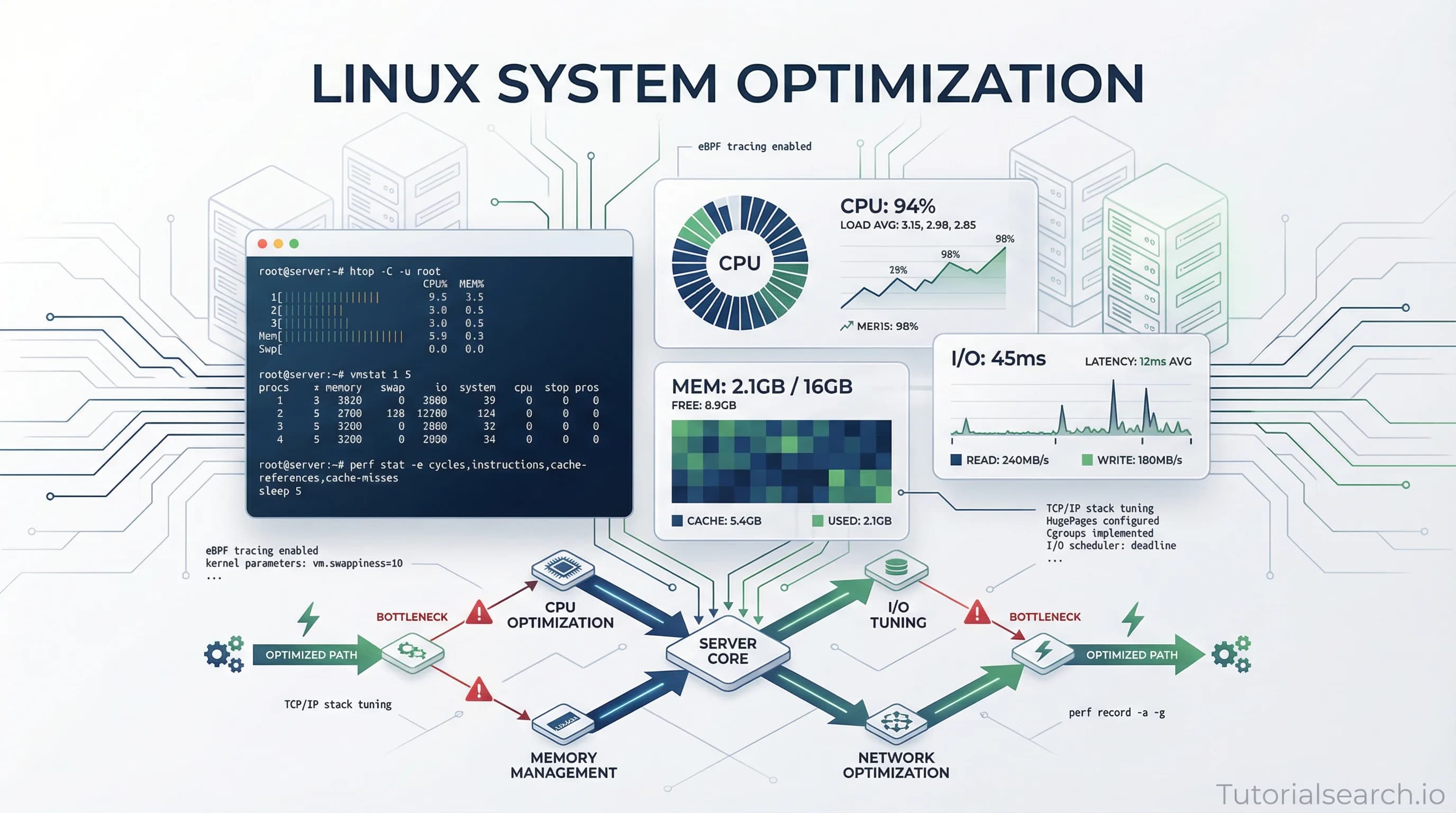
System Optimization Skills Every DevOps Engineer Should Know
System optimization separates engineers who understand their infrastructure from those who just add more RAM. Here are the best courses, tools, and free resources to learn it properly.
Hire the developers behind TutorialSearch.io
We built this site — full-stack web apps, AI integration & automation. Tell us what you need and we'll build yours.
System optimization is one of those skills that separates the engineers who understand their infrastructure from the ones who just add more RAM and hope for the best. If you work with Linux systems in a DevOps or IT role, knowing how to squeeze real performance out of existing hardware is worth more than almost any certification.
This guide covers the best courses, tools, and free resources for learning system optimization — from monitoring fundamentals to kernel-level tuning. You can also browse the full system optimization catalog on TutorialSearch.io.
Key Takeaways
- System optimization starts with measurement, not guessing — you need data before you tune anything
- The Linux System Optimization course on Pluralsight is the clearest structured training available
- Brendan Gregg's free resources at brendangregg.com are required reading for anyone serious about performance
- eBPF has transformed what's possible with Linux performance analysis in the last few years
- Knowing your tools — htop, perf, bpftrace, Prometheus — matters more than knowing every flag by heart
In This Article
- The System Optimization Courses That Pay Off
- System Optimization Tools You Should Already Know
- System Optimization YouTube Channels Worth Your Time
- System Optimization GitHub Repos Worth Starring
- Books for Going Deep on System Optimization
- The System Optimization Communities Where Pros Talk
- Related Skills That Pair Well With System Optimization
- Frequently Asked Questions About System Optimization
The System Optimization Courses That Pay Off
Most people learn system optimization the hard way: after something breaks in production. A structured course lets you build the mental models before things go wrong.
Here's what I'd recommend, ordered by usefulness for the typical DevOps engineer.
1. Linux System Optimization (Pluralsight) — [Editors' Choice]
Taught by David Clinton, this is the clearest course I've found on this topic. It covers CPU scheduling, memory management, disk I/O, and network tuning in a logical sequence. Clinton doesn't just show you commands — he explains why each tuning decision matters.
It's aimed at intermediate engineers who already know their way around Linux. If you're comfortable at the command line but haven't systematically learned performance tuning, this is where to start.
Topics covered:
- Identifying performance bottlenecks with monitoring tools
- Kernel parameter tuning with sysctl
- Managing process priorities and CPU affinity
- I/O scheduler configuration and disk performance
2. Linux Performance Monitoring & Analysis – Hands On (Udemy, ⭐ 4.46)
This course does exactly what the title says: it's hands-on. You'll work through real performance scenarios using tools like top, vmstat, iostat, sar, and perf. The instructor walks you through analysis workflows rather than just listing commands.
The applied approach makes abstract concepts click much faster.
Topics covered:
- Real-time performance monitoring workflows
- CPU, memory, and I/O analysis
- Using
sarfor historical performance data - Diagnosing common Linux performance issues
3. Mastering Back-End Performance Optimization: Practice Tests (Udemy, ⭐ 4.96) — [Editors' Choice]
This one surprised me. It's structured as practice tests, which sounds dry, but actually forces you to think through performance decisions actively rather than watching passively. Nearly 6,300 students have taken it — that's a strong signal.
If you've been through other courses and want to stress-test your knowledge, this is the most efficient way to find your gaps fast.
4. Master DevOps Monitoring with Prometheus (Udemy, ⭐ 4.33)
System optimization doesn't stop at the server level. Prometheus and Grafana have become the standard observability stack for modern infrastructure. This course covers both — metrics collection, PromQL queries, and dashboards that show exactly where your performance issues live.
Good for anyone working with containerized or cloud infrastructure.
5. Red Hat Certified Engineer (RHCE) EX294: Complete Exam Prep (Udemy, ⭐ 5.0)
If you work in enterprise Linux environments — RHEL in particular — this course covers the automation and systems management skills that complement performance tuning directly. It's certification prep, but the content is practical. Red Hat's own RHEL 10 documentation on eBPF-based performance analysis is worth bookmarking alongside it.
6. Hands-On Linux: 6 Linux Projects to Improve Your Resume (Udemy, ⭐ 4.42)
Not a performance course specifically, but useful for engineers who want to build the foundational Linux skills that make optimization work actually make sense. More than 111 system optimization courses are available on TutorialSearch if you want to browse further.
System Optimization Tools You Should Already Know
The tools matter as much as the courses. Here's a quick reference for what each major tool is designed for — so you don't reach for top when you actually need perf.
| Tool | Best For | Learning Curve | Cost |
|---|---|---|---|
| htop | Real-time process, CPU, memory overview | Low | Free |
| perf | CPU profiling, cache misses, kernel tracing | Medium | Free |
| bpftrace / BCC | Deep Linux tracing, custom eBPF programs | High | Free |
| Prometheus + Grafana | Long-term metrics, alerting, dashboards | Medium | Free (OSS) |
| sar (sysstat) | Historical system statistics | Low-Medium | Free |
| vmstat / iostat | Memory pressure and I/O activity snapshots | Low | Free |
Start with htop and vmstat for quick checks. Graduate to perf when you need to understand CPU behavior. Use bpftrace when you need to answer questions that nothing else can.
htop — The go-to interactive process viewer. It gives you a real-time view of CPU usage per core, memory pressure, and the process tree. If you don't have it installed, fix that now.
perf — The Linux profiling tool built into the kernel. It lets you count hardware events, sample call stacks, and trace kernel functions. Brendan Gregg's Linux perf Examples page is the best practical reference for it — and it's free.
eBPF tools (bpftrace / BCC) — eBPF (extended Berkeley Packet Filter) lets you run custom tracing programs inside the kernel without modifying kernel source code. It has transformed Linux observability in the last few years. The official ebpf.io site is a good starting point for understanding what's possible.
sar / sysstat — sar records system activity data over time, which is invaluable for post-incident analysis when real-time tools weren't running. The Linux Journal performance monitoring guide has a solid overview of sar-based workflows.
For current sysctl tuning guidance, OneUptime published a practical Linux performance tuning guide for 2026 covering kernel parameters and I/O scheduler configuration. It's worth reading alongside your coursework.
System Optimization YouTube Channels Worth Your Time
Hire the developers behind TutorialSearch.io
We built this site — full-stack web apps, AI integration & automation. Tell us what you need and we'll build yours.
Video learning works well for this topic. Watching someone trace through a real performance problem in a terminal is far more useful than reading about it abstractly.
NetworkChuck (3.9M+ subscribers) — Chuck covers Linux topics in a way that's accessible without being dumbed down. He has several videos on Linux performance and server configuration that work as good entry points. The production quality is high and he moves fast.
Hussein Nasser — Nasser targets intermediate-to-advanced engineers and goes deep on database internals, networking protocols, and backend performance. His explanations of why things behave the way they do are genuinely valuable. Less entertainment, more depth.
Chris Titus Tech (600K+ subscribers) — Covers Linux system administration with a practical slant. Good for configuration comparisons and workflow improvements. His YouTube channel is worth bookmarking if you work with Linux desktops or mixed environments.
Level1Techs (424K subscribers) — Skews toward hardware and platform-level performance. Useful for understanding what's happening at the CPU and memory level — context that matters when you're doing kernel-level tuning.
System Optimization GitHub Repos Worth Starring
brendangregg/perf-tools — [Editors' Choice]
Brendan Gregg's collection of performance analysis tools built on Linux perf_events and ftrace. If you're serious about system performance, Gregg's tools and methodology are foundational. The companion Linux Performance page maps every layer of the Linux stack to the tools that observe it — one of the most useful reference diagrams in the field.
awesome-foss/awesome-sysadmin — A curated list of open-source sysadmin resources organized by category. The monitoring and performance sections cover tools from Prometheus to Netdata to Glances. A good reference when you're looking for something specific.
For DevOps Automation work that complements optimization — like automated remediation — Ansible and Terraform repos are worth exploring alongside these.
Books for Going Deep on System Optimization
Systems Performance: Enterprise and the Cloud, 2nd Edition by Brendan Gregg — [Editors' Choice]
Everyone recommends this book, and the recommendation is earned. It's the most comprehensive treatment of Linux and cloud systems performance analysis in print. The 2nd edition covers eBPF, cloud environments, and modern hardware. It's 793 pages — not a quick read. But if you work with performance-critical systems, no other book comes close.
BPF Performance Tools by Brendan Gregg
A more focused companion to Systems Performance, covering over 150 BPF tools in detail. If you want to go deep on eBPF-based observability specifically, this is the reference. Gregg's site links to supplementary materials.
Arch Linux: Improving Performance (Free, Online)
Not a book, but the Arch Linux performance guide is thorough, well-maintained, and covers a wide range of tuning techniques — from kernel parameters to file system choices. It's free, regularly updated, and applies broadly beyond just Arch systems.
The System Optimization Communities Where Pros Talk
r/sysadmin — Nearly 900K members. Quality varies, but the volume of real production experience represented here is high. Good for asking about specific performance issues you're hitting.
r/linuxadmin — More focused than r/sysadmin, with roughly 200K members. Better signal-to-noise ratio for Linux-specific performance and tuning questions.
Sysadmin Discord — 25,000+ members. More real-time than Reddit. Useful when you need a quick answer or want to talk through a problem live.
Server Fault (Stack Exchange) — serverfault.com is the Q&A site for professional system administration. The archive of answered questions is enormous and well-indexed. If you have a specific tuning question, there's a good chance it's already been answered.
Linux Foundation — Offers forums and resources around kernel development and system administration. Less chatty than Reddit, more oriented toward deeper technical content and training.
The communities above are also excellent for IT Expertise more broadly — networking, security, and infrastructure topics all have active presence there.
Related Skills That Pair Well With System Optimization
System optimization rarely exists in isolation. Once you're comfortable with it, these adjacent skills become immediately relevant:
- Linux Fundamentals — If system optimization is where you want to go, strong Linux foundations are where you need to start. You can't tune what you don't understand.
- DevOps Automation — Automating performance monitoring and remediation is the natural next step after manual tuning work.
- Network Automation — Network performance is part of system performance. Latency and throughput issues often originate at the network layer.
- Docker Containers — Container resource limits and cgroup configuration are increasingly where system optimization work happens in practice.
- DevOps Essentials — The broader DevOps skillset puts system optimization in its proper context: part of a continuous improvement culture.
- Windows Systems — Mixed environments mean Windows performance tuning is worth knowing too.
- Network Fundamentals — Understanding how traffic flows through your network helps you diagnose the full performance picture.
Browse all courses in the DevOps & IT category for more.
Frequently Asked Questions About System Optimization
How long does it take to learn system optimization?
The basics — reading monitoring data, using htop, vmstat, iostat — can be learned in a weekend. Real proficiency takes months of work on actual systems. Plan for 3–6 months of consistent practice before you feel confident diagnosing and fixing real performance problems.
Do I need Linux experience before starting with system optimization?
Yes, a working knowledge of Linux is essential. You don't need to be an expert, but you should be comfortable at the command line. The Linux Fundamentals courses on TutorialSearch are a good place to build that foundation first.
Can I get a job with system optimization skills?
Yes. Performance engineering, site reliability engineering (SRE), and senior DevOps roles specifically value these skills. Knowing how to diagnose and fix performance problems at the OS level is a real differentiator — many candidates know frameworks well, but fewer understand what runs underneath.
What tools help with system optimization?
The core toolkit: htop, perf, vmstat, iostat, sar, and — for deeper tracing — bpftrace and BCC (the BPF Compiler Collection). Prometheus and Grafana handle long-term metrics and alerting. The system optimization resources on TutorialSearch cover most of these in practical context.
How does system optimization relate to cloud computing?
Cloud optimization means right-sizing instances, optimizing storage I/O, and managing network throughput — the same core principles as on-premises, applied to virtualized infrastructure. The skills transfer directly. Cloud environments add cost as a variable that on-prem tuning doesn't always account for, which changes some priorities.
Why is system optimization important for DevOps?
A slow system isn't just a performance problem. It's a cost problem, a reliability problem, and often an incident waiting to happen. DevOps engineers who understand system optimization can prevent problems before they occur and resolve them faster when they do. The full DevOps & IT course catalog puts this skill in its broader context.
System optimization rewards curiosity. The engineers who get really good at it are usually the ones who see a slow query or a sluggish server and want to understand why — not just fix it and move on. The tools are there. The courses are there. The communities are there. The next step is yours.