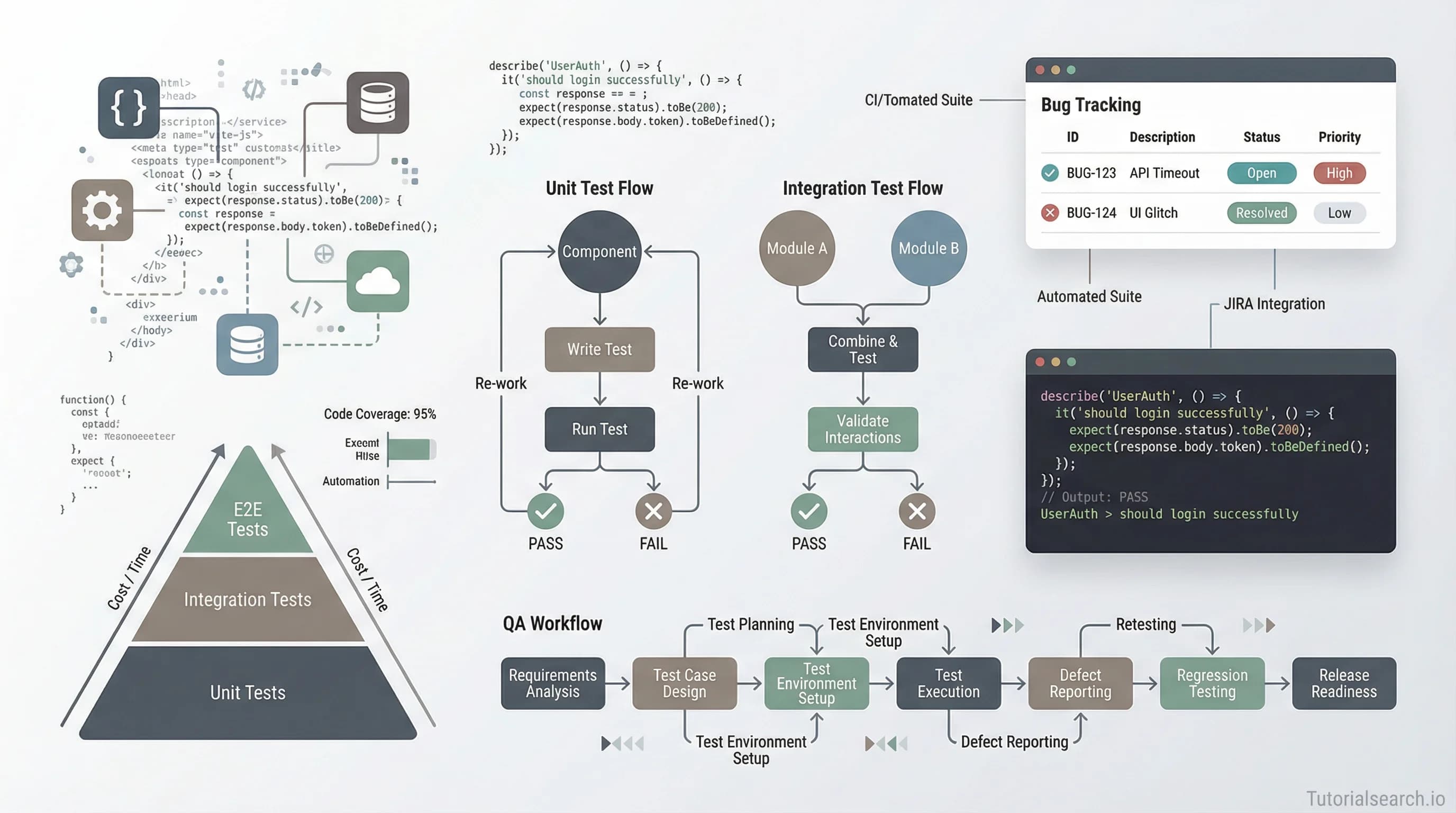
Software Testing Fundamentals Worth Getting Right
Most testers learn tools before understanding testing fundamentals — here are the courses, free resources, and books that build the right foundation first.
Need a web app built? Hire the team behind TutorialSearch.io
We ship fast, production-grade full-stack apps (Next.js, React, edge infra) — the same stack that powers this site.
Software testing fundamentals are the difference between shipping software you trust and software you hope works. Most beginners skip straight to automation tools and wonder why their tests break the moment anything changes.
I've seen this pattern more times than I can count. Someone learns Selenium or Cypress on day one, writes a hundred brittle tests, and then spends all their time fixing tests instead of finding bugs. The fundamentals — test case design, the testing lifecycle, defect reporting, thinking in equivalence classes — none of that got touched. The result is a test suite that gives false confidence.
This guide covers the testing fundamentals courses, free resources, YouTube channels, books, and communities that actually build the right foundation. Whether you're aiming for a QA career or just want to write better tests for your own code, start here.
Key Takeaways
- Software testing fundamentals cover the principles, lifecycle, and design techniques that apply to every testing context — not just one tool
- Learning testing fundamentals before automation tools saves you weeks of rework and produces more reliable test suites
- The ISTQB Foundation Level syllabus is the closest thing to a universal standard for what every tester should know
- Both paid courses and free resources like Guru99 and GeeksforGeeks can get you to a solid foundation
- The software testing community is surprisingly welcoming — join Ministry of Testing early, not later
In This Article
- Where Most Software Testing Journeys Go Wrong
- The Software Testing Fundamentals Courses Worth Your Time
- Testing Fundamentals You Can Learn Without Spending a Dime
- Software Testing YouTube Channels That Actually Teach Something
- The Software Testing GitHub Repos Worth Bookmarking
- Software Testing Books Worth Reading at Least Once
- Software Testing Communities Where Testers Actually Help Each Other
- Related Skills That Pair Well With Testing Fundamentals
- Frequently Asked Questions About Testing Fundamentals
Where Most Software Testing Journeys Go Wrong
Pick up any software testing forum thread from a frustrated beginner and you'll see the same story. They learned a tool first — Selenium, Postman, maybe pytest — and jumped into writing tests. Six months later, their test suite is flaky, nobody trusts it, and they're not sure what to fix.
The issue isn't the tool. It's that they skipped the mental model that makes testing work.
Testing fundamentals cover concepts like:
- Testing levels — unit tests check individual functions, integration tests check how components talk to each other, system tests check the whole thing end to end, and acceptance tests confirm the software does what the business actually needs
- Testing types — functional (does it do what it's supposed to?), non-functional (how fast, how secure, how stable?), regression (did we break anything we fixed before?)
- Black-box vs. white-box testing — black-box means you test behavior without looking at the code; white-box means you use knowledge of the code to design tests
- Test case design techniques — equivalence partitioning (group similar inputs and test one from each group), boundary value analysis (test the edges, not the middle), decision tables (map out combinations of conditions systematically)
- The software testing life cycle (STLC) — a structured process from requirements analysis through test closure
None of this is glamorous. But it's the reason some testers find bugs others miss.
You can explore 265+ testing fundamentals courses on TutorialSearch.io — from beginner introductions to certification prep. The range is wide, and the quality varies just as much. Here's what's actually worth your time.
The Software Testing Fundamentals Courses Worth Your Time
There are courses here for three different goals: understanding testing as a developer, getting a QA job, and passing ISTQB certification. They don't overlap as much as you'd think.
If You're a Developer Who Wants to Test Your Own Code
Unit Testing Fundamentals (Pluralsight) — [Editors' Choice]
Rag Dhiman's course is the one I'd hand to a developer who has written zero tests. It covers what unit tests actually are, why isolation matters, mocking, and how to design tests that don't just pass — they mean something. Dhiman explains the "arrange, act, assert" pattern clearly and doesn't skip the parts that beginners usually get wrong (like testing implementation instead of behavior). Rating: 4.3.
- What makes a good unit test vs. a bad one
- Test doubles, mocks, and stubs — when to use each
- Keeping tests independent so they don't fail in unpredictable order
Python Unit Testing Fundamentals (unittest & pytest) (Udemy)
Coding Gears built this for Python developers who know the language but haven't written tests. It covers both the standard
unittestlibrary and the more popularpytestframework side by side — which is genuinely useful because you'll encounter both in real codebases. 2,415 students, rated 4.5.Postman API Testing Fundamentals (Udemy)
Praveenkumar Bouna's course covers API testing from scratch using Postman. If your work involves REST APIs (and most of it does), this is worth a few hours. It teaches how to write and organize requests, set up environments, and create test scripts. Rated 4.5, 3,236 students.
If You Want a QA Career
Fundamentals of Software Testing Course (Udemy) — [Editors' Choice]
Rated 4.4 with 3,211 students, this is the most complete beginner overview I found. It covers SDLC, STLC, testing types, test case design, defect life cycle, and test documentation. It's not flashy, but it covers exactly what hiring managers ask about in QA interviews. If you're studying for your first QA role, start here.
- Software Development Life Cycle (SDLC) and how testing fits in
- How to write clear, useful test cases from requirements
- Bug reporting: what to include so developers can actually reproduce it
Software Testing Mastery: From Basics to Advanced Techniques (Udemy)
Rated 4.6 with 240 students. Smaller enrollment but unusually high ratings. Good for someone who's done a basics course and wants a bridge to more advanced QA work without jumping straight into automation.
Introduction to Software Testing (Udemy)
Clean intro course, rated 4.4, 1,474 students. If you want something shorter and more focused than the full fundamentals course, this works well as a first pass. It covers testing principles without going deep on any one area.
If You're Going for ISTQB Certification
ISTQB Certified Tester – Foundation Level v4.0 (Udemy) — [Editors' Choice]
ISTQB (International Software Testing Qualifications Board) Foundation Level is the most widely recognized entry-level certification in software testing. This Udemy prep course covers the updated v4.0 syllabus directly — testing principles, test management, test analysis, test design techniques, and test execution. Rated 4.2, 236 students.
Everyone recommends ISTQB certification as a "nice to have." My honest opinion: it's worth pursuing early, not later. It forces you to learn testing vocabulary precisely, which makes every future job conversation easier. The terminology problem in testing is real — "sanity testing" means different things to different teams, but "equivalence partitioning" doesn't.
If you want to explore beyond these seven, the full software testing category has hundreds of options across tools, methodologies, and specializations.
Testing Fundamentals You Can Learn Without Spending a Dime
Paid courses aren't the only path. Some of the best testing fundamentals content is free.
Guru99 Software Testing Tutorial is the most comprehensive free resource I've found for manual testing fundamentals. It covers SDLC, STLC, testing levels, test case design, defect tracking, and more — all written for beginners. The content is a bit dry, but it's accurate and well-organized. Start here if you want a free textbook equivalent.
GeeksforGeeks Software Testing Tutorial covers similar ground with a more technical slant. It's particularly good on black-box and white-box testing techniques, boundary value analysis, and formal test design methods. Useful alongside Guru99 rather than instead of it.
ToolsQA Software Testing Tutorial has a nice ISTQB-aligned structure. If you're studying for Foundation Level, ToolsQA's free content covers the same concepts as the paid courses — just without the guided exercises and video explanations.
QA Wolf — Fundamentals of Software Testing is a shorter read but pulls together the essentials well. Good if you want a quick map of the landscape before diving into anything detailed.
BugBug — Software Testing Basics for 2026 covers how testing has evolved in continuous delivery environments. More relevant to modern teams than some of the older tutorial sites.
My Great Learning Free Software Testing Course is a structured course with a certificate — 2.25 hours covering SDLC, testing models, and documentation. Not deep, but it gives you a credential to show employers while you're still learning.
If you only pick one free resource: Guru99. It's not the most exciting read, but it covers more ground accurately than anything else at no cost. Pair it with ToolsQA if you want ISTQB alignment.
If your testing work involves data, you might also want to look at Data Analysis courses — the testing and data worlds overlap more than people expect.
Software Testing YouTube Channels That Actually Teach Something
Need a web app built? Hire the team behind TutorialSearch.io
We ship fast, production-grade full-stack apps (Next.js, React, edge infra) — the same stack that powers this site.
Most software testing YouTube channels either cover tools without context (here's how to write a Selenium test) or are too abstract to be useful. These three actually teach you how to think about testing.
Raghav Pal — Automation Step By Step has 449K+ subscribers and is one of the best channels for testers who come from a non-engineering background. Raghav explains programming concepts for testers first — he doesn't assume you already know Java or Python. His fundamentals content is clear without being dumbed down. Start with his manual testing playlist before the automation content.
Guru99 on YouTube mirrors the tutorial site content in video form. The "Software Testing Training – Manual Testing Basics for Beginners" playlist has 24 videos and over 2 million views. Good for visual learners who find the website format hard to stick with.
Software Testing Help — 300+ tutorials covering the full testing spectrum, from manual fundamentals to Selenium automation. Launched in 2007, so there's a massive archive. The older videos hold up surprisingly well for fundamentals content since the core concepts don't change much.
Joe Colantonio — TestTalks takes a different approach. Less tutorial, more interview and discussion. His "Automation Testing for Beginners" playlist (62 videos) covers mindset and strategy alongside tools. Worth watching once you've got the basics down and want to understand how real teams think about testing.
A note on YouTube learning: these channels are best for conceptual explanations. Don't try to follow along with automation tutorials until you've worked through the fundamentals in a structured course. Watching someone write tests is not the same as understanding why those tests are designed that way.
The Software Testing GitHub Repos Worth Bookmarking
Most GitHub learning repos are just link dumps. These ones are actually curated and useful.
TheJambo/awesome-testing — [Editors' Choice]
This is the best general-purpose testing resource list on GitHub. It's been maintained for years and covers testing tools, learning resources, conferences, browser testing, security testing, performance, and more. The scope is broad enough to be useful at every career stage. Star this early and come back to it often.
PaulWaltersDev/FreeLearningResourcesForSoftwareTesters
Exactly what it says: a curated list of free learning resources organized by topic — from SDLC basics to exploratory testing to test management. Built for people who don't want to pay for courses but want structured learning paths. Useful for filling specific gaps in your knowledge.
mfaisalkhatri/awesome-learning
Written by someone who came from a non-engineering background and made it to Test Automation Engineer. The perspective is different from most resource lists — it's structured around a real career transition story, which makes the learning path feel more grounded. Particularly useful if you're coming to testing without a CS degree.
testified-oss/awesome-testing-resources
Focused specifically on practice sites — places to actually do testing, not just read about it. Covers UI automation playgrounds, API testing practice apps, and security testing vulnerable apps. If you want to build skills by doing, not just reading, this is the list to follow.
If the automation side of testing interests you, there are 900+ courses in the Automation Testing section — and understanding the fundamentals first makes every one of those courses more useful.
Software Testing Books Worth Reading at Least Once
Books age faster in software testing than in most fields, but these have held up.
"Foundations of Software Testing: ISTQB Certification" by Rex Black, Erik van Veenendaal, and Dorothy Graham
This is the official ISTQB reference for Foundation Level certification — the 4th edition aligns with the current v4.0 syllabus. It's dense but thorough. If you're going for the certification, you need this book. Even if you're not, the formal definitions of testing concepts here are worth having.
"Lessons Learned in Software Testing" by Cem Kaner, James Bach, and Bret Pettichord
293 short lessons, each one a page or less. No fluff. The lessons are practical observations from people who have spent decades finding bugs in real software — things like "tests that always pass are worthless" and "the goal is not to find bugs, it's to provide information." Read one or two lessons a day. This book changes how you think about the job.
"The Art of Software Testing" by Glenford J. Myers (updated by Corey Sandler)
Originally written in 1979, updated in 2011. The age might scare you off, but the core content — how to design test cases systematically, the psychology of testing, program inspections — has barely dated. It's the classic text for a reason. If you want to understand why modern test design techniques look the way they do, read this.
"Software Testing: A Craftsman's Approach" by Paul C. Jorgensen
Strong on the mathematical foundations of test design — not as intimidating as that sounds. Good for people who want to understand equivalence partitioning, boundary value analysis, and decision tables at a deeper level than a certification course covers.
For testers working with enterprise tools, it's worth knowing that Test Design has its own dedicated set of 791+ courses on TutorialSearch.io.
Software Testing Communities Where Testers Actually Help Each Other
Ministry of Testing — The Club
The most active online community for software testers. Ministry of Testing has been around since 2007, and The Club forum is where serious testers hang out. You can ask beginner questions without getting condescended to, which isn't true everywhere. They also run events, 30 Days of Testing challenges, and professional development content. Join this before you feel ready — the learning curve is much easier when you're learning alongside people.
Reddit — r/softwaretesting
Over 20,000 members. Good for quick questions, job search advice, and tool recommendations. Less formal than Ministry of Testing. The community skews toward people actively working in QA, so practical questions get practical answers. Less useful for deep technical discussions but great for real-world perspective.
Discord — QA/Testing servers
The Playwright Community Discord is active if you're working with browser automation. The Cypress community has a channel on Matrix and Discord with 11,000+ members. For general testing, search DISBOARD for software testing servers — there's an active general QA community there worth joining.
These communities are especially useful for Software Quality discussions — the kind of conversations that don't fit into a course curriculum.
Related Skills That Pair Well With Testing Fundamentals
Testing fundamentals are just the start. Here's what most experienced testers develop next:
- Automation Testing — 902+ courses. The logical next step once you know what to automate and why. Selenium, Cypress, Playwright, and pytest are the dominant tools.
- Test Design — 791+ courses. Goes deeper into formal test design techniques beyond the basics. Boundary value analysis, state transition testing, and combinatorial methods.
- Software Quality — 504+ courses. The broader discipline of quality engineering — process improvement, metrics, standards, and QA in agile environments.
- Data Analysis — 522+ courses. Increasingly relevant as data-driven applications become more common. Testing data pipelines and validating data quality is its own skill.
- Excel Analysis — 698+ courses. Still used extensively in QA for test management, defect tracking, and reporting in teams that haven't moved to dedicated tools.
- SAP Quality — 441+ courses. If you're testing in enterprise environments, SAP-specific testing knowledge is a significant differentiator.
You can also search across all testing fundamentals resources or browse the complete software testing category.
Frequently Asked Questions About Testing Fundamentals
How long does it take to learn software testing fundamentals?
Most people reach a solid working understanding in 4–8 weeks. That assumes a few hours per day across a structured course and practical exercises. ISTQB Foundation Level certification typically takes 6–10 weeks of part-time study. The fundamentals themselves aren't complicated — what takes time is building the intuition to apply them to unfamiliar software.
Do I need to know how to code to learn software testing fundamentals?
No. Testing fundamentals — test case design, the STLC, defect reporting, testing levels — are not about writing code. You can build a complete foundation without programming. That said, knowing even basic coding makes you more effective at test automation later, and the job market rewards testers who can do both. If coding interests you, Python is the most practical starting point.
Can I get a QA job with just testing fundamentals knowledge?
Yes, especially for manual QA roles. Entry-level QA positions typically require knowledge of testing fundamentals, the ability to write clear test cases, and basic defect reporting skills — not automation. ISTQB Foundation Level certification strengthens your application significantly. Check the Fundamentals of Software Testing Course if you're targeting your first QA role.
What's the difference between testing fundamentals and test automation?
Testing fundamentals are the principles — what to test, why, and how to design effective tests. Test automation is the practice of writing code or scripts to execute those tests automatically. You can know fundamentals without knowing automation, but good automation requires fundamentals. Most professionals recommend learning fundamentals first. Explore the Automation Testing courses once you have the foundation down.
How do testing fundamentals relate to ISTQB?
ISTQB Foundation Level (CTFL) is essentially a formal examination of testing fundamentals. It covers testing principles, the test lifecycle, test techniques, test management, and tool support. Studying for ISTQB is one of the most efficient ways to learn fundamentals systematically because the syllabus is precisely defined and widely recognized.
The mistake most beginners make is assuming that learning a testing tool means they understand testing. It doesn't. A selenium test written without understanding boundary value analysis or equivalence partitioning is just a script that confirms obvious things work.
Start with the fundamentals. Learn what you're actually supposed to be testing and why, before you automate any of it. The courses and resources above are the fastest path there.