The Research Methods Learning Path That Actually Works
Research methods is where most academic projects succeed or fail. Here are the best courses, free resources, YouTube channels, and books that build real research skills.
Hire the developers behind TutorialSearch.io
We built this site — full-stack web apps, AI integration & automation. Tell us what you need and we'll build yours.
Research methods is where most academic projects succeed or fail — not because of data quality, but because of design choices made long before data collection starts.
The most common mistake? Jumping straight to gathering data. A student builds a 20-question survey, sends it out, collects 200 responses, and then realizes none of the questions actually answer the research question. Or a postgrad conducts six weeks of interviews without a coding framework to analyze them. The data exists. The conclusions don't.
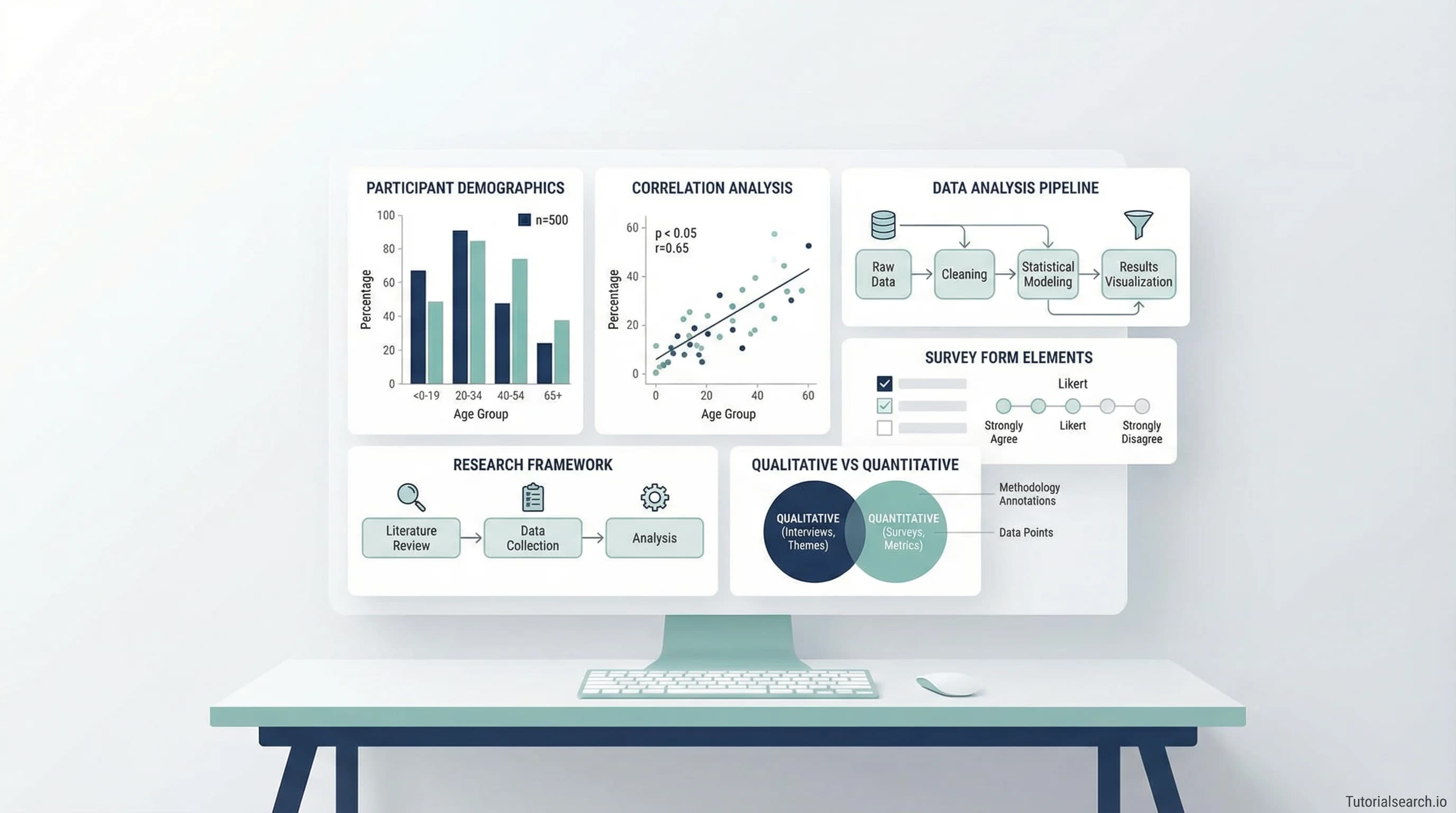
Getting research methods right means understanding a sequence: problem → question → design → collection → analysis → interpretation. Skip the design phase and everything downstream suffers. You can browse 158+ research methods courses on TutorialSearch to find what fits your stage. But first, here's a practical path through what matters and when.
Key Takeaways
- Research methods covers the full cycle from study design to interpretation — every stage connects to the next.
- Most beginners start with data collection and work backward; starting with the research question is the better move.
- Qualitative and quantitative research methods each have strengths — most serious projects use both.
- Free research methods resources from universities and platforms like Coursera are genuinely strong starting points.
- The right research methods course depends on your field — business, social science, health, and psychology each have their own conventions.
In This Article
- Research Methods Courses Worth Starting With
- Free Research Methods Resources That Are Surprisingly Good
- Research Methods YouTube Channels That Teach the Real Thing
- Research Methods Books for Going Deeper
- Research Methods GitHub Repos and Open Tools
- The Research Methods Communities Where People Actually Help
- Related Skills That Pair Well With Research Methods
- Frequently Asked Questions About Research Methods
Research Methods Courses Worth Starting With
Most research methods courses fall into two camps: overview courses that give you the vocabulary, and field-specific courses that dig into how psychology, business, health, or social science research actually works. The strongest path is to start with an overview and then go deep in your field.
1. Research Methods For Business Students [Editors' Choice]
Instructor: Robert Barcik | ⭐ 4.5 | 5,453 students
This is the course I'd hand to someone starting out with no background. It walks through the full research process — from defining a problem to interpreting results — without drowning you in academic jargon. The business framing keeps the focus on "why does this answer actually matter?" which is more useful than abstract theory.
Topics covered:
- Research problem formulation
- Qualitative vs. quantitative design choices
- Survey construction and sampling
- Data analysis and interpretation
- Writing up and presenting findings
The pacing is brisk but not rushed. Barcik explains concepts plainly. For anyone new to research, this is a solid first course.
2. Research Methods and Statistics: An Introduction [Editors' Choice]
Instructor: Monk Prayogshala | ⭐ 4.5 | 5,400 students
Most research methods courses treat statistics as an afterthought, tacked on at the end. This one builds them in from the beginning. Prayogshala is a psychologist, so examples lean toward behavioral and social science — but the logic applies across fields. If you want methods and statistics in one place, this is worth it. It's the kind of course that prevents the "I collected data but now I don't know how to analyze it" problem.
3. Research Methods Made Easy
Instructor: Dr Asif Kamal | ⭐ 4.5 | 1,526 students
The name is slightly optimistic — research methods are never fully "easy" — but this course earns it. Dr. Kamal strips the process to its essentials, covering research design, data collection, and analysis without unnecessary complexity. Useful for students who are intimidated by heavier courses or textbooks.
4. Research Methods for Dissertation Business Students [Editors' Choice]
Instructor: Dr Ryan Thomas Williams | ⭐ 5.0 | 1,003 students
A perfect five-star rating. More importantly, this course earns it. It's narrower in scope — built specifically for postgraduate business students doing dissertations — but that focus is its biggest strength. Every module answers a question dissertation students actually ask. If you're at this stage, this course is one of the most practical you'll find anywhere.
5. Research Methods for Medical and Health Studies
Instructor: Dr. Hasanain Ghazi | ⭐ 3.9 | 282 students
Healthcare research has its own vocabulary: clinical trials, epidemiology, evidence hierarchies, systematic reviews. This intermediate course covers the specific challenges of health research including ethics clearance, controlled trials, and case studies. Not for beginners, but it fills a real gap for health science students.
6. Research Methods in Social Science (Certificate)
Instructor: Dr. Bev Knox | ⭐ 5.0 | 7 students
Small enrollment, perfect rating. Dr. Knox's course includes a certificate, which is useful for academics needing documented credentials. Social science-focused, covering ethnography, discourse analysis, interviews, and surveys. Worth considering if you're in sociology, education, or political science.
Qualitative vs. Quantitative: A Quick Comparison
The debate about whether to use qualitative or quantitative research methods is largely a waste of time for beginners. Most real research questions benefit from some mix of both. Pick the combination that fits your question, not the one fashionable in your department.
Here's the practical breakdown:
| Qualitative | Quantitative | |
|---|---|---|
| What it does | Explores meaning, context, experience | Measures patterns, tests hypotheses |
| Data type | Words, themes, observations | Numbers, statistics |
| Common methods | Interviews, focus groups, ethnography | Surveys, experiments, existing datasets |
| Best for | "Why" and "how" questions | "How many" and "does X cause Y" |
| Weakness | Hard to generalize broadly | Can miss nuance and context |
| Sample size | Small (often 10–30) | Large (often 100+) |
Most research methods courses now teach mixed methods — using both approaches in the same study to get a fuller picture. It's worth learning both even if your current project leans one direction.
Free Research Methods Resources That Are Surprisingly Good
Paid courses are useful, but some of the most reliable research methods materials are completely free. These are worth bookmarking.
UC Berkeley Library Research Methods Guide
Berkeley's library built one of the cleaner open research methods guides available. It covers quantitative, qualitative, data science methods, text mining, and systematic reviews. The guide is organized around SAGE Research Methods — a database that contains case studies, instructional videos, and sample datasets. Even without a Berkeley login, the external links and resource categories are useful.
Coursera: Understanding Research Methods
Free to audit. This Coursera course is one of the highest-rated introductions to the topic available online. It covers research design, ethics, literature reviews, and basic analysis. Good for learners who prefer video lessons over textbooks. You can preview the first module without paying anything.
Alison: Essentials of Research Methodology
Alison's free course covers the full arc: formulating a research problem, designing methods, selecting samples, collecting data, analyzing it, and writing a proposal. Completely free to take, with an optional certificate fee. It's a strong no-cost alternative if budget is a real constraint.
Not entirely free — most access is through university libraries — but many institutions subscribe. If yours does, this is one of the most comprehensive research methods libraries available: nearly 130 hours of video, Little Green Books (quantitative focus), Little Blue Books (qualitative focus), encyclopedias, and real case studies. Check your library's database list before paying for anything else.
Emerald Publishing: Research Methods Guides
Short, practical guides from Emerald on specific methodological decisions: how to design a survey, how to run thematic analysis, how to write a literature review. Written by researchers for researchers. Free to read online, with no registration required.
If you want a broader search across platforms, TutorialSearch.io indexes free and paid research methods resources in one searchable place. Many learners building research skills also end up developing academic writing skills in parallel — both reinforce each other closely.
Research Methods YouTube Channels That Teach the Real Thing
Hire the developers behind TutorialSearch.io
We built this site — full-stack web apps, AI integration & automation. Tell us what you need and we'll build yours.
Most educational YouTube channels about research methods are decent but forgettable. A few genuinely stand out.
Dr. Todd Grande (YouTube)
1.6 million subscribers. Over 3,600 videos. Grande built his channel around counseling and psychology, but his statistical and research methods content is some of the most accessible around. He has 190+ videos specifically on SPSS (the statistical software widely used in social science research), plus content on research design, hypothesis testing, and data analysis. No filler. Just the concept, the application, and a clear explanation. Search "Dr Todd Grande research methods" on YouTube and start with his SPSS basics playlist.
SPSS Tutorials (spss-tutorials.com)
If your research involves social science, behavioral science, or health studies, you will likely encounter SPSS at some point. The free tutorials at spss-tutorials.com — and their companion YouTube content — walk through everything from data entry to regression analysis. The site is plain and functional, not flashy. The content is clear and complete, which matters more.
Sage Research Methods Video (methods.sagepub.com/video)
Nearly 130 hours of structured video covering the whole research methods curriculum — from philosophy of science through to specific analytical techniques. Access is typically through a university library subscription. If your institution has it, this is one of the most organized video libraries available on the subject.
Research Methods Books for Going Deeper
Everyone recommends starting with a textbook. The real question is which one, because picking wrong can make research methods feel more complicated than it is.
Contrarian take: Skip the thick 500-page reference books for now. If you're a beginner, a comprehensive guide will slow you down. Start shorter and more targeted.
"Research Methodology: A Step-by-Step Guide for Beginners" by Ranjit Kumar
The title delivers. Kumar walks through the research process sequentially: define your problem, identify your approach, collect data, analyze it, write it up. Each chapter functions as a standalone module. Good for self-directed learning.
"The Craft of Research" by Booth, Colomb, and Williams [Editors' Choice]
This is the book that changes how people think about research. It's less about specific methods and more about reasoning — how to ask good questions, find evidence, build arguments, and communicate findings clearly. Widely used in academic writing courses. Anyone doing any research, academic or professional, will get something from it.
"Research Design: Qualitative, Quantitative, and Mixed Methods Approaches" by Creswell & Creswell
The sixth edition is the current standard reference for mixed methods research design. Comprehensive — maybe too dense for beginners — but invaluable once you're designing a study and need to justify your methodological choices. Updated with APA 7th edition standards.
"Introducing Research Methodology" by Uwe Flick
Flick's book bridges the qualitative and quantitative traditions without overwhelming you. More readable than Creswell as a starting point. Good for social science students who need a single-volume intro covering both approaches.
Free option: The PDF "Research Methodology: Tools and Techniques" from EU Academic (euacademic.org) is a decent no-cost overview. Not as polished as the books above, but it covers the fundamentals without any purchase.
Research Methods GitHub Repos and Open Tools
Researchers don't talk about GitHub much, but there are genuinely useful repos here — especially for understanding how working researchers apply the methods taught in courses.
A curated list of reproducible research case studies, projects, tutorials, and media. Reproducibility is one of the biggest ongoing problems in modern research — this repo takes it seriously. If you've read a paper and wondered how to actually verify or replicate the findings, this is full of real examples showing how researchers approach it.
A broad collection of research tools: reference managers (Zotero, Mendeley), writing tools, data visualization options, and collaboration platforms. Well-organized website version available. More useful for finding specific tools than for learning research methods concepts directly.
Awesome Computational Social Science
For researchers working at the intersection of social science and computational methods. Covers SICSS (Summer Institute in Computational Social Science) learning materials, social media data methods, and digital research approaches. Increasingly relevant as research methods expand beyond traditional surveys and experiments to include digital trace data.
These repos are also helpful for seeing how practicing researchers talk about methods — the gap between classroom knowledge and actual practice is real, and GitHub can bridge it.
The Research Methods Communities Where People Actually Help
Good communities don't just confirm what's right. They help you figure out why you're stuck.
r/AskAcademia and r/GradSchool (Reddit)
These two subreddits are where graduate students and early-career researchers congregate. Questions about research design, methodology choices, and statistical analysis come up constantly and usually get thoughtful answers. Search before posting — many common questions have been answered thoroughly. The r/labrats subreddit is also useful for empirical and lab-based research questions.
D/ARC — Discord Academic Research Community (darcmode.org)
An inclusive network of over 700 media researchers and academics focused on digital and social media research methods. If you're researching online platforms or using digital methods, this is a surprisingly active and helpful community. Graduate students and junior faculty are explicitly welcome.
Study Together (studytogether.com/discord)
Less about methodology, more about accountability. This is a Discord community with 24/7 virtual study rooms for students and researchers who want to work alongside others. Useful during the long data analysis phase when you need focus more than answers.
Research methods connects closely to academic skills and student success more broadly — critical reading, time management, and writing all feed directly into doing good research.
Related Skills That Pair Well With Research Methods
Research methods works better when you build the surrounding skills too. These areas connect naturally:
- Academic Writing — Research findings only matter if you can communicate them clearly. Writing and research methods are two sides of the same coin.
- Academic Skills — Critical reading, note-taking, and literature review skills feed directly into the early stages of research design.
- Test Preparation — If you're studying research methods for a qualifying exam, targeted preparation makes a real difference.
- Teacher Strategies — Educators who teach research methods will find overlapping content here, especially around evidence-based teaching practices.
- AI Pedagogy — AI tools are changing how research is conducted and taught. This category covers integrating AI into learning and research workflows.
- Student Success — The study habits and self-management skills that make or break long research projects.
- Academic Exams — Useful if your research methods knowledge will be formally evaluated.
- Online Teaching — For educators looking to teach research methods in digital formats.
Frequently Asked Questions About Research Methods
How long does it take to learn research methods?
A solid beginner-level understanding takes 4–8 weeks of consistent study. That's enough to design and carry out a basic study with either qualitative or quantitative methods. Getting comfortable with advanced approaches — mixed methods, longitudinal designs, complex statistical analysis — takes considerably longer, often a full semester. The Research Methods For Business Students course covers the fundamentals in about 6–8 hours of video.
Do I need statistics knowledge to learn research methods?
Not at the start. But you'll need some statistics eventually for quantitative work. Many courses build in the necessary stats as you go. If you want both from the beginning, Research Methods and Statistics: An Introduction is designed exactly for this combination.
What are the core components of research methods?
Research methods typically cover six stages: problem formulation, literature review, research design, data collection, data analysis, and interpretation and write-up. Understanding how they connect is more important than mastering any single stage. You can explore more at the TutorialSearch research methods page.
What's the difference between qualitative and quantitative research methods?
Qualitative methods explore meaning and experience through words and observation — interviews, focus groups, ethnography. Quantitative methods measure and test through numbers — surveys, experiments, statistical datasets. Most modern research combines both, which is called mixed methods. Neither approach is inherently better; the right choice depends on your research question.
Can I get a job using research methods skills?
Yes, across more industries than most people expect. Academic research is the obvious path, but market research, UX research, public policy analysis, healthcare research, and data science all require solid research methods skills. The core ability — designing studies that generate trustworthy answers to real questions — transfers broadly. If you're building career-focused skills here, also explore academic skills courses to develop the full picture.
The best next step is simpler than most guides suggest: pick one course, work through it, and apply what you learn to a question you actually care about. Everything else builds from there.