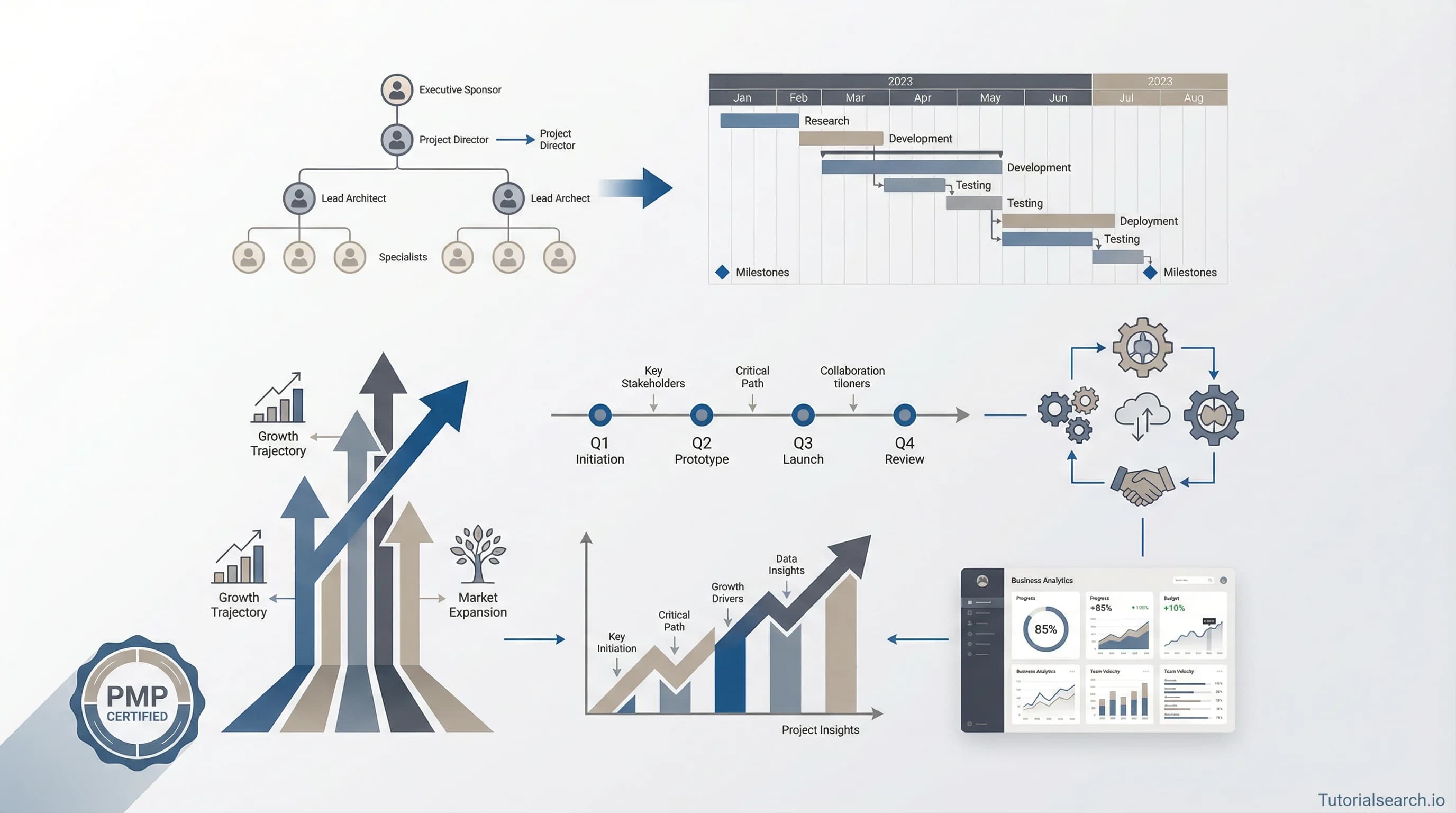
Project Skills That Actually Get You Promoted
Project skills aren't just about methodology — the power skills that get you promoted are communication, leadership, and conflict resolution. Here are the courses and resources that build them.
Hire the developers behind TutorialSearch.io
We built this site — full-stack web apps, AI integration & automation. Tell us what you need and we'll build yours.
Most people studying project management make the same mistake: they spend months grinding through PMBOK chapters and PMP practice exams, then wonder why they still feel lost in real projects.
The issue isn't the certification. It's that certifications teach frameworks. What gets you promoted — or trusted with bigger projects — is something different. PMI calls them "Power Skills": communication, collaborative leadership, problem-solving, and conflict resolution. Their 2023 Pulse of the Profession report found these four skills matter more for career success than any technical methodology. Doesn't matter your region, your industry, or your years of experience.
If you're building project skills and you haven't started with the interpersonal side, you're working backwards. Communication, leadership, and conflict resolution are what distinguish project managers who keep getting tapped for bigger projects from those who stay stuck managing the same type of work year after year. The 124+ project skills courses on TutorialSearch.io cover everything from PMP prep to Agile to communication — and this guide will help you pick what actually moves the needle.
Key Takeaways
- PMI research names communication, leadership, and problem-solving as the top project skills for career advancement.
- "Power Skills" (the human side of project management) consistently outperform technical knowledge in career outcomes.
- Free project skills training from PMI, Coursera, and Udemy is genuinely competitive with paid options.
- Pairing soft skills training with certifications like PMP creates a much stronger profile than either alone.
- Real-world communities like r/projectmanagement and PMI's forums help you apply what you learn faster.
In This Article
- The Project Skills Courses I'd Recommend to a Friend
- Free Project Skills Training That Doesn't Feel Like Free Training
- Project Skills YouTube Creators Who Actually Know Their Stuff
- Project Skills GitHub Repos Worth Starring
- Project Skills Books Worth Your Time
- Related Project Management Skills Worth Exploring
- Frequently Asked Questions About Project Skills
The Project Skills Courses I'd Recommend to a Friend
This is where most people start — and it's a reasonable instinct. A structured course forces you to actually learn, not just browse YouTube for an hour and feel productive.
My honest take: most project skills courses spend too much time on Gantt charts and not enough on the human stuff. The ones below are the exceptions.
Chartered Project Manager Certification Fast-Track Capstone (Udemy, Free) [Editors' Choice]
Instructor John Masud Parvez built something unusual here: a certification-track course that is free and rated 4.96 out of 5. That rating with 128+ enrolled students is extraordinary — courses at this quality level usually cost $50–100. It covers leadership, stakeholder management, and project delivery in a practical format. If you're starting from scratch, this is the one I'd put in front of you first.
10X Project Manager — Lead IT, Digital and Tech Projects (Udemy, Paid) [Editors' Choice]
The Tech MBA team built this course for people managing IT and digital projects specifically — not construction, not generic theory. Rated 4.81, it focuses on the project skills digital managers actually use week to week: stakeholder communication, leading Agile teams, handling scope creep. The specificity is what makes it good.
Project Management: Applied Soft Skills for Managers (Udemy, Paid) [Editors' Choice]
Chris Croft is one of those instructors who clearly enjoys teaching. This course focuses almost entirely on power skills — conflict resolution, team motivation, and communication under pressure. Rated 4.64, with a style that feels like a smart colleague explaining things, not a lecture. If you already know PM methodology and want to get better at the human side, this is the one. Most PM training ignores this side of things. Chris Croft doesn't.
Master Course in Project Management 2.0 (Udemy, Paid)
Dr. José Prabhu J's comprehensive course has 45,000+ enrolled students for a reason. It covers methodology, communication, leadership, and business acumen in one package. Good for people who want one course that covers everything rather than piecing together several.
Project Management, Business Leadership Communication Skills (Udemy, Paid)
LearnersCare LLC packed communication and leadership training directly into a project management course — which is the combination PMI's data says matters most. Rated 4.41 with 2,400+ students.
COMPLETE PMI RENEWAL — All 60 PDUs for PMP/PgMP/CAPM (Udemy, Paid)
A practical choice if you hold a PMI certification and need your renewal PDUs. Adrian Nuttall (PMP) covers all three domains of the PMI Talent Triangle, including Power Skills. Rated 4.59. Not glamorous, but it works — and it costs less than most alternatives.
The Project Management Crash Course (Udemy, Paid)
Yassine Tounsi's crash course (rated 4.56) is exactly what it says: a compressed, efficient run through core PM skills. Good for getting up to speed quickly before a new role, or as a refresher.
Here's a quick comparison to help you choose:
| What you need | Best pick |
|---|---|
| Free + comprehensive | Chartered PM Certification (Free, 4.96★) |
| IT/digital project focus | 10X Project Manager |
| Purely soft skills | Applied Soft Skills by Chris Croft |
| One course for everything | Master Course in PM 2.0 |
| Already certified, need PDUs | Complete PMI Renewal |
Free Project Skills Training That Doesn't Feel Like Free Training
The conventional wisdom is that free courses are watered-down versions of paid ones. For project skills specifically, that's not always true.
PMI's Free Kickoff Course is a 45-minute digital course and toolkit that covers PM basics — and it comes from PMI, the organization that sets the industry standards. Forty-five minutes sounds short. But if you want to understand the PMI framework before paying for anything, this is the right first stop.
PMI's Power Skills Resource Hub is underused. PMI offers a free self-assessment template covering collaborative leadership, communication, problem-solving, and strategic thinking. The diagnostic alone is worth your time before you spend money on a course.
Delivering the Perfect Construction Project (Udemy, Free) — Tim Fairley's delivery-focused course is rated 4.45 with 2,300+ students. Technically construction-facing, but the project delivery and communication frameworks transfer broadly.
Asana's Project Management Skills Guide isn't a course — it's a comprehensive, regularly updated reference covering both hard and soft PM skills in one place. Written for practitioners, not academics. Their list of 25 skills (split across soft, hard, and technical) is a useful self-assessment checklist for figuring out which gaps to close first.
Class Central aggregates 5,500+ project management courses from edX, Coursera, and similar platforms, including free options from Google, UC Irvine, and Rice University. The Google Project Management Certificate is free to audit on Coursera — it covers communication, stakeholder management, and project execution in real depth.
The Digital Project Manager publishes detailed skills guides and free templates. Their breakdown of project management skills for your resume is the best single-page reference I've found for understanding what employers actually look for in 2026. It's more useful than most courses for anyone in the early job-hunting stage.
Project Skills YouTube Creators Who Actually Know Their Stuff
Hire the developers behind TutorialSearch.io
We built this site — full-stack web apps, AI integration & automation. Tell us what you need and we'll build yours.
YouTube is underrated for project skills training — especially power skills like communication and leadership. Watching how someone actually handles a scenario is more useful than reading about it.
Adriana Girdler has been teaching project management for 20+ years. What makes her different is the soft skills focus: how to say no diplomatically, dealing with difficult team members, running better meetings. Most PM channels skip this. She doesn't. If you want to get better at the human part of projects, her channel is worth an afternoon.
Mike Clayton does something smart: bite-sized, well-structured videos that cover one concept at a time. His soft skills series and leadership content are both good. Works well for learning during commutes without losing the thread.
The Association for Project Management (APM) is the UK's chartered professional body for project managers. Their YouTube channel is more authoritative than most — covering fundamentals, Agile, and leadership with talks from working practitioners. The guest speaker quality is noticeably high.
One thing these three channels share: they all take the interpersonal side of project management seriously. That's what separates them from channels that cover nothing but templates and methodologies.
Project Mgmt Made Simple is worth a mention for anyone just starting out. The channel breaks down core PM principles in ways that feel logical and doable rather than overwhelming. Good for building a mental model of how projects actually flow before you dive into a paid course.
A practical approach: watch one short YouTube video per day on a specific project skills topic (stakeholder management, risk communication, running retrospectives), then look for a real situation at work where you can apply it. That cycle — watch, apply, reflect — will move your skills faster than any course alone.
Project Skills GitHub Repos Worth Starring
GitHub might seem like an odd place to learn project skills. But the best repos here aren't codebases — they're curated encyclopedias.
NajiElKotob/Awesome-ProjectManagement is one of the most comprehensive project management resource lists on GitHub. It includes books, courses, tools, articles, and frameworks — all organized and actively maintained. A genuinely useful bookmark for any level of PM.
shahedbd/awesome-project-management is shorter but well-curated, with a useful breakdown of tools by methodology. Helps when you're trying to figure out where Agile vs. Waterfall vs. hybrid actually get used in practice.
SixArm/project-management-guide by Joel Parker Henderson is structured like a glossary — one PM topic per page. Useful when you need to understand a concept quickly without reading a full book. I've returned to this one more than any other single reference.
Project Skills Books Worth Your Time
Everyone recommends the PMBOK. You should probably read it eventually — but it's a reference guide, not a cover-to-cover starting point. These are the books I'd recommend first:
Project Management for the Unofficial Project Manager by Kory Kogon, Suzette Blakemore, and James Wood is built for people managing projects without formal authority — which describes most project managers in their first few years. Every chapter focuses on influence, communication, and leadership without a title. It's one of the few PM books where the content is immediately applicable the following week.
Making Things Happen by Scott Berkun covers defining scope, making decisions under pressure, and building team trust. What makes it worth reading is that Berkun writes about what actually happens in real projects: the ambiguity, the politics, the moments when the PMBOK offers nothing useful. His chapter on communication and trust is the best thing I've read on the topic.
The Absolute Beginner's Guide to Project Management by Michael Greer fills the gap between the soft skills books and the PMBOK. It covers project planning, scheduling, and team collaboration in plain language — genuinely useful for someone stepping into a PM role for the first time and needing to understand the structural side as well.
The PMBOK Guide (7th Edition) — once you've got the soft skills foundation, this is your reference. The 7th edition shifted toward outcome-based thinking over pure process compliance, which makes it more readable than previous versions. Available from the PMI bookstore.
If you prefer free, ProjectManagement.com has 12,000+ articles, templates, and project plans for registered members (free registration). The depth of content on power skills is impressive — more than enough to keep you busy before you buy anything.
A note on reading order: start with "Project Management for the Unofficial Project Manager" to build the soft skills mindset, then "Making Things Happen" to understand how projects actually run, then use PMBOK as a reference once you're working in the field. Most people do this backwards — they start with PMBOK and wonder why it doesn't translate to their actual job.
Related Project Management Skills Worth Exploring
Project skills don't exist in isolation. These adjacent areas pair directly with what you've been reading about — and each one deepens what you're already building.
- Project Essentials — 777 courses covering foundational methodologies and frameworks. Start here if the soft skills course led you to want more structure underneath it.
- Agile Scrum — 716 courses on the most widely used project delivery methodology. Agile amplifies power skills because the whole framework is built around communication and collaboration.
- Project Planning — 232 courses on planning skills. These are the hardest technical project skills to learn and the ones that create the most downstream problems when they're weak.
- Agile Management — 335 courses for managing Agile teams specifically, where you need both methodology knowledge and real people skills.
- PMP Exam — 539 courses for the certification track. PMP now requires Power Skills PDUs, so there's direct overlap with everything above.
- Project Delivery — 289 courses on execution and delivery. This is where all the project skills you've built actually get tested.
Frequently Asked Questions About Project Skills
How long does it take to learn project skills?
You can cover the core concepts in 1–3 months of consistent effort. But project skills — especially power skills like communication and conflict resolution — develop over years of real-world practice. Courses give you the framework. The reps come from using that framework on actual projects.
Do I need PMP certification to build strong project skills?
No. PMP helps your resume and signals industry knowledge, but many effective project managers work without certifications. Start with project skills courses and real application first. Certification is more valuable once you have a practical foundation to build from.
Can project skills help me get hired in project management?
Yes — but the path varies by level. Entry-level roles care more about demonstrable soft skills and tools knowledge than certifications. Mid-level roles start rewarding certifications more. PMI's Power Skills research consistently shows communication and leadership are the two factors most correlated with both getting hired and getting promoted.
What project skills matter most in Agile environments?
Adaptability, collaborative communication, and a feedback mindset matter most in Agile roles. If you're heading into Agile work, check out the Agile Scrum courses — but pay as much attention to the communication modules as to the Scrum mechanics themselves.
Where can I practice project skills outside of a job?
The r/projectmanagement subreddit is one of the most active PM communities online — real practitioners sharing real challenges. PMI's community forums are also useful if you're heading toward certification. Volunteering for a project lead role in a nonprofit or community group is the fastest way to get reps outside of paid work.
The honest reality about project skills: the people who advance fastest are not the ones who memorized the most frameworks. They're the ones who communicate clearly, resolve conflict before it escalates, and lead a team through ambiguity without losing the thread. That's what PMI's data shows — and it holds up in practice.
Start with a strong course. Build the habits. Find a community. The certification can follow once you have the foundation. Browse the full project management course catalog to find where you fit right now.