Project Fundamentals: The No-Fluff Roadmap for New PMs
Master project fundamentals with curated courses, free resources, YouTube channels, and communities for new PMs. A practical roadmap from initiation to closure.
Hire the developers behind TutorialSearch.io
We built this site — full-stack web apps, AI integration & automation. Tell us what you need and we'll build yours.
Project fundamentals are the core skills that determine whether a project succeeds — and they're more learnable than most job listings suggest. Most people who end up managing projects didn't plan for it. One Tuesday you're a team member; the next, someone's asking you to "just coordinate" a product launch involving six departments, a tight deadline, and a stakeholder who changes their mind every other day. As of 2026, the demand for people who can run organized, communicative, risk-aware projects keeps growing — and the fundamentals haven't changed. You can browse top-rated project fundamentals courses on TutorialSearch to see what's available by platform and rating.
This guide is structured as a roadmap. Start wherever you are — whether that's total beginner or someone who's been winging it for two years — and work through the resources that match your style and timeline. We'll cover curated courses, free tools, YouTube channels, GitHub repos, books, and communities. The goal is confident project delivery, not just exam prep.
One honest note before we start: the certification industry has made project management feel more complicated than it needs to be early on. The fundamentals are not complicated — they're just rarely taught directly.
Key Takeaways
- Project fundamentals cover five lifecycle phases: initiation, planning, execution, monitoring, and closure
- You don't need a certification to apply project fundamentals immediately — but credentials like PMP and APM PFQ signal that knowledge to employers
- Project fundamentals skills transfer across industries, making them one of the most durable professional investments available
- Free resources from Google and PMI cover the essentials at no cost
- The best project fundamentals courses blend real-world practice with theory; exam prep alone rarely produces effective project managers
In This Article
- What Project Fundamentals Actually Cover
- Project Fundamentals Courses Worth Your Time
- Free Project Management Resources That Hold Up
- YouTube Channels That Make Project Fundamentals Click
- GitHub Repos for Project Management Practitioners
- Project Fundamentals Books With Real Staying Power
- Communities Where Project Managers Gather
- Which Project Management Certification Fits Your Goals?
- Related Project Management Skills Worth Exploring
- FAQ
What Project Fundamentals Actually Cover
The phrase "project fundamentals" sounds like a watered-down version of something more serious. It isn't.
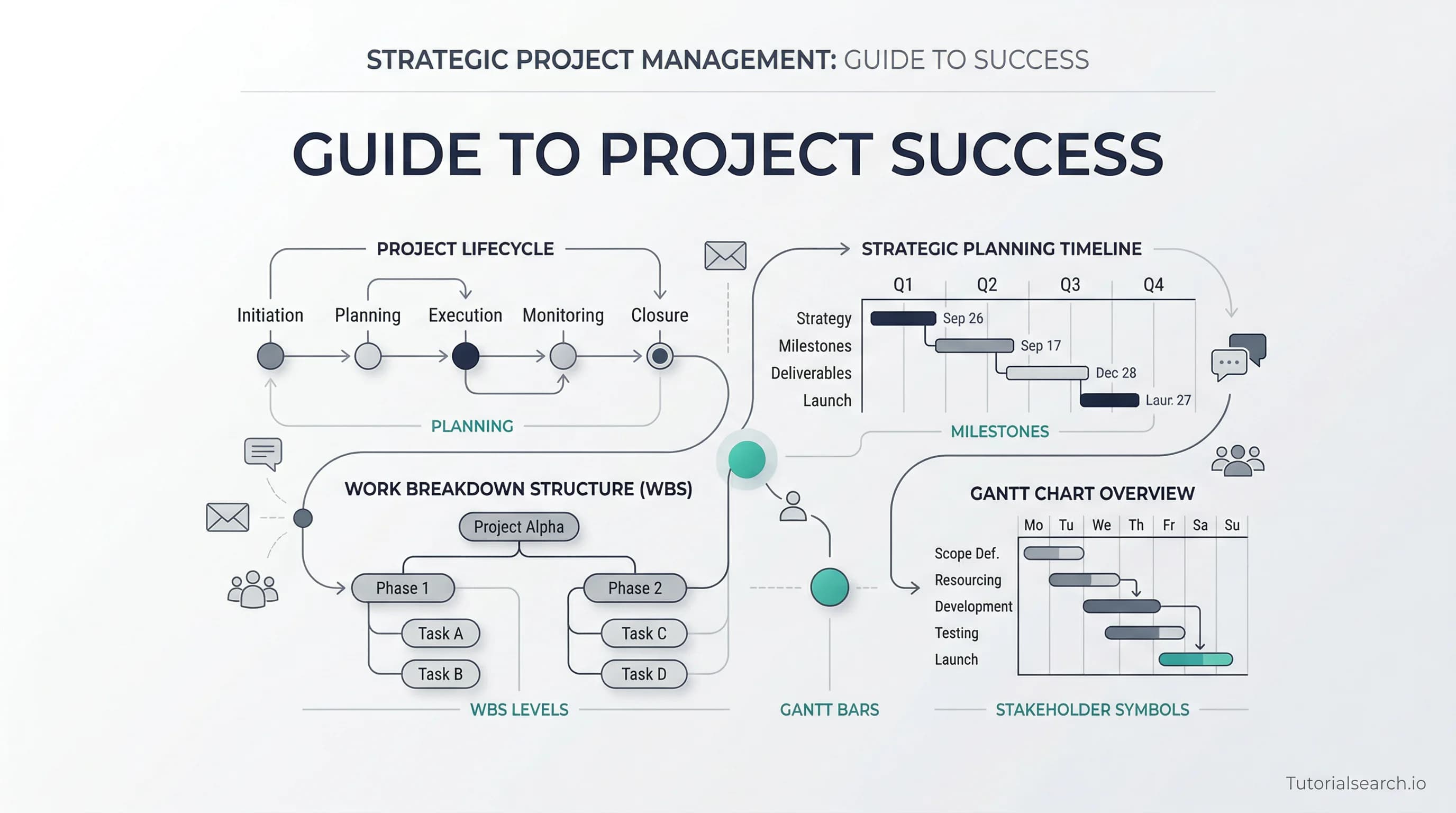
Every successful project — a software launch or a physical build, a three-person initiative or a hundred-person program — moves through five lifecycle phases: initiation, planning, execution, monitoring and control, and closure. This structure is formalized in the PMBOK Guide, the global standard published by the Project Management Institute. The eighth edition (released January 2026) shifted from prescribing specific processes to articulating twelve core principles. That change is meaningful: it acknowledges that good project management is about judgment, not just checklists.
What often goes untaught is that project fundamentals cover more than Gantt charts and status reports. Scope management — defining what's in the project and holding that line under pressure — is where most projects actually fail. Stakeholder engagement means identifying who cares about the outcome and keeping them appropriately informed. Risk assessment means thinking three steps ahead while things are still on track. Communication planning means no one is surprised when something goes wrong.
Master those four things and you'll outperform most people who've been managing projects for years through muscle memory alone.
Here's my contrarian take: too many new project managers spend months studying methodology before ever touching a real project. You don't need to memorize 49 PMBOK processes before your first kick-off. You need to write clear deliverables, communicate expectations early, and flag risk before it becomes a crisis. Those three habits are worth more than any framework on day one.
Project Fundamentals Courses Worth Your Time
The five courses below cover different entry points — pure beginner introductions, methodology-specific tracks, and certification-adjacent material. Picks are based on content quality and real-world applicability, not just enrollment numbers.
- Project Management Fundamentals: A Beginner's Guide (Udemy, ★ 4.4) [Editors' Choice]
This is where I'd send someone with zero project management background. It covers what a project actually is (less obvious than it sounds), walks through Waterfall, Scrum, and Kanban, and grounds each concept in real-world application. The sections on stakeholder strategy and risk management are genuinely practical — not just definitional. The course also touches on Kanban metrics and how to implement it for an actual team, which you rarely get at this level. For building a solid base before moving to certification material, this is the clearest starting point available.
- Project Management Fundamentals | Learn PM Basics Fast (Udemy, ★ 4.6) [Editors' Choice]
The title promises speed, and the course delivers. It covers the core material efficiently without cutting corners, with exercises designed for application rather than memorization. Ideal for analysts, team leads, or anyone handed PM responsibilities without a formal transition. The pacing is one of its strongest attributes — it moves at the speed of a working professional, not a full-time student.
- Introduction to Project Management — Practical & Real World (Udemy, ★ 4.5)
Where other beginner courses use abstract frameworks, this one grounds every concept in workplace scenarios: client conflicts, budget overruns, and scope debates where everyone in the room is technically right. Learners who've tried other PM courses and found them too dry consistently mention this one as the exception. Rated 4.5 with strong reviews specifically around the instructor's clarity.
- PRINCE2 Project Fundamentals | Learn PRINCE2 Fast (Udemy, ★ 4.8) [Editors' Choice]
PRINCE2 dominates project management in the UK, much of Europe, and Commonwealth countries. If your work environment runs on it — or you're targeting employers who require it — this is the sharpest introduction available. At 4.8 stars it's the highest-rated course in this category, and that rating holds up. The structure is well-paced, explanations are precise, and the methodology sticks after you're done. Worth it if PRINCE2 is anywhere in your career path.
- Project Management for Non-Project Managers — Part 1 (Udemy, ★ 4.5)
A significant portion of people learning project management aren't pursuing PM roles. They're engineers, marketers, designers, or operations professionals who've been handed a project. This course is built for that audience. It strips away the formal framework jargon, focuses on what actually matters day-to-day, and doesn't assume you want letters after your name when you're done. One of the more honest course titles in this space.
Free Project Management Resources That Hold Up
Paid courses aren't the only route. These free resources cover project management fundamentals seriously and won't waste your time.
PMBOK Guide (PMI) — The global reference standard for project management, maintained by the Project Management Institute. PMI members access it through membership. Even if you're not pursuing certification, reading the principles section of the eighth edition gives you the clearest map of how the field organizes its thinking in 2026.
PMI Free Online Courses — PMI offers a generous free course library covering lifecycle phases, stakeholder engagement, and risk fundamentals. Professionally produced and available to anyone with a PMI account.
Google Project Management Certificate — Six courses built by Google's project management team, covering traditional, agile, and hybrid methods. It's auditable for free on Coursera and aligned with PMI's CAPM requirements. For anyone wanting a structured, comprehensive first exposure to project management without paying for a course, this is the best single free option available. The program has over 4 million enrollees and is worth that reputation.
OnlinePMCourses.com — Mike Clayton's site is a quietly excellent resource. Between the free articles, "What is..." explainer series, and study guides, it covers nearly every project management concept in plain English. The scope management and risk explainers are particularly good for beginners who want depth without jargon.
Class Central — Project Management — Aggregates over 5,000 project management courses from every major platform, filterable by free/paid, provider, and rating. Use it when you're comparing options before committing to a course. For a more curated view with direct course pages and ratings by platform, search for project fundamentals on TutorialSearch.
Rebels Guide to Project Management — Elizabeth Harrin's long-running blog covers every corner of project management in plain language. The breakdown of PMBOK 7th edition principles is one of the best free explanations of how modern PM thinking has shifted from process compliance toward adaptive judgment.
YouTube Channels That Make Project Fundamentals Click
Hire the developers behind TutorialSearch.io
We built this site — full-stack web apps, AI integration & automation. Tell us what you need and we'll build yours.
Some concepts — risk matrices, stakeholder maps, critical path analysis — make more sense when you see them built in real time than when you read about them.
Adriana Girdler — Nearly 270,000 subscribers, 150+ videos, and consistent quality since 2013. Girdler covers practical PM skills and career development without padding. Her videos get to the point quickly, and the advice is grounded in real practitioner experience. Best starting points: her scope management series and the stakeholder communication playlist.
OnlinePMCourses — Mike Clayton — Two new videos weekly (Tuesdays and Thursdays), with a "What is..." series that clearly defines every major project management concept. Clayton also runs @ManagementCourses for leadership-adjacent topics. High production value, well-organized, and strong on methodology comparisons for people trying to understand where PRINCE2 fits versus PMP versus CAPM.
Chris Croft Management — Croft has been posting practical project management and time management content since 2007. His explanations of critical path, risk response strategies, and scope creep are some of the clearest available for free. More conversational than produced — which works well for complex concepts that benefit from a slower, worked-through format.
GitHub Repos for Project Management Practitioners
GitHub is underused as a project management learning resource. These two repositories are worth bookmarking.
shahedbd/awesome-project-management ⭐ 743 stars — The most comprehensive curated list of project management resources on GitHub. Covers tools (ClickUp, Jira, Asana, Trello, Monday), methodologies (Agile, Scrum, Kanban, PRINCE2, Lean), free templates, books, courses, and community links. If you want a single reference that maps the entire project management ecosystem, this is it.
opf/openproject ⭐ 9,000+ stars — OpenProject is the leading open-source project management platform. Beyond being a functional tool, its public issue tracker and roadmap are a real-world demonstration of how a large, coordinated software team structures project work. If you're learning project management concepts and want to see them operating at scale, browsing this project's planning board is more instructive than most tutorials.
Project Fundamentals Books With Real Staying Power
Most project management books fall into one of two traps: too textbook-heavy, or too focused on the consultant's view of things. These avoid both.
PMBOK Guide, Eighth Edition by the Project Management Institute — The standard reference. Not a cover-to-cover read, but the principles section is essential for anyone taking the field seriously. The 2026 edition reinforces the move from rigid process compliance toward adaptive, judgment-based management.
Project Management Absolute Beginner's Guide by Greg Horine — This book walks through every stage of the project lifecycle with the kind of clarity you'd hope for from someone who both teaches and practices PM. Scope, schedule, budget, risk, and communication are all covered in a way that connects concept to application without becoming academic. Available on Amazon and widely held in public libraries. Prefer video? This course on project management foundations covers overlapping ground in a different format.
The Lazy Project Manager by Peter Taylor — The contrarian recommendation on this list. Taylor argues you should identify the 20% of PM activity that produces 80% of outcomes and focus your effort there. It's a fast read, and the mental model is useful for avoiding the trap of being perpetually busy without making the project actually move forward. If you've ever felt like your project has a lot of activity but not a lot of progress, read this one next.
Communities Where Project Managers Gather
Learning project management accelerates when you can ask questions from people who've already been in the situation you're navigating.
r/projectmanagement — Active and well-moderated. Good mix of career advice, tool comparisons, and real-world stories. Strong for situational questions like "how do you handle a stakeholder who keeps expanding scope without adjusting the deadline?" — you'll usually get three or four genuinely useful responses.
r/pmp — Focused on PMP exam prep and certification navigation. Current study resources, experience reports, and community accountability threads. If you're working toward the PMP, this community is worth browsing regularly in the months before your exam.
PMI Community — The official PMI platform. More formal than Reddit, but useful for templates, local chapter connections, and navigating certification pathways. PMI membership also unlocks the full PMBOK library and the free online courses mentioned earlier in this guide.
Which Project Management Certification Fits Your Goals?
Certifications signal commitment to the field and do carry real career value. The three most common entry-level tracks differ enough that the choice matters.
| Certification | Best For | Experience Required | Exam Format | Typical Prep Time |
|---|---|---|---|---|
| PMP (PMI) | Experienced PMs seeking global recognition | 36 months leading projects | 180 questions, 230 min | 3–6 months |
| APM PFQ | UK/Europe beginners, no experience needed | None required | 60 multiple-choice, 1 hr | 1–3 months |
| CompTIA Project+ | IT professionals new to PM | 12 months recommended | 95 questions, 90 min | 1–2 months |
The PMP exam is being updated in July 2026, requiring at least 50% of your documented experience to reflect Agile or hybrid methods. Worth knowing before you register, especially if your current experience is mostly traditional waterfall environments. APM PFQ is the gentler entry point for UK and Commonwealth candidates. CompTIA Project+ fits naturally for people approaching PM from IT infrastructure backgrounds.
Related Project Management Skills Worth Exploring
If project fundamentals have caught your interest, these adjacent areas connect directly with what you've built:
- Project Essentials — Deeper coverage of the operational core: stakeholder management, communication frameworks, and day-to-day project execution
- Agile Scrum — The most widely adopted agile framework; pairs cleanly with traditional PM fundamentals for a hybrid approach used by most modern teams
- Agile Management — Broader agile principles across Kanban, SAFe, and adaptive planning; useful for anyone stepping into a leadership role in fast-moving teams
FAQ
How long does it take to learn Project Fundamentals?
Most people can build a working understanding in 4–8 weeks with consistent study. That covers the theory. Real competence comes from applying the concepts on an actual project — even a small internal one works. Don't wait until you've finished a course to start practicing.
Do I need experience before starting?
No. The beginner courses on this list assume zero background. If you're targeting certification later, PMP exam prep courses are the natural next step once you've built your fundamentals.
Can I get a job with Project Fundamentals skills?
Yes — particularly in project coordinator, junior PM, and business analyst roles. At the entry level, most hiring managers are looking for structured thinking and communication ability, not specific certifications. A portfolio of small managed projects often outweighs a certificate in early-career conversations.
What skills are covered in Project Fundamentals?
The core skills are scope management, risk identification, stakeholder communication, and time management. These four areas account for the majority of what separates projects that land well from those that don't.
How do Project Fundamentals differ from Agile methods?
Traditional project fundamentals follow a sequential lifecycle — one phase completes before the next begins. Agile breaks work into short iterative cycles with continuous feedback. Most modern teams use a hybrid of both. Understanding the fundamentals gives you the structural vocabulary that makes agile approaches easier to apply correctly when you need them.