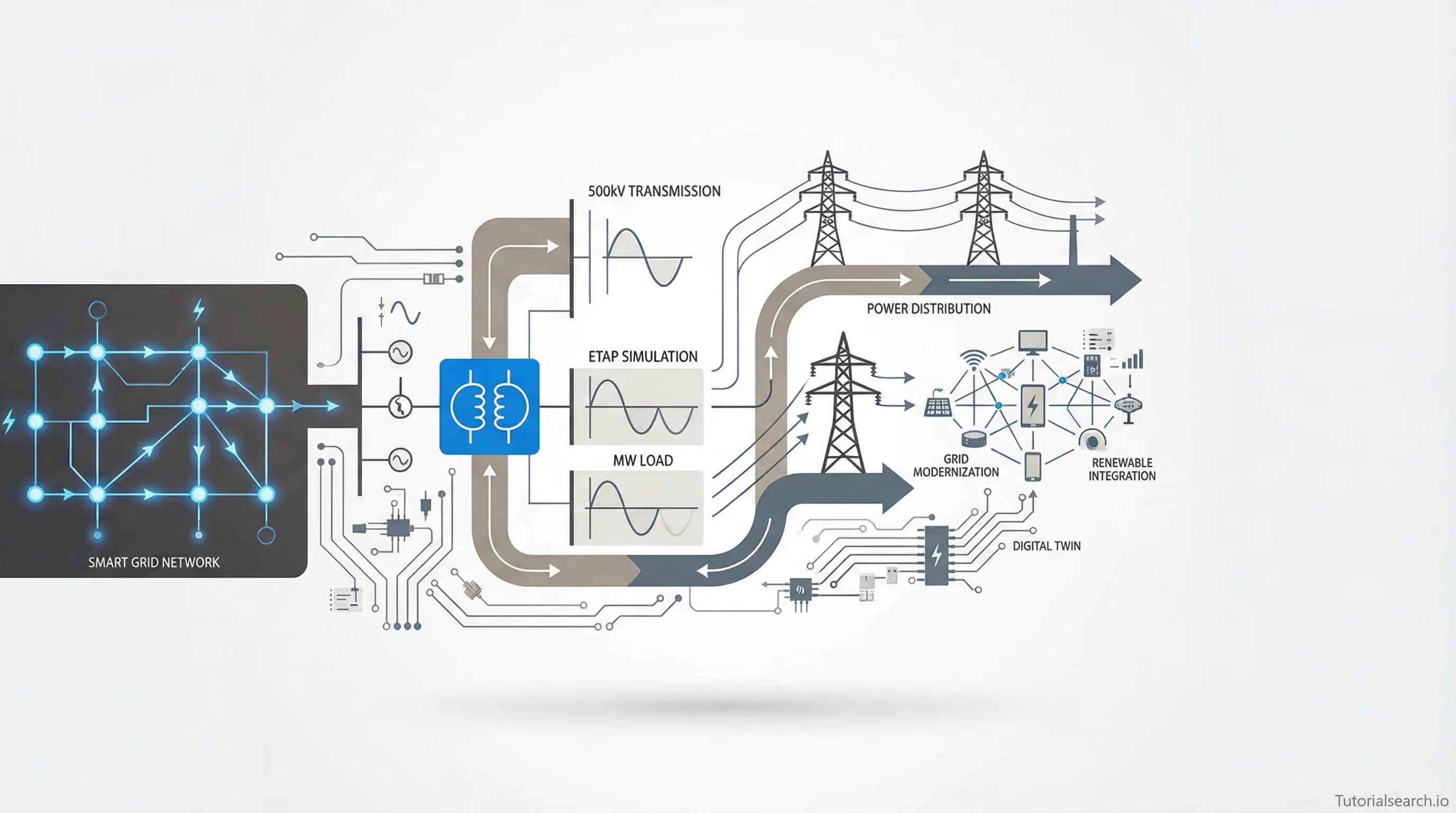
Power Systems: The Courses, Software, and Resources That Deliver
Power systems engineering is at the center of the global energy transition. Here are the best courses, simulation tools, free resources, and communities for learning electrical power systems in depth.
Hire the developers behind TutorialSearch.io
We built this site — full-stack web apps, AI integration & automation. Tell us what you need and we'll build yours.
Power systems engineering is at the center of the global energy transition — and it's creating one of the most in-demand skill sets in electrical engineering. The grid is changing faster than it has since electrification itself. We're shifting from centralized coal and gas plants to distributed renewables, battery storage, and smart infrastructure. Utilities, EPC contractors, and energy startups all need engineers who understand how grids actually work.
The problem is that university curricula haven't caught up. Most academic programs teach power systems theory well — load flow equations, fault calculations, stability analysis. But they rarely teach the software that employers actually use on the job. And most online courses either stay too shallow or jump straight into tools without explaining the fundamentals underneath.
This guide is designed to close that gap. I've pulled together the best power systems courses, simulation software training, free resources, and professional communities — for both students building a foundation and working engineers who need to get up to speed on tools like ETAP and DigSilent PowerFactory.
Key Takeaways
- Power systems learning works best when you combine theory with simulation tools like ETAP or DigSilent from the start
- The highest-rated power systems courses focus on real software used in utilities and industrial facilities
- MIT OpenCourseWare offers a free, rigorous power systems course — no registration required
- Power systems skills pair naturally with energy systems, protection engineering, and smart grid technologies
- The IEEE Power & Energy Society is the essential professional community for staying current in this field
In This Article
- The Power Systems Courses Worth Your Time
- Pick Your Path: A Quick Decision Guide
- Power Systems Software You'll Actually Use in the Field
- Free Power Systems Resources That Go Surprisingly Deep
- Power Systems YouTube: Channels That Actually Teach
- Power Systems GitHub Repos Worth Exploring
- Books for Going Deep on Power Systems
- Power Systems Communities Where People Actually Help
- Related Skills Worth Exploring
- Frequently Asked Questions About Power Systems
The Power Systems Courses Worth Your Time
Most learners make one core mistake: they treat power systems like any other engineering subject and try to read through textbooks before touching any software. That works for circuits. It doesn't work well here.
The real insight in power systems comes from watching how a grid responds under load, under fault conditions, or with a changing generation mix. You can read about voltage stability all day. You won't really understand it until you see a simulation diverge.
There are 158 power systems courses in the TutorialSearch library. Here's where I'd start, depending on where you are.
1. Electrical Power Systems ⭐ 4.25 | Instructor: Mohammed Tafesh | Beginner
This is the right entry point if you're new to the field. Tafesh builds from first principles — power generation, transformer theory, transmission line modeling — without assuming prior knowledge of protection systems or network analysis. The pacing in early modules is deliberately measured, which beginners need more than they realize.
2. All Electrical Transformers in Electrical Power Systems ⭐ 3.97 | Instructor: Mohammed Tafesh
Transformers are the backbone of any grid — and most intro courses don't give them enough depth. This standalone course covers autotransformers, instrument transformers, and three-phase configurations properly. It's worth completing before you move into software-based analysis.
3. Mastering Overcurrent Protection in Electrical Power Systems ⭐ 4.28 | Instructor: Elite Engineering | Beginner — [Editors' Choice]
Protection is probably the most under-taught area in academic power systems programs. This course covers relay coordination, time-current curves, and fault analysis — the knowledge that matters when you're designing or auditing real protection schemes. The 4.28 rating with consistent reviews about practical applicability makes it stand out. If you're headed into utility or industrial work, this is essential early reading.
4. Substation Power Engineering Fundamentals ⭐ 4.10
Substations are where theory meets hardware. This course covers bus configurations, switching equipment, grounding, and the basics of substation design. More applied than most fundamentals courses.
5. Transmission Power Engineering Fundamentals ⭐ 3.82
A useful complement to the substation course. Covers line parameters, steady-state analysis, and basic protection for transmission systems. Not the most polished course, but the content is solid.
Pick Your Path: A Quick Decision Guide
Power systems attracts people from very different starting points. Here's a quick map:
| Where You Are | Start Here | Then Go Here |
|---|---|---|
| EE student, first exposure | Electrical Power Systems (Tafesh) | Overcurrent Protection course |
| Working engineer, need ETAP skills | ETAP full course (Power To Human) | Complete Electrical Power with ETAP |
| Know the theory, want renewables focus | MATLAB Power Systems | DigSilent PowerFactory |
| Academic / research context | MIT OCW (free) | awesome-open-source-power-electronics (GitHub) |
| Career switcher, self-study | Electrical4U (free) + MIT OCW | One paid ETAP course |
Power Systems Software You'll Actually Use in the Field
Here's something most courses don't say directly: software proficiency often matters more than theoretical depth when you're trying to get hired or promoted in power systems work. Employers want people who can run load flow studies, short-circuit analysis, and transient stability simulations in industry-standard tools. The underlying theory is assumed. The tool skills are what separate candidates.
6. ETAP - Power Systems Full Course & Renewable Energy ⭐ 4.18 | Instructor: Power To Human — [Editors' Choice]
ETAP is the industry standard for power system analysis in utilities and industrial facilities. This course walks through the full workflow — building single-line diagrams, running load flow and fault analysis, and modeling protection coordination. The renewable energy integration section is genuinely useful for anyone working on solar or wind interconnection projects. If you can only take one software course, make it this one.
7. ETAP with Fully Practical Approach ⭐ 4.29
If the full ETAP course feels like too much at once, this course is more task-focused. It's a good complement if you want to build speed on specific analysis types without starting from scratch every time.
8. DigSilent PowerFactory - Power Systems Analysis ⭐ 4.15 | Instructor: Power To Human | 1,843 students — [Editors' Choice]
DigSilent PowerFactory is widely used in Europe and increasingly in large-scale renewable integration projects globally. This is the most enrolled power systems course in the TutorialSearch library, which tells you something about demand for this skill. The instructor covers dynamic simulations and steady-state analysis in real depth. If you're working on grid integration for wind or solar farms, prioritize this one.
9. The Complete Electrical Power with ETAP & Manual Analysis ⭐ 4.58 — [Editors' Choice]
The highest-rated course in this roundup. What sets it apart is the dual approach: you run the same calculations manually and then in ETAP. That forces you to understand what the software is actually computing — instead of treating it as a black box. If you already have some ETAP exposure, this is where I'd go next.
10. MATLAB Power Systems: Modeling & Renewable Integration ⭐ 3.94 | Instructor: Power To Human
MATLAB/Simulink is more common in research and academic settings than ETAP, but it's also used in some industrial simulation workflows. This course focuses on modeling renewable energy systems — useful if you're working at the intersection of power systems and energy systems research.
Free Power Systems Resources That Go Surprisingly Deep
The best free resources in power systems are genuinely excellent — not watered-down introductions but rigorous learning material that competes with paid courses.
MIT OpenCourseWare: Introduction to Electric Power Systems — ocw.mit.edu (Free)
This is the actual MIT course, with lecture notes, problem sets, and exams. It covers transmission system modeling, load flow, fault analysis, and stability — essentially a full semester of graduate-level power systems content. No registration required. If you're serious about the theoretical foundation, work through this alongside your first paid course.
Electrical4U — electrical4u.com (Free)
One of the most comprehensive free references in electrical engineering. The power systems section covers generators, transformers, protection systems, and grid components in a way that's both accessible and technically accurate. Good for quick reference and filling in gaps.
Coursera: Electric Power Systems — coursera.org (Free to audit)
Available to audit at no cost. Covers generation, transmission, and distribution with a more guided format than MIT OCW. Useful if you prefer structured progression over self-directed study.
NREL Grid Modernization — nrel.gov (Free)
The National Renewable Energy Laboratory publishes technical reports and open tools on modern grid design. This isn't a beginner tutorial — it's serious analysis of grid stability with high renewables penetration, distributed generation integration, and future grid architectures. Worth bookmarking once you have the fundamentals down.
AllAboutCircuits — allaboutcircuits.com (Free)
Less academically rigorous than MIT OCW but more approachable for self-study. Covers power electronics and systems fundamentals in a way that builds intuition before you tackle heavier mathematical material.
Students interested in the wider science curriculum on TutorialSearch will find meaningful overlap between power systems and adjacent topics like materials science — relevant for conductor and insulation research — and structural analysis, which matters for transmission tower and substation design.
Power Systems YouTube: Channels That Actually Teach
Hire the developers behind TutorialSearch.io
We built this site — full-stack web apps, AI integration & automation. Tell us what you need and we'll build yours.
YouTube won't replace structured courses for power systems. But it's genuinely useful for visual explanations of concepts that are hard to grasp from equations alone. Transformer equivalent circuits, phasor diagrams, and fault current flow paths are all easier to understand in motion.
Engineering Devotion — Search YouTube for "Engineering Devotion power systems"
Dr. Mithun Mondal's channel focuses on solved numerical problems in power systems — exactly the practice you need when working through exam prep or reinforcing a concept from a course. The pace is methodical and the problems are drawn from real textbook exercises.
The Engineering Mindset — Search YouTube for "The Engineering Mindset power systems"
More conceptual than technical, this channel explains how components like transformers, switchgear, and circuit breakers work in practice. Good for building physical intuition before getting into the mathematics.
IEEE Smart Grid Webinars — smartgrid.ieee.org
Free recordings from working experts on grid modernization topics: machine learning for grid optimization, real-time fault detection, and demand response systems. More advanced than tutorial content, but watching even a few gives you a clear picture of where the field is heading.
For a broader list of electrical engineering YouTube channels, the AllSpice roundup at allspice.io is worth a look.
Power Systems GitHub Repos Worth Exploring
Open source tools for power systems analysis have improved significantly in recent years. If you're doing academic research or want to prototype analysis without a commercial license, these are the repos to know.
awesome-open-source-power-electronics — github.com/upb-lea/awesome-open-source-power-electronics
A curated list of open source tools for power electronics simulation, design, and analysis. If you're working at the intersection of power systems and power electronics — which is increasingly common with renewable energy converters and grid-tied inverters — this is the best starting point on GitHub.
Power Systems GitHub Topic — github.com/topics/power-systems
Browsing this topic reveals active projects including Python-based load flow solvers, PSCAD interface scripts, and grid simulation frameworks. Useful for finding real code to study, fork, or contribute to.
awesome-electronic-engineering — github.com/SergioGasquez/awesome-electronic-engineering
Broader than power systems specifically, but contains good pointers to simulation tools, textbooks, and learning resources. If you're building physics fundamentals alongside power systems knowledge, this repo covers both.
Books for Going Deep on Power Systems
I'll say this plainly: for power systems, textbooks are genuinely necessary in a way that they aren't for many other engineering topics. Load flow analysis, fault calculation methods, and stability theory require mathematical depth that online content rarely provides in full.
Power System Analysis and Design by Glover, Overbye & Sarma — The industry-standard undergraduate textbook. Clear explanations, solid problem sets, and updated editions that include renewable integration and smart grid material. Most university power systems courses are taught alongside this book.
Power System Analysis by William D. Stevenson — An older text (first published in 1955, updated through multiple editions) but still widely referenced. More mathematically rigorous than Glover. Use it if you want to understand the analytical foundations — not just the computational procedures.
The Standard Handbook for Electrical Engineers (McGraw-Hill) — A reference text rather than a study guide. Covers power generation, transmission, distribution, and protection in practical terms. Worth having as a reference once you're working in the field.
For free reading, the University of Ottawa sustainable power systems course materials are publicly available as a PDF and cover a graduate-level semester of content.
IEEE Transactions on Power Systems — ieee-pes.org
Not a textbook, but a journal worth following. Abstracts are freely available. Reading titles and abstracts regularly keeps you connected to where research is heading — grid resilience, power flow optimization, integration of distributed energy resources, and machine learning applications in grid operation.
The BookAuthority list of best power systems books is also worth browsing if you want community-sourced recommendations.
Power Systems Communities Where People Actually Help
IEEE Power & Energy Society — ieee-pes.org
The most important professional organization in this field. Student membership is affordable and includes access to journals, webinars, and local chapter events. The IEEE PES resource center includes "Power System Basics" sessions specifically aimed at people new to the field — a useful structured introduction from working professionals.
r/ElectricalEngineering on Reddit
An active community that regularly covers power systems topics. Good for practical questions about career paths, software tool comparisons, and specific technical problems. The community skews toward students and early-career engineers, which means responses are practical rather than academic.
Electrical Engineering Discord — discord.com/invite/tUU9dPp
Over 23,000 members. The power systems and energy channels are active with daily discussions. More informal than IEEE forums but faster for getting quick answers on practical questions.
AllAboutCircuits Forum — forum.allaboutcircuits.com
Technically focused discussion boards with threads on power systems, protection relay coordination, and simulation tools. Better than Reddit for detailed technical questions where you need an engineer to explain the reasoning, not just point to a resource.
Power systems and environmental sustainability increasingly overlap — if that intersection interests you, the environmental science community on TutorialSearch covers grid decarbonization from a different angle.
Related Skills Worth Exploring
Power systems doesn't exist in isolation. Engineers in this space regularly need adjacent knowledge:
- Energy Systems — Battery storage, microgrids, and renewable integration sit directly at the intersection of power systems and energy systems engineering. Over 257 courses available.
- Physics Concepts — Electromagnetic theory and thermodynamics underpin many aspects of grid component behavior. Worth revisiting if your physics foundation is shaky.
- Physics Fundamentals — Classical mechanics and calculus-based physics are assumed in most power systems courses. These 237 courses cover that ground.
- Materials Science — Conductor materials, dielectric insulation, and superconducting cables are active research areas that connect directly to transmission system design.
- Structural Analysis — Transmission tower design and substation civil work both require structural analysis knowledge — useful for engineers who cross into project engineering roles.
- General Chemistry — Relevant for battery storage chemistry, transformer oil testing, and SF6 gas insulation systems.
Frequently Asked Questions About Power Systems
How long does it take to learn Power Systems?
A solid working foundation takes 3–6 months of consistent study. That's enough time to complete 2–3 courses, work through practice problems, and develop basic proficiency in a simulation tool like ETAP. Reaching a professional level — where you can run load flow studies and design protection schemes independently — typically takes 1–2 years of focused work, ideally with real project exposure alongside the coursework.
Do I need a full electrical engineering degree to learn Power Systems?
Not to get started. Many simulation-focused courses assume only basic circuit analysis knowledge — Ohm's law, phasors, and three-phase system fundamentals. A complete EE degree matters for senior engineering roles. But for technicians, project managers, or engineers transitioning from related fields, focused self-study on the power systems topic page gets you further than you might expect.
Can I get a job with Power Systems skills?
Yes — and demand is growing. The energy transition is driving hiring across utilities, EPC contractors, battery storage developers, and renewable energy firms. Power systems skills combined with ETAP or DigSilent proficiency are genuinely marketable. Grid modernization and EV infrastructure are two areas where new hiring is concentrated right now.
What's the difference between Power Systems and Power Electronics?
Power systems deals with the large-scale grid — generation, transmission, distribution, and protection. Power electronics focuses on devices like converters, inverters, and rectifiers that control energy flow at the component level. They overlap significantly in renewable energy work, where a solar inverter's behavior directly affects grid stability. Both are worth learning if you're going into the energy sector.
How do smart grids improve Power Systems reliability?
Smart grids add real-time monitoring, automated fault detection, and two-way communication to traditional power infrastructure. Instead of waiting for a service call to identify a fault, smart grid systems can isolate problems automatically and reroute power within seconds. The IEEE Smart Grid initiative has free webinar content on this — and it's increasingly covered in newer simulation-based courses in the TutorialSearch library.
The gap between academic power systems knowledge and professional practice is real — but it's closeable. The resources above give you a direct path: build the fundamentals, get hands-on with simulation software early, and plug into the IEEE community to stay current. Pick one course from the list, get a trial license for ETAP or DigSilent, and start modeling something. That's where it clicks.