Physics Mechanics: From Foundations to Problem-Solving Mastery
Master Physics Mechanics from Newton's laws through energy conservation. Complete learning path with top courses, external resources, and practice strategies for genuine understanding.
Hire the developers behind TutorialSearch.io
We built this site — full-stack web apps, AI integration & automation. Tell us what you need and we'll build yours.
Mechanics intimidated me for years. I'd stare at free-body diagrams and think, "There's no way I'll ever understand this." But here's what changed: once I realized mechanics isn't about memorizing rules—it's about understanding how things move and why—everything clicked. The same shift happens for most people who actually stick with it. Physics Mechanics is the foundation that makes every physical system comprehensible, from the simplest pendulum to the engines that power our world.
This guide walks you through the entire landscape of Physics Mechanics: what it actually is, why it matters, and how to master it through structured courses and resources that work.
Key Takeaways
- Physics Mechanics explains motion and forces using Newton's three laws—once you grasp these, you can analyze almost any physical system
- Mathematics matters: algebra and trigonometry are essentials, but they become intuitive through physics problems, not abstract exercises
- The best learning path progresses from kinematics (describing motion) to dynamics (explaining why things move) to energy conservation and momentum
- 114+ courses exist on platforms like Udemy, with the strongest ones balancing theory, worked examples, and practice problems
- Real mastery means solving diverse problems, not just watching lectures—active practice is non-negotiable
Table of Contents
- What Is Physics Mechanics, Really?
- The Three Pillars: Kinematics, Dynamics, and Energy
- Why Engineers and Scientists Depend on These Concepts
- The Mathematical Foundation You Actually Need
- Building Your Learning Path: From Zero to Problem-Solver
- Top Courses for Mechanics Mastery
- Essential External Resources and References
- Practice Problems: Where Learning Happens
- Advanced Topics: When You're Ready
- FAQ: Your Mechanics Questions Answered
- Related Physics Topics
What Is Physics Mechanics, Really?
Physics Mechanics is the study of motion, forces, and how objects interact. It's not theoretical abstraction—it's the language of how your car accelerates, why bridges need specific designs, and how projectiles follow curved paths.
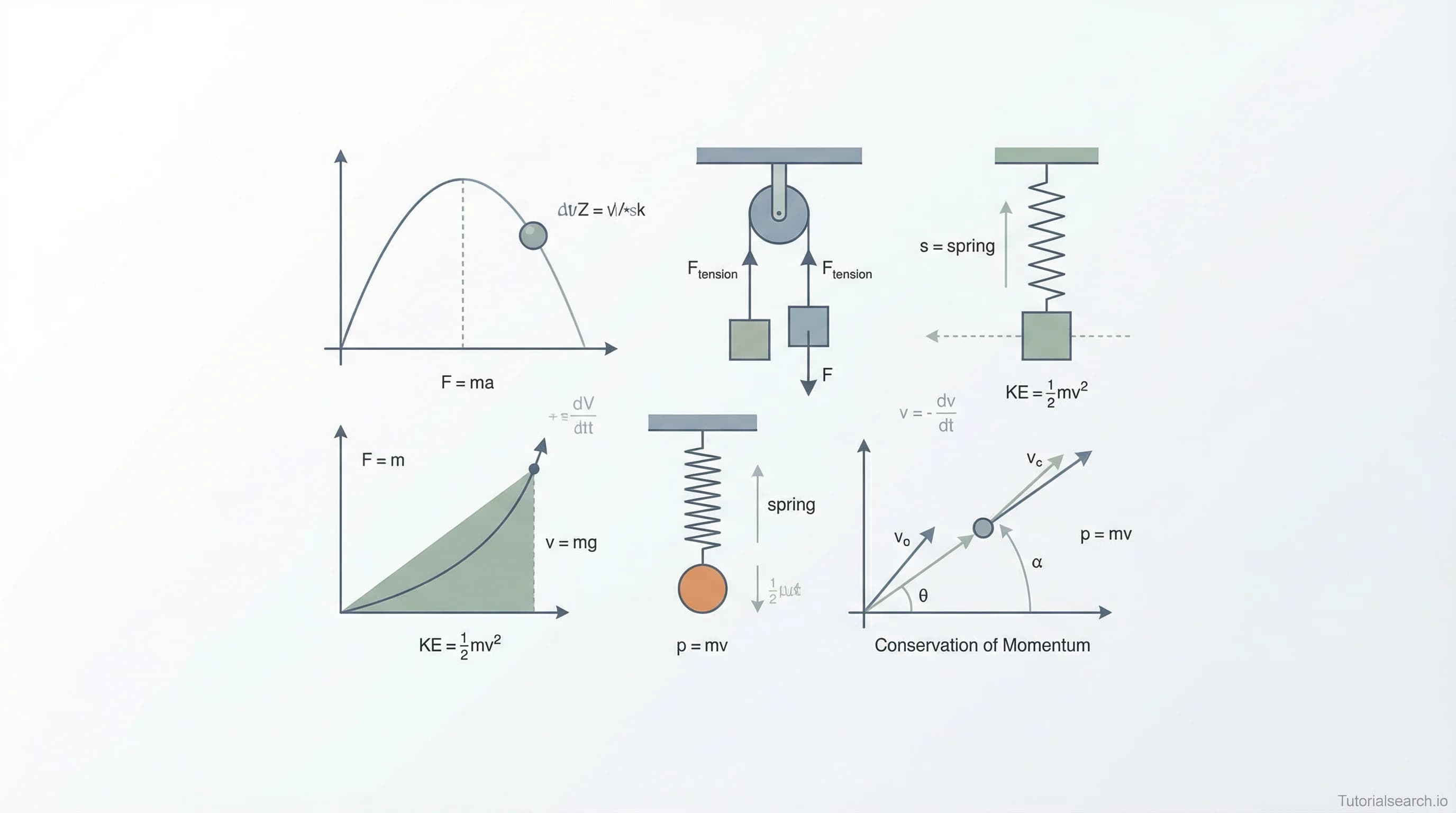
The discipline splits into three connected areas: kinematics describes what motion looks like (velocity, acceleration, path), dynamics explains why motion happens (forces, Newton's laws), and energy methods show conservation principles that simplify complex systems.
Most people get confused because they conflate memorization with understanding. You don't need to memorize that F=ma works—you need to understand why a force causes acceleration and how mass resists that acceleration. This distinction changes everything about how effectively you learn.
Mechanics sits at the intersection of pure science and engineering. Physicists use it to understand fundamental truths about the universe. Engineers use it to design structures that don't collapse. This topic is genuinely useful, not abstract for its own sake.
The Three Pillars: Kinematics, Dynamics, and Energy {#the-three-pillars}
Kinematics: Describing Motion Without Forces
Kinematics answers: "If something moves this way, what are its position, velocity, and acceleration?" You're describing motion, not explaining it yet.
Start with one-dimensional motion. An object starting at rest and accelerating steadily downward is kinematic motion. You can calculate where it'll be after three seconds using kinematic equations—no need to understand gravity yet.
This foundation matters because it gives you the mathematical language before concepts like force enter. Many learners struggle later because they skipped proper kinematics training. Spend time here with constant acceleration problems, and you'll find dynamics much clearer.
Two-dimensional projectile motion enters next. A ball thrown at an angle follows curved paths—kinematics predicts exactly where and when it lands. Free-body diagrams start appearing here, showing which directions forces act. Practice drawing these carefully; they're your visual tool for solving dynamics problems later.
Dynamics: Understanding Why Things Move
Dynamics is where Newton's three laws transform understanding into power. The first law says stationary objects stay stationary without force. The second law quantifies how much acceleration a force causes. The third law reveals that forces come in pairs.
Newton's Second Law (F=ma) is the core equation, but the insight matters more than the formula: force produces acceleration proportional to force and inversely proportional to mass. Heavy objects resist acceleration more than light ones.
Forces come in types: gravity (always downward), normal force (perpendicular to surfaces), friction (resisting motion), tension (pulling through ropes), and applied forces (whatever pushes the system). Identifying every force accurately is half the battle. Free-body diagrams force this clarity.
Inclined planes offer perfect introductory dynamics problems. An object sliding down a ramp experiences gravity pulling straight down, normal force perpendicular to the ramp, and friction along the surface. Resolving these forces into components along and perpendicular to the ramp teaches how to decompose forces—a skill used constantly in mechanics.
Energy Methods: A Powerful Shortcut
Work-energy relationships provide an alternative approach when force analysis gets complex. Work equals force times distance; kinetic energy equals half mass times velocity squared; potential energy depends on height.
The work-energy theorem states that work done on an object equals its kinetic energy change. This eliminates need for force analysis when only initial and final states matter. Energy conservation means total mechanical energy stays constant in isolated systems—incredibly useful for pendulums, collisions, and spring systems.
Power represents the rate energy transforms. A light bulb consuming 60 watts transforms 60 joules per second into heat and light. Understanding power means grasping how much work per unit time a system requires.
Spring systems introduce elastic potential energy. Compressed springs store energy that releases as kinetic energy when released. This connects to real-world applications: car suspension systems, athletic equipment, and structural engineering all depend on spring mechanics.
Why Engineers and Scientists Depend on These Concepts
Physics Mechanics underlies every engineering discipline. Civil engineers apply mechanics to design buildings that withstand wind, earthquakes, and their own weight. Mechanical engineers use dynamics to design efficient machines. Aerospace engineers calculate forces on aircraft to ensure safe flight.
Understanding mechanics makes you fluent in the language engineers speak. You can read structural design documents, understand why specific materials appear in designs, and troubleshoot problems by analyzing forces and motion.
For physicists, mechanics provides the foundation for quantum mechanics and relativity. Einstein's theory of relativity begins with questions about mechanics at extreme speeds. Quantum mechanics inherited concepts like energy and momentum from classical mechanics. You can't truly understand advanced physics without mechanics fundamentals.
Beyond technical fields, mechanics explains everyday observations. Why do you lurch forward when a car stops suddenly? Inertia (Newton's First Law). Why does kicking a heavy box hurt your foot? Action-reaction pairs (Newton's Third Law). Mechanics transforms the physical world from mysterious to predictable.
The Mathematical Foundation You Actually Need {#mathematical-foundation}
Most people overestimate the mathematics required for Physics Mechanics. You need algebra (solving equations), trigonometry (working with angles), and basic calculus (derivatives and integrals). That's genuinely it for introductory mechanics.
Algebra means moving terms around equations to isolate unknowns. In mechanics, you're constantly solving for acceleration, force, or velocity using algebraic rearrangement. This becomes automatic through practice.
Trigonometry enters whenever forces point at angles. A force at 30 degrees from horizontal has components you find with sine and cosine. This skill develops naturally—you'll solve problems with angled forces repeatedly until components become intuitive.
Calculus appears because velocity is the rate change of position, and acceleration is rate change of velocity. Derivatives describe these relationships mathematically. You don't need calculus for introductory mechanics, but calculus-based physics courses explicitly use derivatives. If you're shaky on calculus, study it directly alongside mechanics rather than waiting until confusion stops you.
Most physics courses provide formula sheets for exams, but that's not permission to ignore understanding. The formulas work because of mathematical relationships worth comprehending. A formula sheet helps during exams but shouldn't replace understanding why equations work.
Start with algebra if it's weak. Move to trigonometry next. Add calculus last if you're pursuing calculus-based physics. This sequence respects the mathematics' actual demands and prevents overwhelm.
Building Your Learning Path: From Zero to Problem-Solver {#learning-path}
Effective learning in Physics Mechanics follows a progression. Start with kinematics and one-dimensional motion. Master constant acceleration problems thoroughly before moving to two-dimensional motion. Only then tackle forces and Newton's laws, building on kinematics fluency.
Week 1-2: One-dimensional kinematics with constant acceleration. Work 20+ problems with only kinematics equations. Don't touch forces yet. Problems might be: "A car accelerates from rest at 2 m/s². How far does it travel in 5 seconds?" Simple math, clear physics.
Week 3-4: Two-dimensional motion and projectiles. Add velocity and acceleration vectors. Problems now: "A ball is thrown at 30 degrees at 20 m/s. How high does it go? How far away does it land?" More visualization required but still no forces.
Week 5-6: Forces and free-body diagrams. Newton's laws enter. Problems shift: "A 10 kg box sits on a frictionless surface. A 50 N force pushes it. What's the acceleration?" Now forces explain motion.
Week 7-8: Friction, normal forces, applied forces in realistic scenarios. Inclined planes. Tension in ropes. "A 10 kg box slides down a 30-degree ramp with friction coefficient 0.2. What's its acceleration?" Complexity increases through more forces, not harder mathematics.
Week 9-10: Work and energy. "A ball is thrown upward at 20 m/s. Using energy methods, what's its maximum height?" Same problems but solved differently—energy approach often simpler.
Week 11-12: Momentum, collisions, conservation principles. "Two balls collide. Before collision: Ball A (2 kg) moving at 5 m/s hits Ball B (3 kg) at rest. After collision they stick. What's final velocity?" Conservation laws replace force analysis.
This 12-week progression takes you from fundamentals to genuine problem-solving ability. Spread across months if needed, but the sequence matters more than speed.
Top Courses for Mechanics Mastery {#top-courses}
[Editors' Choice] Learn Kinematics in Physics Mechanics | For Beginners
Platform: Udemy | Instructor: Vinasirajan Viruthshaan | Students: 44+ | Rating: 4.78/5
This course specifically targets kinematics foundations. Start here if you're building from scratch. The instructor focuses on clear explanations over overwhelming detail, perfect for beginners. At this rating and student count, the course has proven itself with beginning learners specifically.
Best for: Absolute beginners with no physics background. Build confidence and fundamentals first.
[Editors' Choice] Physics - Kinematics for High School and AP Physics 1
Platform: Udemy | Instructor: Corey Mousseau | Students: 1,900+ | Rating: 4.67/5
This course has proven itself at scale—nearly 2,000 students with sustained high ratings. Corey Mousseau is known for clarity. This course bridges high school and college levels, making it adaptable for different backgrounds. The breadth of student feedback validates teaching quality.
Best for: Students preparing for AP Physics 1 or seeking broader kinematics coverage. The large student base means abundant course reviews help you verify it matches your learning style.
Physics - Energy and Momentum - High School and AP Physics
Platform: Udemy | Instructor: Corey Mousseau | Students: 636 | Rating: 4.51/5
After mastering forces with Corey Mousseau, this natural continuation covers energy and momentum systems. The instructor's consistent quality across courses means you'll maintain learning flow. These topics build directly on dynamics understanding.
Best for: Students completing forces and dynamics, ready for conservation principles and energy methods.
How to Solve Physics Problems with Forces (Mechanics)
Platform: Udemy | Instructor: Edouard Reny | Students: 294 | Rating: 4.73/5
This course emphasizes problem-solving rather than theory. Many learners understand concepts but freeze when encountering new problems. Edouard Reny teaches the mental approach to tackling physics problems systematically. This skill accelerates progress enormously.
Best for: Students who understand concepts but struggle with problem-solving. Bridges theory to practice.
Mastering Mechanics - Both High School & University
Platform: Udemy | Instructor: Mechanics Mentor | Students: 86 | Rating: 4.84/5
Despite fewer students than others listed, this course earns the highest rating (4.84). This suggests exceptional quality and selective audience that values deep mastery. "Mechanics Mentor" instructor name indicates specialization in this exact topic.
Best for: Serious learners wanting comprehensive coverage and willingness to invest time for excellence. Smaller class size might mean more instructor engagement.
Quantum Physics & Quantum Mechanics
Platform: Udemy | Instructor: Pritika Vipin | Students: 145 | Rating: 4.21/5
Once you've mastered classical mechanics, quantum mechanics extends your understanding to atomic scales. Classical mechanics predicts perfectly at everyday speeds; quantum mechanics explains what happens at atomic dimensions. This bridge course builds directly on mechanics foundations.
Best for: Students completing classical mechanics, interested in how mechanics transforms at quantum scales.
Mechanical Engineering 101: Forces and Moments (Mechanics)
Platform: Udemy | Instructor: The Engineering World | Students: 1,531+ | Rating: 3.70/5
This course applies mechanics to engineering contexts. Forces and moments are mechanics concepts essential for engineering design. The large student base indicates broad appeal. Lower rating (3.70) compared to pure physics courses suggests content is more specialized—appropriate if you need engineering applications specifically.
Best for: Engineering students needing mechanics applied to design problems rather than pure physics contexts.
Double Pendulum
Platform: Udemy | Instructor: Ross McGowan | Students: 374 | Rating: 5.0/5
Perfect score with 374 students—this course likely focuses on a specific mechanics system. Double pendulums illustrate complex dynamics beautifully. An instructional topic with perfect rating suggests exceptional teaching. This advanced topic capitalizes on mechanics fundamentals.
Best for: Students with mechanics foundations seeking deeper understanding through complex system analysis.
Calculus: Complete Course
Platform: Udemy | Instructor: Woody Lewenstein | Students: 1,367+ | Rating: 4.70/5
If calculus is your weak point, address it directly. Calculus-based physics courses require integration and differentiation fluency. This comprehensive calculus course has proven itself at scale. Combining calculus study with physics courses strengthens both.
Best for: Physics students needing parallel calculus study for calculus-based mechanics courses.
Introduction to Wind Energy
Platform: Udemy | Instructor: Kiran Ramkrishna Beldar | Students: 135 | Rating: 4.12/5
Real-world mechanics application: wind turbines use rotational dynamics and energy conservation principles. This course shows mechanics in technological contexts. Energy transformation from wind to electricity uses every mechanics concept you've learned.
Best for: Students interested in renewable energy, wanting to see mechanics applied to modern technology challenges.
Essential External Resources and References {#external-resources}
Hire the developers behind TutorialSearch.io
We built this site — full-stack web apps, AI integration & automation. Tell us what you need and we'll build yours.
Interactive Learning Platforms
Physics Classroom Newton's Laws Tutorial provides structured lessons on Newton's three laws with free-body diagrams and worked examples. The lessons progress logically: foundational concepts first, then individual laws, then applications. This free resource complements paid courses perfectly by offering alternative explanations when concepts feel unclear.
Khan Academy's Kinematics and Dynamics Unit covers the same progression in video format with quizzes. Khan Academy's strength is responsive pacing—watch videos at your speed and pause to take notes. Practice problems with immediate feedback help identify exactly where understanding breaks down.
MIT OpenCourseWare's Classical Mechanics Course provides the actual lectures from MIT's world-renowned physics program. MIT OCW includes video lectures, notes, exams, and solutions. This free resource lets you experience MIT-quality instruction. The mathematics level is higher than introductory courses, but the teaching excellence justifies the effort.
Textbooks and Reference Materials
Fundamentals of Physics by Halliday and Resnick remains the most widely-used introductory physics textbook. Comprehensive, with excellent worked examples and problems. Use this as your permanent reference—buy used copies for less, and you'll consult it for years.
Classical Mechanics by John R. Taylor bridges introductory and advanced treatments. Once you've mastered basics, Taylor's text introduces more sophisticated approaches like Lagrangian mechanics. The progressive structure lets you advance naturally rather than jumping to graduate texts.
OpenStax College Physics is free, comprehensive, and legally shared. Download Chapter 4 on Dynamics and Newton's Laws. The open-source nature means you can annotate, remix, and share—perfect for studying.
GitHub Educational Resources
Open Source Physics on GitHub maintains repositories with interactive simulations and educational tools. Tracker, their video analysis tool, lets you analyze actual motion in videos—powerful for seeing physics in the real world. Easy Java Simulations (EJS) lets you build your own physics simulations, deepening understanding through creation.
Open Physics Education Network provides complete course materials including notes, assignments, and solutions for classical mechanics. The PHY 321 course blends analytical and computational approaches, teaching you both pencil-and-paper problem-solving and computational physics methods.
Awesome Physics Repository curates open-source physics software. This collection points to tools, simulations, and educational resources organized by topic. Browse this when you want to see what's available beyond traditional courses.
YouTube Channels for Concept Explanation
Crash Course Physics offers 40-minute video summaries of physics branches. Episodes on Newton's Laws, kinematics, and energy cover fundamentals in engaging 10-minute segments. Good for reviewing concepts you've learned elsewhere or getting quick overviews.
Walter Lewin's Physics Lectures presents complete MIT physics courses. Lewin is legendary for making physics intuitive. His 8.01 (Classical Mechanics) lectures are freely available. If you can access these, watch them—the teaching is genuinely exceptional.
Veritasium explains physics concepts through experiments and real-world demonstrations. Derek Muller's approach emphasizes why things happen, not just that they do. Episodes on momentum, energy, and forces build intuition through visual reasoning.
Physics Girl (Dianna Cowern) explains physics with engaging demonstrations. Her kinematics and mechanics videos break down concepts through household experiments you can replicate. This channel excels at making abstract concepts concrete.
PBS Space Time focuses on astrophysics and relativity but includes mechanics concepts. Dr. Matt O'Dowd's explanations work backward from interesting questions to mechanics principles. Good for seeing where mechanics leads in advanced physics.
Standards and Documentation
International Standards for Physics Education establish what mechanics topics belong in different curriculum levels. These standards help you understand scope: what belongs in high school, what in introductory college, what in advanced courses.
Physics education research published at organizations like the American Association of Physics Teachers reveals how people learn mechanics most effectively. Research shows misconceptions are predictable and specifically addressed instruction overcomes them.
Practice Problems: Where Learning Happens {#practice-problems}
Understanding theory means nothing without problem-solving practice. This isn't optional—it's where learning actually occurs. Reading about Newton's Second Law and applying it to novel situations uses completely different brain regions.
Start with textbook problems at the back of each section. Every good mechanics textbook provides problems ordered by difficulty. Begin with straightforward problems using single concepts. "A 5 kg box accelerates at 3 m/s² from a 15 N force. Find the friction force." These single-concept problems build confidence.
Progress to multi-concept problems combining kinematics and dynamics. "A ball is thrown upward at 20 m/s from a 30-meter building. How long until it hits the ground? What's its speed on impact?" These require choosing which equations apply—the real skill of problem-solving.
Finally attempt complex, realistic scenarios. "A car approaching a red light traveling at 25 m/s decelerates at 5 m/s² due to friction with the road and air resistance. The driver's reaction time is 0.5 seconds. How far does the car travel before stopping?" These require setting up the problem yourself—no structure given.
Online resources like Khan Academy provide immediate feedback on answers. If your answer's wrong, the system tells you but usually doesn't just give the answer—you reconsider your reasoning. This productive struggle is where learning happens.
Create a problem journal. Write problems you encounter, your solution method, and check answers. Review journals monthly. Patterns in mistakes reveal misconceptions worth addressing. Maybe you consistently forget to convert units, or you misidentify force types. Knowing specific error patterns accelerates improvement.
Teach someone else. Explain your solution to a study partner or imagine explaining to a future version of yourself. This forces clarity. If you can't explain clearly, understanding has gaps. Teaching reveals and fills those gaps.
Advanced Topics: When You're Ready {#advanced-topics}
Once you've mastered fundamentals, several advanced areas deepen understanding:
Rotational Motion applies mechanics to spinning objects. Angular velocity and angular acceleration replace linear versions. Torque (rotational force) replaces force. Moment of inertia (rotational mass) replaces mass. The parallels are exact—if you understand linear mechanics, rotational mechanics follows naturally.
Lagrangian and Hamiltonian Mechanics reformulate classical mechanics using energy instead of forces. These approaches are mathematically more elegant and enable solutions to problems where force analysis would be prohibitively complex. This is graduate-level physics, but understanding it deepens classical mechanics foundations.
Oscillations and Waves extend mechanics to systems moving in cycles. Pendulums, springs, and sound waves all follow oscillatory motion. Understanding oscillations predicts how systems respond to disturbances—essential for engineering applications.
Special Relativity shows mechanics transforms at extreme speeds near light. Kinetic energy formulas change. Momentum conservation looks different. Time itself becomes relative. Relativity preserves all classical mechanics insights for everyday speeds while revealing that classical mechanics is special case of more general physics.
Quantum Mechanics shows mechanics transforms at atomic scales. Particles and waves become inseparable. Probability replaces certainty. Yet momentum and energy conservation remain—the principles underlying mechanics persist even when mechanics' equations transform.
FAQ: Your Physics Mechanics Questions {#faq}
What are the core principles of Physics Mechanics?
Physics Mechanics studies motion and forces through Newton's three laws. The first law states that objects maintain their state of motion without force. The second quantifies how force produces acceleration (F=ma). The third reveals forces come in equal and opposite pairs. These principles describe how all macroscopic objects move and interact, forming the foundation for understanding physical systems from bridges to orbits.
What math skills are required for Physics Mechanics?
You need algebra (manipulating equations), trigonometry (handling angles), and calculus (understanding rates of change). Introductory mechanics uses algebra and trigonometry. Calculus-based physics (using derivatives and integrals) is more rigorous but follows naturally if you've mastered algebra-based mechanics. Start where you are mathematically and strengthen weak areas in parallel with physics study.
How does Physics Mechanics relate to engineering?
Mechanics is fundamental to all engineering. Civil engineers apply mechanics to design structures. Mechanical engineers use dynamics and energy methods to design machines. Electrical engineers use mechanics to understand motors and energy systems. Aerospace engineers calculate aerodynamic forces. Chemical engineers use mechanics for fluid flow design. If you pursue any engineering discipline, mechanics mastery is prerequisite knowledge.
What is the difference between classical and modern Physics Mechanics?
Classical mechanics describes motion at everyday speeds and scales—perfectly accurate for cars, buildings, and machines. Modern mechanics extends this: relativity describes motion at extreme speeds near light, quantum mechanics describes atomic-scale behavior. Classical mechanics is fundamentally correct at everyday scales but incomplete at extremes. Modern mechanics preserves classical insights while revealing larger truths.
Why is understanding Physics Mechanics important?
Mechanics explains why the world works the way it does. It transforms the physical universe from mysterious to predictable. Engineers apply mechanics to create technologies from smartphones to space stations. Scientists use mechanics to understand gravitational systems, from atoms to galaxies. Intellectually, mechanics satisfies our drive to comprehend the world. Practically, it's prerequisite for technical careers. Philosophically, it reveals the universe operates according to discoverable principles.
Can you learn Physics Mechanics without advanced mathematics?
Yes. Algebra-based mechanics courses teach everything with minimal calculus. You can solve free-fall problems, analyze forces on inclined planes, and understand energy conservation using only algebra and trigonometry. Calculus-based courses are more elegant and lead to advanced physics, but algebraic mechanics is complete. Choose algebra-based if you want practical understanding without mathematical overhead. Choose calculus-based if you're pursuing physics or advanced engineering.
Related Physics Topics
Continue your physics education with these complementary subjects:
General Chemistry — Chemistry applies physics to atomic and molecular scales. Understanding chemical bonding requires mechanics principles. Chemistry builds naturally after mechanics mastery.
Environmental Science — Environmental systems involve mechanics: fluid dynamics in oceans, atmospheric pressure systems, motion of pollutants. Mechanics understanding clarifies environmental phenomena.
Life Sciences — Biomechanics applies mechanics to living systems. How muscles move bones, how hearts pump blood, how sound travels through ears—all involve mechanics.
Materials Science — Material properties (strength, elasticity, durability) depend on mechanics principles. Understanding stress, strain, and deformation requires mechanics foundations.
Structural Analysis — This engineering discipline is pure applied mechanics. Every structural principle derives from forces and mechanics. Engineering structures depend entirely on mechanics mastery.
Final Thought
Physics Mechanics transforms the world from mysterious to understandable. The same force principles that kept you in your seat as your childhood swing moved also describe planetary orbits. The energy conservation you use to calculate a ball's impact speed explains how power plants generate electricity. Every physical system ultimately obeys mechanics' principles.
The learning journey from confused beginner to confident problem-solver takes genuine effort and sustained practice. But thousands of learners have made this journey. The courses, resources, and practice methods exist and work. The path is clear. Your understanding of how the physical world works starts here.