Physics Fundamentals: The Courses and Tools That Work
Physics fundamentals explained — explore the best courses, free resources, YouTube channels, and GitHub repos to build a solid foundation in mechanics, energy, and waves.
Hire the developers behind TutorialSearch.io
We built this site — full-stack web apps, AI integration & automation. Tell us what you need and we'll build yours.
Most people start learning physics the wrong way. They grab a textbook, hit the first formula, and spend an hour memorizing F = ma without any idea what force actually means. Two weeks later, they've quit.
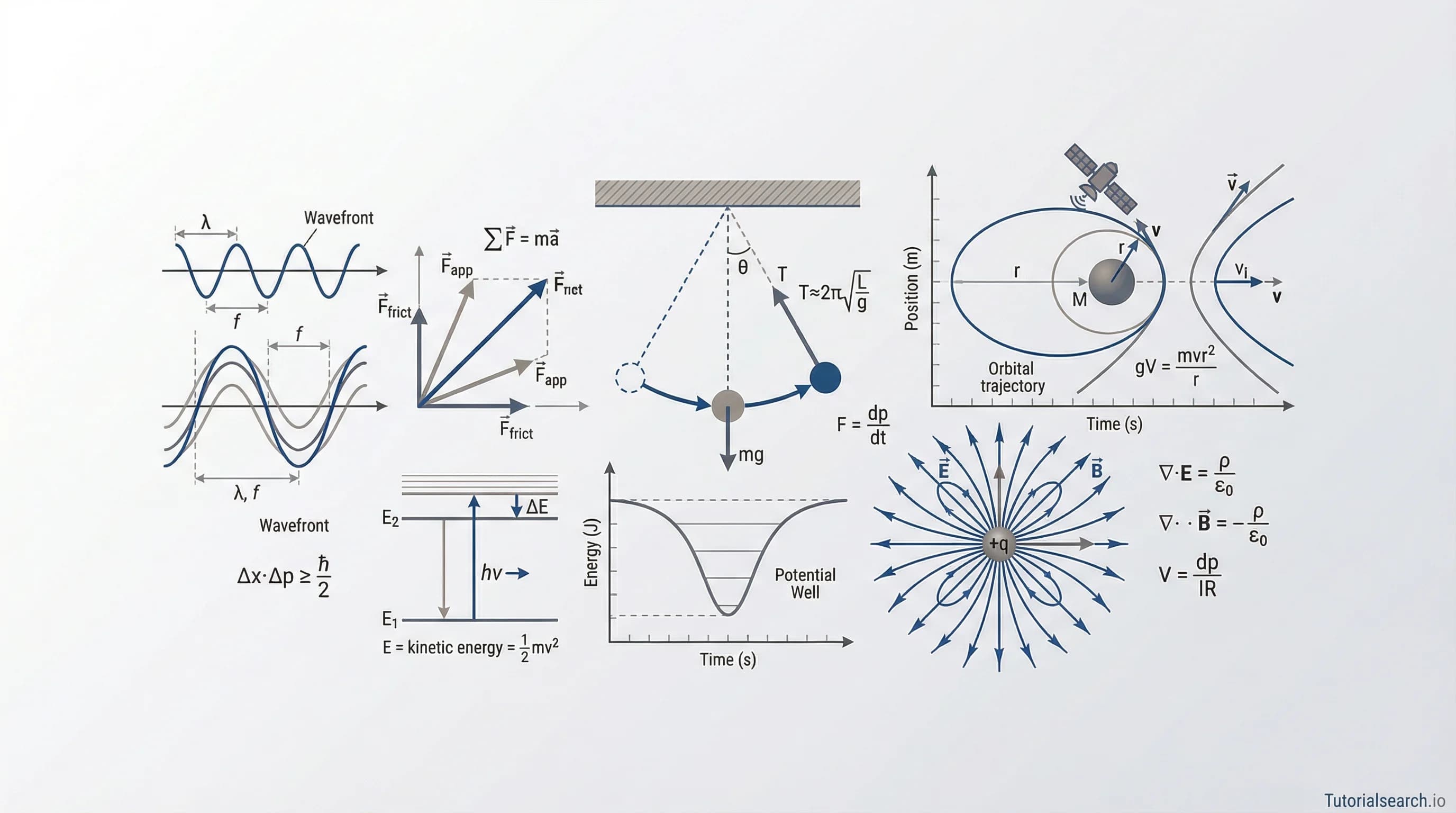
Physics fundamentals — the real bedrock of mechanics, energy, waves, and motion — rewards a different approach. Start with the why before the how, build up from intuition to math, and the formulas start to feel obvious rather than arbitrary.
There are 237 physics fundamentals courses on TutorialSearch.io. These are the ones worth your time, plus the free resources, GitHub repos, and YouTube channels that actually fill in the gaps.
Key Takeaways
- Physics fundamentals covers mechanics, waves, thermodynamics, and electromagnetism — the four pillars of classical physics.
- The biggest beginner mistake is memorizing formulas before understanding concepts. Intuition first, math second.
- Free resources like the Feynman Lectures and MIT OpenCourseWare cover everything you need — no paywall required.
- YouTube channels like MinutePhysics and CrashCourse Physics can make abstract physics fundamentals concepts click fast.
- Physics fundamentals training opens direct paths to engineering, data science, and research careers.
In This Article
- The Mistake That Trips Up Most Physics Learners
- Physics Fundamentals Courses I'd Actually Enroll In
- Free Physics Fundamentals Resources That Surprised Me
- Physics Fundamentals YouTube: Channels That Actually Teach
- Physics Fundamentals GitHub Repos Worth Bookmarking
- Going Deep: Physics Fundamentals Books Worth Your Time
- The Physics Fundamentals Communities Where Help Is Real
- Related Physics and Science Topics Worth Exploring
- Frequently Asked Questions About Physics Fundamentals
The Mistake That Trips Up Most Physics Learners
No one tells beginners this: most physics courses are structured for people who already understand physics.
They front-load definitions, hit you with a formula on page three, and assume you'll catch up. If you've ever felt lost staring at a kinematics equation, that's not on you. That's on how the course was built.
The better approach — one that actually sticks — is to start with phenomena. What happens when you throw a ball? Why does a bicycle stay upright? How does a microwave heat your food? Physics fundamentals answers these questions with increasing precision, not just increasingly complex notation.
That means choosing resources that build intuition first. The ones that explain why acceleration is a vector before asking you to add two of them. The ones that let you visualize a wave before describing it with an equation.
That's the filter I used for everything below.
One more thing before you start: you need solid algebra and some comfort with graphs to begin. You don't need calculus for most introductory physics fundamentals material — though it helps. If your math feels shaky, a week with Khan Academy's algebra refresher before diving in is time well spent.
Physics Fundamentals Courses I'd Actually Enroll In
The full list of physics fundamentals courses has 237 options. Here's how I'd narrow it down.
For Absolute Beginners
Essential Physics: Master Classical and Newtonian Mechanics by WR Training (Udemy) [Editors' Choice]
Rating: 4.5 | 697 students
This is the course I'd hand to someone who's never studied physics and wants a real foundation — not a watered-down summary. It covers Newton's laws, kinematics, energy, and work in a clear sequence that builds understanding step by step.
What makes it stand out: WR Training doesn't rush to formulas. Each concept gets worked through with diagrams and solved examples before asking you to do it yourself. By the end, the math feels like a natural extension of ideas you already understand — not a wall you're climbing.
Unlike some physics courses that dump all the definitions upfront and expect you to figure out the relationships on your own, this one shows you how the pieces connect.
Physics for Beginners by Marouane El Hizabri (Udemy)
Rating: 3.9 | 1,142 students
A solid starting point if you want shorter videos and a lighter time commitment. It covers the core topics — motion, force, energy — without overwhelming you. The 3.9 rating reflects that it's better for true beginners than for anyone looking for real depth, but as a first contact with the subject it works.
Fundamentals of Physics by The Learning Hub (Udemy)
Rating: 4.0 | 118 students
Smaller student count, but consistently reviewed as well-paced. This one works if you want a survey across multiple physics areas rather than deep coverage of mechanics alone.
For Students Who Know the Basics
The Complete AP and College Physics Course (Udemy) [Editors' Choice]
Rating: 4.6 | 20,837 students
This one has the numbers to back it up. Over 20,000 students, 4.6 rating, comprehensive coverage of AP Physics 1, 2, and C-level material — mechanics, electricity, magnetism, waves, and thermodynamics — with problem sets and practice exams built in.
If you're prepping for an AP exam, a college physics course, or just want a complete self-study curriculum, this is the strongest paid option by a wide margin. The student count alone says something about how effective it is at actually getting people through the material.
Newton's Laws of Motion (Classical Mechanics) — AP Physics (Udemy) — FREE
Rating: 4.7 | 114 students
Free and sharply focused. This covers just Newton's laws with the precision needed for AP-level work. A good supplement if you want to drill classical mechanics specifically before moving on.
You can search all 237 physics fundamentals courses on TutorialSearch.io to find the exact fit for your level.
If You Only Pick One
| Your Situation | Best Starting Course |
|---|---|
| Total beginner | Essential Physics: Master Classical and Newtonian Mechanics |
| Preparing for AP or college | The Complete AP and College Physics Course |
| Short on time | Physics for Beginners |
| Budget is zero | Newton's Laws of Motion (free) |
Free Physics Fundamentals Resources That Surprised Me
Everyone recommends Khan Academy first. And it's good — but it's not where I'd start for physics fundamentals.
Khan Academy works best when you already know what you're confused about. The video search and topic navigation are great for targeted help. For a complete, structured course? The alternatives below are often stronger.
The Physics Classroom (physicsclassroom.com) [Editors' Choice]
This is the free resource I come back to most. It's a high-school-level tutorial that explains concepts through text, diagrams, animations, and interactive exercises — all organized into a clear learning sequence.
The level is pitched just right: serious enough to be useful, simple enough to be readable. Mechanics, waves, electricity, and light are all here. And unlike some free resources that haven't been touched since 2015, The Physics Classroom is actively maintained and well-designed. Start here before trying anything else.
The Feynman Lectures on Physics (feynmanlectures.caltech.edu)
Nobel laureate Richard Feynman spent two years delivering these lectures to Caltech undergrads in the early 1960s. They were recorded, transcribed, and decades later put online for free.
Volume I covers mechanics, radiation, and heat. Volume II covers electromagnetism. Volume III covers quantum mechanics. No account required, no paywall.
These aren't beginner-friendly in the traditional sense — Feynman assumes mathematical maturity. But his way of thinking about physics is unlike anything else you'll read. Even if the math goes over your head, the conceptual sections alone are worth the time.
MIT OpenCourseWare — Classical Mechanics (ocw.mit.edu/courses/physics/)
MIT's free courseware includes full lecture videos, problem sets, exams, and an online textbook for their 8.01 Classical Mechanics course. This is the actual MIT curriculum, taught at a demanding level, available to anyone with an internet connection.
If you want to see what physics fundamentals looks like in a top engineering school's first-year program — and test yourself against their standards — this is it.
Open Yale Courses — Fundamentals of Physics I (oyc.yale.edu/physics/phys-200)
Professor R. Shankar's Yale course is one of the best introductory physics courses available anywhere, paid or free. The lectures are recorded and available with full notes, exams, and problem sets.
Part I covers Newtonian mechanics, special relativity, gravitation, thermodynamics, and waves. It's pitched at students with solid algebra and some calculus. If you're serious about building a proper physics foundation without paying for a university course, start here.
Class Central — 500+ Free Physics Courses (classcentral.com)
For browsing free physics fundamentals courses from MIT, Yale, edX, and Coursera, Class Central has a well-curated list. Good for finding structured alternatives to the paid Udemy options above.
Physics also connects directly to adjacent fields. If you're curious about how physics principles apply to the real world, the materials science courses and energy systems programs on TutorialSearch.io are worth exploring alongside your core physics study.
Physics Fundamentals YouTube: Channels That Actually Teach
Hire the developers behind TutorialSearch.io
We built this site — full-stack web apps, AI integration & automation. Tell us what you need and we'll build yours.
YouTube is where physics fundamentals get genuinely fun. These channels approach the material in ways that textbooks can't.
MinutePhysics (youtube.com/minutephysics)
Two to five minute videos that take a single concept and explain it with hand-drawn animations and clean narration. It's not a curriculum — don't try to use it as your primary source. But for making an abstract idea click, MinutePhysics is excellent.
The videos on quantum mechanics, special relativity, and the nature of light are particularly good for breaking up the monotony of working through textbook problems.
CrashCourse Physics (youtube.com/crashcourse) [Editors' Choice]
Dr. Shini Somara hosts a 46-episode series that covers a full year of high school and introductory college physics. Episodes run about 10 minutes each, are well-produced, and hit mechanics, waves, thermodynamics, electricity, and more.
It's dense — you'll want to pause and take notes. But as a free course structure covering the full scope of physics fundamentals, this is the best video series I've found. Pair it with The Physics Classroom for written reference and you have a solid free curriculum.
Physics Girl (youtube.com/physicsgirl)
Dianna Cowern makes videos about physics experiments, space, and everyday phenomena. Less of a course, more of an inspiration source. If you're trying to stay interested in physics while grinding through problem sets, Physics Girl is the antidote to burnout. Her experiments make abstract physics fundamentals feel real and worth caring about.
Khan Academy Physics (youtube.com/khanacademy)
Khan Academy's worked-example style shines on YouTube. The physics playlists cover mechanics, waves, and electricity with step-by-step problem-solving that's genuinely useful when you're stuck. Better for targeted help on specific problems than as a primary learning path.
One honest note: video-only learning isn't enough for physics. Every resource list should include more problem practice than most people think they need. Videos help concepts land — they don't replace working through problems yourself.
Physics Fundamentals GitHub Repos Worth Bookmarking
punnypenguins/introductory-physics-roadmap
A structured roadmap for university-level Physics I and II. Useful if you're self-studying and want to know what concepts to cover in what order. Clear, well-maintained, designed for both enrolled students and self-directed learners who want a structured sequence rather than a grab-bag of resources.
A curated list of physics software, simulations, and tools. If you want to go beyond reading and actually run physics simulations — planetary motion, oscillations, wave interference — this is where to start. Seeing the math animate in front of you changes how quickly things stick.
mejbass/Open-Source-Physics-Curriculum
A full self-taught physics curriculum using free online resources. Covers everything from classical mechanics through quantum theory with specific resource recommendations at each stage. Good for people who want a long-term roadmap rather than just the next course to take.
These repos pair especially well with the structural analysis courses on TutorialSearch.io for students who want to see physics applied to real engineering and construction problems.
Going Deep: Physics Fundamentals Books Worth Your Time
"University Physics" by Young and Freedman
The standard textbook for introductory physics at most universities. Dense, thorough, and packed with solved examples and problem sets at every level. You'll find used editions for very little money — older editions are nearly identical in content to new ones and cost a fraction of the price.
Not a casual read. But if you want the authoritative reference for all of physics fundamentals, this is it.
"Conceptual Physics" by Paul Hewitt
Popular advice tells beginners to start with Young and Freedman. I disagree for most people. Hewitt's book prioritizes conceptual understanding over math, making it genuinely readable for non-physicists.
It's not rigorous enough to stand alone if you're studying for an engineering degree. But as an entry point that builds intuition before adding equations? It's better for most beginners than jumping straight into a calculus-based text. Read Hewitt first, then move to Young and Freedman when the concepts feel solid.
HyperPhysics (hyperphysics.phy-astr.gsu.edu) — Free Online Reference
Not a book, but structured like one. Georgia State University's HyperPhysics has concept maps connecting every area of physics — click a concept, see how it connects to others. Better as a reference tool than a linear learning resource, but invaluable once you're working through problems and need to quickly see how ideas relate.
The Feynman Lectures on Physics (Print Edition)
If you want a physical copy of the Feynman lectures mentioned earlier, all three volumes are available in a boxed set. Worth having if you're serious about the subject — these are genuinely beautiful books that hold up as reference material long after you've moved past the introductory level.
Physics fundamentals connects directly to fields like electrical engineering and general chemistry — the underlying principles are shared, and it's worth exploring those areas as your physics knowledge grows.
The Physics Fundamentals Communities Where Help Is Real
r/Physics (reddit.com/r/physics)
The largest physics community on the internet. Good for reading recommendations, asking conceptual questions, and following current research. The community skews toward serious students and professionals, so expect thoughtful answers but also high standards.
For introductory-level questions, r/learnphysics and r/AskPhysics are more welcoming to beginners.
Physics Discord Server (discord.com/invite/physics)
Over 64,000 members and actively moderated, with channels for specific areas — mechanics, electromagnetism, quantum — and a dedicated homework help section. If you're stuck on a problem and need a real person to work through it with you, this is usually faster than waiting for a Reddit reply.
Physics Forums (physicsforums.com)
The longest-running physics forum on the web. Answers here tend to be longer and more technical than Reddit, which is useful when you need a full explanation rather than a quick hint. There's active expert participation across classical physics, modern physics, and applied topics.
If your interest in physics fundamentals extends toward life sciences or environmental applications, it's worth exploring the life sciences courses and environmental science programs on TutorialSearch.io — physics shows up in both fields more than most people expect.
Related Physics and Science Topics Worth Exploring
If physics fundamentals interests you, these related areas extend your knowledge in useful directions:
- Physics Concepts — deeper dives into specific topics like quantum mechanics, special relativity, and thermodynamics once you have the fundamentals
- General Chemistry — chemistry and physics share core principles around energy, forces, and atomic structure; the two subjects reinforce each other well
- Electrical Engineering — applies physics fundamentals directly to circuit design and electromagnetic systems
- Materials Science — how physics governs the structure and properties of the materials engineers work with
- Energy Systems — the physics of power generation, storage, and transfer
- Structural Analysis — force, motion, and mechanics applied to buildings, bridges, and mechanical systems
- Life Sciences — biophysics applies physics principles to living systems in ways that often surprise people
- Environmental Science — thermodynamics, fluid dynamics, and wave physics underpin climate and earth science
Frequently Asked Questions About Physics Fundamentals
How long does it take to learn physics fundamentals?
For a solid foundation in classical mechanics, waves, and basic thermodynamics — the core of physics fundamentals — expect 3-6 months of consistent study at roughly 5-10 hours per week. A complete introductory physics curriculum equivalent to two semesters of college coursework takes closer to a year for most self-directed learners. Your math background makes a significant difference: stronger algebra and calculus skills compress that timeline.
Do I need calculus to learn physics fundamentals?
No, not at first. Most introductory physics fundamentals content — including the courses above — is taught at an algebra-based level. You can understand force, motion, energy, and waves without calculus. You'll need it for upper-level mechanics, electromagnetism, and thermodynamics, so it's worth learning alongside your physics study if you plan to go deep.
Can I get a job with physics fundamentals knowledge?
Physics training is a strong foundation for engineering, data analysis, research, and technical roles. Employers in aerospace, semiconductors, energy, and tech actively look for candidates with physics backgrounds. You can explore applied directions through the electrical engineering courses and energy systems programs on TutorialSearch.io to see where physics knowledge leads in practice.
What are the core areas in physics fundamentals?
Physics fundamentals covers five main areas: mechanics (force, motion, Newton's laws), energy (work, kinetic and potential energy), waves (sound, light, oscillation), thermodynamics (heat, temperature, entropy), and electromagnetism (electric and magnetic fields). Most introductory courses cover the first three in depth and introduce the last two. The physics concepts courses on TutorialSearch.io go deeper into each area once you have the basics.
What math skills do I need before starting physics fundamentals?
A solid grasp of algebra — solving equations, working with fractions and exponents, reading graphs — is the real minimum. Trigonometry (sine, cosine, angles) comes up quickly in mechanics. Basic calculus helps but isn't required for most introductory material. If you can rearrange an equation and plot a line, you have enough to start.
How does physics fundamentals connect to engineering careers?
Every branch of engineering draws directly from physics fundamentals. Mechanical engineering applies classical mechanics and thermodynamics. Electrical engineering builds on electromagnetism. Civil engineering uses structural mechanics — which you can explore through structural analysis courses on TutorialSearch.io. Physics isn't just a prerequisite for engineering — it's the language engineers use to describe what their designs actually do.
The best next move depends on where you are right now. Starting fresh? The Essential Physics course gets you from zero to functional fast. Want free and thorough? Open Yale's Fundamentals of Physics I is the strongest free course available. Want to see how physics fits into a broader science education? Start with the full science category on TutorialSearch.io — there's a lot of ground worth covering, and physics fundamentals is the right place to begin.