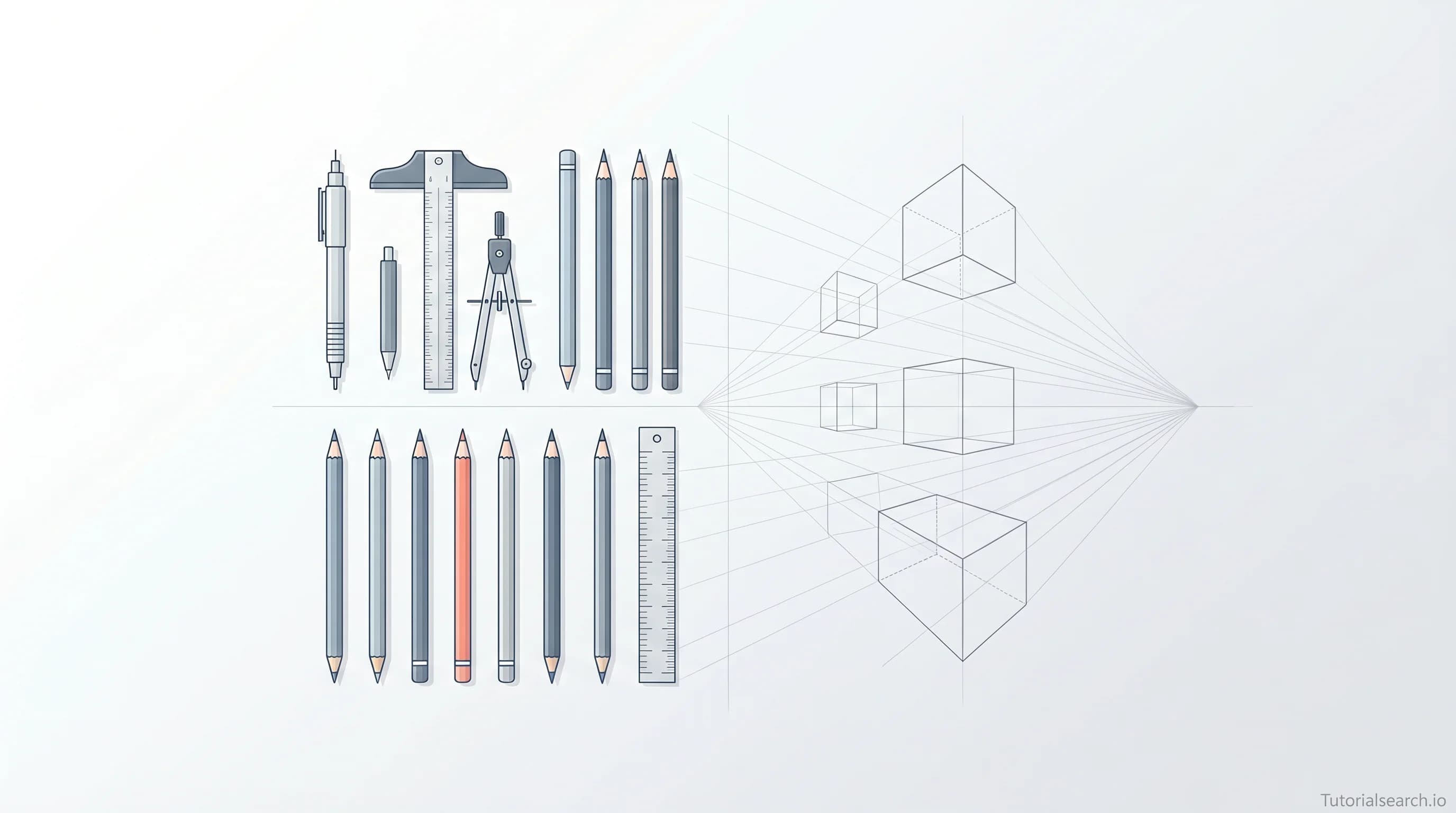
Perspective Drawing: The Complete Roadmap From Flat to Dimensional
A complete learning roadmap for perspective drawing — covering the best courses, free resources, YouTube channels, and books to take you from flat sketches to convincing three-dimensional illustration.
Hire the developers behind TutorialSearch.io
We built this site — full-stack web apps, AI integration & automation. Tell us what you need and we'll build yours.
Perspective drawing is the single skill that separates flat, lifeless sketches from illustrations that feel like you could step into them — and after years of watching students struggle with it, I can tell you most people learn it backwards. They copy rules about vanishing points without ever understanding why those rules exist. This guide collects the best perspective drawing courses, tools, and free resources I've found, organized as an actual learning path rather than a random pile of links.
Whether you're drawing cityscapes, vehicles, or interior spaces, perspective is the invisible scaffolding that makes everything else click. As of 2026, the range of free and paid resources available is genuinely impressive — and I've done the work of sorting the good from the filler.
Key Takeaways
- Perspective drawing creates realistic depth by controlling vanishing points and horizon lines on a flat surface
- Start with one-point perspective drawing before moving to two-point and three-point techniques
- Most perspective drawing students quit because they start too complex — simple box exercises are the fastest path to competence
- The best perspective drawing courses combine visual instruction with structured exercises you actually complete
In This Article
- A Note on How Most People Learn Perspective Wrong
- Perspective Drawing Courses Worth Paying For
- Free Perspective Drawing Resources That Are Surprisingly Good
- YouTube Channels for Perspective Drawing
- GitHub Repos and Open Curricula Worth Exploring
- Books That Actually Teach You to See in 3D
- One-Point vs. Two-Point vs. Three-Point: A Quick Decision Guide
- Perspective Drawing Communities
- Related Perspective Drawing Skills Worth Exploring
- FAQ
A Note on How Most People Learn Perspective Wrong
Here's a counterintuitive truth: most perspective drawing tutorials teach you formulas before they teach you to see. You memorize where to put the vanishing point without understanding what the vanishing point represents — which is the direction your eye travels along parallel lines until they converge at infinity.
I made this mistake myself. I spent weeks drawing perfectly plotted one-point perspective rooms that looked technically correct and somehow still felt wrong. The problem was that I was drawing symbols of perspective rather than observing it. The fix wasn't more rules. It was spending time on deliberate box-drawing exercises that forced me to internalize spatial relationships until they became automatic.
That shift in approach — from memorizing rules to building spatial intuition — is the thread that runs through every resource I recommend here.
Perspective Drawing Courses Worth Paying For
The structured course format works particularly well for perspective because the subject rewards progressive repetition. These are the courses I'd point a serious student toward.
- The Ultimate Perspective Drawing Course (Udemy) — Hamish Neilands
[Editors' Choice] This is the most comprehensive single course I've found for perspective drawing. Neilands works through the full progression — from basic horizon lines through complex vehicle drawing in three-point perspective — with a clarity that makes even the tricky concepts (foreshortening, shadows in perspective) feel manageable. The course is rated 5 stars and covers all levels, so returning to it as your skills improve actually pays off. If you only pick one course from this list, start here.
- One-Point Perspective Drawing: Easy Guide to Add Depth and Dimension to Your Sketches (Skillshare) — Nur Ornek
[Editors' Choice] Ornek has a gift for breaking down intimidating concepts without dumbing them down. This course is designed specifically for beginners who want to understand one-point perspective before tackling anything more complex, and the step-by-step approach to adding depth to sketches is genuinely practical. Students who've tried other resources and bounced off them tend to find this one finally makes perspective click. It's the most beginner-friendly entry point on this list.
- How to See and Use Perspective for Urban Sketching (Skillshare) — Teoh Yi Chie
[Editors' Choice] Teoh Yi Chie's courses have a devoted following for good reason — he draws on location, in real time, showing you how perspective actually works when you're not in a controlled classroom environment. This intermediate course is about perspective as a seeing tool, not just a construction technique. It's especially valuable if your goal is urban sketching, travel drawing, or working from life rather than imagination.
- Freehand Perspective Sketching: 7-Day Messy Drawing Challenge (Skillshare) — Sam Gillett
This one is different from the others in a useful way: it's explicitly about freehand perspective, accepting the looseness that comes with drawing without a ruler. Most perspective courses are oriented toward precise technical drawing. Gillett's 7-day challenge format forces you to actually draw every day, which is more valuable than watching tutorials you never act on.
- Drawing Made Clear: The Complete Guide to Perspective (Udemy) — Tristan StM
A thorough, methodical course for students who want to understand the why behind perspective drawing rules. Tristan StM builds up from first principles, which makes the material stick better than courses that just show you where to place vanishing points. Good complement to the more intuition-focused resources on this list.
- Learn Perspective in Procreate – One-Point Perspective (Skillshare) — The Artmother
If you're drawing digitally, this course bridges the gap between traditional perspective principles and the Procreate workflow. The Artmother has built a substantial following for her clear, warmly delivered instruction, and this course (nearly 1,200 students, rated 4.95) applies one-point perspective specifically to digital illustration. If perspective drawing as a whole interests you, also explore the broader art & illustration category to find where it fits into a creative skill set.
Free Perspective Drawing Resources That Are Surprisingly Good
The quality ceiling for free perspective drawing resources is higher than you'd expect. These are worth your time before you spend a dollar on anything.
DrawABox.com — This is the most rigorous free drawing program I know of. Rather than teaching perspective as a set of rules, DrawABox builds spatial reasoning from first principles through box-drawing exercises. Lesson 1 alone — which covers lines, ellipses, and basic box construction — has transformed how thousands of people approach perspective. It's free, structured, and the community provides homework feedback. The only downside is that it's slow-paced by design; expect weeks or months on the foundational exercises before seeing obvious results.
Student Art Guide – One-Point Perspective — Originally designed for high school students, this resource is cleaner and more useful than most paid textbooks. Free downloadable worksheets, step-by-step videos, and lesson plans that take you from horizon lines to complex cityscapes. The "beginner-friendly" framing understates how thorough the coverage actually is.
Artist's Network – Beginner's Guide to Perspective Drawing — A solid conceptual introduction to perspective drawing with clear diagrams and practical demonstrations. Good for establishing the vocabulary (vanishing points, horizon lines, orthogonal lines) before jumping into exercises.
Clip Studio Paint – A Beginner's Guide to Perspective — This guide is specifically aimed at digital artists and explains how to use perspective rulers in Clip Studio Paint alongside traditional concepts. Even if you don't use CSP, the conceptual sections are valuable.
Ran Art Blog – Perspective Drawing Guide — A well-written, updated guide (April 2026) covering all three main perspective types with clear explanations and exercises. Less academic than Student Art Guide, more practically oriented.
EasyDrawingTips – Perspective Drawing Tutorial — A good visual reference for beginners who need to see the mechanics of perspective illustrated simply before working through more detailed material.
For a more structured guided path, beginner art and foundational art courses pair well with these free resources.
YouTube Channels for Perspective Drawing
Hire the developers behind TutorialSearch.io
We built this site — full-stack web apps, AI integration & automation. Tell us what you need and we'll build yours.
Video instruction is particularly effective for perspective because watching someone construct a drawing in real time communicates spatial relationships that static diagrams often can't.
Perspective Academy — [Editors' Choice] The most focused YouTube resource specifically on perspective drawing. The channel covers everything from 1-point and 2-point basics through 5-point curvilinear perspective, with step-by-step city drawing and architectural composition lessons. The instruction style is clear and methodical without being dry. For anyone who learns best from video, start here.
Circle Line Art School — Artist and instructor Tom McPherson uploads new drawing tutorials every week, and a significant portion of the library covers perspective. The tutorials are famously accessible — if you're brand new and need someone to slow down and explain horizon lines from scratch, this channel does that without condescension.
Perspective Drawing Tutorials Playlist — A curated YouTube playlist covering essentials from horizon lines and vanishing points through 1-point, 2-point, and 3-point perspective, with over 2.5 hours of instruction. Good for systematic study rather than browsing.
Perspective Drawing Channel — Focused specifically on perspective drawing techniques with lessons that complement what you'd find in structured courses. Best used as supplementary material once you have the basics down.
Search TutorialSearch for more perspective drawing courses to find video-based options alongside these free channels.
GitHub Repos and Open Curricula Worth Exploring
GitHub isn't the obvious place to look for drawing resources, but there are a few genuinely useful finds here.
Open Drawing Curriculum — An open-source, crowdsourced curriculum for learning to draw, with perspective listed as one of the seven core fundamentals alongside construction, gesture, composition, and anatomy. The repository links out to free resources and exercises, organized in a way that gives you a sense of where perspective fits in the larger drawing learning journey. Small but thoughtfully put together.
Drawing Learning Resources — A curated list maintained on GitHub covering drawing fundamentals including perspective, with links to books, online courses, and communities. Lists Scott Robertson's work and references DrawABox, making it a reasonable jumping-off point for building a self-directed curriculum.
Both pair well with Procreate illustration courses if you want to apply these fundamentals in a digital environment.
Books That Actually Teach You to See in 3D
The perspective drawing book landscape contains both brilliant classics and a lot of derivative content that rehashes the same diagrams. These are worth your time.
Perspective Made Easy by Ernest Norling — Written in 1939 and still the best starting point for most beginners. Norling had a gift for making perspective feel intuitive rather than mechanical, and the book's exercises build on each other in a way that's rare even in modern texts. Rated 4.25 from over 2,200 Goodreads reviews — that's longevity earned, not manufactured. If Scott Robertson's How to Draw has ever felt overwhelming, start here first.
How to Draw: Drawing and Sketching Objects and Environments from Your Imagination by Scott Robertson — The advanced reference for serious students. Robertson brings almost two decades of teaching at the graduate design level to this book, and his coverage of complex perspective scenarios — curvilinear perspective, vehicles, organic forms in 3D space — is unmatched. This is a book you grow into, not through. Average rating of 4.57 from 1,200+ reviews.
For structured video instruction covering similar ground to these books, a dedicated perspective drawing course covers comparable material in video format.
One-Point vs. Two-Point vs. Three-Point: A Quick Decision Guide
Most beginners don't know which type of perspective to learn first. Here's an honest breakdown:
| Perspective Type | Vanishing Points | Best For | Difficulty |
|---|---|---|---|
| One-Point | 1 | Interiors, corridors, roads receding to center | Beginner |
| Two-Point | 2 | Buildings, vehicles, objects at an angle | Intermediate |
| Three-Point | 3 | Aerial views, dramatic low/high angles | Intermediate–Advanced |
| Five-Point (Curvilinear) | 5 | Fisheye effects, panoramic scenes | Advanced |
Start with one-point. Spend real time there — not a single afternoon, but several sessions until boxes and rooms feel automatic. Two-point follows naturally because you're essentially just adding a second constraint. Three-point is two-point with the vertical lines converging, which means it makes sense once two-point is solid.
The biggest mistake is skipping to three-point perspective too early because the results look impressive. The results also look impressively wrong when you don't understand what the third vanishing point represents.
Perspective Drawing Communities
Finding people to share work with and get critique from accelerates learning in ways that solo practice can't.
r/learnart — One of the best subreddits for foundational drawing feedback, with an active community that takes critique seriously. Perspective drawing questions get substantive responses rather than generic encouragement.
r/drawing Discord Server — The official Discord for r/drawing, where discussion, technique, and artwork are all welcome. Active voice channels and a culture that's genuinely welcoming to beginners asking perspective questions.
WetCanvas Forums — One of the oldest artist communities online, with dedicated drawing forums where you'll find both beginners and working professionals. The depth of archived threads on perspective techniques alone is worth browsing.
Related Perspective Drawing Skills Worth Exploring
If perspective drawing interests you, these related skills build naturally on what you've learned:
- Illustration Techniques — Over 1,350 courses covering the broader craft of illustration, where perspective is one tool among many
- Procreate Illustration — Apply perspective principles digitally with Procreate's built-in perspective guides and rulers
- Mixed Media Art — Perspective drawing as a foundation for combining traditional and digital media
- Creative Expression — Move beyond technical accuracy into using perspective as an expressive choice
- Beginner Art — If you're just starting out, broader foundational art skills pair well with perspective study
FAQ
How long does it take to learn perspective drawing?
Most students can grasp one-point perspective drawing in a few focused sessions — maybe 3–5 hours of deliberate practice. Two-point perspective typically takes a few weeks of regular practice to feel natural. Genuine fluency across all perspective types, where you can construct complex scenes from imagination without conscious effort, takes months of consistent work. Structured online courses provide learning paths that make this timeline faster.
Do I need drawing experience before learning perspective drawing?
Basic mark-making ability helps, but you don't need significant experience. One-point perspective is actually a good early skill to develop because it builds confidence quickly — you can draw a believable corridor or interior space before you can draw a convincing human figure. Start with simple box drawing before working up to complex scenes.
Can I get a job with perspective drawing skills?
Perspective drawing is a professional skill used in architecture, game design, film concept art, animation background design, and technical illustration. Game and film studios specifically hire perspective artists for environment and background work. Combined with digital tools and illustration skills, solid perspective drawing capability is part of a marketable concept art skillset.
What is perspective drawing used for in art?
Perspective drawing creates the illusion of depth on a flat surface, making artwork feel spatially coherent and three-dimensional. It's essential for architectural drawings, environment design, vehicle illustration, interior design visualization, and any scene where you want objects to feel like they exist in real space relative to each other.
Do I need math skills for perspective drawing?
No. The most important skill is spatial reasoning — the ability to imagine how objects would look from different angles. Basic geometry helps you understand why certain rules work, but working artists don't do calculations. They develop intuition through practice. Ernest Norling's Perspective Made Easy is a good reminder that this subject doesn't need to feel like engineering.