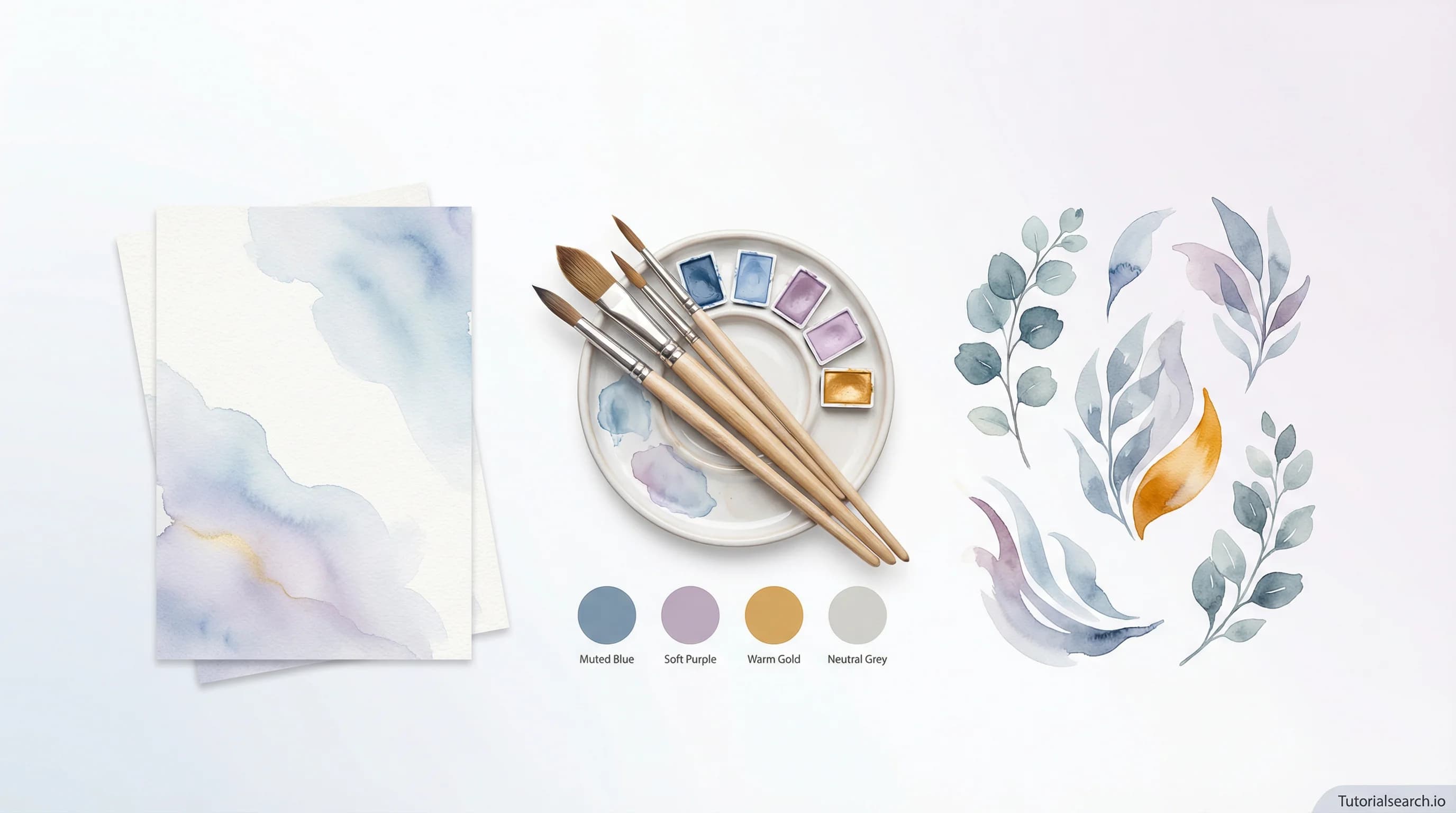
Paint Your Way In: The Best Watercolor Illustration Courses, Tutorials & Resources for 2026
A curated guide to the best watercolor illustration courses, free tutorials, YouTube channels, books, and communities — organized as a journey from first brushstroke to confident illustrator.
Hire the developers behind TutorialSearch.io
We built this site — full-stack web apps, AI integration & automation. Tell us what you need and we'll build yours.
You're sitting at your kitchen table with a cheap set of watercolors, a cup of murky water, and a sheet of printer paper that's already buckling. You touch brush to paper and the pigment bleeds in a direction you didn't expect. The green you mixed looks muddy. The petal you envisioned is more blob than blossom.
And yet — something about it is beautiful. The way the color feathered at the edge, the accidental gradient where two pigments met. That moment, the one where watercolor does something you didn't plan and it's somehow better, is the reason people fall in love with this medium and never quite leave.
I've spent more time than I'd like to admit exploring watercolor illustration courses and tutorials, and the landscape is enormous. Over 1,000 courses across platforms, countless YouTube channels, free guides, GitHub repos (yes, really), and books that range from paint-by-numbers gentle to fiercely opinionated. This guide is my attempt to sort through all of it so you can spend less time searching and more time painting.
Whether you're picking up a brush for the first time or you've been painting for years and want to push your illustration work into more intentional territory, I've organized everything by where you are in the journey — and I'll be honest about what's worth your time and what isn't.
The Quick Foundations Check
Before diving into courses and tutorials, a brief reality check on materials. Watercolor illustration is one of the most affordable art forms to start, but one decision matters more than the rest: buy decent paper. Student-grade paints are fine. Cheap brushes work. But thin paper will buckle, pill, and make you think you're worse than you are. Grab a pad of 140lb/300gsm cold-pressed watercolor paper — Canson XL or Strathmore 400 series are both solid entry points under $15.
If you want a deeper dive into watercolor techniques and fundamentals before jumping into illustration specifically, that's a smart move. Illustration demands brush control, color mixing confidence, and an understanding of layering — skills that pure technique courses build efficiently.
Courses That Changed How I Think About Watercolor Illustration
Not all courses are created equal, and honestly, the watercolor illustration space has a lot of lovely-looking classes that teach you to copy a single project without building transferable skills. The courses below do the opposite — they teach you to think in watercolor.
The Standouts
Ink & Watercolor Illustration: Learn Simple & Magical Techniques & Find Your Style by Yasmina Creates (Skillshare) — [Editors' Choice]
With over 12,000 students, this is the most popular watercolor illustration course I found, and it earns that status. Yasmina's teaching style is warm, unhurried, and focused on helping you develop your own aesthetic rather than copying hers. The ink-and-watercolor combination is particularly powerful for illustration because ink gives you structure while watercolor provides atmosphere. If you only take one course from this entire list, make it this one.
Watercolor Illustration: Transform Daily Objects Into Whimsical Characters by Hélène Baum (Skillshare) — [Editors' Choice]
This is the course I wish I'd found earlier. Hélène's approach — turning everyday objects into illustrated characters — forces you to think creatively about composition and storytelling, which is what separates illustration from painting. Over 7,300 students and a 4.6 rating speak for themselves, but what really sets this apart is the conceptual framework. You leave with a process, not just a finished piece.
From Idea to Finished Illustration by Benjamin Aeilkema (Udemy) — [Editors' Choice]
Here's where Udemy surprises. Benjamin walks through the full creative pipeline — from initial concept and thumbnail sketches through to a polished final illustration. At 4.65 stars with 3,400+ students, this isn't watercolor-specific, but the principles apply beautifully to watercolor illustration. If you're frustrated that your paintings feel "nice" but lack purpose or narrative, this is your missing piece.
Watercolor Illustration: Developing a Wedding Brand Suite by Carolyn Wiedeman (Skillshare)
Don't skip this because you're not into weddings. Carolyn's course is secretly one of the best classes on commercial watercolor illustration — designing a cohesive visual identity with watercolor elements. At 6,500+ students and a 4.67 rating, it teaches you to think about consistency, branding, and how illustration serves a purpose beyond the frame. Practical and surprisingly transferable.
Transform Watercolor Illustrations into Intricate Patterns by Sandra Mejia (Skillshare)
Sandra's class bridges watercolor illustration and surface pattern design — an increasingly lucrative niche. With 6,400+ students, it teaches you to take your hand-painted illustrations and turn them into repeating patterns for fabric, stationery, or digital products. If you're interested in the business side of illustration, this is essential viewing.
Worth Exploring
Watercolor Blossoms - Pro Techniques Explained by Anna Bucciarelli (Skillshare) — Nearly 3,000 students and a teaching style that breaks down professional-level techniques into digestible steps. Anna doesn't simplify to the point of uselessness, which I appreciate.
Watercolor Wings: Unleash Your Creativity and Paint Expressive Butterflies by Will Elliston (Skillshare) — Will has multiple watercolor animal courses, all excellent. The butterfly class (4.72 rating, 1,200 students) is a great entry point because it teaches expressive color blending through a single subject.
Watercolor Illustration: Create a Set of Magical Potions by Giulia D'Andrea (Skillshare) — A perfect 5.0 rating (small class, but still). This whimsical course is pure fun, and sometimes that's exactly what you need to stay motivated. The potion bottles teach glass transparency effects and color layering in a way that doesn't feel like homework.
Food Illustration: Jam on Toast Paint with Me by Nianiani (Skillshare) — Nianiani's YouTube presence is beloved for good reason, and her Skillshare classes maintain that same detailed, methodical approach. Food illustration is an underrated gateway into watercolor illustration because the subjects are simple, colorful, and forgiving.
| Course | Platform | Rating | Students | Best For |
|---|---|---|---|---|
| Ink & Watercolor by Yasmina Creates | Skillshare | 4.3 | 12,239 | Finding your style |
| Transform Daily Objects by Hélène Baum | Skillshare | 4.6 | 7,345 | Creative thinking |
| From Idea to Finished Illustration | Udemy | 4.65 | 3,448 | Full creative pipeline |
| Wedding Brand Suite by Carolyn Wiedeman | Skillshare | 4.67 | 6,593 | Commercial illustration |
| Intricate Patterns by Sandra Mejia | Skillshare | 4.29 | 6,416 | Surface design |
| Watercolor Blossoms by Anna Bucciarelli | Skillshare | 4.38 | 2,967 | Pro floral techniques |
You can find all of these and hundreds more on our watercolor illustration collection page, or search for exactly what you're after on TutorialSearch.io.
Surprisingly Good Free Stuff
Here's a contrarian opinion: for watercolor illustration fundamentals, free resources are often better than paid courses. Courses excel at structured projects and accountability, but the raw techniques — wet-on-wet, glazing, color mixing, brush control — are taught brilliantly by people giving their knowledge away for free.
Jenna Rainey's Complete Beginner's Guide to Watercolor — [Editors' Choice]
Jenna's free guide is more comprehensive than many paid courses I've seen. It covers supplies, color theory, basic strokes, and culminates in a full floral wreath composition. The fact that this is free is almost absurd. If you're brand new, start here before spending a cent.
Watercolor Affair — Watercolor Basics for the Absolute Beginner — A no-nonsense written guide that covers the fundamentals clearly: working light to dark, glazing techniques, wet-on-wet vs. wet-on-dry. Bookmark this as a reference you'll return to.
The Postman's Knock — Simple Watercolor Illustration Tutorial — Lindsey's tutorials are consistently among the most accessible I've found. She writes the way a patient friend teaches — specific, visual, and never condescending. The site also includes a free worksheet for practice.
Domestika's 23 Free Watercolor Painting Tutorials — A curated collection featuring multiple artists and techniques, from Ana Santos' wet-on-wet method to Naranjalidad's watercolor pencil tips. Great for exposure to different styles and approaches.
Emily Wassell's Watercolour Tutorials — Step-by-step guides specifically designed for beginners wanting to learn loose-style painting. Each tutorial lists exact colors needed, which removes a surprising amount of friction.
Let's Make Art — Free tutorials you can pair with their watercolor calendars. The calendar format is clever — it gives you a built-in painting schedule, which solves the biggest problem beginners face: consistency.
If you're looking for something more structured than individual tutorials but not ready for a full paid course, explore our beginner art resources page for curated options across skill levels.
Hit Play: YouTube Creators Worth Your Evening
Hire the developers behind TutorialSearch.io
We built this site — full-stack web apps, AI integration & automation. Tell us what you need and we'll build yours.
YouTube is where watercolor illustration really shines as a learning medium — you need to see water behavior, brush pressure, and color mixing in real time, and no amount of written description substitutes for video.
Mind of Watercolor (Steve Mitchell) — [Editors' Choice]
Steve's channel name comes from the idea that watercolors have a mind of their own, and his entire teaching philosophy is about working with the medium rather than fighting it. His tips videos are gold — short, specific, and immediately applicable. If you watch one watercolor YouTube channel, make it this one.
Nianiani — Nianiani's step-by-step tutorials walk you from sketch to finished piece with a level of detail that's almost meditative. Her style leans illustrative rather than fine art, which makes her channel particularly relevant if you're here for illustration specifically. She shows color mixing in real time and explains every decision.
Marco Bucci — I keep coming back to Marco's channel because he teaches art fundamentals — color, light, composition — in ways that transcend any single medium. His color theory videos genuinely changed how I approach watercolor palettes. Not watercolor-specific, but essential.
Mateusz Urbanowicz — Working in Japan as an illustrator and comic book artist, Mateusz's shop front illustrations are internet-famous for a reason. Watching him paint with Schmincke Horadam pigments is equal parts educational and hypnotic. His process videos reveal the thinking behind professional illustration in a way that tutorials often don't.
Jenna Rainey — Jenna's YouTube presence complements her written guides perfectly. Her videos cover everything from supply hauls to full paintings, and she has a knack for making advanced techniques feel approachable without dumbing them down.
Watercolor Misfit (Carrie Luc) — Carrie's cute, cartoony style and wonderful design sensibility make her videos a joy to watch. Her instructional content is beautifully crafted, and her style proves that watercolor illustration doesn't have to mean "traditional" or "serious."
If you're drawn to the intersection of watercolor and digital art, you might also enjoy our Procreate illustration collection — several artists combine traditional watercolor techniques with digital tools to stunning effect.
Repos, Roadmaps & Open-Source Learning
Yes, GitHub has watercolor resources. No, I'm not joking.
tombetthauser/watercolor-basics — A teacher with 10+ years of experience distilled their best exercises into a GitHub repo. These are the exercises that regularly helped frustrated art students make something they genuinely liked. It's raw, it's personal, and it's the kind of resource you won't find on a glossy platform.
myfoxtail/watercolor-painting — A structured learning plan for watercolor painting, created by someone who analyzed how to learn effectively and applied that framework to watercolor. Covers basic techniques, simple subjects (trees, flowers, cubes), and builds toward composition. Think of it as an open-source syllabus.
gracelgilbert/watercolor-stylization — This one's for the technically curious: a real-time watercolor stylization renderer that takes input geometry and makes it look like a realistic watercolor painting, with controls for paper color, bleeding intensity, and hand tremor. Fascinating if you're interested in where traditional and digital watercolor intersect.
stamen/watercolor — Stamen's watercolor-style map tiles are a piece of design history — they're archived in the Cooper Hewitt (the Smithsonian Design Museum). Even if you never use it for mapping, the aesthetic approach to translating watercolor textures into digital formats is inspiring for any illustrator.
Read Your Way Deeper
Books offer something screens don't: you can prop them open next to your painting desk and reference them with wet hands. Here are the ones worth owning.
Everyday Watercolor: Learn to Paint Watercolor in 30 Days by Jenna Rainey — Yes, Jenna again. Her book structures learning into daily bite-sized lessons over a month, and the modern aesthetic makes it feel contemporary rather than dated. Perfect if you respond well to daily practice schedules.
Watercolor Made Simple Workbook — What makes this special is that projects are pre-sketched on actual watercolor paper bound into the book. You literally just need paint and brushes. It removes the "I don't know what to draw" barrier completely. Ideal for absolute beginners who feel paralyzed by a blank page.
The Watercolour Flower Artist's Bible by Claire Waite Brown — Comprehensive reference for anyone drawn to botanical and floral watercolor illustration specifically. It covers individual flower techniques with clear step-by-step photography.
For something unconventional, check out creative expression resources on our creative expression browse page — sometimes the best thing for your illustration practice isn't another technique book but something that pushes your conceptual thinking.
If You Only Have 5 Minutes: Pick Your Path
Not sure where to start? Here's the shortest decision tree I can offer:
"I've literally never painted before."
→ Start with Jenna Rainey's free beginner guide, then take Yasmina Creates' Ink & Watercolor course.
"I can paint, but my illustrations feel flat."
→ Watch Marco Bucci's color theory videos on YouTube, then take Hélène Baum's Transform Daily Objects course.
"I want to turn illustration into income."
→ Sandra Mejia's Patterns course + Carolyn Wiedeman's Wedding Brand Suite. Learn to make illustration functional, not just decorative.
"I just want to paint something pretty tonight."
→ Pick any Nianiani video on YouTube, pour yourself a drink, and follow along. No pressure, no grades, just paint.
Where Artists Actually Talk to Each Other
Learning in isolation is a fast track to quitting. These communities keep the momentum going.
r/watercolor — Reddit's watercolor community is active, supportive, and refreshingly honest with feedback. Daily posts range from total beginners to professionals, and the sidebar resources are well-curated.
WetCanvas Forums — The longest-running online art community, and the watercolor section is particularly active. The forum format encourages deeper conversations than social media allows — technique discussions, book reviews, material comparisons.
Art Prof Discord — A free Discord community run by Art Prof (RISD-affiliated), where you can chat with art educators and fellow students. Broader than watercolor-specific, but the feedback quality is exceptional.
Huckleberry Art Academy Discord — A Discord server for artists at all levels, from beginners to industry professionals working in gaming, TV, and film. They run gesture drawing events up to three times a week and have an active critique section.
If you're interested in broadening beyond watercolor illustration into other mediums, explore mixed media art resources or browse our full Art & Illustration category.
Frequently Asked Questions
What materials are essential for watercolor illustration?
You need watercolor paper (140lb/300gsm minimum — this is non-negotiable), a basic set of watercolor paints (student grade is fine to start), round brushes in a few sizes (a size 6 and size 10 will cover most needs), a mixing palette, and two water containers (one for rinsing, one for clean water). Total startup cost: under $40.
Is watercolor illustration difficult to learn?
The basics are surprisingly approachable — you can produce something satisfying in your first session. But mastering water control, layering, and timing takes genuine practice. The medium is unforgiving in that you can't easily correct mistakes, which some people find frustrating and others find freeing. Most students see meaningful improvement within 30 days of regular practice.
How does watercolor illustration differ from watercolor painting?
Illustration is narrative — it tells a story or communicates a specific idea. Painting can be purely about color, light, and mood. Watercolor illustration typically involves more intentional composition, often incorporates line work (ink or pencil), and serves a purpose beyond the frame: editorial, children's books, branding, surface design. The techniques overlap significantly, but the intent differs.
What career paths exist for watercolor illustrators?
Freelance illustration, children's book illustration, editorial illustration, surface pattern design (fabric, stationery, wallpaper), branding and wedding design, greeting cards, and teaching. A strong online portfolio — particularly on Instagram and Behance — is essential for visibility. Many working illustrators combine watercolor with digital tools for production efficiency.
Your Next Move
Stop researching. Seriously. You have enough information now. Grab whatever paper and paint you have, open one of the free resources above, and paint something ugly. Then paint something slightly less ugly. Then do it again tomorrow.
The watercolor illustrators you admire didn't get there by finding the perfect course — they got there by painting hundreds of imperfect pieces and learning from each one. Every resource on this list is a tool to accelerate that process, but the process itself is irreplaceable.
If you want to explore everything available, browse our full collection of 1,000+ watercolor illustration courses or jump into related topics like illustration techniques and art skills. The brush is in your hand. Use it.