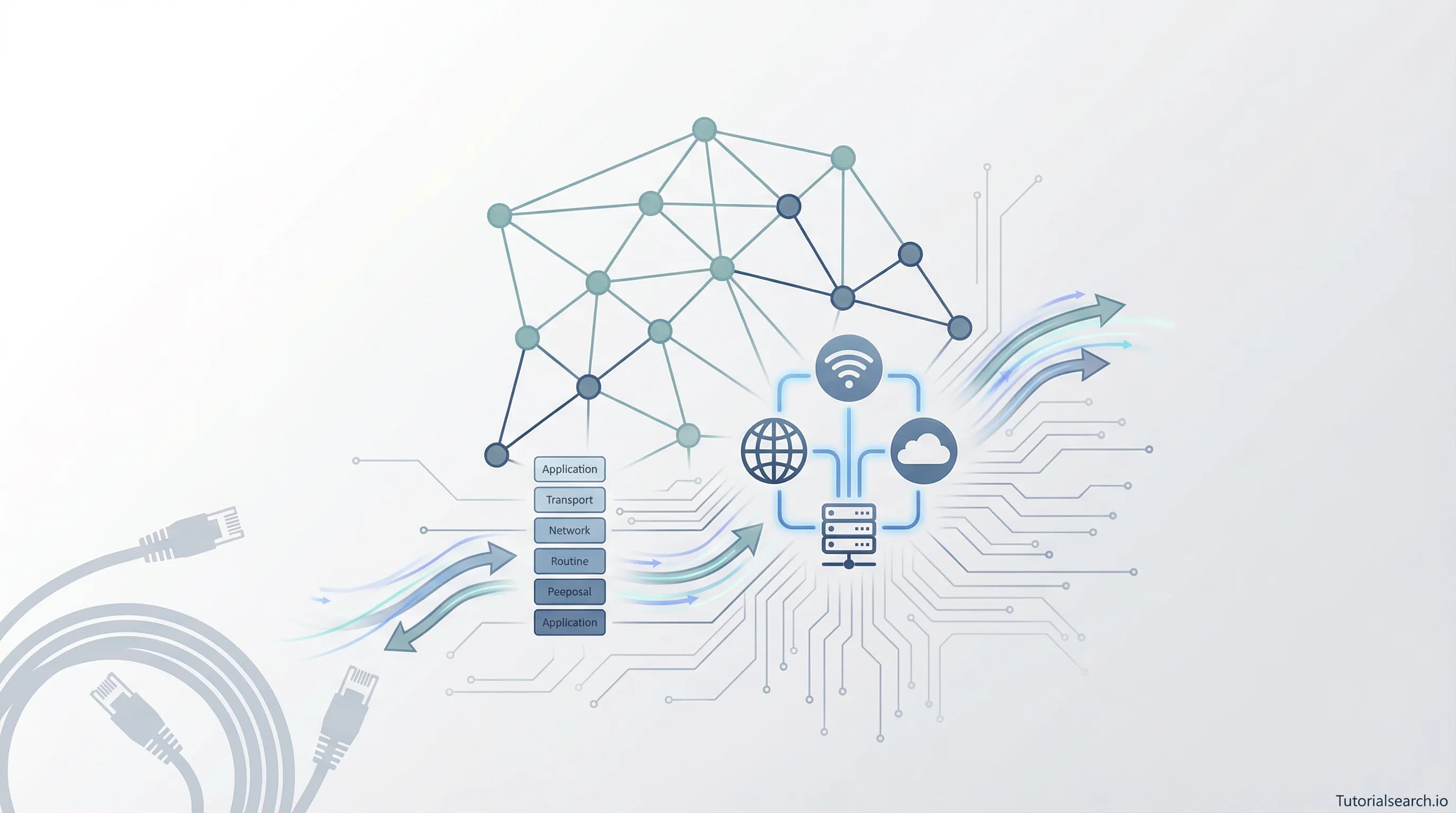
Network Fundamentals Mastery: Your 2026 Learning Roadmap
Master network fundamentals with curated courses, free resources, YouTube tutorials, and active communities. Complete 2026 guide from OSI models through advanced packet analysis.
Need a web app built? Hire the team behind TutorialSearch.io
We ship fast, production-grade full-stack apps (Next.js, React, edge infra) — the same stack that powers this site.
Network fundamentals form the backbone of every IT professional's skill set. Whether you're starting a cybersecurity career, pursuing a CCNA certification, or simply want to understand how the internet works, mastering core networking concepts is non-negotiable. This guide covers everything you need to build a solid networking foundation — from OSI models and TCP/IP to real-world packet analysis and troubleshooting.
Understanding network fundamentals isn't just theoretical knowledge. It's the practical ability to diagnose connectivity issues, optimize network performance, and implement security measures that protect organizational assets. When you understand how data flows across networks, how devices communicate, and where vulnerabilities exist, you become invaluable to any tech team. Network professionals command higher salaries, receive more job opportunities, and build careers that span decades across virtually every industry.
Key Takeaways
- Network fundamentals cover the OSI model (7 layers), TCP/IP protocols, IP addressing, subnetting, and routing concepts that form the foundation of all network communications
- Hands-on experience with tools like Wireshark, Cisco Packet Tracer, and subnetting calculators accelerates learning and builds practical troubleshooting skills faster than lectures alone
- CCNA certification remains the industry gold standard, requiring solid fundamentals knowledge and opening doors to higher-paying roles in networking
- Free resources from Microsoft Learn, Cisco Academy, and NetworkLessons.com provide quality education without requiring upfront investment
- Practice labs and real packet capture analysis are more valuable than passive lectures for truly internalizing how networks function
- Active communities on Discord and Reddit provide mentorship, study groups, and job opportunities for aspiring network professionals
Top Curated Courses for Network Fundamentals
The best way to master network fundamentals is through structured, instructor-led courses that combine theory with hands-on labs. Courses provide accountability, organized curriculum, and access to instructors who answer questions. The right course can reduce learning time significantly while increasing retention.
Free CCNA 200-301 Course: Network Fundamentals
Editors' Choice — David Bombal's free CCNA course stands out as exceptional value. With 73,476 students and a 4.57 rating, this beginner-friendly course teaches TCP/IP, the OSI model, subnetting, and routing without any cost. The course uses live demonstrations and Cisco Packet Tracer labs to cement foundational concepts. Most learners report this single course provided everything needed to pass CCNA fundamentals sections. Bombal's teaching style breaks complex topics into manageable pieces, making it accessible even for those with zero networking background.
Network Fundamentals by Network Engineer
This comprehensive course from Atul Sharma covers network devices, protocols, and troubleshooting methodologies. With nearly 18,000 students and consistent 4.1+ ratings, it bridges the gap between theory and real-world application. The instructor's background in network engineering shines through practical examples that show how concepts apply in production environments. His real-world troubleshooting examples teach you what actually happens when networks fail.
Introduction to Computer Networks for Non-Techies (2025)
Editors' Choice — If jargon-heavy networking courses intimidate you, this course demystifies concepts for absolute beginners. Over 75,000 students give it 4.77 stars. Perfect for career changers, project managers, or anyone without prior IT experience who needs to understand networking basics without drowning in technical details. This course avoids unnecessary terminology while still covering essential concepts that form your foundation.
CCNA (200-301) - Network Fundamentals and Internet Protocols
Oak Academy's structured approach systematically covers CCNA fundamentals topics. The course emphasizes practical scenarios and includes practice questions that mimic the actual exam, making it ideal for certification-focused learners. Their teaching methodology progresses from foundational concepts through advanced topics at a sustainable pace. This structured progression prevents overwhelm while building comprehensive understanding.
IT Networking Fundamentals for Beginners
Editors' Choice — Vahagn Hayrapetyan's course attracts 5,200+ learners with a 4.52 rating. It covers foundational concepts progressively, building from basic terminology through IP addressing and routing. The pacing works well for self-paced learners who need flexibility while maintaining structure. Many students appreciate the clear prerequisites and logical progression.
Free Learning Resources and Platforms
Quality free resources exist if you know where to look. These platforms provide legitimate, comprehensive network fundamentals education without financial barriers. Many working professionals learned networking entirely through free resources, proving that cost isn't a barrier to mastery. The internet has democratized technical education in remarkable ways.
Start with Microsoft's official guide to build core concepts. Microsoft's production quality and enterprise perspective provide credibility you won't find everywhere. Their alignment with Azure infrastructure means you're learning modern cloud-era networking alongside fundamentals.
You'll discover that NetworkLessons.com offers exceptional depth without paywalls. The site provides detailed explanations, interactive diagrams, and free lab exercises that progress from OSI model basics through advanced routing. Rene Molenaar maintains this resource with meticulous attention to accuracy, making it trusted by networking professionals worldwide. The interactive nature helps cement understanding.
Cybrary's FREE Network Fundamentals Course balances breadth with depth from a cybersecurity perspective. You can also earn accredited certificates through Alison's Basics of Computer Networking, which adds credentials to your professional profile. This certification carries some weight in hiring decisions.
For quick reference and concept clarification, GeeksforGeeks Computer Networks Tutorial breaks down concepts into digestible articles with visual examples. Cisco Networking Basics Guide offers the vendor's perspective on network architecture and best practices. These reference resources become invaluable when you need clarification on specific concepts.
YouTube Channels and Video Tutorials
Video learning accelerates understanding of complex networking concepts. These channels combine quality instruction with engaging presentation styles that make abstract concepts concrete. The visual demonstration of packet flow, network topology, and protocol interactions helps cement understanding faster than text alone.
Eli the Computer Guy's 18-hour series across 29 videos makes an exceptional free resource. His methodical teaching style works especially well for visual learners who benefit from step-by-step progression. Each video builds on previous concepts, creating a coherent learning journey from basics through advanced topics.
NetworkChuck brings energy to CCNA education through colorful animations and relatable explanations. Students consistently report his videos make concepts "click" after struggling with textbook definitions. His personality makes watching hours of networking content feel engaging rather than tedious. The animations visually show packet movement through networks.
Professor David Wetherall recorded 92 detailed videos covering routing, TCP/IP, Ethernet, DNS, HTTP, and network security. This university-quality content rivals formal coursework in rigor while remaining freely available. Wetherall's academic background ensures technical accuracy and proper explanation of underlying principles.
FreeCodeCamp's 12-hour deep dive covers networking end-to-end with production quality comparable to professional training programs. Their comprehensive scope makes it excellent for building connected mental models of how networks function. This single video covers concepts that would take weeks to gather from scattered sources.
Networking Guruji focuses on CCNA preparation with structured learning paths for certification pursuit. His content specifically targets exam requirements, making it valuable for those pursuing professional credentials. The focus on practical knowledge rather than theory makes his channel particularly useful.
GitHub Repositories and Network Tools
Open-source projects and curated resource lists accelerate your learning journey. GitHub contains both educational resources and professional tools used in production networks. These communities have identified the best resources through collective expertise.
The facyber awesome-networking list aggregates the best courses, books, tutorials, and tools in one place. Awesome-lists curate community knowledge, saving you hours of scattered research. These repositories have hundreds to thousands of stars, indicating community validation of quality.
nyquist/awesome-networking focuses on practical resources for designing, implementing, and operating computer networks. The emphasis on practical application makes it valuable for professionals transitioning from theory to hands-on work. You'll find production tools alongside learning materials.
mikeroyal/Networking-Guide covers wired and wireless design, configuration, hardware, protocols, security, backup, recovery, and virtualization. This comprehensive guide functions as both learning resource and reference material, giving it long-term value beyond initial learning. It's been bookmarked by thousands of professionals.
Essential Books for Deep Learning
Need a web app built? Hire the team behind TutorialSearch.io
We ship fast, production-grade full-stack apps (Next.js, React, edge infra) — the same stack that powers this site.
Reading networking books builds conceptual frameworks that video content alone doesn't provide. Books allow deeper exploration of topics, providing context and philosophical foundation. The linear narrative of a well-written book can explain complex relationships more effectively than scattered resources.
Kurose and Ross's textbook remains the gold standard, using a top-down methodology that shows "why" before "how." Starting with application layer concepts before diving into physical implementations resonates with modern learners who want context before details. The academic rigor ensures accuracy while remaining accessible to motivated learners.
Networking All-in-One For Dummies demystifies networking without sacrificing accuracy. The book covers wired and wireless networks, TCP/IP, and troubleshooting with Doug Lowe's characteristic clarity. For Dummies books have earned respect in technical communities for making complex topics genuinely understandable while maintaining correctness.
Comparison: Free vs. Paid Learning Paths
Choosing between free and paid learning paths involves tradeoffs beyond cost. Consider your learning style, accountability needs, and timeline goals. Neither path is universally superior; the best choice depends on your circumstances.
| Aspect | Free Courses | Paid Courses | Best For |
|---|---|---|---|
| Cost | $0 | $15-200 | Budget-conscious learners; Career changers testing commitment |
| Instructor Support | Limited/Community | Email/Forums | Structured feedback; Accountability |
| Hands-on Labs | Varies; Often Simulator-based | Included; Often Cisco Packet Tracer | Practical experience; Certification prep |
| Certification Guarantee | None | Often included | CCNA/CompTIA pursuit |
| Time Commitment | 40-100+ hours | 40-100+ hours | Comparable for both paths |
| Community Support | Active Discord/Reddit | Course forums | Question resolution speed |
| Completion Rate | 5-15% | 30-50% | Accountability matters |
| Insider Note: The paid/free distinction matters less than commitment. Many professionals complete free CCNA courses and pass the exam. The difference lies in accountability structures and guided learning paths, not content quality. For certification pursuit, paid courses offer organized sequences and practice exams that accelerate readiness. Browse our Security Fundamentals section for related concepts that build on networking knowledge. |
Active Communities and Study Groups
Networking communities provide mentorship, study partners, and job opportunities that individual learning can't match. Isolation kills motivation; communities provide the opposite. Real people at every level exist ready to help you succeed.
The Cisco Study Group Discord brings 28,000+ CCNA aspirants together where members share resources and provide encouragement. The active environment transforms isolated learning into collaborative effort. You'll find people at every experience level willing to help newer members succeed. The peer-to-peer learning accelerates understanding.
Reddit's CCNA subreddit hosts thousands of professionals and engineers who answer questions within hours and share exam experiences. The community maintains a non-judgmental environment where newcomers feel safe asking basic questions. Many people report that community support made the difference between giving up and persisting toward their goals.
Networking Discord Servers provide real-time support beyond Reddit's asynchronous discussions. Real-time chat enables dynamic problem-solving that email-based support can't match. The immediacy of answers provides momentum for learning.
Frequently Asked Questions
What exactly are network fundamentals, and why do I need to learn them?
Network fundamentals encompass the concepts, protocols, and devices that enable computers to communicate. Understanding fundamentals is essential because every IT role—from help desk support to cloud architecture—requires basic networking knowledge. Network issues underlie most IT problems, so understanding networks transforms you from someone who reboots servers into someone who actually fixes problems. This transformation dramatically increases your value and earning potential.
Explore our Network Security guide to understand applied security concepts built on network fundamentals.
Is a CCNA certification worth pursuing in 2026?
CCNA certification remains the industry standard for networking roles. Certified professionals earn 15-25% more than uncertified peers according to Cisco surveys. The exam's difficulty means employers trust CCNA holders actually understand networking rather than simply memorizing definitions. In a competitive job market, certification provides concrete proof of competency employers respect.
How long does it realistically take to master network fundamentals?
Most learners need 40-100 hours of focused study to comprehend core concepts. The timeline varies based on background—IT professionals with system administration experience progress faster because they understand underlying infrastructure. Real mastery requires 6-12 months of consistent practice beyond initial coursework. Don't rush; deep understanding compounds over time.
Should I use Cisco Packet Tracer or GNS3 for practice labs?
For network fundamentals, Cisco Packet Tracer is ideal. It's free, requires minimal system resources, and includes pre-built labs aligned with CCNA topics. GNS3 offers more realism but demands higher system specifications. Start with Packet Tracer to build foundational skills before advancing to more complex simulation environments.
What's the difference between the OSI model and TCP/IP model?
The OSI (Open Systems Interconnection) model describes networking in seven layers as a theoretical framework. The TCP/IP model condenses those concepts into four practical layers and describes how the internet actually functions. Both are essential and required for CCNA exams. OSI provides the detailed framework; TCP/IP shows real-world application. Understanding both gives you theoretical depth and practical perspective.
Can I learn network fundamentals completely free, or do I need paid courses?
Completely free learning is absolutely possible. David Bombal's CCNA course, NetworkLessons.com, Microsoft Learn, and FreeCodeCamp provide legitimate, high-quality education at zero cost. However, paid courses excel at structured progression and accountability. Combine free resources for core concepts with strategic paid content for exam preparation if pursuing certification.
Related Topics in Cybersecurity
Network fundamentals unlock understanding in complementary cybersecurity domains. Build your network skills before specializing in security areas:
- Explore our Network Security guide to learn securing networks you design
- Discover Security Fundamentals to understand networking and security intersection
- Master Ethical Hacking to understand how attackers exploit network vulnerabilities
- Study Cloud Security to apply networking in modern cloud environments
- Pursue Security Certification paths building on networking fundamentals
Final Thought: Network fundamentals might seem abstract until you see them in action. The moment you use Wireshark to capture real packets crossing your network and understand what each byte means, theory becomes concrete. That realization—when understanding clicks—makes the investment worthwhile. Start with one free resource today. The networking community is ready to support your journey.
The Learning Ecosystem: How Everything Connects
Understanding network fundamentals isn't isolated learning—it's entering an ecosystem. Each resource type serves different purposes in your learning journey. Courses provide structure. YouTube videos offer visual explanation. Books deliver depth. Communities supply motivation and real-world perspective. The most successful learners combine multiple resource types strategically.
Start with YouTube to visualize concepts. Move to courses for systematic coverage. Reference books for deep dives into confusing topics. Practice continuously with simulators. Ask communities when stuck. This integrated approach works faster than any single resource because different people learn through different modalities.
The networking community is remarkably supportive. Experienced professionals remember their own struggles and actively help newcomers. This culture creates positive feedback—helping others reinforces your own knowledge while building community bonds. You're not competing; you're collaborating toward collective mastery.
Your learning timeline matters less than consistency. Thirty minutes daily for six months beats weekend cramming marathons. The spacing effect in cognitive psychology shows that distributed practice builds stronger memory and deeper understanding. Consistency compounds. Small gains accumulate into transformation.
Building Your Networking Mindset
Network fundamentals seem like memorization—remembering OSI layers, TCP/IP protocols, subnet masks—but mastery transcends memorization. Real understanding means you can explain why networks function the way they do, not just what they do. You grasp the tradeoffs between centralization and distribution, speed and reliability, simplicity and capability.
This systems thinking extends beyond networking. Network problems rarely result from single points of failure; they cascade across layers and domains. Understanding this complexity prepares you for cybersecurity work where attackers don't target networks directly but exploit nuanced protocol behaviors. Network fundamentals build your mental model of connected systems.
Your journey from "what is networking?" to "I understand how the internet works" takes time but rewards the effort continuously. Every concept you master unlocks new understanding. Subnetting suddenly makes sense when you grasp binary math. Routing protocols become clear once you understand distance-vector principles. The concepts interconnect.