Master Project Risk Management Before Your Next Project Fails
Project risk management separates teams that ship from teams that scramble. This guide covers the best courses, free resources, YouTube channels, and books for every PM level.
Hire the developers behind TutorialSearch.io
We built this site — full-stack web apps, AI integration & automation. Tell us what you need and we'll build yours.
PMI's 2023 Pulse of the Profession found that organizations with poor risk practices waste an average of 11.4 cents of every dollar they invest in projects. That adds up fast. Project risk management isn't a formality you tick off a checklist — it's the discipline that determines whether your projects land on time, on budget, and without a fire drill every other week.
The problem isn't that people ignore risk. Most project managers do some version of risk identification. The problem is that identified risks sit in a register, get reviewed at kickoff, and then never get touched again. That's not risk management. That's risk theater.
Key Takeaways
- Project risk management means identifying, analyzing, and responding to threats before they derail your project — not just listing them.
- The best project risk management courses range from beginner fundamentals to PMP exam prep — your goal determines your starting point.
- Free guides from Atlassian, Asana, and PMI cover the core process without a paywall.
- The most common failure in project risk management isn't missing risks — it's writing them down and doing nothing about them.
- If you're pursuing PMP or PMI-RMP certification, targeted exam-prep courses outperform general overviews for exam readiness.
In This Article
- Choosing Your Path With Project Risk Management
- Project Risk Management Courses That Actually Work
- Free Project Risk Management Resources Worth Bookmarking
- Project Risk Management on YouTube — Channels That Actually Teach
- Project Risk Management Books Worth Reading
- Related Project Management Skills Worth Exploring
- Frequently Asked Questions About Project Risk Management
Choosing Your Path With Project Risk Management
There's a mistake a lot of people make when they start learning project risk management: they lead with technique and skip context.
Risk matrices, probability-impact grids, and risk registers are all useful tools. But if you don't understand what project risk management is actually trying to accomplish, those tools are just bureaucratic paperwork.
The goal isn't to predict the future. It's to reduce surprises and give your team options before situations escalate into emergencies.
Before choosing a course or resource, be honest about where you're starting from:
New to project management entirely? Start with a beginner project risk management course that walks through the full risk lifecycle: identification, analysis, response planning, and monitoring. Don't jump into PMP exam prep — build the mental model first. You need to understand why these steps exist before the frameworks make sense.
Experienced PM building structured risk skills? A course with real templates, worked examples, and case studies will move the needle faster than a theoretical overview. Look for instructors with PMP, PgMP, or PMI-RMP credentials — they've lived through enough failed risk plans to know what actually matters.
Preparing for the PMP or PMI-RMP exam? Dedicated exam-prep courses are a smarter investment than general risk overviews. They're structured around exam knowledge areas and include practice questions that broad introductory courses skip. The risk knowledge domain is heavily weighted on both exams, and targeted preparation shows.
Already working in PM and just want to get sharper? Free resources from PMI, Atlassian, and ProjectManager.com cover the fundamentals clearly. Pair any of them with a real risk register template and apply the concepts to an active project. Passive reading doesn't build intuition — applying a framework does.
If you're not sure which category fits, the full project risk management course library has 229 courses organized by level and focus. Start there, pick one, and build from it.
Project Risk Management Courses That Actually Work
These courses cover the full spectrum from beginner introductions to certification prep. They're selected by rating, student volume, and curriculum depth.
1. Project Risk Management by Khalid Abdelaal [Editors' Choice]
Project Risk Management (Udemy, 4.3★, 11,547 students) is the most-enrolled course in this category for a reason.
Abdelaal covers the full PMBOK®-aligned risk process: risk identification, qualitative and quantitative analysis, risk response planning, and ongoing monitoring and control. The course follows the PMI framework closely, which means the knowledge you build here transfers directly to PMP exam prep if you go that route later.
What makes this one particularly useful: Abdelaal draws a clear distinction between qualitative analysis (which risks are most likely and most impactful) and quantitative analysis (assigning numeric values to probability and impact). Most beginners conflate the two. Getting this right early saves a lot of confusion down the line.
One caveat: the course covers a lot of ground. If you're completely new to project management, you might want the fundamentals course first.
2. Project Risk Management: PMP Certification by OZIS Academy
Project Risk Management: PMP Certification (Udemy, 4.4★, 8,444 students) is built for PMP candidates who want to strengthen the risk knowledge area before exam day.
A lot of conventional advice says to study the full PMBOK® Guide cover-to-cover. Practically speaking, working professionals with limited study time do better with targeted preparation. OZIS Academy's content is tight and exam-focused — it prioritizes what actually shows up on the test rather than treating every topic equally.
If you're planning to explore PMP exam prep courses more broadly, this course pairs well with a full exam-prep program as a risk-specific deep dive.
3. Project RISK Management: A Fun Project Management Course by Dean A. Sheppard
Project RISK Management: A Fun Project Management Course (Udemy, 4.5★) is the outlier on this list — and that's the point.
Sheppard (MEng, MSc, PMP) approaches the content differently. The examples are grounded, the pacing moves, and the course name isn't ironic. This works best for intermediate learners who find traditional PM content too dry to stick with. If you've started other risk management courses and abandoned them halfway through, try this one.
4. Project Risk Management: Identify & Control Uncertainty by Tim Fairley [Editors' Choice]
Project Risk Management: Identify & Control Uncertainty (Udemy, 4.5★) has fewer students than the top courses, but it's consistently one of the highest-rated options in the category.
Fairley's framing of risk as "uncertainty to control rather than problems to avoid" is a meaningful shift. Teams that treat every risk as a problem to fear end up padding timelines, avoiding decisions, and managing defensively. Teams that treat risk as uncertainty to navigate make better calls. This course teaches the better mindset.
5. Project Risk Management Fundamentals by Manish Nadar
Project Risk Management Fundamentals (Udemy, beginner, 4.1★) is the clearest starting point for people new to the topic.
Nadar doesn't assume prior PM knowledge. The course covers risk registers, impact analysis, and response strategies at a digestible pace without rushing past the foundational concepts. If you already have solid PM experience, skip this one — it won't challenge you. For someone in their first PM role, it's the right entry point.
Quick Project Risk Management Course Comparison
| Goal | Best Course |
|---|---|
| Broadest risk management coverage | Khalid Abdelaal (11,500+ students) |
| PMP exam preparation | OZIS Academy PMP course |
| Beginner-friendly entry | Manish Nadar's Fundamentals |
| Strongest mindset shift on risk | Tim Fairley's Identify & Control |
| Most engaging delivery | Dean A. Sheppard's course |
Free Project Risk Management Resources Worth Bookmarking
Hire the developers behind TutorialSearch.io
We built this site — full-stack web apps, AI integration & automation. Tell us what you need and we'll build yours.
Not every useful resource costs money. These free guides and courses are legitimate.
Atlassian's Project Risk Management Guide is the best free step-by-step resource available. Atlassian writes for working practitioners — concrete examples, actual templates, and a clear walkthrough of the identify → analyze → respond → monitor process. Bookmark this page for pre-project review.
Asana's Risk Management Process Guide covers the practical mechanics of building a probability-impact matrix and integrating risk reviews into your project workflow. Asana also has a companion guide on risk registers specifically with a usable template — this is the piece to grab when you're building your first real risk register.
ProjectManager.com's Risk Process Guide goes deep on the step-by-step process and includes free downloadable templates. The depth here rivals many paid introductory courses.
Coursera's Managing Project Risks and Changes (University of California, Irvine) — free to audit, with a certificate option available. This course has something most risk management content misses: it focuses on communicating risk to stakeholders. Knowing how to identify risks is only half the job. Getting decision-makers to actually act on them is the other half, and this course addresses it directly.
PMI's Risk Management Practice Guide — the global professional standard for risk management in projects. Dense reading, but worth at least the framework chapters. One thing most beginners miss: the PMI standard treats risks as both threats and opportunities. Project teams that only track negative risks miss legitimate upsides that could accelerate delivery or reduce costs.
plan.io's Risk Management Plan Guide is a free, plain-language walkthrough of building an actual risk plan. Less comprehensive than the books listed below, but free and practical.
Project Risk Management on YouTube — Channels That Actually Teach
There's no shortage of project management content on YouTube. Finding the channels that go beyond surface-level tips is harder.
Project Risk Coach (Harry Hall) is the most focused channel specifically on this topic. Hall spent decades managing projects in corporate environments before building educational content, and it shows. His videos break down risk identification, risk scoring methods, and risk response strategies in ways that are immediately applicable to real work. If you only follow one channel, make it this one.
ProjectManager.com YouTube Channel publishes regular explainers covering risk management processes and templates within the broader project management context. The production quality is solid, and the content reflects how risk management works in practice rather than just in theory.
Institute of Risk Management (IRM) produces webinars and training content for enterprise risk professionals. If your goals extend beyond project risk into organizational or enterprise risk management (ERM — managing risk across an entire organization, not just individual projects), IRM bridges the two disciplines well.
LinkedIn Learning's Project Management Foundations: Risk module covers "unknown unknowns" — risks that can't be planned for specifically because you don't even know they exist yet. This concept gets glossed over in most introductory content. Understanding it changes how you build risk buffers and manage stakeholder expectations on complex projects.
Pairing any of these channels with the Agile Scrum resources on TutorialSearch.io will round out your understanding of how risk is managed differently in iterative versus waterfall environments.
Project Risk Management Books Worth Reading
Books build depth that courses can't replicate. These are worth the investment.
Project Manager's Spotlight on Risk Management by Kim Heldman — The lightest entry on this list, and a good place to start. Heldman writes for working PMs, not academics. The content is practical, the examples are grounded, and the scope is focused on what actually matters for day-to-day risk work.
Fundamentals of Risk Management by Paul Hopkin and Clive Thomson (6th edition) — This one goes broader than project risk into enterprise risk management. Useful when you need to understand how individual project risks connect to organizational exposure. The sixth edition reflects how the discipline has evolved, which matters in a field where frameworks shift regularly.
Managing Risk in Projects by David Hillson — Short, focused, and precise. Hillson is one of the most respected practitioners in the risk management world. The book is denser than Heldman's, but the depth is higher. If you want to understand why risk management is designed the way it is, this is the book.
The PMBOK® Guide (Seventh Edition) — Essential if you're pursuing PMP or PMI-RMP certification. The risk knowledge area chapters are the ones to prioritize. Reading them alongside a targeted project exam prep course is the most efficient path to exam readiness.
One underrated free resource: plan.io's risk planning series covers the practical basics for free and is clearer than many paid introductions.
Related Project Management Skills Worth Exploring
Project risk management doesn't sit in isolation. These adjacent skills make your risk work significantly more effective.
Project Planning — Risk identification is harder without a clear project plan. These 232 courses build the planning foundation that risk work depends on.
Agile Scrum — Agile teams manage risk differently from traditional waterfall projects. Sprint cycles create natural checkpoints for risk review, but the approach to risk registers and escalation paths is distinct. If you work in Agile environments, this knowledge area is essential.
PMP Exam Prep — Project risk management is a heavily weighted domain on the PMP exam. The 539 courses in this category cover full exam preparation, with risk management woven throughout.
Project Delivery — Risk responses only matter if the project actually gets executed. These 289 courses cover the delivery phase where most planned risk responses play out.
Agile Management — Broader than Scrum, this category covers Kanban, SAFe, and hybrid frameworks where risk is embedded into the delivery cycle rather than handled as a separate process.
Project Essentials — Core project management fundamentals that every PM needs regardless of specialization. If project risk management is your first PM topic, this is the right place to build the broader foundation first.
Browse the full project management learning library or use TutorialSearch.io's search to find courses specific to your tools and frameworks.
Frequently Asked Questions About Project Risk Management
How long does it take to learn project risk management?
You can learn the core framework — identification, analysis, response planning, and monitoring — in 8 to 12 hours of focused study. Applying it competently on real projects takes several months of practice. If you're preparing for the PMI-RMP exam, plan for 3 to 6 months of structured preparation.
Do I need PMP certification to work in project risk management?
No. Many effective risk managers work without any certification. That said, PMP or PMI-RMP certification validates your knowledge of the PMBOK® framework and signals credibility to employers. If you're considering the PMP exam path, risk management is one of the heaviest-weighted domains — and dedicated risk training gives you a real advantage over candidates who only studied general PM content.
What's the difference between risk management and issue management?
Risks are potential problems that haven't happened yet. Issues are problems that have already happened. Risk management is proactive — you identify threats before they occur and plan responses in advance. Issue management is reactive — you respond to problems in real time. Most project managers blur the two and end up doing only issue management, which is why risk registers sit untouched in most organizations.
Can I get a job focused on project risk management?
Risk management is typically a specialization within project management rather than an entry-level track. Most dedicated risk management roles require 3 to 5 years of general PM experience first. The exception is large organizations — banks, pharmaceutical companies, and defense contractors — where risk management is a dedicated career path from the start. If that interests you, the project essentials courses will help you build the foundation these roles expect.
What is a risk register and why does it matter?
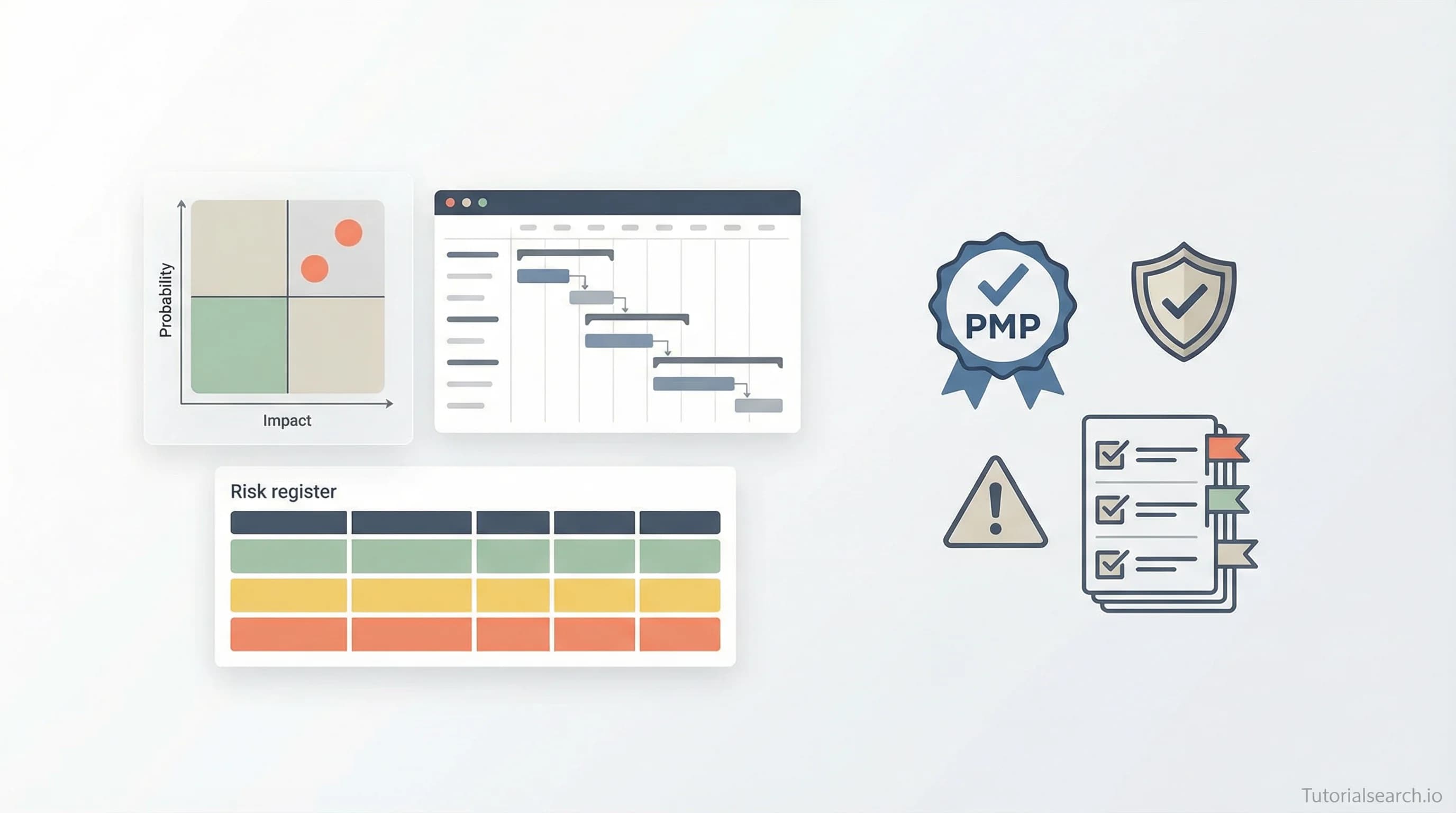
A risk register is a living document where you log identified risks, their likelihood, their potential impact, and your planned response. It's the central tool of project risk management. A register that gets filed after kickoff and never updated is just paperwork. A register that gets reviewed regularly and drives actual decisions is where risk management happens. The Atlassian and Asana guides linked in this post both include solid templates to start from.
Most projects don't fail because of unforeseeable disasters. They fail because someone identified the risk, wrote it down, and never did anything with it.
Start with one course. Build one real risk register on an active project. The framework will click faster through application than through any amount of reading alone. Browse the full course library and pick the one that fits where you are now.