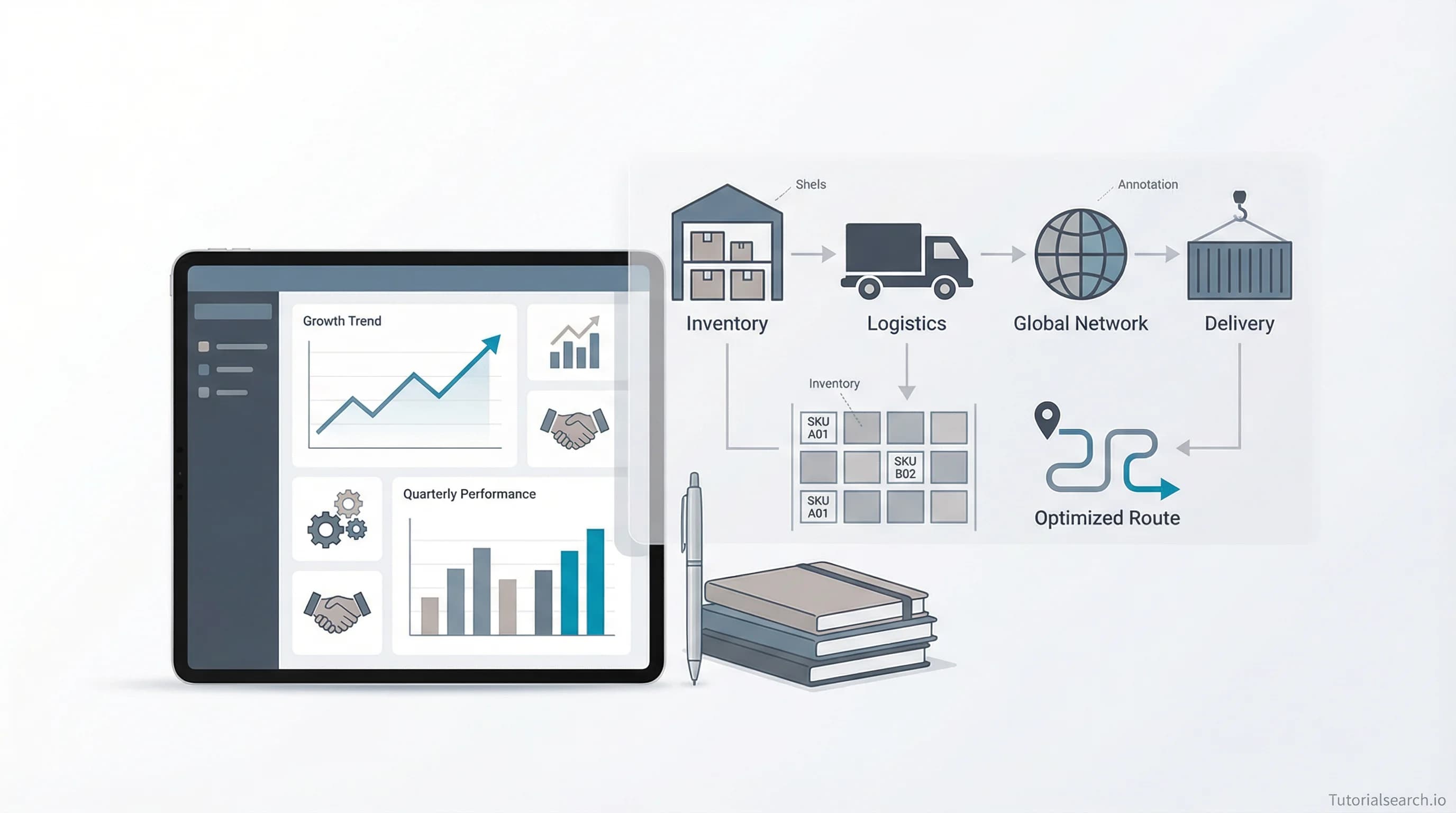
Master Logistics Management in 2026: Top Courses, Resources & Communities
Learn logistics management with curated courses, free tutorials, YouTube channels, GitHub repos, books, and communities. Master supply chain optimization, warehouse operations, and inventory control.
Hire the developers behind TutorialSearch.io
We built this site — full-stack web apps, AI integration & automation. Tell us what you need and we'll build yours.
Logistics management isn't just about moving boxes from point A to point B anymore. In 2026, it's become a strategic competitive advantage where companies that master supply chain optimization can slash costs by 15-30% while delivering faster. Whether you're managing a warehouse, coordinating shipments across continents, or optimizing inventory levels, the difference between mediocre and exceptional logistics can determine whether your business thrives or merely survives.
The supply chain has never been more complex. Global disruptions, shifting consumer expectations, and technological acceleration mean that logistics professionals need to combine traditional operational excellence with modern data analytics and automation. I've seen organizations waste six figures on transportation simply because they didn't optimize routes; conversely, I've watched small teams save millions by implementing basic demand forecasting. The good news? There's never been more learning resources available. From practical courses on demand planning to real-time route optimization tools, you can build world-class logistics capabilities without years of trial-and-error.
This guide pulls together the 2026 landscape of logistics management learning—curating top courses, free resources, GitHub projects, books, and communities to help you master every dimension of modern supply chain operations.
Key Takeaways
- Logistics management spans five core pillars: transportation, warehousing, inventory control, order fulfillment, and technology integration—each requiring specialized knowledge and strategic alignment.
- The skill gap is real: Companies report that finding logistics professionals who can blend operations expertise with data analytics is harder than ever; focused training closes this gap fast.
- Free resources abound in 2026: From MIT's supply chain courses to curated GitHub collections, you don't need expensive certifications to master the fundamentals—but credentials do matter for career progression.
- Technology is no longer optional: AI-powered routing, WMS automation, and real-time visibility are table stakes; learning to work with these tools separates today's logistics leaders from yesterday's coordinators.
- Community > isolation: The fastest way to solve novel logistics problems is tapping into Reddit's r/supplychain, Discord communities, and industry forums where practitioners share real-world battle scars and solutions.
Table of Contents
- Curated Courses for Logistics Mastery
- Free Learning Resources That Actually Work
- YouTube Channels & Video Deep-Dives
- GitHub Repositories for Technical Logistics
- Books That Shape Logistics Thinking
- Industry Communities & Networking
- Modern Logistics: A Comparison Framework
- Related Topics Worth Exploring
- Frequently Asked Questions
Curated Courses for Logistics Mastery
The best logistics courses combine theory with real-world application. They should cover demand forecasting, warehouse operations, transportation optimization, and increasingly, data-driven decision making. Avoid courses that treat logistics as a filing system; look for ones that teach optimization.
Logistics Management: International Transport & Shipping by Laurence Gartside is the natural starting point for understanding cross-border logistics. With a 4.5+ rating from over 10,000 students, this course covers INCOTERMS, customs documentation, and international best practices. It's designed for professionals who need to understand global supply chains rather than local warehouse operations. Gartside's experience shines through—he explains why certain trade agreements exist and how they impact your bottom line, not just what the acronyms mean. [Editors' Choice] for international scope.
Logistics Management & Geospatial Route Planning with Python by Christ Raharja bridges the gap between logistics theory and modern optimization. If you're tired of manual route planning, this course teaches you to automate it using Python and geospatial data. The 5.0 rating reflects its practical focus—students walk away with actual code they can apply to their operations. This course matters because route efficiency directly impacts fuel costs and delivery speed; even a 5% improvement compounds to six figures annually for mid-size operations. It's where logistics becomes measurable.
Logistics Management Foundations by Suppachok Nitsoonkit provides the broadest overview, covering warehouse design, inventory strategies, transportation modes, and compliance. At 4.2 rating with over 1,200 students, it's the course I'd recommend for career-changers or managers new to logistics. It doesn't go deep on any single topic, but that's the point—you need the mental model before specializing. Think of it as the prerequisite to every other course on this list.
Global Logistics Management, INCOTERMS, & Exports By Sea/Air by Dr. Vijesh Jain dives specifically into international trade logistics. With 2,400+ students and 4.6 rating, it's the gold standard for learning how to navigate global trade agreements, shipping contracts, and customs protocols. Dr. Jain's teaching style is deliberate—he explains the why behind each regulation, which helps you remember and apply the rules even when they change.
Strategic Logistics Management by Eric Yeboah teaches positioning logistics within organizational strategy. Unlike courses focused on operations, this one asks: How does logistics become a competitive advantage? When do you build versus buy? Where's your real leverage? [Editors' Choice] for strategic thinking.
Beyond individual courses, consider exploring Supply Chain Management topics at scale to understand how logistics fits into broader organizational strategy.
Free Learning Resources That Actually Work
Quality free resources aren't hidden—they're just scattered across platforms. Here's where to find them in 2026.
Great Learning Academy's Logistics Management Course teaches the 7Rs of logistics (right product, right quantity, right condition, right place, right time, right customer, right cost) in practical terms. It's genuinely free with an optional certificate upgrade. The course covers warehouse location strategy, reverse logistics, and lean principles—exactly what you need before reading advanced material.
Coursera's Supply Chain & Logistics Specialization lets you audit most courses free, though certificates require payment. The quality is university-level; many modules come from schools like Rutgers and Michigan State. You get video lectures, readings, and peer discussions without the tuition bill.
Alison's Logistics Management Course offers free learning paths specifically designed for resource-constrained environments. The interface is clean, and the content is structured for independent learners. It's less trendy than Coursera but often more accessible.
MIT's Supply Chain Management Course is now free and online. Sixteen lectures from MIT faculty cover everything from demand planning to network design. This isn't a course pretending to be MIT-quality—it's actually from MIT professors who teach the live version.
Logistics Operational Guide Documentation from the UN's Logistics Cluster is free, open-source, and used by humanitarian organizations worldwide. If you've never seen real-world, under-resourced logistics operations, this is illuminating. It covers emergency supply chains where optimization means lives.
YouTube Channels & Video Deep-Dives
Video learning works well for logistics because you can watch warehouse layouts, see truck routing in action, and understand spatial relationships that text can't capture. The best logistics YouTube channels combine theory with evidence from real operations.
The Supply Chain Show™ from SCMDOJO offers comprehensive content covering procurement, logistics, and supply chain management. The channel hosts industry practitioners, so you get real-world war stories alongside theory. Expect 15-30 minute episodes on specific topics like inventory optimization or last-mile delivery challenges. [Editors' Choice] for breadth and authenticity.
Rob O'Byrne's Supply Chain Channel draws on his 30+ years in logistics. His 87,900+ subscribers stay for his practical tips, his dry humor, and his ability to explain complex concepts in conversational language. His most-watched videos break down real failures and how to avoid them.
Supply Chain Now brings leaders and practitioners together in discussion format. Less polished than some channels, but more authentic. You'll see real disagreements, which teaches you how to think critically about supply chain tradeoffs.
SupplyChainBrain features industry thought leaders discussing fundamental principles, emerging trends, and innovations. If you want cutting-edge perspectives on automation, sustainability, and global supply chain shifts, this channel stays ahead of the curve.
GitHub Repositories for Technical Logistics
Hire the developers behind TutorialSearch.io
We built this site — full-stack web apps, AI integration & automation. Tell us what you need and we'll build yours.
If you're building logistics tools or want to understand the architecture behind them, GitHub has community-driven projects worth studying. These projects show how supply chain optimization actually gets implemented.
Awesome Supply Chain Repository by Dalton is a curated list of supply chain resources: blogs, podcasts, projects, and standards. It's regularly updated and worth bookmarking as a reference. You'll discover supply chain visualization projects, optimization libraries, and emerging tools.
Another Awesome Supply Chain Compilation by Funkmyster focuses on blogs, podcasts, standards, and real projects. Overlaps with Dalton's but has different selections—both are worth exploring.
Reinforcement Learning for Supply Chain Management by Yudhisteer demonstrates using machine learning to optimize robot routing in a warehouse. Understanding this project helps you evaluate modern logistics software vendors who claim AI-powered optimization. [Editors' Choice] for bridging technical depth and practical applicability.
Books That Shape Logistics Thinking
Books give you frameworks that stick. You don't read them for the latest tricks—you read them to think differently about problems.
Logistics and Supply Chain Management by Martin Christopher (now in 4th edition) is the de facto textbook. If you're going to read one book, read this. Christopher explains integrated supply chain thinking—how decisions in one area ripple through the entire network. Universities use it because it scales from beginner awareness to advanced strategic thinking.
Supply Chain and Logistics Management Made Easy by Paul A. Myerson is exactly what the title promises. Myerson breaks down demand planning, supply planning, and logistics into digestible chunks. It's perfect for someone stepping into logistics from a different background.
How the World Ran Out of Everything by Peter S. Goodman (2024) tells supply chain stories through human experience. You learn about chip shortages, port congestion, and raw material crunches through real perspectives. It contextualizes why 2026's supply chains matter.
The Goal by Eliyahu Goldratt is a novel about a plant manager saving his facility using Theory of Constraints. It doesn't teach logistics directly, but it teaches how to think about system constraints and bottlenecks—the mental model underlies all optimization.
Industry Communities & Networking
The fastest way to solve a logistics problem that no course covers is asking someone who's already solved it. These communities are where that happens.
r/supplychain on Reddit has 50,000+ members discussing everything from inventory holding costs to demand forecasting. The community is active, occasionally irreverent, and brutally honest about what works and what doesn't. Threads on emerging tools and vendor comparisons are particularly valuable.
r/logistics focuses specifically on logistics operations, warehouse management, and transportation. Less academic than r/supplychain, more practical. You'll find truckers, warehouse managers, and logistics coordinators sharing real-world experience.
Supply Chain Discord Server offers a more intimate forum for logistics discussion. Discord's real-time chat format means you can ask quick questions and get answers from seasoned professionals.
Supply Chain Forum hosts structured discussions on news, strategy, collaboration, and management. It's older-school than Reddit but has a core of deeply experienced practitioners.
The single best decision you can make in 2026? Join at least two communities. One Reddit thread or Discord conversation will save you months of trial-and-error.
Modern Logistics: A Comparison Framework
How do you choose between a traditional 3PL provider, an integrated technology platform, and building in-house capabilities? This framework helps you think through the tradeoffs.
| Capability | Traditional 3PL | Tech-Enabled Platform | In-House Build |
|---|---|---|---|
| Setup Time | 2-4 weeks | 1-2 weeks | 6-18 months |
| Flexibility | Medium (contractual limits) | High (API-driven) | High (full control) |
| Upfront Cost | Minimal | $5-50K/month | $200K-2M+ |
| Scalability | Limited by capacity | Unlimited (cloud) | Limited by team |
| Customization | Low | Medium-High | Complete |
| Data Visibility | Delayed | Real-time | Depends on integration |
| Best For | Seasonal peaks | Growing tech-forward | High-volume proprietary |
Most mid-size companies use a hybrid: outsourced transportation with owned inventory management and real-time visibility through a tech platform. Your choice depends on whether logistics is core to your business.
Related Topics Worth Exploring
If you master logistics management, these adjacent topics multiply your impact:
- Business Strategy — How supply chain becomes competitive advantage
- Management Skills — Leading teams through operational change
- Operations Management — Lean principles and continuous improvement
- Business Improvement — Six Sigma and scaling optimizations
Frequently Asked Questions
What are the core components of modern logistics management?
Modern logistics spans five interconnected domains: transportation (mode selection, route optimization), warehousing (layout, automation, labor), inventory management (demand forecasting, safety stock), order fulfillment (picking, packing, shipping), and technology integration. Your logistics management course should cover all five; if it skips any, it's incomplete.
How long does it take to build real expertise in logistics?
Fundamentals take 3-6 months through structured learning, but real judgment takes 2-3 years in an operations role. You need to see demand variation across seasons, manage crises, and learn from failure. That's why studying established systems while working in logistics accelerates the timeline. The best logistics professionals combine study with immediate application.
What's the difference between logistics and supply chain management?
Logistics is the tactical execution: moving stuff, managing inventory, optimizing routes. Supply chain is the strategic orchestration: planning demand, selecting suppliers, designing the entire network. Great logistics can't fix bad supply chain strategy, and strategy without execution fails. Start with logistics foundations, then expand to strategic thinking.
Why are soft skills as important as technical skills?
Logistics executes through people—warehouse teams, carriers, suppliers, internal stakeholders. You can have perfect algorithms and data, but if your team isn't aligned or vendors don't trust you, execution breaks. The best logistics leaders spend 40% managing people, 40% on strategy, and 20% on technical details. Negotiation, influence, and communication separate good from great.
Should I pursue a logistics certification?
Certifications matter for corporate career progression, but they're not required for competence. By 2026, employers increasingly care about demonstrated results over badges. If you're early-career or transitioning from another field, certification provides structure and legitimacy. Combine it with practical projects. Never pursue certification instead of building real skills.
What role does sustainability play in modern logistics?
It's becoming table stakes. Customers, regulators, and investors expect logistics to minimize environmental impact. This means fuel efficiency, shipment consolidation, and lower-emission modes. Companies treating sustainability as a constraint optimize locally; those treating it as a design challenge find cost savings. Modern courses address this reality.
The logistics management landscape in 2026 is both more challenging and more enabling than ever. Complexity has increased—global disruption, e-commerce, and talent shortages create headwinds. But the tools, communities, and knowledge available have exploded. Free MIT courses, hands-on coding projects, global practitioner communities—these didn't exist a decade ago. Your competitive advantage isn't access to information; it's having discipline to apply it. Pick three resources from this guide. Commit to one for 60 days. Measure impact on your operations. Then iterate.
The logistics leaders you'll see in 2026 aren't the ones who memorized all the theory; they're the ones who combined learning with relentless execution, who stayed connected to practitioner communities, and who treated logistics as strategy, not overhead.