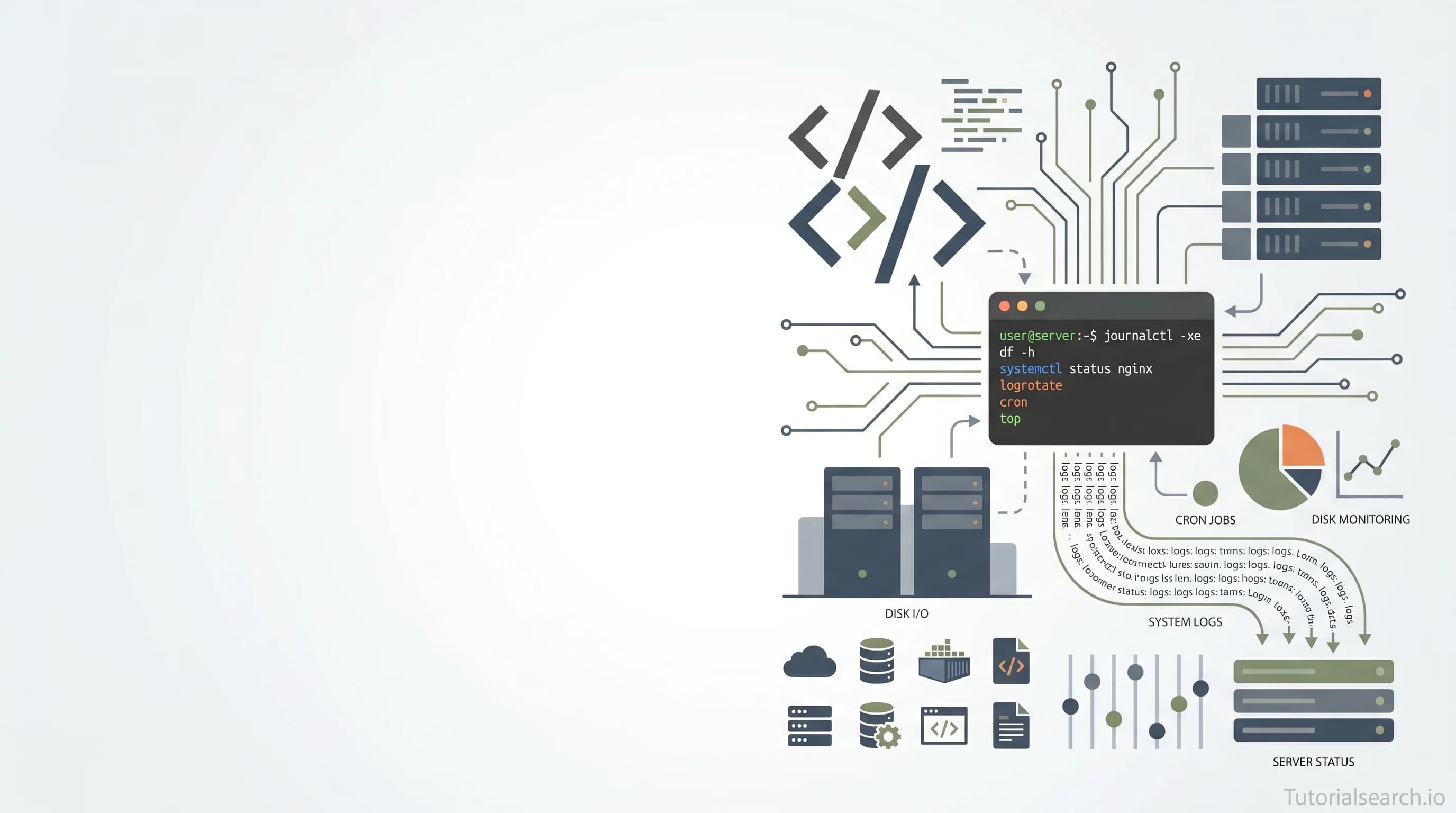
Linux System Maintenance: The Courses and Resources Sysadmins Actually Use
A curated guide to the best Linux system maintenance courses, free resources, GitHub repos, YouTube channels, and books — covering log management, disk monitoring, security patching, and automation.
Hire the developers behind TutorialSearch.io
We built this site — full-stack web apps, AI integration & automation. Tell us what you need and we'll build yours.
Linux system maintenance is the unglamorous work that separates stable, secure servers from the ones that wake you up at 3am. As of 2026, the gap between teams who treat maintenance reactively and those who automate it proactively has never been wider — and the courses, tools, and communities that help you cross that gap are better than ever.
If you've ever had a disk fill up silently, a package update break production, or a log file eat half your storage, this guide is for you. You'll find the courses, free resources, GitHub repos, YouTube channels, and books I'd genuinely recommend to anyone who manages Linux systems — whether you're a developer who inherited a server or a dedicated sysadmin leveling up. Start by browsing system maintenance courses on TutorialSearch to see what structured learning looks like.
Key Takeaways
- Linux system maintenance covers log management, disk monitoring, security patching, and automated upkeep — not just software updates
- A proactive maintenance schedule prevents the majority of production outages that system maintenance teams deal with
- The best Linux system maintenance approach combines scripted automation with monitoring tools like Prometheus and Grafana
- Free resources like the Arch Linux Wiki and Red Hat documentation rival paid courses for reference depth
In This Article
- Curated Linux System Maintenance Courses
- Free Linux System Maintenance Resources That Hold Up
- Linux Sysadmin YouTube Channels Worth Your Time
- GitHub Repos for Maintenance Scripts and Automation
- Books Every Linux Sysadmin Should Know About
- Community: Where Sysadmins Actually Ask for Help
- Paid vs. Free: Picking the Right Linux System Maintenance Path
- Related Linux System Maintenance Skills Worth Exploring
- FAQ
Curated Linux System Maintenance Courses Worth Taking
The course catalog for this topic is messier than most. Search "system maintenance" and you'll get results covering HVAC systems, hydraulic equipment, and diesel generators — genuinely useful if you maintain oil rigs, but not what most people land here for. I've sorted through the noise so you don't have to.
Linux System Maintenance and Troubleshooting (Pluralsight) [Editors' Choice]
David Clinton built this course around the real rhythm of Linux system maintenance: not the dramatic incident response, but the steady work of keeping systems healthy. You'll cover disk usage management, log rotation, scheduled task automation with cron, and package management across RPM and Debian-based systems. Clinton has a direct, practitioner style — no unnecessary theory. If you manage a Linux server and you're not sure what you should be checking each week, this is where to start. The intermediate-level framing is accurate; you'll want basic terminal comfort coming in.
Linux Monitoring and Maintenance (LPIC-2) (Pluralsight) [Editors' Choice]
Andrew Mallett structured this around LPIC-2 certification objectives, which means the coverage is unusually systematic. You get kernel management, system startup troubleshooting, network configuration maintenance, and security hardening — topics that other maintenance courses gloss over. The certification angle is a genuine advantage: LPIC-2 forces a breadth of coverage that job-focused courses tend to skip. If you're preparing for a sysadmin role or want to demonstrate competency with something verifiable, this pairs well with the Clinton course above.
Maintenance Mastery: From Basics to Best Practices 2.0 (Udemy)
Robert Witczak's course takes a broader view of maintenance practices — useful for understanding the operational thinking behind good maintenance schedules. The "all levels" label is accurate; expect foundational concepts delivered with enough practical detail to be useful. Strong choice if you want to understand maintenance philosophy before diving into Linux-specific commands.
Windows Server Administration Concepts: Maintenance (Pluralsight)
Aaron Sampson's beginner-level course is worth noting for teams running mixed Windows/Linux environments. Maintenance principles translate across platforms more than people expect — patch management strategy, log review cadences, and change control thinking apply whether you're in PowerShell or Bash.
Rotating Equipment Masterclass: Pumps & Compressors (Udemy)
This one earns its place for a niche but significant audience: systems engineers and DevOps practitioners working in industrial environments where physical infrastructure maintenance connects directly to the servers and SCADA systems they manage. WR Training Pro's course is highly rated (4.6★, 7,000+ students) and covers the mechanical maintenance thinking that IT-focused sysadmins often lack when they cross into operational technology environments.
If Linux system maintenance has you thinking about automation more broadly, scripting your maintenance tasks with Ansible or Bash is where the real leverage is.
Free Linux System Maintenance Resources That Hold Up
Paid courses give you structure. These free resources give you depth — and most of them are better reference material than anything you'll find in a course.
Red Hat Enterprise Linux System Administrator's Guide (Official docs) — Red Hat's documentation is unusually readable for enterprise docs. The system administration guide covers getting started, system locale and date, managing users, and service management with systemd. Even if you're not running RHEL, the concepts apply to CentOS, Rocky Linux, AlmaLinux, and Fedora directly. Free and comprehensive.
Arch Linux System Maintenance Wiki — The Arch wiki is the best Linux reference on the internet, full stop. The system maintenance page specifically covers keeping the system up to date, checking for orphaned packages, cleaning the package cache, and disaster recovery planning. It's written for Arch users but the advice applies to any distribution. Bookmark it.
The Linux Command Line (Free PDF) — William Shotts makes this available free on his website. Maintenance work lives at the command line, and this book covers shell fundamentals, file permissions, process management, and scripting — all the building blocks for writing your own maintenance automation. If you've been copy-pasting commands without understanding them, this is the cure.
DigitalOcean Tutorials — Over 6,000 tutorials covering specific maintenance tasks: setting up log rotation with logrotate, configuring automatic security updates on Ubuntu, monitoring disk usage with df and du, scheduling tasks with cron. DigitalOcean tutorials are well-maintained and tested against real deployments. Search their library for whatever maintenance task you're trying to solve.
Linux Foundation Forums — System Administration — The Linux Foundation's official forums cover real production problems. Not as active as Stack Overflow, but the quality of answers skews higher because the audience is practicing professionals.
For a more structured path through this material, search Linux system maintenance courses on TutorialSearch to find a learning progression that free docs can't replicate.
Linux Sysadmin YouTube Channels Worth Your Time
Video content for Linux maintenance is scattered — plenty of "top 10 commands" fluff, and less actual maintenance workflow content. These channels deliver the real thing.
Learn Linux TV [Editors' Choice] — Jay's channel is the gold standard for practical Linux system administration on YouTube. He covers real maintenance workflows: setting up unattended-upgrades, configuring fail2ban, managing users and permissions, working with systemd services. Over 20 years of sysadmin experience shows in how he explains not just what to do but why. His Linux Server playlist is particularly relevant for maintenance topics.
The Linux Basics Course: Beginner to Sysadmin — This freeCodeCamp playlist walks through essential Linux commands and sysadmin fundamentals in structured sequence. The format is methodical, which suits maintenance learning well — you want to understand the tools before you automate them.
Chris Titus Tech — Chris covers Linux optimization, cleanup scripts, and system tuning with the directness of someone who actually runs these systems. His content on disk cleanup, package management, and performance tweaking is practical and regularly updated.
TechHut — Good for Linux server tutorials that combine theory with demonstration. Covers topics like setting up monitoring, configuring remote access, and basic security hardening that every maintained system needs.
GitHub Repos for Maintenance Scripts and Automation
Hire the developers behind TutorialSearch.io
We built this site — full-stack web apps, AI integration & automation. Tell us what you need and we'll build yours.
The best maintenance scripts are the ones someone else already debugged. These repos are worth starring.
awesome-foss/awesome-sysadmin [Editors' Choice] — The canonical curated list for open-source sysadmin tools. Organized by category: backup, monitoring, log management, configuration management, and more. If you're looking for a tool to solve a specific maintenance problem, check here before searching GitHub generally. Thousands of stars and actively maintained.
RooneyMcNibNug/sysadmin-resources — A curated collection of links and tools specifically aimed at working sysadmins. More opinionated and curated than awesome-sysadmin, which makes it useful for cutting through the noise.
almostengr/ubuntu-automation — Scripts for monitoring and automating routine Ubuntu maintenance tasks: disk checks, git operations, MySQL maintenance, log cleanup. Practical shell scripts you can adapt for your own environment without starting from scratch.
linux-system-roles/auto-maintenance — Red Hat's official automation tooling for Linux system roles. Useful for teams managing fleets of RHEL/CentOS/Fedora systems who want consistent, tested maintenance automation.
These repos pair well with solid Linux foundations — adapting and extending shell scripts requires understanding what each command actually does.
Books Every Linux Sysadmin Should Know About
These four books represent different layers of the maintenance knowledge stack. You don't need all four, but knowing which one covers your current gap is useful.
The Linux Command Line by William Shotts (free online — see the Free Resources section above) remains the best entry point into command-line fluency. Maintenance work is command-line work. If you're not yet comfortable at the terminal, this comes first.
How Linux Works, 3rd Edition by Brian Ward is the book I'd recommend to anyone who wants to understand what's actually happening when they run maintenance commands. It covers the boot process, kernel device management, filesystem internals, and networking implementation. When something breaks during maintenance, this is the understanding that lets you diagnose it rather than guess.
UNIX and Linux System Administration Handbook, 5th Edition by Evi Nemeth et al. is the reference book. DNS, SMTP, configuration management, containers, cloud infrastructure — it's all here. Senior sysadmins keep it within arm's reach. The 2017 edition hasn't aged out; the principles of system administration are stable even as specific tools change.
Linux Bible, 11th Edition by Christopher Negus is the practical hands-on reference covering RHEL 9, Ubuntu 24 LTS, and Fedora 41. Good for people who want comprehensive coverage across distributions with exercises to practice what they've learned.
Community: Where Sysadmins Actually Ask for Help
Forums and communities are where you learn what actually breaks in production — knowledge that no book or course covers.
r/sysadmin Discord Server — The r/sysadmin Discord has over 25,000 members and is one of the most active professional communities for system administrators. Real questions from people running real infrastructure. The signal-to-noise ratio is better than most tech Discords because the community skews toward working professionals.
Reddit r/sysadmin — The subreddit (over 900,000 members) is invaluable for finding out what maintenance problems other teams are hitting and how they solved them. The weekly "Rant Wednesday" threads alone are worth the subscription.
Linux Foundation Forums (linked above in Free Resources) — More formal, slower-paced than Discord, but the answers here tend to be thorough and come from practitioners with verifiable experience.
Paid vs. Free: Picking the Right Linux System Maintenance Path
This is the question everyone actually has. Here's an honest breakdown:
| Free Path | Paid Courses | |
|---|---|---|
| Best for | Reference, specific tasks, self-directed learners | Structured progression, certification prep, accountability |
| Time to competency | Longer — you curate your own path | Faster — sequenced for you |
| Depth | Often deeper on specific topics (Arch wiki, Red Hat docs) | More consistent across all maintenance areas |
| Cost | Free (except your time) | $15–$50/month for Pluralsight; $15–$200/course on Udemy |
| Best free pick | DigitalOcean Tutorials + awesome-sysadmin (see above) | — |
| Best paid pick | — | Linux System Maintenance and Troubleshooting (see above) |
| Certification value | None | High — LPIC-2 is recognized in enterprise hiring |
The honest answer: start free. The Red Hat docs, DigitalOcean tutorials, and the Learn Linux TV channel will take you surprisingly far. Move to paid courses when you want certification preparation or when the lack of structure is slowing you down.
Related Linux System Maintenance Skills Worth Exploring
If system maintenance interests you, these adjacent skills will make you dramatically more effective:
- Linux Fundamentals — Maintenance work assumes solid Linux foundations. If any of the concepts above felt unfamiliar, foundational Linux knowledge is the prerequisite.
- DevOps Automation — Automating maintenance tasks with Ansible, shell scripts, or cron is how you scale from managing one server to managing fifty.
- Network Fundamentals — Server maintenance increasingly includes network configuration. Understanding subnets, DNS, and firewall rules makes you a more complete sysadmin.
- Docker Containers — Containerized infrastructure has its own maintenance requirements: image updates, volume cleanup, container health checks.
FAQ
What are the key tasks of Linux system maintenance?
The core tasks are: log file management (rotation and review), disk space monitoring, security patching, package updates, cron job auditing, user account management, and performance monitoring. Automated scripts handle the routine parts; human review catches what automation misses. Explore Linux system maintenance courses to see how these areas are taught systematically.
How long does it take to learn Linux system maintenance?
For basic competency — understanding core commands and setting up a maintenance routine — expect 2–4 weeks of focused learning. For the depth needed to confidently manage production systems, plan for 3–6 months. LPIC-2 certification typically takes 6–12 months of preparation depending on your starting experience.
Do I need to know programming to learn Linux system maintenance?
Not programming in the traditional sense, but shell scripting is essential. Bash scripting — writing scripts that automate disk checks, log rotation, and health monitoring — is the single most valuable skill you can add to maintenance knowledge. Python is useful for more complex automation but not required to start.
Why is scheduled system maintenance important?
Unplanned downtime costs far more than scheduled maintenance windows — in time, reputation, and often revenue. Scheduled maintenance lets you apply security patches before vulnerabilities are exploited, catch disk issues before they cause data loss, and address performance degradation before users notice. The "if it's not broken, don't fix it" philosophy doesn't hold in production environments.
Can I get a job with Linux system maintenance skills?
Yes. Linux system administration remains one of the most consistently in-demand skills in tech. Roles like sysadmin, DevOps engineer, SRE (site reliability engineer), and cloud infrastructure engineer all require Linux maintenance knowledge. LPIC-2 certification adds verifiable credibility, and hands-on experience — even in a home lab — is valued by most hiring managers.
What tools are commonly used for Linux system maintenance?
The core toolkit includes: cron and systemd timers for scheduling, logrotate for log management, df/du/ncdu for disk monitoring, apt/dnf/pacman for package management, fail2ban for security, and monitoring stacks like Prometheus + Grafana for production observability. Configuration management tools like Ansible handle maintenance at scale.