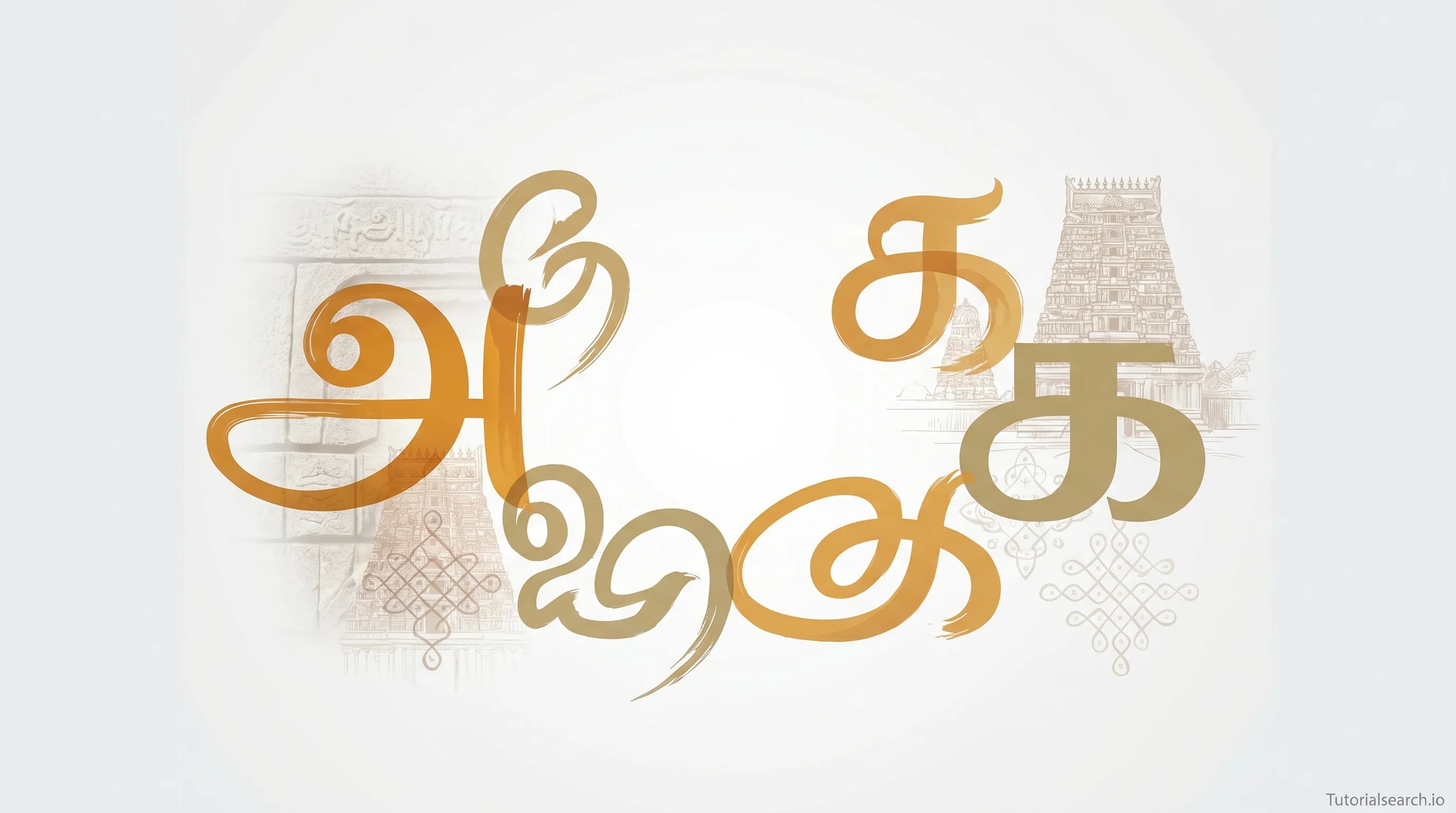
Want to Learn Tamil? Here Are the Resources That Actually Work
A curated guide to the best Tamil language courses, free websites, YouTube channels, GitHub repos, and books — covering spoken Tamil, the script, and communities for every type of learner.
Hire the developers behind TutorialSearch.io
We built this site — full-stack web apps, AI integration & automation. Tell us what you need and we'll build yours.
Tamil is one of the world's oldest living languages — spoken by over 80 million people across Tamil Nadu, Sri Lanka, Singapore, Malaysia, and diaspora communities worldwide — and as of 2026, the resources for learning it have never been better. Whether you're reconnecting with family heritage, planning a trip to Chennai or Jaffna, or simply drawn to one of the few languages with a continuous literary tradition spanning more than 2,000 years, this guide covers every angle: courses, free websites, YouTube channels, GitHub repos, books, and communities.
One caveat before diving in: Tamil has two distinct registers — classical literary Tamil (centamil) and the colloquial spoken form (kotuntamil) — and these differ considerably. Most learners should start with spoken Tamil. Browse all Tamil language courses here to see the full range of what's available.
Key Takeaways
- Tamil is a Dravidian language unrelated to Hindi or Sanskrit, which means English speakers must rewire their grammar intuitions when learning Tamil.
- Most Tamil beginners should focus on spoken Tamil first before tackling the script, since the writing system (an abugida with 247+ characters) has a steep learning curve.
- The best Tamil courses combine romanized transliteration with audio practice — avoid anything that jumps straight into the script without audio support.
- A consistent 20–30 minutes per day of Tamil study beats irregular marathon sessions; use a mix of structured courses and informal YouTube exposure.
- Learning the Tamil script unlocks access to Tamil literature, films, and news — worth the effort once you have conversational basics down.
In This Article
- The Tamil Courses Worth Your Time
- Free Tamil Learning Resources That Deliver
- YouTube Channels for Tamil Learners
- GitHub Repos Useful for Tamil Language Learners
- Tamil Books Worth Reading (or Listening To)
- Tamil Script vs. Spoken Tamil: Which to Learn First?
- Tamil Learning Communities Online
- Related Tamil and Language Skills Worth Exploring
- FAQ
The Tamil Courses Worth Your Time
Finding a good Tamil course in English is genuinely harder than finding one for Spanish or Mandarin. The language just doesn't have the commercial pull of those giants. But the courses below deliver real results — I've ranked them by quality and usefulness, with the top picks getting the most attention.
Learn Spoken Tamil for Absolute Beginners (Udemy) — [Editors' Choice] This is the one I'd send a friend to first. Sanjay Dhanasekaran has been teaching Tamil to international students for over 12 years and has helped more than 500 people reach spoken fluency. The course prioritizes practical sentences organized by real-life situations — introductions, asking for directions, at a hospital, ordering food — and uses visual vocabulary (pictures of vegetables, animals, household items) to anchor words in memory. English transliteration is provided throughout, so you don't need to know the script to benefit. More than 12,600 students and 810 reviews speak for themselves. It's one of the few Tamil courses where you feel like you're learning from a real teacher rather than a translation algorithm. The instructor's companion Memrise courses for vocabulary review are a nice bonus. Highly recommended as your first Tamil course.
Learn Tamil Language - Complete Beginner Tamil Course (Udemy) — [Editors' Choice] Bhashafy Languages built this course around "comprehensible input" — a linguistically-sound approach where you learn through context and visuals rather than rote memorization. The course runs about 6 hours and covers basic conversation, vocabulary for travel and everyday life, pronunciation techniques, and a window into Kollywood (Tamil cinema) for cultural immersion. Both formal and colloquial Tamil are addressed, which matters enormously if you want to speak with people across generations. Rated 4.8 by 286 reviewers. Worth the price.
iLearnTamil - Learn Spoken Tamil Language Online (Udemy) — This free course comes from a platform affiliated with Tamil Virtual University and focuses on spoken Tamil through structured audio-visual lessons. The rating (4.6) reflects consistent quality. Good as a supplement or for learners on a tight budget who want something more structured than random YouTube videos. Covers practical conversation topics.
Learn to Read and Write Tamil Letters (Udemy) — Another free option, this one from Sudha Muthuraj who has 11 years of teaching experience. It focuses specifically on the Tamil script — each letter introduced alongside simple words and audio pronunciation. If you've got spoken basics down and want to start reading, this is the most efficient entry point. 1,725 students, free with certificate optional.
Learn Tamil Language: A Complete Journey to Fluency (Udemy) — Geetha Shanmugam's course covers the full stack: script foundations, grammar, pronunciation, and conversational dialogues. It's taught in English and works for both kids and adults. At 15 hours of content, it's one of the more comprehensive options available. Good for learners who want grammar explained systematically rather than through immersion.
Tamil Speaking Course - Beginner (Udemy) — A focused speaking course for those who want conversational Tamil without the grammar deep-dives. Practical phrases, basic dialogues, and audio-driven lessons. 1,697 students. A decent pick if you specifically want to speak and travel rather than read or write.
Tamil Vocabulary Course - Upgrade Your Speaking (Skillshare) — Structured around 50 common daily phrases, 50 nouns, 50 verbs, 50 adjectives, 20 adverbs, and 50 sentence exercises. Works well as a supplement once you have basic Tamil — not a first-step course, but a good vocabulary accelerator.
If you're still deciding which Tamil course fits your goals, take stock of whether you want conversational fluency first, script reading skills, or a grammar-heavy approach — the answer shapes which option above will work best for you.
Free Tamil Learning Resources That Deliver
The good news: you can build solid Tamil foundations for free. Here's what's actually worth your time.
LearnTamil.com — A textbook-style website updated in January 2026 that covers the Tamil alphabet, pronunciation, numbers, pronouns, verbs, and grammar in structured chapters. Written clearly for English speakers. A genuinely good free reference to bookmark alongside your paid course.
Alison Tamil for Beginners — A free structured course covering the Tamil alphabet, basic greetings, numbers, colors, and essential vocabulary. Good as a structured introduction before committing to a more intensive paid course.
50Languages Tamil — Learn Tamil through practical sentences and basic dialogues with audio. The approach is pattern-based and works well for pronunciation and phrase acquisition. Fully free, no sign-up required.
Basic Tamil - Open Textbook (MSU) — Michigan State University's open-access Tamil textbook for second-language learners. Academic in tone but rigorous and well-structured. If you want proper grammar instruction with exercises, this is excellent and completely free.
Tamil Virtual University — The Tamil Nadu government's digital initiative for Tamil language and culture. Contains extensive literary resources, grammar tools, and learning materials. More useful at intermediate to advanced stages; beginners may find it overwhelming.
All Language Resources - Tamil Guide — A curated mega-list of 40+ Tamil learning tools, apps, and websites. Worth scanning if you want to see every option in one place.
For a more structured video-based path, search Tamil courses on TutorialSearch to compare platform options and ratings.
YouTube Channels for Tamil Learners
Hire the developers behind TutorialSearch.io
We built this site — full-stack web apps, AI integration & automation. Tell us what you need and we'll build yours.
YouTube is arguably the best supplementary resource for Tamil learners, primarily because you get to hear real pronunciation and natural speech patterns.
LEARN TAMIL YouTube Channel — One of the primary YouTube destinations for English-speaking Tamil learners. Covers pronunciation, grammar, and conversation from a beginner-friendly angle. The channel was built specifically for learners outside India who want to connect with the language, and the videos balance grammar explanation with practical conversation. A good complement to any paid course.
Learn Tamil Through English (YouTube) — This playlist approach works well for absolute beginners — short lessons that use English explanations to introduce Tamil words, phrases, and sentence patterns. Good for daily 10-minute practice sessions.
Learn and Speak Tamil Playlist — A curated playlist of Tamil speaking lessons organized by topic. Works well as a daily review supplement.
Talkpal Tamil YouTube Tips — Worth reading for the specific techniques: shadowing, slowing playback speed, and using Tamil film dialogue to train your ear. Tamil cinema (Kollywood) in particular is a rich resource — watching films with Tamil subtitles is one of the fastest ways to build real listening comprehension.
GitHub Repos Useful for Tamil Language Learners
Most Tamil GitHub resources are built for NLP researchers and developers, but a few are genuinely useful for language learners too.
awesome-tamil (Ezhil Language Foundation) — 11 stars. A curated list of open-source Tamil datasets, programming libraries, dictionaries, fonts, and tools. More developer-oriented, but the dictionaries and corpus sections are useful for learners building vocabulary reference lists or studying Tamil script.
open-tamil (Ezhil Language Foundation) — Python-based Tamil NLP tools including keyboard layouts, encoding converters, and transliterators. If you're a developer learning Tamil, this is the toolkit you want. The encoding converters help when working with older Tamil text resources.
tamil-nlp-catalog (narVidhai) — A comprehensive catalog of Tamil NLP resources including datasets, models, and tools. The datasets section includes 200+ hours of voiced Tamil conversations — useful for listening practice at an advanced level.
KaniyamFoundation Tamil Word List — A machine-readable list of Tamil nouns and words, useful if you want to build flashcard decks or vocabulary lists programmatically. Particularly handy for developers who want to build study tools.
Tamil Books Worth Reading (or Listening To)
Spoken Tamil for Absolute Beginners by Sanjay D — [Editors' Choice] This is the print companion to the Udemy course by the same instructor. It uses romanized transliteration alongside Tamil script, covers 30+ audio tracks via supplementary files, and includes conjugation tables for the 100 most common Tamil verbs. The best beginner book on the market for English speakers. Use it alongside any structured spoken Tamil course for a complete self-study system.
Tamil for Beginners by Kausalya Hart — A university-level introduction with audio CD support. Hart's approach is academic and rigorous — great for people who want to understand Tamil's grammatical structure deeply. The audio CD is essential.
Learn Tamil with 1000 Essential Words — A bilingual Tamil-English picture vocabulary book. Each word comes with an illustration and phonetic guidance, making it genuinely accessible for visual learners and kids. Not a complete course, but excellent as a vocabulary supplement.
Tamil Script vs. Spoken Tamil: Which to Learn First?
This is the question everyone has, and the conventional answer ("learn the script first") is wrong for most learners.
The case for spoken Tamil first: Tamil's script is an abugida (vowel sounds are inherent in consonants, modified by diacritical marks) with 247+ character combinations. It takes weeks just to recognize letters confidently. If you tackle script and speech simultaneously as a complete beginner, you'll burn out. Prioritizing spoken Tamil using romanized transliteration means you can have a basic conversation within weeks — which provides enormous motivational fuel.
The case for learning the script early: Tamil is not well-served by transliteration systems. Different sources use different romanization conventions, and colloquial pronunciation deviates from written Tamil in ways that create confusion. Learning the script within your first 2-3 months means you can access authentic Tamil content — films, books, news, Instagram posts from Tamil speakers.
My recommendation: Start with spoken Tamil for the first 4-6 weeks using transliteration. Once you can form basic sentences, pivot to script learning in parallel.
| Approach | Best For | Risk |
|---|---|---|
| Spoken Tamil first | Diaspora reconnection, travel, casual conversation | May develop pronunciation habits that conflict with written forms |
| Script first | Academic study, classical literature, formal Tamil | High burnout risk; slow to reach practical speaking ability |
| Parallel learning (spoken + script from week 5) | Most learners | Requires more structured time commitment |
Tamil Learning Communities Online
r/learnTamil (Reddit) — The most active English-language community for Tamil learners. Good for asking questions like "why does this verb form change?" or "what's the difference between these two words?" The community is patient with beginners.
Vanakam Tamil Discord Server — A language-focused Discord for Tamil learners with native speakers available for practice. Finding a language exchange partner here is genuinely possible.
Tamil Stack Exchange — Q&A format for more technical linguistic questions about Tamil grammar, script, and historical development. Better than Google for specific grammar questions.
Related Tamil and Language Skills Worth Exploring
If Tamil has caught your interest, these related areas pair naturally with your studies:
- Language Learning Courses — Broader language acquisition methodology, including spaced repetition, comprehensible input, and fluency frameworks that apply to Tamil and beyond.
- Korean Language Courses — Korean, like Tamil, has a non-Roman script that takes time to learn but unlocks rich culture. Learners who've tackled one often find the other more approachable.
- French Learning Courses — Tamil and French share one surprising connection: both are official languages in Pondicherry (Puducherry), a former French territory in Tamil Nadu.
FAQ
How long does it take to learn Tamil?
For conversational spoken Tamil, expect 6-12 months at 30 minutes per day if you're consistent. The US Foreign Service Institute classifies Tamil as a Category III language, estimating around 1,100 hours to professional proficiency. Practical travel-level Tamil — enough to navigate Tamil Nadu or have basic family conversations — is achievable in 3-4 months with focused study.
Do I need to know Hindi to learn Tamil?
No — and this is a common misconception worth clearing up. Tamil is a Dravidian language, completely unrelated to Hindi and Sanskrit (which are Indo-European). Your Hindi knowledge is neither helpful nor a hindrance. Starting from zero is perfectly normal.
Is Tamil worth learning even if I don't have Tamil heritage?
Absolutely. Tamil is an official language in India, Sri Lanka, Singapore, and parts of Malaysia. It has one of the world's oldest living literary traditions. Chennai is a growing tech hub, and Tamil-speaking communities are significant in the UK, Canada, Australia, and the US. Career applications in translation, international business, and education are real.
Can I get a job with Tamil language skills?
Yes, particularly in translation, education, tourism, international trade with South India and Sri Lanka, and organizations working with Tamil diaspora communities. Tamil-language proficiency is also valued in government and diplomatic contexts in countries where Tamil has official status.
What is the Tamil script, and how hard is it to learn?
Tamil script is an abugida — each consonant has an inherent vowel sound, modified by diacritical marks for other vowels. There are 12 vowels, 18 consonants, and one special character (ஆய்தம்), which combine into 247+ character forms. Most learners find character recognition takes 4-8 weeks of consistent practice. The trickier part is that colloquial and literary Tamil have different vocabularies, so written Tamil can look different from what you hear in conversation.
Is Tamil related to other Dravidian languages?
Yes. Tamil belongs to the Dravidian language family alongside Telugu, Kannada, and Malayalam. If you already speak Telugu or Kannada, you'll find Tamil has recognizable grammatical patterns — particularly the agglutinative morphology (words built by stacking suffixes). The vocabularies are quite distinct, and spoken Tamil differs significantly from its Dravidian cousins.