Laravel Basics — Where to Start and What to Skip
Learning Laravel basics doesn't have to mean drowning in tutorials. Here are the courses, free resources, and tools that actually get you building PHP web apps faster.
Need a web app built? Hire the team behind TutorialSearch.io
We ship fast, production-grade full-stack apps (Next.js, React, edge infra) — the same stack that powers this site.
Most PHP beginners try to learn Laravel basics before they have solid PHP skills. They hit the first php artisan make:controller command, get confused by service containers and dependency injection, and quietly give up. The framework didn't fail them — the learning order did.
Laravel is a PHP web framework that handles the repetitive parts of web development: routing, database queries, user authentication, and API structure. Instead of writing boilerplate code for every project, you follow Laravel's conventions and ship features faster. If you're ready to learn it right, you'll find 194+ Laravel basics courses on TutorialSearch.io. But before you pick one, read this first.
Key Takeaways
- Laravel basics cover routing, controllers, models, views, and database interactions — the core of every Laravel app.
- You need solid PHP and object-oriented programming skills before Laravel basics will make sense.
- The free official Laravel Bootcamp is the best starting point for most beginners — it walks you through a real app.
- The highest-rated Laravel courses on Udemy aren't the most popular ones — ratings beat student count every time.
- The Laravel Discord has 48,000+ members, making it one of the most active PHP communities you can join.
In This Article
- Laravel Courses That Get You Building Fast
- Free Laravel Resources That Are Surprisingly Good
- Laravel YouTube Channels I Keep Coming Back To
- Laravel GitHub Repos Worth Starring
- Laravel Books Worth the Investment
- The Laravel Communities Where People Actually Help
- Related Laravel Skills Worth Exploring
- Frequently Asked Questions About Laravel Basics
Laravel Courses That Get You Building Fast
Most people who review Laravel courses use student count as the main signal. That's a mistake. The most popular Laravel course on Udemy has 58,000+ students and a 4.2 rating. Meanwhile, some smaller courses with a few hundred students sit at 4.85 and above. Rating reflects teaching quality. Student count reflects marketing budget.
The courses below are ranked by quality, not popularity.
1. Laravel 9 - Building a Complete Portfolio Website (A to Z) (Udemy) [Editors' Choice]
Instructor Morshedul Arefin builds a full portfolio site from zero — routing, controllers, models, views, and authentication all included. The 4.86 rating from 342 students is unusually high for a technical course. The reason is the format: you ship a real project you can put in front of employers. Nothing hypothetical, nothing toy-sized. This is the course to start with if you want a concrete outcome.
2. Laravel 12 PHP Framework – From Beginner to Advanced (Udemy) [Editors' Choice]
Robert Apollo covers Laravel 12 — the version you'll actually be using in 2026. The course includes an interactive code cheat sheet (not a static PDF) that stays useful after the course ends. The structured learning path moves from setup through advanced features without large gaps. If staying on the current version matters to you, this is the right pick. 4.7 rating.
3. Portfolio Blog E-Commerce in Laravel 11 for Beginners (Udemy)
Three project types in one course: portfolio, blog, and e-commerce. That's a smart structure. You see how the same Laravel patterns — Eloquent relationships, Blade templates, route model binding — apply to different problem shapes. 4.83 rating from 5,672 students means this one is well-tested. Good for anyone who learns by building variety.
4. Laravel 10 - Making a Complete Non-Profit Charity Website (Udemy)
Another Arefin course, this one at a 4.87 rating. The charity site format covers forms, authentication, and content management in a context that feels purposeful. If the portfolio project doesn't interest you as a build target, this one might land differently.
5. Laravel - Build News Portal and Magazine Website (2024) (Udemy)
8,929 students and a 4.57 rating. A content-heavy site with post categories, an admin panel, and user management. Good preparation for the kind of Laravel work that pays well — content systems, dashboards, role-based access. Web Solution US packs a lot of practical scope into this one.
6. Getting Started with Laravel (PHP Framework) 7 - The Basics (Pluralsight)
For Pluralsight subscribers, this is the clean conceptual foundation course. Focused purely on basics: routing, middleware, Eloquent, and Blade. Narrower scope than the project-based courses above — useful if you want to understand concepts before you start building.
7. Laravel 11 Blog System App Project with Authentication (Udemy)
A tightly scoped project course covering authentication from scratch — registration, login, sessions, and protected routes. 4.65 rating. If authentication is the specific gap you're filling, this is more targeted than a full-stack course.
If You Only Pick One: A Decision Guide
| Your situation | Best first course |
|---|---|
| Want a real project to show employers | Laravel 9 – Portfolio Website |
| Want the most current Laravel version (12) | Laravel 12 – Beginner to Advanced |
| Have Pluralsight access | Getting Started with Laravel 7 |
| Want to see 3 project types | Portfolio Blog E-Commerce in Laravel 11 |
| Want to understand auth deeply | Laravel 11 Blog System with Authentication |
Free Laravel Resources That Are Surprisingly Good
The paid courses above are worth it. But you can learn the full Laravel basics without spending a dollar first. These free resources are better than most things you'd pay for.
Laravel Bootcamp [Editors' Choice]
The official free bootcamp from the Laravel team. You build Chirper — a microblogging app — from zero. It covers routing, controllers, Eloquent, Blade, and authentication in a structured sequence. Most beginners underrate this because it's free. That's the wrong call. The Bootcamp is maintained by the core team and always reflects the current Laravel version. Start here before any paid course. It's 13 lessons and you end up with a working app.
The Laravel docs are among the best-written in the PHP world. Readable, code-heavy, and honest about which features are complex. After the Bootcamp, keep the docs open in a tab. The Eloquent section and the Routing section will be the ones you revisit most.
The official learning hub includes a 10-video PHP Fundamentals track. If you don't have PHP OOP (object-oriented programming) experience yet, watch those videos before anything else. Skipping PHP fundamentals is the most common reason people struggle with Laravel basics. The Learn Hub also links to the Getting Started guide — a lighter version of the Bootcamp.
Laravel Eloquent ORM and Database Essentials (Pluralsight — free trial)
Eloquent is Laravel's ORM — a system that lets you write database queries in PHP instead of raw SQL. User::find(1) instead of SELECT * FROM users WHERE id = 1. Once you have the basics, Eloquent's relationships (hasMany, belongsTo, many-to-many) are where the real power is. This Pluralsight course covers both. Good for a targeted deep-dive after the Bootcamp.
The first month is free, and the free content library is larger than most paid platforms. Jeffrey Way has been making Laravel videos since 2013 — his teaching is precise and conversational, not lecture-style. If you can afford the $99/year subscription, it's the best ongoing Laravel education available. But the free tier alone is worth using.
If you're also exploring general web development concepts alongside Laravel, understanding HTTP, request-response cycles, and REST architecture will make the framework's structure click faster.
Laravel YouTube Channels I Keep Coming Back To
A lot of Laravel YouTube content is either "here's how to install it" (too basic) or "here's a complex package integration" (too advanced). These channels are actually useful for people in the middle — past "hello world" but not yet at production-scale apps.
Laravel Daily [Editors' Choice]
Povilas Korop runs this channel with consistent, practical videos. Not "how to make your first route" — more like "how to structure this specific real-world problem in Laravel." 200+ free videos covering everything from Eloquent quirks to admin panel packages. After you've done the Bootcamp and one structured course, this channel is what keeps improving your code quality.
A free 6.5-hour Laravel course lives on this channel. It covers setup, routing, Eloquent, authentication, and APIs. The pacing works for beginners — not slow enough to feel hand-held, not fast enough to lose you. Watch it before committing to a paid course if you want a feel for whether Laravel suits your style.
Clean, short episodes on Laravel installation, routing, Blade templates, and CRUD (create, read, update, delete) operations. If you've used Net Ninja for JavaScript or other topics, the Laravel series feels immediately familiar. Good for filling specific concept gaps without watching a full course.
These three channels together cover beginner through intermediate. They're also active enough that recent videos reflect current Laravel versions, which matters — older tutorials sometimes reference deprecated approaches.
Laravel GitHub Repos Worth Starring
Need a web app built? Hire the team behind TutorialSearch.io
We ship fast, production-grade full-stack apps (Next.js, React, edge infra) — the same stack that powers this site.
The most comprehensive Laravel resource list on GitHub. Packages, tutorials, podcasts, hosting guides, community links. Use it as a reference, not a reading list. When you need a package for a specific problem — file uploads, PDF generation, payment processing, role-based permissions — search this list before building from scratch.
From the same team behind the Laravel Daily YouTube channel. An ordered learning path from basics through advanced concepts. Each topic links to specific resources. When you've finished the Bootcamp and your first course and you're wondering what to study next, this roadmap gives you the answer. The ordering is genuinely well-thought-out.
Curated specifically for learning — books, video courses, blog posts, and exercises organized by difficulty. More focused than the general awesome-laravel list if you're in active learning mode rather than looking for packages.
The full-stack development community uses Laravel heavily as a back-end framework. These repos will also point you toward the packages and architectural patterns that full-stack Laravel teams rely on in production.
Laravel Books Worth the Investment
Laravel: Up & Running by Matt Stauffer (O'Reilly)
This is the book Taylor Otwell — Laravel's creator — recommends. It covers every major Laravel feature in depth, from basic routing through advanced topics like queues, events, and broadcasting. It's not a beginner's first resource. But once you've built one or two projects with the Bootcamp or a course, this becomes the reference that fills in everything you didn't realize you were missing. Updated for recent Laravel versions.
The Laravel Survival Guide
116 pages. Focused on exactly what a working Laravel developer needs — no filler. If you learn by reading and want something you can finish in a weekend, this is it. Especially useful for developers coming from other frameworks who need to understand Laravel's specific conventions without starting from PHP basics.
Beginning PHP Laravel (available on Kindle Unlimited)
Beginner-friendly and slower-paced. Builds an inventory management system step by step. If you're newer to both PHP and Laravel, this book's measured pace helps. The Kindle Unlimited access makes it very low-risk — try it before committing.
For those interested in the web site creation side of things, Laravel books often cover deployment to shared hosting and VPS environments — practical knowledge that courses sometimes skip.
The Laravel Communities Where People Actually Help
48,000+ members. The official Laravel Discord is one of the most active PHP communities anywhere. There are dedicated channels for beginners, specific packages, job postings, and showcasing projects. Unlike a lot of technical Discords, the beginner channels are genuinely welcoming — questions get real answers, not "just Google it."
The official forum is better than Discord for questions that need a detailed, searchable answer. Post your question and solution here when you solve something tricky — you'll save someone else three hours later.
Active and useful for architectural questions: "Is this the right approach?" gets real feedback. Also a good place to share projects — the community gives direct, honest responses.
The Laracasts forum is largely open to read even without a subscription. Search it before posting a question anywhere else — the chances are high that someone asked the same thing in 2020 and the answer is still valid.
If you're working on website development projects professionally, these communities also cover deployment, server configuration, and scaling Laravel apps — not just writing code.
Related Laravel Skills Worth Exploring
Laravel pairs well with other web development skills. These related areas are worth adding to your learning path:
- Web Applications — Laravel is a web application framework. Understanding how web apps handle state, sessions, and API design makes your Laravel code more intentional.
- Full Stack Development — Laravel handles the back end. Pairing it with a front-end skill (Vue.js, which the Laravel team also maintains, is the most natural fit) rounds out a full-stack skill set.
- Front-End Frameworks — Livewire and Inertia.js are two Laravel-native front-end tools that extend what you can build without writing a separate single-page app.
- WordPress Development — Many developers move from WordPress to Laravel when they need more control. The transition takes work, but the patterns are familiar enough to make it possible.
- General Web Development — HTTP, REST, and request-response fundamentals are what Laravel is built on top of. Understanding the web layer makes the framework's structure far more intuitive.
Frequently Asked Questions About Laravel Basics
How long does it take to learn Laravel basics?
Most developers with PHP experience can get through core Laravel basics in 4–8 weeks with consistent daily practice. Without PHP experience, add 2–4 weeks to build that foundation first. The basics — routing, controllers, Eloquent, Blade, authentication — are learnable fast. More advanced features like queues, events, and broadcasting take months of real project work to get comfortable with. You can find structured Laravel basics courses to set the pace.
Do I need PHP experience before learning Laravel?
Yes. Laravel assumes you already know PHP — especially classes, objects, namespaces, and interfaces. If those terms are unfamiliar, start with the official PHP Fundamentals track before any Laravel course. Skipping this step is the most common reason beginners hit walls and quit. The good news is that PHP basics don't take long to pick up if you already know another programming language.
Can I get a job with Laravel skills?
Yes. PHP powers roughly 77% of websites, and Laravel is the dominant PHP framework for new applications. Companies hiring PHP developers very often hire specifically for Laravel. Pair your Laravel knowledge with MySQL or PostgreSQL, a front-end skill, and three or four real GitHub projects, and you're hireable. The full-stack development job market values Laravel back-end skills, especially for SaaS and content-heavy applications.
What is Eloquent ORM in Laravel?
Eloquent is Laravel's ORM — object-relational mapper — a system that lets you work with your database using PHP code instead of raw SQL. Instead of writing SELECT * FROM users WHERE id = 1, you write User::find(1). Eloquent also handles relationships: one-to-many, many-to-many, and polymorphic relationships. It's one of the most-loved parts of Laravel. The Laravel Eloquent ORM course on Pluralsight covers it in depth if you want dedicated practice.
What are the core components of Laravel basics?
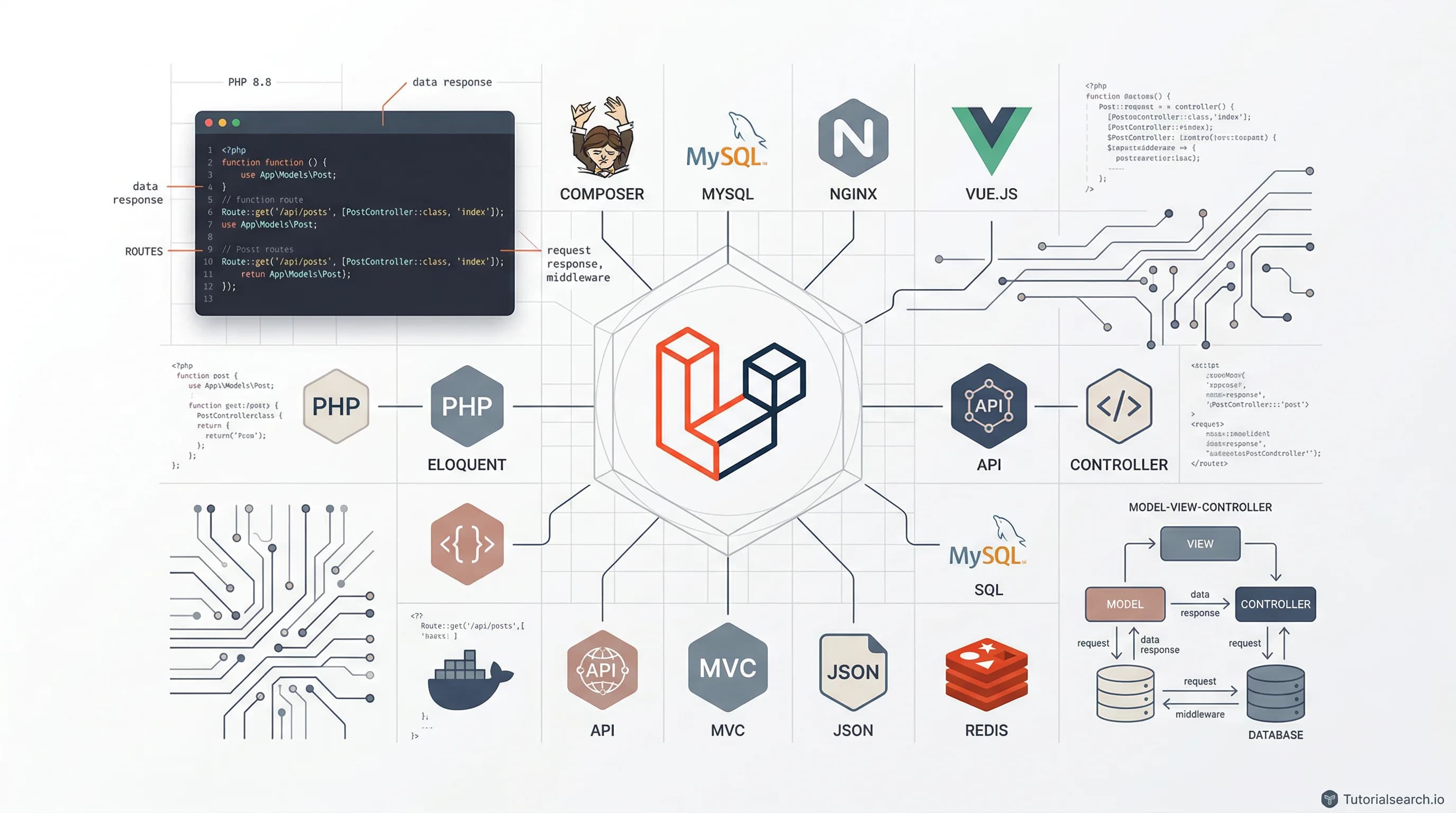
Every Laravel application uses the same five pieces working together. Routes define which URL triggers which action. Controllers handle the logic for each request. Models represent your database tables and manage data. Views (written in Blade, Laravel's template engine) handle what the user actually sees. Middleware sits between the request and your app — handling things like authentication checks. Understanding how these five pieces connect is what "knowing Laravel basics" actually means.
The most efficient path through Laravel basics is: Laravel Bootcamp first — free, official, real project. Then pick one structured course, either Morshedul Arefin's portfolio course or Robert Apollo's Laravel 12 course depending on whether you want a portfolio project or the most current version. Subscribe to the Laravel Daily YouTube channel for the long run. Join the Discord when you have questions. The rest — books, GitHub repos, the Laracasts library — you'll find as you build.