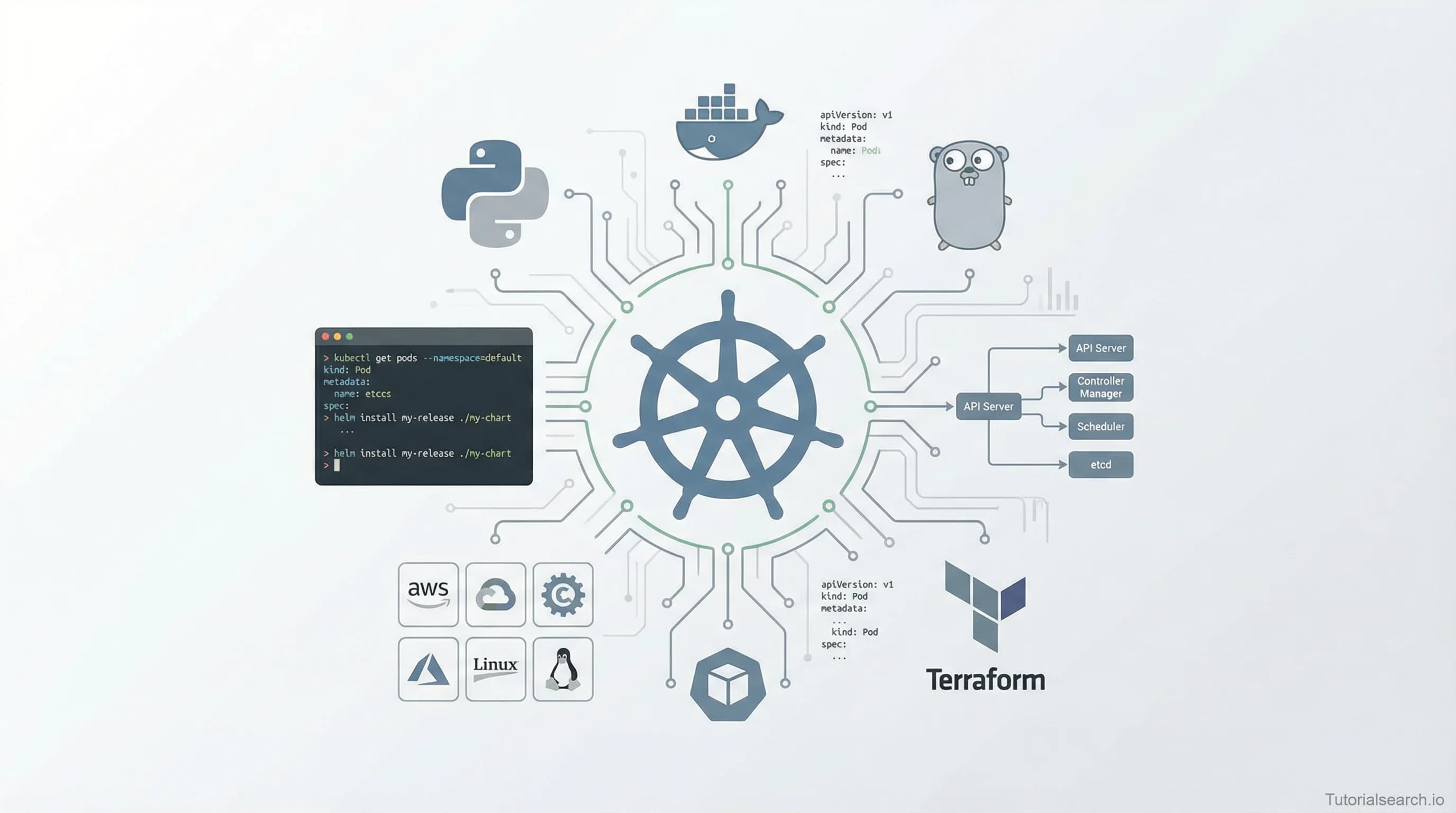
Kubernetes Resources Demystified — Courses, Labs, and Guides
Kubernetes resources are the foundation of every cluster — and most tutorials rush past them. Here are the courses, free labs, GitHub repos, and books that build real understanding of CRDs, controllers, and operators.
Hire the developers behind TutorialSearch.io
We built this site — full-stack web apps, AI integration & automation. Tell us what you need and we'll build yours.
Kubernetes resources are the building blocks of every cluster — and most tutorials rush past them. Here are the courses, free labs, hands-on guides, and books that actually build real understanding of core resources, CRDs, and operators.
Most people learning Kubernetes hit the same wall. They can deploy a Pod and write a Deployment. They've memorized enough YAML to pass a basic test. But ask them to explain what a Kubernetes resource actually is — or how to define a custom one — and the answer gets fuzzy fast.
The real issue isn't YAML. It's that most tutorials skip the conceptual layer. A Kubernetes resource is a record of intent. You tell the API server what you want, and controllers work to make the cluster match that desired state. Once that mental model clicks, everything from Pods to CRDs starts to make sense.
CRDs — Custom Resource Definitions — extend this further. They let you add entirely new resource types to the Kubernetes API: your own objects, your own schemas, managed by your own controllers. This is the foundation of how operators work. Prometheus, ArgoCD, cert-manager — all of them are built on CRDs. Understanding that pattern is what separates someone who uses Kubernetes from someone who can extend it.
Before diving in, you can browse the full catalog of 142+ Kubernetes Resources courses on TutorialSearch.io to get a sense of the range across Udemy and Pluralsight.
Key Takeaways
- Kubernetes resources define desired cluster state, and controllers constantly work to maintain it
- CRDs let you add new resource types to the Kubernetes API — this is how operators like ArgoCD and Prometheus are built
- The best Kubernetes resources courses combine conceptual depth with hands-on labs, not just manifest copying
- You can experiment with CRDs in-browser for free using Killercoda or the official Kubernetes playground — no cluster setup required
- Docker Containers basics are the most important prerequisite before tackling Kubernetes resources in depth
In This Article
- The Kubernetes Resources Courses Worth Your Time
- Free Kubernetes Resources Learning Paths That Actually Work
- Kubernetes Resources on YouTube — Channels That Deliver
- When You Want to Go Deep With Kubernetes Resources
- Where the Kubernetes Community Hangs Out
- Related Kubernetes Skills Worth Building
- Frequently Asked Questions About Kubernetes Resources
The Kubernetes Resources Courses Worth Your Time
The honest problem with Kubernetes courses is that most treat resources as a side note. You get one lecture on resource limits, a quick glance at ConfigMaps, and then it's straight to networking. The courses below go further.
1. Kubernetes for Developers: Core Concepts — Dan Wahlin (Pluralsight) [Editors' Choice]
Rating: 4.8 stars. This is the course I'd hand to a developer who says "I kind of know Kubernetes but I'm not sure I really understand it." Wahlin treats each resource type as part of a connected system — he explains why Pods, Deployments, and Services exist as separate objects, not just what their YAML looks like.
His teaching style is measured and clear. He doesn't rush through concepts. If you've been working with Docker Compose and want to understand how Kubernetes resources map to what you already know, his companion course on moving from Docker Compose to Kubernetes is a natural pairing. I've seen engineers go from confused about namespaces to confidently writing multi-resource manifests after Wahlin's approach clicked for them.
2. Learn DevOps: The Complete Kubernetes Course — Edward Viaene (Udemy) [Editors' Choice]
Rating: 4.6 stars, 110,000+ students enrolled. The sheer enrollment count tells you something. This course has earned its audience through consistent quality and regular updates. A 2024 addition covers writing a Kubernetes Operator Controller in Go — rare material at this price point.
One thing worth knowing upfront: the course has been running since 2016, so some older sections feel dated. The content on writing operators and using MutatingWebhooks is sharp. The AWS EKS section is usable, but the official AWS docs are better for that specific topic. Skip the older parts; the newer additions are the reason to enroll.
3. Creating Custom Resources in Kubernetes — Zachary Bennett (Pluralsight) [Editors' Choice]
Rating: 4.2 stars. This is the course most Kubernetes learners need but don't know exists. Bennett covers CRDs from the ground up — defining custom resource types, writing custom controllers, and building a complete operator. It's intermediate level, so you should know your way around kubectl first.
Here's a pushback on conventional wisdom: when someone asks how to "go deeper" with Kubernetes, the usual answer is "study for your CKA." That's wrong for most developers. If you want to understand how Kubernetes actually extends — how the tools you already use were built — this course is the better starting point.
4. Kubernetes Training: Learn K8s from Zero to Cloud — Jose Portilla (Udemy)
Rating: 4.6 stars, 4,500+ students. Portilla's bootcamp is the best entry point if you want to go from zero to a working cloud deployment in a single course. It covers all core Kubernetes resource types, then builds up to Helm charts, operators, and a final AWS deployment. Portilla explains things twice when needed — not condescendingly, just patiently.
5. Certified Kubernetes Administrator (CKA) Hands-On Training — Digital Cloud Training (Udemy)
Rating: 4.6 stars, 4,100+ students. For those pursuing the CKA, this course covers the resource landscape comprehensively — RBAC resources, storage resources, admission controllers, and advanced scheduling. Instructor Michael Levan served on the Kubernetes v1.28 Release Team, which gives the content real credibility. If certification isn't your goal, the earlier courses are better fits.
Pick your path at a glance
| Your Goal | Recommended Course |
|---|---|
| Core resource types (beginner) | Wahlin's Core Concepts (Pluralsight, 4.8★) |
| CRDs and custom operators | Bennett's Creating Custom Resources (Pluralsight, 4.2★) |
| Bootcamp from zero to cloud deployment | Portilla's K8s from Zero to Cloud (Udemy, 4.6★) |
| CKA certification prep | Digital Cloud Training CKA (Udemy, 4.6★) |
| Most popular + actively updated | Viaene's Complete Kubernetes Course (Udemy, 4.6★) |
Free Kubernetes Resources Learning Paths That Actually Work
Free Kubernetes learning is genuinely excellent right now. These resources rival most paid courses for depth and accessibility — and a few of them are better than anything you'd pay for.
Official Docs: Custom Resources — kubernetes.io
The official documentation on custom resources is the single best reference for understanding CRDs. It explains when to use CRDs versus the Aggregated API, covers the full CRD spec format, and walks through schema validation with OpenAPI v3. Pair it with the official CRD step-by-step tutorial that has you creating one in a real cluster. Detailed, authoritative, and completely free.
Kubernetes Basics Interactive Tutorial — kubernetes.io [Editors' Choice]
Six browser-based modules covering deployments, scaling, updates, and service exposure. You run real kubectl commands against a real cluster with no installation required. This is the best free resource for building muscle memory with core Kubernetes resource types.
Reading about rolling updates is one thing. Accidentally misconfiguring a deployment and watching the reconciliation loop self-heal is another. The hands-on format makes the desired-state model stick in a way that reading never quite does.
Killercoda Kubernetes Scenarios — Killercoda
Browser-based Kubernetes labs with guided scenarios — free tier available. The CKA and CKAD-focused exercises include hands-on CRD and operator scenarios. Quality varies across scenarios, but the structured paths are well-designed for building toward intermediate skills.
Kubernetes Learning Path — GitHub, 7.5k⭐
A structured roadmap from beginner to advanced maintained by Techiescamp. It covers foundational concepts, cluster administration, resource management, networking, and operators in sequence. The structure is logical, and it connects naturally to DevOps Automation workflows like GitOps — useful context once you understand what resources are being automated.
Awesome Kubernetes — GitHub, 15.8k⭐
The definitive curated list for Kubernetes resources, tools, and tutorials. Don't read it cover to cover. Use it as a reference when you need to find something specific — a resource type explanation, an operator framework, or production tooling for a particular use case.
DevOpsCube Kubernetes Roadmap — devopscube.com
35+ hands-on tutorials organized into a clear learning sequence. Covers architecture, resource management, storage, security, and monitoring in depth. A strong alternative to paid courses for self-directed learners who prefer to learn by doing rather than watching.
Introduction to Kubernetes (LFS158) — Linux Foundation
Free, self-paced, and backed by the organization that runs the CNCF. Covers Kubernetes architecture and core resource types from scratch. A solid option if you prefer a structured course format but aren't ready to pay yet.
Kubernetes Resources on YouTube — Channels That Deliver
Hire the developers behind TutorialSearch.io
We built this site — full-stack web apps, AI integration & automation. Tell us what you need and we'll build yours.
TechWorld with Nana — YouTube
Nana is probably the most recommended Kubernetes educator on YouTube, and the reputation is deserved. Her full Kubernetes tutorial for beginners is 4+ hours of genuinely clear explanation. The visual diagrams of resource relationships — how Deployments manage ReplicaSets which manage Pods, how Services expose them — make abstract concepts concrete fast.
CNCF YouTube Channel — YouTube (@cncf)
The CNCF channel publishes KubeCon sessions, SIG updates, and explainers on Kubernetes resource topics, CRDs, and operator patterns. Signal-to-noise varies, but the API Machinery SIG sessions and KubeCon talks on operator frameworks are excellent. Free and updated regularly with new conference content.
If you're also building Linux Fundamentals skills alongside Kubernetes — a sensible combination since cluster administration involves real Linux work — both CNCF and KodeKloud's YouTube channels cover that territory well.
KodeKloud — YouTube (@kodekloud)
KodeKloud's free content covers Kubernetes resources, RBAC, and CRD basics at a deliberate pace. Good for reinforcing concepts that faster-talking instructors gloss over. Their paid courses are among the best in the CKA prep space, but the free YouTube material is substantial enough to stand on its own for beginners.
When You Want to Go Deep With Kubernetes Resources
Kubernetes Up and Running — Kelsey Hightower, Brendan Burns, Joe Beda (O'Reilly)
Burns and Beda helped build Kubernetes. Hightower writes about it more clearly than almost anyone. The chapters on resource management and the control loop explain the desired-state model in a way that makes CRDs feel like a natural extension of the system. Start here if you want the architectural foundation before getting hands-on.
Kubernetes in Action, Second Edition — Marko Lukša (Manning)
More detailed and more pedagogical than Up and Running. Lukša builds complexity slowly, explaining the rationale behind each resource type before showing how to use it. The chapter on extending Kubernetes with CRDs and custom controllers is one of the clearest written explanations available. If Up and Running gives you the "what," Lukša gives you the "why it works this way."
Kubernetes Operators — Jason Dobies and Joshua Wood (O'Reilly)
This one is underrated. Everyone recommends Up and Running for foundations, but if CRDs and the operator pattern are your specific goal, this is the better book. Dobies covers the full operator lifecycle — CRD schema design, controller implementation with the Operator SDK, reconciliation logic patterns, and testing strategies.
If you're evaluating open-source operators or building your own, this book belongs on your shelf. Also bookmark the official Operator Pattern documentation as a free primer, and Ivan Velichko's deep-dive on the operator pattern at iximiuz.com for a practitioner's explanation of how controllers actually work.
Where the Kubernetes Community Hangs Out
Active communities make a real difference when you're stuck on a resource configuration problem or trying to understand why your reconciliation loop isn't behaving as expected.
- Discuss Kubernetes — The official forum. Good for specific questions about resource behavior, API changes, and cluster configuration nuance.
- r/kubernetes on Reddit — Best for architecture questions, "what's the right pattern here" debates, and job-related discussions. Higher signal-to-noise than most technical subreddits.
- CNCF Slack — Project-specific channels (ArgoCD, Cert-Manager, Helm, Prometheus) and SIG channels. Most useful once you're working with a specific Kubernetes ecosystem tool built on CRDs.
- CNCF's Top 28 Kubernetes Resources for 2026 — The CNCF's own annual curated list. A useful bookmark for staying current.
Related Kubernetes Skills Worth Building
Kubernetes resources don't exist in isolation. These areas connect directly to resource management and cluster operations:
Docker Containers — Kubernetes orchestrates containers. Understanding Docker images, networking, and volumes makes resource definitions much less abstract. This is the single most important prerequisite. 411+ courses available if you need to build that foundation.
DevOps Automation — GitOps tools like ArgoCD and Flux manage Kubernetes resources through Git-based workflows. Once you understand what resources are, automating them through CI/CD pipelines is the natural next step. 699+ courses in this category.
Linux Fundamentals — Cluster administration involves file systems, processes, and networking. A solid Linux foundation makes kubectl debugging and node troubleshooting much less painful. Worth building early.
Network Automation — Services, Ingress, and NetworkPolicy resources define how traffic flows through a cluster. Network automation concepts overlap significantly with Kubernetes network resource configuration.
DevOps Essentials — Kubernetes is a DevOps tool at its core. If you're new to infrastructure-as-code and CI/CD thinking, exploring DevOps Essentials will make Kubernetes resource patterns feel less arbitrary.
IT Expertise — For broader context on how Kubernetes fits into enterprise infrastructure, the IT Expertise category has 914+ resources worth browsing.
Frequently Asked Questions About Kubernetes Resources
How long does it take to learn Kubernetes Resources?
Core resource types — Pods, Deployments, Services, ConfigMaps — typically take 2-4 weeks to get comfortable with through daily practice. CRDs and custom controllers add another 2-4 weeks. Writing a functional operator from scratch usually takes 2-3 months of focused learning. The official Kubernetes Basics Interactive Tutorial gets you hands-on with core resources in a few hours and is the best first step.
Do I need to know Docker before learning Kubernetes Resources?
Yes — at least the basics. You don't need Docker expertise, but understanding container images, how containers run, and basic networking makes Kubernetes resource concepts much clearer. Most beginners who skip this step struggle to understand why Pods exist as a concept. Explore Docker Containers courses to build that foundation first — it pays off quickly.
What is the difference between a Kubernetes Resource and a CRD?
A Kubernetes resource is any object managed by the Kubernetes API — Pods, Deployments, Services, Namespaces. A CRD (Custom Resource Definition) is a way to add entirely new resource types to that API. When you install ArgoCD or Prometheus on a cluster, they register CRDs — so your cluster gains new object types like Application or PrometheusRule. Built-in resources are the default vocabulary. CRDs let you add custom words to that vocabulary.
Can I get a job knowing Kubernetes Resources?
Yes. The CKA (Certified Kubernetes Administrator) is one of the most recognized credentials in the DevOps space. Companies running cloud-native infrastructure need engineers who understand resource management, RBAC, and cluster operations. You don't need to build operators to be employable — solid understanding of core resources, troubleshooting, and RBAC gets you into most Kubernetes-related roles.
Are there free ways to practice with Kubernetes Resources?
Several good ones. The official Kubernetes Basics Tutorial runs in-browser with zero setup. Killercoda offers guided labs including CRD-focused scenarios. Play with Kubernetes gives you a temporary free cluster. For structured free learning, the Linux Foundation's Introduction to Kubernetes (LFS158) covers core resources from scratch. Browse the full Kubernetes Resources catalog on TutorialSearch.io to find what fits your current level.
For most people, the right starting combination is Wahlin's Core Concepts course on Pluralsight plus the official Kubernetes Basics interactive tutorial — a few hours of video paired with hands-on practice. If you already understand the basics and want to learn CRDs specifically, Bennett's Pluralsight course is the clearest path available. And when you're ready to go deep on the operator pattern, Kubernetes Operators by Dobies is worth every penny.