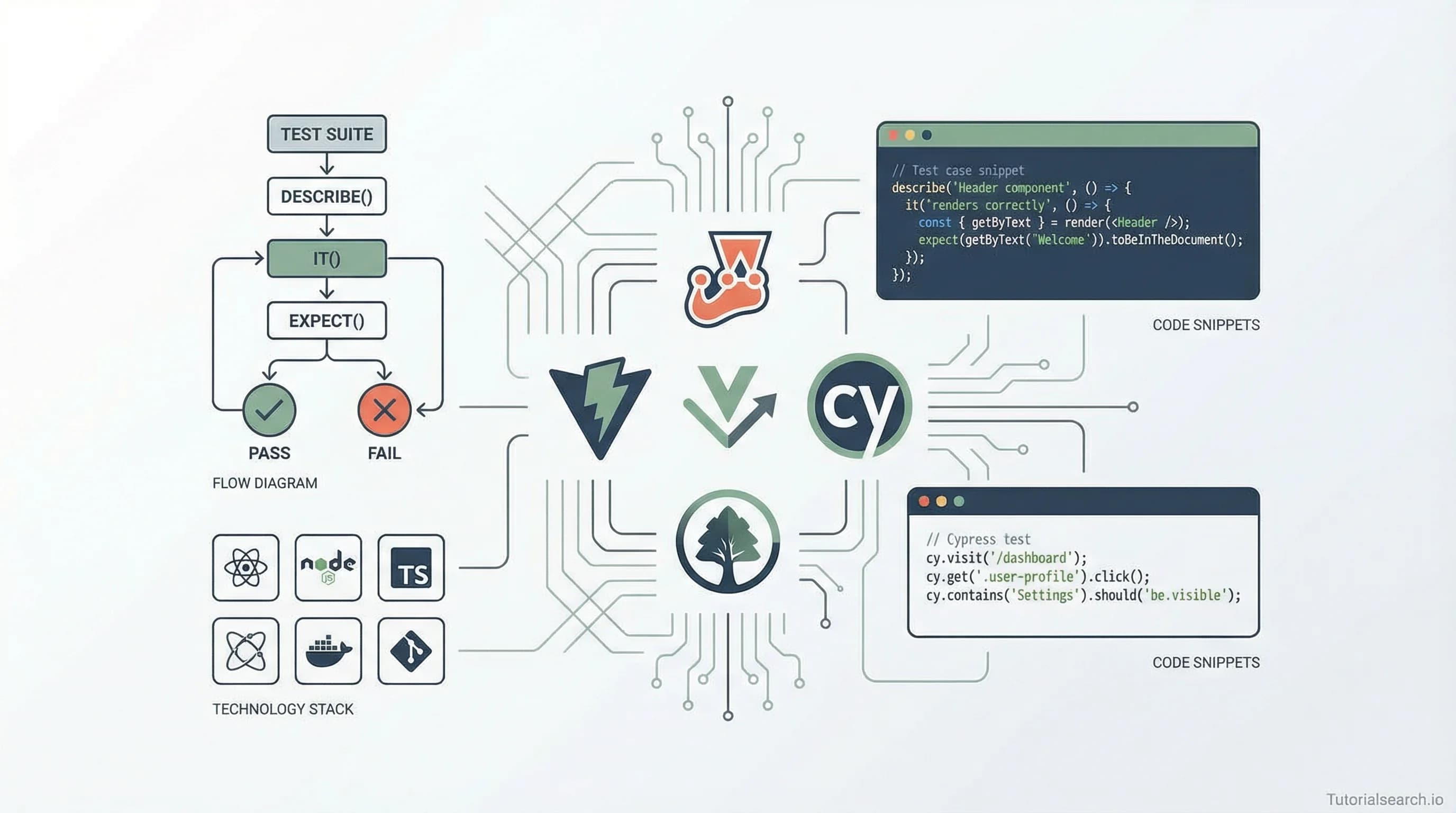
JavaScript Testing Doesn't Have to Be Complicated
JavaScript testing is easier than it looks. This guide covers the best courses, free resources, GitHub repos, and tools — from Jest and Vitest to Cypress and Mocha.
Need a web app built? Hire the team behind TutorialSearch.io
We ship fast, production-grade full-stack apps (Next.js, React, edge infra) — the same stack that powers this site.
JavaScript testing is one of the most searched topics in web development — and one of the most misunderstood. Here's what actually works, from the courses and tools that move the needle to the free resources you'll keep coming back to.
The biggest mistake developers make with JavaScript testing isn't writing bad tests. It's spending hours comparing frameworks, getting overwhelmed, and never starting at all.
Jest vs Vitest vs Mocha. Unit vs integration vs E2E. Mocking strategies. Code coverage targets. It looks like a lot. But here's the thing: you can start with one framework, one test file, and one assertion. Everything else comes later.
This guide cuts through the noise. Whether you're writing your first test or building a full testing strategy for a team project, you'll find the JavaScript testing courses, free tools, GitHub repos, and communities worth your time — organized in the order you actually need them.
Key Takeaways
- Jest is still the most-used JavaScript testing framework, but Vitest is now the smarter pick for Vite-based projects
- You can write your first useful JavaScript test in under 30 minutes with the right starting point
- Unit testing and integration testing serve different goals — you eventually need both for reliable JavaScript code
- Free resources like the official Jest docs and Codecademy's unit testing course are solid starting points, no cost required
- The best JavaScript test is the one you actually ship — pick a tool and go
In This Article
- Pick Your JavaScript Testing Stack First
- JavaScript Testing Courses That Actually Move You Forward
- Free JavaScript Testing Resources Worth Bookmarking
- The JavaScript Testing YouTube Channels Worth Following
- JavaScript Testing GitHub Repos to Star Right Now
- JavaScript Testing Books for When You Want to Go Deep
- Where JavaScript Testers Actually Hang Out
- Related JavaScript Skills Worth Exploring
- Frequently Asked Questions About JavaScript Testing
Pick Your JavaScript Testing Stack First
Here's the framework decision that trips up almost every beginner: they think there's a "right" answer they need to research their way to.
There isn't. Pick based on your project, not on which framework won the most blog posts.
| Framework | Best For | Quick Setup |
|---|---|---|
| Jest | Node.js, legacy React projects, broad compatibility | npm install --save-dev jest |
| Vitest | Vite-based projects (React, Vue, Svelte) | npm install --save-dev vitest |
| Mocha + Chai | Node.js, maximum flexibility | npm install --save-dev mocha chai |
| Cypress | End-to-end browser testing | npm install --save-dev cypress |
Here's my actual take: everyone recommends starting with Jest, and until recently that was the right call. But in 2026, if you're building on Vite — and most new React and Vue projects do — Vitest is the better starting point. It's faster, the config is almost identical to Jest, and it's built for the same ecosystem you're already in. Jest is still the right choice for older projects and anything that doesn't use Vite.
The good news: learning either one transfers almost completely to the other. Test structure, matchers, mocking patterns — it's all the same. Don't let the choice stall you.
If you need to browse your options before committing, the JavaScript testing topic page has 126 courses across all major frameworks. Worth scanning before you invest time in a single course.
JavaScript Testing Courses That Actually Move You Forward
A good JavaScript testing course has you writing real tests within the first 30 minutes — not spending an hour on theory. Here are the ones that earn their time.
1. JavaScript Unit Testing — The Practical Guide [Editors' Choice]
Instructor: Academind by Maximilian Schwarzmüller
Platform: Udemy | Level: Beginner | Rating: 4.8 | 31,000+ students
This is the JavaScript unit testing course I'd recommend to someone starting from zero. Max's courses consistently rank at the top of Udemy for good reason — he explains concepts clearly without dumbing them down.
What makes this one stand out: unlike testing courses that front-load 45 minutes of "why testing matters," this one gets you into a test file fast. It covers Jest from setup through mocking, async testing, and code coverage. The project-based approach means you're testing real code — functions with actual business logic — not trivial add(1, 2) examples.
What it covers: Jest setup, test structure, assertions, mocking, async tests, code coverage
2. Seamless JavaScript Testing with Wallaby.js [Editors' Choice]
Instructor: Wes Higbee
Platform: Pluralsight | Level: Intermediate | Rating: 4.7
Most developers have heard of Wallaby.js (a real-time test runner that gives you inline feedback in your editor as you type) but never actually tried it. This course changes that.
If you've ever felt like the feedback loop between code and tests is too slow, Wallaby.js solves it. Wes Higbee shows you how to set it up and integrate it into a real workflow. This isn't a "run tests and see results" course — it's about building the habit of testing continuously while you code.
Best for intermediate developers who know Jest or Mocha but want to test faster and more naturally.
3. Cypress 9 Fundamentals
Instructor: Adhithi Ravichandran
Platform: Pluralsight | Level: Beginner | Rating: 4.6
End-to-end testing is often the last thing developers add and the first thing they regret skipping. Cypress 9 Fundamentals is a strong, practical introduction for developers who want to test their apps the way users actually experience them.
Adhithi's course covers Cypress setup, writing your first E2E test, and integrating with CI pipelines. It stays hands-on throughout, which is the right approach for a tool like Cypress that really only clicks once you see it running in a real browser.
4. Testing JavaScript for Node.js with Mocha
Instructor: Jonathan Mills
Platform: Pluralsight | Level: Intermediate | Rating: 4.5
If your backend runs on Node.js, this Mocha testing course earns its place. What I like about Jonathan Mills' approach: he spends real time explaining why you structure tests a certain way, not just showing you the syntax. That matters when you're deciding how to test an API route or a database helper.
Covers unit testing, integration testing, and async patterns in Node — all three of which you'll need in a real backend project.
5. SinonJS Fundamentals [Editors' Choice]
Instructor: Nate Taylor
Platform: Pluralsight | Level: Intermediate | Rating: 4.6
Mocking is where most testing tutorials get hand-wavy. They'll show you jest.fn() and call it done. But real-world JavaScript code depends on external APIs, databases, timers, and file systems — all of which need to be mocked properly in tests.
SinonJS is the most flexible JavaScript mocking library, and this focused course on it is surprisingly hard to find anywhere else. Essential if you're testing code that makes real network calls or depends on side effects.
6. Node.js Testing Strategies
Instructor: Rob Conery
Platform: Pluralsight | Level: Intermediate | Rating: 3.9
A broader look at Node.js testing approaches — useful if you want context on how unit, integration, and E2E testing fit together in a Node project before committing to one course.
For even more options, the full JavaScript testing course list on TutorialSearch.io covers 126 courses across every major framework and skill level.
Free JavaScript Testing Resources Worth Bookmarking
These are the free resources I'd actually use — not the list of every tutorial that mentions Jest.
Jest Official Documentation — Start here if you're going the Jest route. The "Getting Started" page gets you from install to first test in minutes. The Mocking section is worth reading even after you've been using Jest for months.
Vitest Official Documentation — Clean and easy to read. If you're coming from Jest, the migration guide is surprisingly short because the APIs are nearly identical.
Codecademy: Learn JavaScript Unit Testing — Covers Mocha and Chai with interactive exercises. The free tier gives you enough to understand the core concepts before committing to a full course.
FreeCodeCamp: Test a React App with Jest, Testing Library, and Cypress — One of the best free guides for React testing specifically. Walks through a real setup end-to-end, which most short tutorials skip.
The Modern JavaScript Tutorial — Testing section — javascript.info is updated regularly (last updated March 2026) and the testing section is a clean introduction to the concepts without framework lock-in.
dwyl/learn-tdd on GitHub — A complete beginner's step-by-step TDD (Test-Driven Development, the practice of writing tests before writing code) tutorial in JavaScript. Most TDD tutorials are theory-heavy. This one makes you write actual code from the first commit.
If you're interested in automation development as a natural next step after testing, there are 838 courses on TutorialSearch worth exploring — testing and automation overlap significantly.
The JavaScript Testing YouTube Channels Worth Following
Need a web app built? Hire the team behind TutorialSearch.io
We ship fast, production-grade full-stack apps (Next.js, React, edge infra) — the same stack that powers this site.
Fireship — Jeff Delaney's channel is the fastest way to get a clear mental model of how any JavaScript tool works. His testing videos are short (under 10 minutes), technically accurate, and dense in a good way. Not a dedicated testing channel, but his Jest and Cypress explainers are some of the clearest available.
The Net Ninja — Has a dedicated Jest testing series for beginners. Longer format than Fireship, which works well if you need more hand-holding on the setup steps.
Traversy Media — Brad Traversy's intro to JavaScript testing is one of the most-watched free tutorials on the subject. Practical and beginner-friendly.
FreeCodeCamp YouTube — Occasionally publishes full-length JavaScript testing courses (2-4 hours) completely free. Worth searching "JavaScript testing" directly on the channel. The full-length format is rare and valuable.
A note on YouTube testing content generally: it goes out of date faster than written docs. Always check the upload date and confirm the framework version before following along.
JavaScript Testing GitHub Repos to Star Right Now
goldbergyoni/javascript-testing-best-practices [Editors' Choice]
24,600+ stars. This is the reference. Yoni Goldberg built a comprehensive guide covering 50+ best practices for JavaScript and Node.js testing — organized into sections on test structure, backend testing, frontend testing, and CI. The difference between this repo and most guides is depth: each principle comes with a real-world explanation, code examples, and the reasoning behind it.
If you're setting up testing on a professional project for the first time, read through this before writing a single test file.
MarcL/awesome-javascript-testing
A curated list of JavaScript testing tools, articles, tutorials, and videos. Maintained and organized. Good for discovering tools you didn't know existed (like Wallaby.js or Testing Library).
Already mentioned in the free resources section, but worth starring even if you're past the beginner stage. The repo structure is clean and the commit history follows a real TDD workflow, which is rare.
If you like the GitHub learning path approach, the JavaScript Development browse page has 1,062 courses covering the broader JavaScript ecosystem — testing fits naturally into that skill set.
JavaScript Testing Books for When You Want to Go Deep
Testing JavaScript Applications by Lucas F. Costa (Manning, 2021)
The most practical current book on the subject. Covers Node.js, React, and API testing together, which matches how most real projects are structured. Available on Manning's website with free chapter previews.
Test-Driven JavaScript Development by Christian Johansen (Addison-Wesley)
The original reference for TDD in JavaScript. Older but still relevant for the methodology. If you want to understand test-driven development as a practice — not just as a collection of tools — this is the book. Available on O'Reilly.
Learning Test-Driven Development by Saleem Siddiqui (O'Reilly, 2021)
A beginner-friendly introduction to TDD that uses JavaScript, Python, and Go side-by-side. You don't need to know all three languages — picking one and following along works fine. The multi-language approach is actually useful because it shows you that TDD is a mindset, not just a syntax.
Learning the testing methodology pairs well with deeper programming fundamentals — understanding how to structure code makes it easier to test.
Where JavaScript Testers Actually Hang Out
r/javascript — 2.5M+ members. Testing questions get real answers here, especially for framework comparisons and "should I test X?" questions. More practical than theoretical.
Stack Overflow — JavaScript — 1.5M+ questions tagged JavaScript. For specific testing problems ("how do I mock a module in Jest"), Stack Overflow is still the fastest path to an answer.
JavaScript Mastery Discord — 69,000+ members. Active channels for frameworks and libraries, including testing discussions. Good for getting code reviewed by other developers.
Testing Peer Review (Slack) — Dedicated QA and software testing community with JavaScript-specific channels. Better for testing strategy questions than syntax questions.
Related JavaScript Skills Worth Exploring
JavaScript testing doesn't exist in isolation. These related skills pair naturally with it:
- JavaScript Development — The broader JS ecosystem. 1,062 courses covering everything from async patterns to TypeScript. Testing makes more sense once your core JS skills are solid.
- Automation Development — Testing and automation overlap a lot. If you're writing E2E tests with Cypress, you're already doing test automation. 838 courses here.
- Programming Fundamentals — Understanding code structure, functions, and data flow makes writing testable code significantly easier. 1,122 courses.
- Object Programming — Writing testable code often means understanding how to structure it with clear boundaries. Object-oriented patterns help. 901 courses.
- Modern Languages — If JavaScript testing leads you toward TypeScript (it often does), exploring modern language patterns is a natural next step. 3,420 courses.
Frequently Asked Questions About JavaScript Testing
How long does it take to learn JavaScript testing?
You can write your first working test in under an hour. To get comfortable with unit testing patterns — mocking, async tests, coverage — expect 2-4 weeks of consistent practice. End-to-end testing with Cypress adds another 1-2 weeks to get fluent.
The honest answer: testing is a skill you improve gradually by doing it on real projects. No course replaces the experience of debugging a failing test in production code.
Do I need to know JavaScript well before learning testing?
Yes, the basics at minimum. You need to be comfortable with functions, async/await, modules, and object structure. If you're still learning JavaScript fundamentals, finish those first — testing code you don't fully understand is frustrating and ineffective.
If your fundamentals need work, the Python Basics browse page has strong analogous courses for learning programming fundamentals in a slightly simpler language first. Or go straight to programming fundamentals courses on TutorialSearch.
Can I get a job with JavaScript testing skills?
Yes — and it's an underrated skill set. Most companies want developers who write tests, but fewer developers actually do it well. If you can show testing experience (a GitHub portfolio with real test files, for example), it stands out in interviews.
QA automation roles specifically — which often involve Cypress, Selenium, and JavaScript — are in high demand and frequently pay well.
What is the difference between unit testing and integration testing in JavaScript?
Unit tests (using Jest or Vitest) test a single function or module in isolation. You mock any dependencies so you're only testing one piece of logic at a time.
Integration tests check how multiple parts of your code work together — a route handler plus the database it queries, for example.
End-to-end (E2E) tests, typically done with Cypress, simulate a real user clicking through your app in a browser.
Most applications need all three. Start with unit tests, add integration tests as your project grows, and add E2E tests for critical user flows.
What are the best JavaScript testing tools for beginners?
Jest if you're using Node.js or an older React project. Vitest if you're using Vite. Both have zero-configuration setups and strong documentation. For a free, guided introduction, Codecademy's JavaScript unit testing course is one of the best starting points — it covers Mocha and Chai through interactive exercises.
The hardest part of JavaScript testing isn't the tooling. It's building the habit. Pick a framework, write one test for one function in your current project, and ship it. That first real test catching a real bug — that's when it clicks.