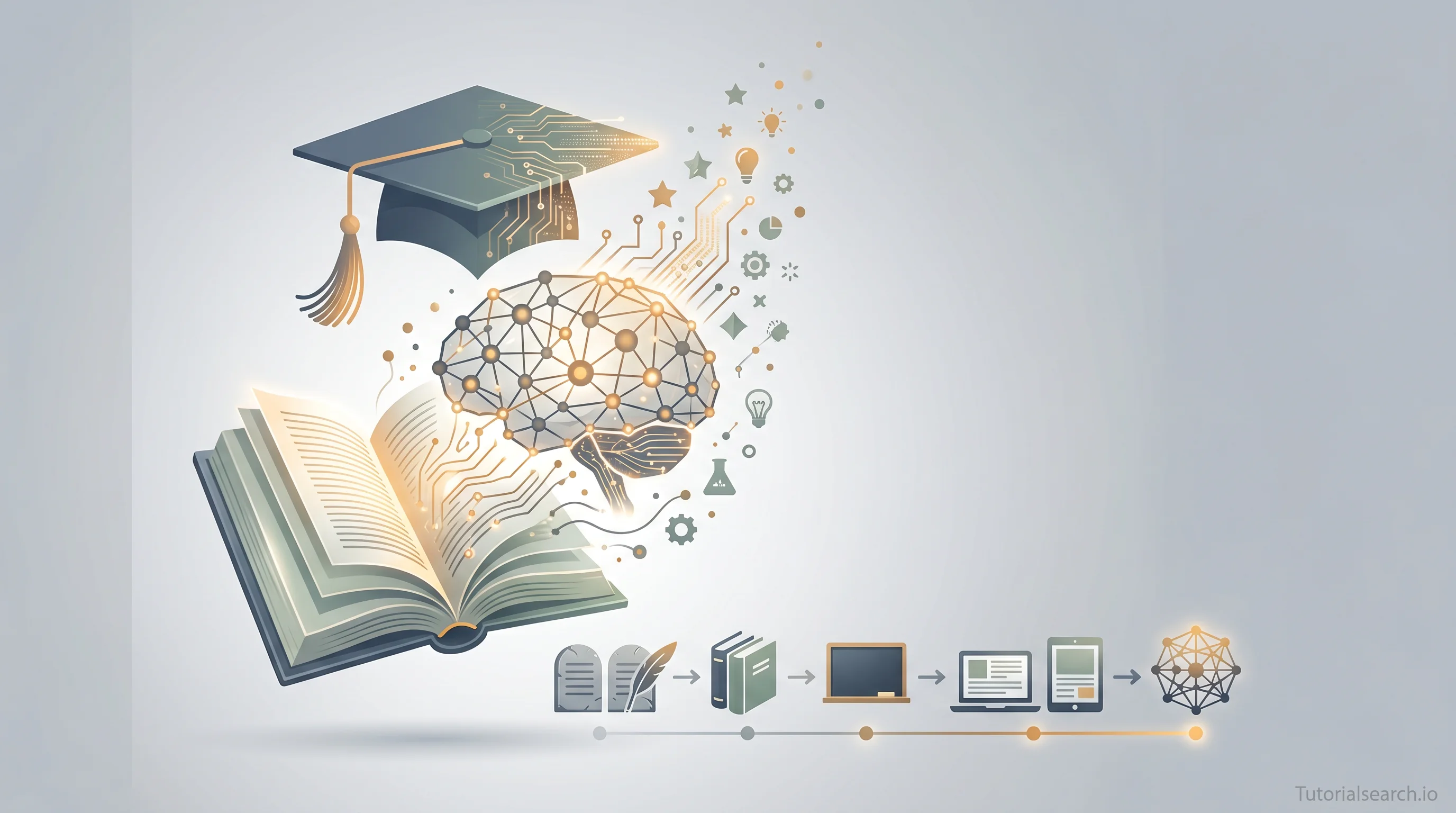
Is Education Ready for What's Coming? A Future Learning Guide
Future education is being reshaped by AI, personalized learning, and a rethinking of what being educated means. Here are the courses, resources, and tools worth your time.
Hire the developers behind TutorialSearch.io
We built this site — full-stack web apps, AI integration & automation. Tell us what you need and we'll build yours.
The most disruptive force in future education isn't AI — it's the growing gap between what schools teach and what the world actually needs. As of 2026, classrooms around the world are being reshaped by personalized learning, AI integration, and a fundamental rethinking of what "educated" means. Whether you're a teacher trying to stay relevant, a student mapping out your path, or a lifelong learner trying to make sense of it all, future education courses have never been more worth your time.
This guide cuts through the noise. We pulled together the courses, tools, books, and communities worth your attention — and added our honest take on what's actually worth it versus what's just hype.
Key Takeaways
- Future education is shifting from standardized delivery to personalized, adaptive learning — and courses that prepare you for this shift are more valuable than ever
- AI is a tool in future education, not a replacement for good teaching; the educators who thrive will blend both
- Free, high-quality future education resources from UNESCO, OECD, and leading universities are widely available — you don't need to spend much to learn well
- The most future-ready skill isn't technical: it's the ability to keep learning and adapting as the landscape keeps changing
In This Article
This guide covers structured courses, free resources, tools, and community for anyone navigating future education. Use the sections below, or start with the UNESCO Futures of Education initiative if you want the big picture first.
- The Future Education Courses Worth Your Time
- Free Future Education Resources That Are Surprisingly Good
- YouTube Channels That Actually Teach You How Education is Changing
- GitHub Projects Pushing Future Education Forward
- Books That Shaped How I Think About Future Education
- The Future Education Community Worth Joining
- Paid vs. Free: How to Choose Your Future Education Path
- Related Future Education Skills Worth Exploring
- FAQ
The Future Education Courses Worth Your Time
Here are the courses I'd point you to first. They vary in approach — some are about teaching methods, others about learning systems, and a few tackle the philosophical questions about where education is headed.
Competency Based Education: Proven Step-by-Step Framework (Udemy) — [Editors' Choice] Sancy S's course is one of the more practically grounded options out there. It focuses on competency-based education (CBE) — the model where students advance by demonstrating mastery rather than sitting through hours. CBE is gaining serious traction at university and K–12 levels, and the step-by-step framework here is concrete and immediately applicable. This is the approach I'd recommend if you're an educator looking to implement future-ready practices today, not theorize about them in five years.
The Education 4.0 (Udemy) — [Editors' Choice] Education 4.0 refers to the alignment of learning systems with Industry 4.0 demands: digital skills, systems thinking, creativity, and lifelong adaptability. This course breaks down what that actually means in practice. It's a good conceptual foundation if you're getting your bearings on the landscape, with clear framing of why the old model isn't just outdated — it's actively limiting.
Mastering Education: A Suggestopedic Approach (Udemy, Ivan Markov) — Suggestopedia is a methodology developed by Bulgarian psychiatrist Georgi Lozanov that uses relaxation, music, and environment to supercharge retention. Genuinely unusual. Not for everyone, but if you're curious about the neuroscience side of future learning, it opens up a perspective you won't find in mainstream EdTech content.
Educational Psychology & Special Education Certification (Udemy) — [Editors' Choice] Future education isn't just about technology — it's about designing learning for the full range of human difference. This course grounds you in educational psychology and gives practical tools for inclusive teaching. Rating of 4.9 with thousands of students says a lot. If you work with diverse learners (and all educators do), this belongs on your list.
Complete Generative AI for Upskilling & Learning Initiatives (Udemy) — Aimed at L&D professionals and educators who want to integrate generative AI into training and learning design. Covers prompt engineering for educational contexts, AI-assisted course creation, and how to evaluate AI tools for specific use cases. More practical than theoretical, which is a welcome change.
Instructional Design Strategies & Use Cases for Metaverse (Udemy) — [Editors' Choice] Metaverse learning environments are moving from novelty to real-world pilots. This course covers instructional design for immersive learning contexts — a genuinely niche skill becoming more in-demand. If you're an instructional designer looking for a differentiator, this is it.
Free Future Education Resources That Are Surprisingly Good
You don't need to spend money to get a serious foundation in how education is changing. These resources are free or freely accessible, and several are better than most paid courses.
UNESCO Futures of Education — The most authoritative global resource on where education is headed. UNESCO's flagship initiative brings together researchers, educators, policymakers, and youth to rethink education beyond 2030. The reports are dense but readable, and the core question they're wrestling with — "what should education become?" — is exactly the right one. Start with the Reimagining Our Futures Together report.
OECD Education and Skills Policy — The OECD's work on future skills and educational systems is policy-focused but deeply practical. Their Learning Compass 2030 framework is used by education ministries worldwide. If you want to understand systemic changes in education — not just classroom tactics — this is essential reading.
Frontiers in Education: AI Personalized Learning Review — A 2026 peer-reviewed systematic review of AI and personalized learning trends. Drier than a blog post, but if you want to understand what research actually says versus what edtech vendors claim, this delivers. Open access, no paywall.
Faculty Focus — A higher ed teaching publication with consistently good, practitioner-focused content. Their piece on designing the 2026 AI-powered classroom is a strong entry point. Subscribe to their newsletter — it's one of the few education newsletters that doesn't feel like a press release.
Marzano Research: 6 Education Predictions for 2026 — Marzano is one of the most cited researchers in K–12 education. This piece is short and opinionated, which makes it useful. Whether you agree with all six predictions or not, it frames the right debates.
Khan Academy — Still the gold standard for free, structured learning. Spending a week using Khan Academy's adaptive practice features tells you more about personalized learning than reading about it. Their AI tutor Khanmigo is worth exploring specifically.
YouTube Channels That Actually Teach You How Education is Changing
These channels don't just cover education — they model what good future-focused learning looks like.
Edutopia on YouTube — The George Lucas Educational Foundation's channel is the best visual resource for what progressive K–12 education looks like in practice. They document real classrooms using project-based learning, social-emotional learning, and tech integration. It's not aspirational fantasy — these are actual teachers in actual schools. Essential viewing if you're trying to close the gap between future education theory and practice.
TED-Ed — [Editors' Choice] The animated lesson format is now copied everywhere, but TED-Ed still does it best. Their lessons on learning science, cognition, and educational psychology are directly relevant to future education topics. Start with their series on how memory works and why traditional testing fails at measuring actual learning.
Khan Academy YouTube — Beyond the platform, the YouTube channel is a genuinely useful companion. Sal Khan's videos on the future of AI in education are worth watching — he's one of the few thinking seriously about this who also has practical experience to ground it in reality.
Focus on EDU — A more specialized channel that interviews education leaders and practitioners on the trends reshaping their fields. Covers equity, esports in education, coaching models, and the future of learning environments. Less polished than the big channels, more substance per minute.
GitHub Projects Pushing Future Education Forward
Hire the developers behind TutorialSearch.io
We built this site — full-stack web apps, AI integration & automation. Tell us what you need and we'll build yours.
The open-source community is building the infrastructure for personalized, AI-powered education. These repos are worth knowing about.
AI for Education Organization — A GitHub org dedicated to open-source tools at the intersection of AI and education. Includes projects around adaptive assessment, AI tutoring frameworks, and learning analytics. If you're a developer wanting to contribute to future education technically, this is where to start.
LearnAI — An AWS Hackathon-winning personalized learning platform built on Claude Haiku. It processes textbooks and PDFs and generates tailored educational content using RAG — essentially an AI tutor you can point at any document. The code is clean and the architecture is instructive even if you're not planning to fork it.
awesome-education — A curated list of resources, services, and apps for teaching and learning. The curation is a bit dated in places but it's a useful map of the ecosystem — tools for classroom management, LMS options, assessment tools, and more. Good for orientation.
ai-education GitHub Topic — Not a single repo but a live curated topic page. This is where new AI-in-education projects land first. Worth checking periodically if you want to stay on the cutting edge of what developers are building for the future of learning.
Books That Shaped How I Think About Future Education
The best books on future education don't give you a roadmap — they give you better questions.
Brave New Words by Salman Khan (2024) — Khan's take on how AI will transform education is grounded in his experience building one of the world's largest learning platforms. His central argument: AI doesn't replace teachers, it gives every student access to a one-on-one tutor. It's optimistic but not naive, and the practical proposals are more concrete than you'd expect from a book this broad. If you only read one book on this list, make it this one.
The Innovator's Dilemma by Clayton Christensen — Not technically an education book, but the most useful framework I know for understanding why education systems resist change. Christensen's concept of disruptive innovation explains exactly why good schools can still produce graduates who aren't prepared for what's next. Required reading for anyone trying to change education from the inside.
Designing the Future — Faculty Focus Resource Collection — Not a single book but a body of work worth treating as one. Their articles on AI-powered classroom design and adaptive learning systems are research-backed and written for practitioners. All free online.
The Future Education Community Worth Joining
r/education on Reddit — One of the most active education communities online, with ~400K members. Conversations range from policy debates to classroom stories to what's actually working. It skews toward K–12 in the US but has good international representation. Useful for getting a pulse on what real educators think about the changes in their fields, not just what researchers and vendors claim.
r/edtech on Reddit — A smaller but more focused community on educational technology. Good for discussing specific tools, hearing from practitioners who've tried them, and staying current on what's gaining traction versus what's fading. The honest skepticism here is healthy — edtech is full of hype, and this community calls it out.
Paid vs. Free: How to Choose Your Future Education Path
Not every future education resource is worth paying for. Here's an honest breakdown based on situation:
| Situation | Best Starting Point |
|---|---|
| Just exploring the topic | UNESCO's free reports + Edutopia YouTube |
| Educator wanting classroom tools | Competency-Based Education course on Udemy (paid) |
| L&D professional integrating AI | Generative AI for Upskilling course (paid) |
| Developer building EdTech | LearnAI GitHub repo + AI for Education org (free) |
| Researcher or policy thinker | OECD resources + Frontiers peer-review (free) |
| Formal credential seeker | Educational Psychology & Special Education Certification on Udemy (paid) |
The free resources are genuinely excellent for building a conceptual foundation. Paid courses earn their cost when you need structure, accountability, or a specific skill to apply immediately. If you're ready to invest, search future education on TutorialSearch to compare your options.
Related Future Education Skills Worth Exploring
Future education connects to a cluster of adjacent disciplines worth your time:
- AI Pedagogy — The specific practice of teaching with and about AI tools. As AI becomes standard in every classroom, pedagogical frameworks for using it well are essential.
- Teacher Strategies — 441 courses on the tactics that actually move students. Future education is ultimately about better teaching.
- Online Teaching — Hybrid and fully remote learning environments are becoming structural. Designing them well is its own discipline.
- Academic Skills — The foundational toolkit. No future-ready learning strategy works without strong underlying skills to build on.
FAQ
How long does it take to learn Future Education?
It depends on what "learn" means for you. Getting a solid conceptual grasp of future education trends takes a few weeks of focused reading and a good course. Building practical skills as an educator or instructional designer — enough to meaningfully change how you teach or design learning — takes several months of applied work. There's no finish line; it's a moving target by definition.
Do I need a teaching background to learn about Future Education?
No. While the field is often framed around educators, future education is genuinely relevant to anyone in L&D, HR, educational technology, policy, or parenting. The concepts around personalized learning, AI integration, and competency-based systems apply well beyond the traditional classroom.
How will AI change Future Education?
AI is already changing how educators personalize instruction, assess student progress, and design curriculum. In the near term, expect AI tutors that adapt to individual learning pace, AI-assisted assessment that moves beyond standardized tests, and tools that reduce administrative burden so teachers can focus on what humans do best — build relationships and guide sense-making. What AI won't replace: the motivational, relational, and mentorship functions of great teaching.
Can I get a job with Future Education skills?
Yes, and the demand is growing. Roles like instructional designer, learning experience designer, EdTech specialist, L&D manager, and curriculum developer are actively seeking people who understand personalized learning, AI integration, and competency-based frameworks. Browse Teaching & Academics courses to find options that map directly to these roles.
What are the biggest challenges in Future Education?
Equitable access is the central one — technology that personalizes learning for well-resourced students can widen existing gaps if it's not designed with equity in mind. Teacher training and institutional resistance are also significant. Most educators want to adapt but face system-level constraints that make change slow.
What is the role of online learning in Future Education?
Online learning has moved from supplement to structural component. Blended models — combining online flexibility with in-person depth — are becoming the norm, particularly in higher education and corporate training. The question isn't whether online learning belongs in future education; it's how to design online experiences that are genuinely engaging and effective, not just convenient. The best online programs build community, provide real feedback, and adapt to how each learner progresses.