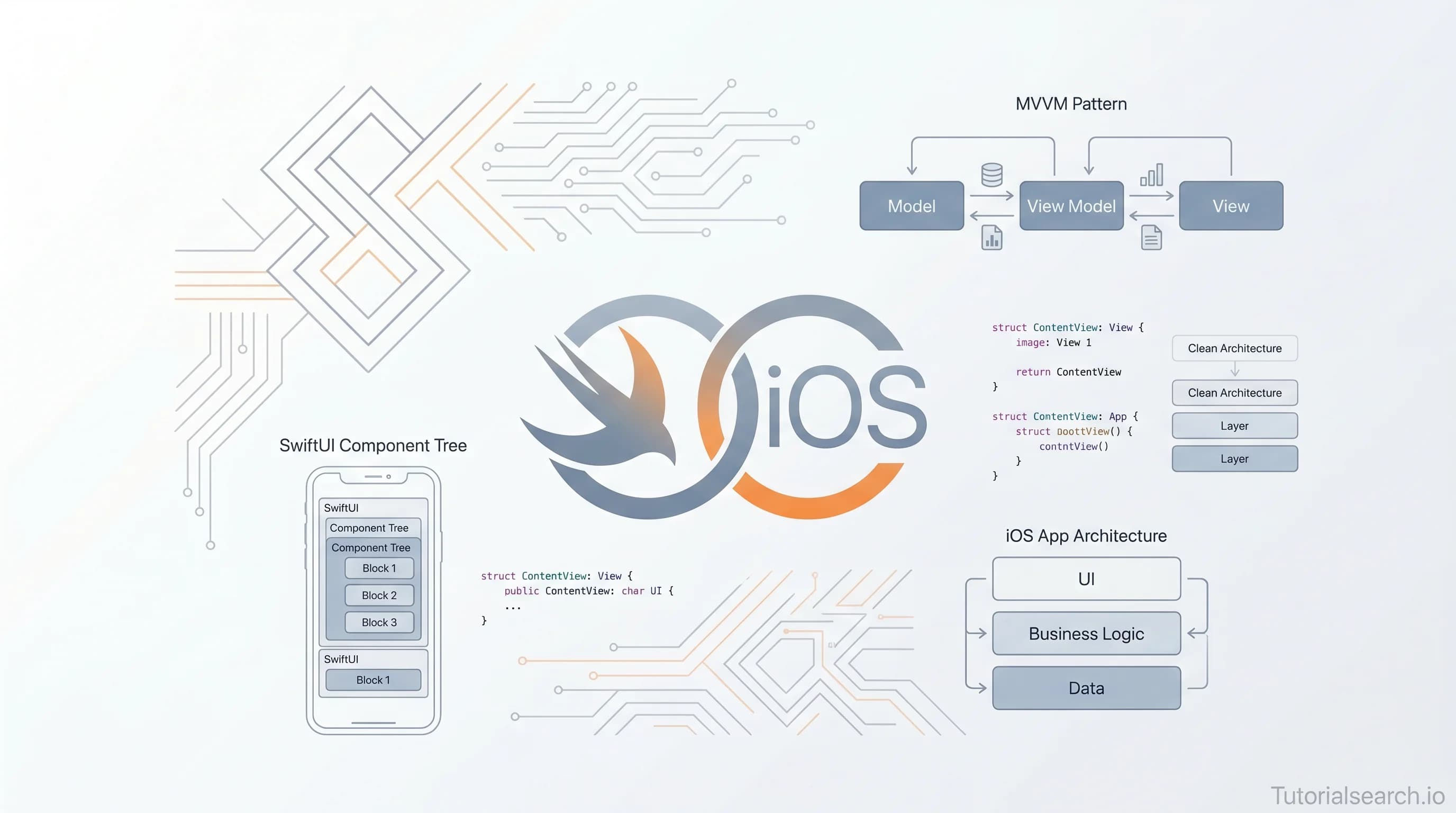
iOS Architecture Explained: The Patterns, Courses, and Resources That Actually Make Sense
iOS architecture is what separates developers who build and ship from those who stay stuck. This guide covers MVVM, VIPER, TCA, and Clean Architecture — plus the courses, free resources, GitHub repos, and books that actually teach you to make confident architectural decisions.
Need an app built? Hire the team behind TutorialSearch.io
Web and cross-platform apps shipped end-to-end — design to deploy — by the developers behind this site.
iOS architecture is the skill that separates developers who get stuck in tutorial loops from those who confidently build and maintain real apps — and as of 2026, the pattern landscape has never been more interesting or more confusing. You've probably heard MVC, MVVM, VIPER, TCA, and Clean Architecture thrown around in job postings, Slack channels, and code reviews. But which one should you actually learn? And where do you start?
This guide cuts through the noise. I'll cover the best iOS architecture courses on TutorialSearch, the free resources worth your time, the GitHub repos that teach by example, and honest opinions on what actually works in production. Whether you're trying to pass a technical interview or just stop fighting your own codebase, there's something here for you.
Key Takeaways
- iOS architecture knowledge is what hiring managers test for at mid-to-senior levels — not syntax
- MVVM with SwiftUI is the dominant pattern in 2026, but knowing why matters as much as knowing how
- The Composable Architecture (TCA) is increasingly common in larger codebases and worth understanding
- Free resources like Hacking with Swift and Apple's own tutorials cover architecture well at the beginner level
- iOS architecture skills pair naturally with SwiftUI, dependency injection, and testability
In This Article
- iOS Architecture Courses Worth Taking
- Free iOS Architecture Resources That Deliver
- YouTube Channels for Learning iOS Architecture Patterns
- The iOS Architecture GitHub Repos I Keep Coming Back To
- Books on iOS Architecture Worth Reading
- Which iOS Architecture Pattern Should You Actually Pick?
- Where iOS Architects Connect and Argue
- Related iOS Architecture Skills Worth Exploring
- FAQ
iOS Architecture Courses Worth Taking
Finding a genuinely good iOS architecture course isn't easy. Most beginner SwiftUI courses mention MVVM briefly and move on. The courses below actually dig into why patterns exist, not just how to copy them.
iOS System Design for Self-Taught Developers (Udemy) — [Editors' Choice]
Norbert Grover built this course specifically for developers who learned iOS from YouTube and online tutorials — people who can build an app but can't yet explain their architectural decisions. It covers the system-level thinking that separates junior from senior engineers: load balancers, message queues, offline-first design, and how they integrate with iOS apps. The section on architecture tradeoffs between MVC, MVVM, and VIPER is unusually honest — Grover doesn't pretend there's one right answer, which is refreshing.
What I appreciate most is that the course doesn't just show you patterns in isolation. It connects them to real scenarios: what happens when your user count grows, what happens when your team grows, and how architectural decisions made on day one either help or haunt you six months later. Rated 5.0 with over 1,300 students, this is the clearest path I've seen from "I can build apps" to "I understand how they scale."
Mastering SwiftUI Architecture: Patterns and Best Practices (Udemy) — [Editors' Choice]
Mohammad Azam is one of the most consistent iOS instructors on Udemy, and this course is his cleanest work. It focuses entirely on architectural patterns within SwiftUI — MVVM, separation of concerns, dependency injection — rather than treating architecture as a footnote to UI building. The emphasis on testable design is what sets it apart. Rated 4.72 with over 1,100 students across all experience levels.
SwiftUI MVVM Masterclass – Build a Polished Tic Tac Toe App (Udemy)
Raul Gutierrez takes an unusual approach: instead of a generic CRUD app, he uses a game (Tic Tac Toe) to demonstrate MVVM, clean layering, dependency injection, and separation of concerns. The structured build from system design to App Store-ready product is genuinely useful for understanding how architecture decisions compound over a project's lifecycle. Rated 5.0 with a substantial set of recent reviews — clearly a course people are finishing.
Composable SwiftUI Architecture Using Redux (Udemy) — [Editors' Choice]
Most iOS courses ignore TCA and Redux-inspired patterns entirely. Mohammad Azam doesn't. This course teaches the Redux mental model applied to SwiftUI — unidirectional data flow, reducers, and composable state — which is exactly the pattern behind Point-Free's Composable Architecture. If you're heading into larger teams or larger codebases, this is the course that'll make TCA click. Rated 4.71 with over 1,000 students.
From Feeds to Hired: SwiftUI Patterns That Pass Interviews (Udemy)
Norbert Grover again — this time focused on interview performance. The course builds a SwiftUI RSS reader while teaching MVVM, async/await, clean code, and protocol abstraction. What makes it different is the explicit focus on how hiring managers evaluate architecture decisions in take-home tests and technical interviews. Rated 4.93 with 2,200+ students.
iOS Dev Mastery – Build a Pro Finance App with SwiftUI & MVVM (Udemy)
Raul Gutierrez's finance app course shows MVVM, dependency injection, Git, and modular layering applied to a salary calculator — a deliberately boring domain that keeps the focus on architecture rather than flashy UI. Rated 4.85 with solid student numbers. If you want more iOS architecture options, browse all iOS architecture courses to find formats that fit your schedule.
Free iOS Architecture Resources That Deliver
You don't need to pay for everything. These free resources cover iOS architecture well and hold up in 2026.
Apple's App Organization Documentation — Apple's own guide to structuring SwiftUI apps. Dry, but authoritative. Start here before reading anyone's opinion about the "right" architecture, since Apple's recommendations inform what reviewers expect to see.
Apple's SwiftUI Concepts Tutorials — Interactive tutorials that walk through structural decisions in SwiftUI apps. The section on exploring app structure is directly relevant to architecture patterns.
Hacking with Swift: Introducing MVVM — Paul Hudson's Hacking with Swift is one of the most trusted free resources in the iOS community. This specific guide introduces MVVM in a SwiftUI context without jargon overload.
Clean Architecture for SwiftUI (Alexey Naumov's blog) — One of the most thorough free articles on applying Clean Architecture principles in a SwiftUI codebase. The author built a real reference app using the pattern, and the article walks through every decision. Worth a slow read.
Point-Free's Composable Architecture Tutorials — The official step-by-step tutorials for TCA are free and surprisingly accessible. If you want to understand why Redux-inspired patterns are gaining traction in iOS, start here before paying for any course.
Swift Forums — The official Swift community forum has ongoing discussions about architecture patterns, especially as new Swift language features (macros, the Observation framework) change how patterns work in practice.
Apple Developer Forums — For platform-specific architecture questions, the Apple Developer Forums are better than Stack Overflow. You'll find threads about SwiftData, the Observation framework, and architectural implications of new APIs.
YouTube Channels for Learning iOS Architecture Patterns
Need an app built? Hire the team behind TutorialSearch.io
Web and cross-platform apps shipped end-to-end — design to deploy — by the developers behind this site.
Video content is how most iOS developers actually learn architecture — seeing refactoring in real time is worth more than reading about it.
Sean Allen (YouTube) — Three videos per week, targeting intermediate and advanced developers. Sean's content regularly touches on architecture: protocol-oriented design, MVVM implementation, and code organization. His "Stop Doing This in Swift" style videos are particularly good at catching architectural anti-patterns.
Essential Developer (YouTube) — Caio and Mike from Essential Developer focus almost exclusively on senior-level iOS topics: TDD, Clean Architecture, SOLID principles, and professional code design. It's dense. It's also the most architecturally rigorous free iOS content available anywhere. Their "iOS Lead Essentials" program has a paid tier, but the YouTube channel alone is substantial.
SwiftfulThinking (Nick Sarno) (YouTube + GitHub) — Nick's MVVM and CoreData series are approachable entry points for developers coming from beginner SwiftUI content. He publishes source code for every video, so you can clone and run each example.
Rebeloper (YouTube) — Alex Nagy's channel covers architecture patterns with a practical bias — less theory, more "here's how this works in a real feature." Good for developers who find abstract architecture discussions hard to connect to actual code.
For even more structured video-based iOS architecture content, search TutorialSearch for iOS courses which often include dedicated architecture modules.
The iOS Architecture GitHub Repos I Keep Coming Back To
tailec/ios-architecture — The same list-of-repositories app rebuilt in every major iOS architecture: MVC, MVVM, MVVM+RxSwift, VIPER, RIBs, and more. The value here is direct comparison. Same app, same features, completely different structure. Invaluable for actually understanding the tradeoffs rather than just reading about them.
onmyway133/awesome-ios-architecture — A curated list of iOS architecture resources, example apps, and libraries. Well-maintained and comprehensive. Good as a jumping-off point when researching a specific pattern.
pointfreeco/swift-composable-architecture — The official TCA library with extensive documentation and examples. Even if you don't plan to use TCA, reading the README and examples is an education in what "composable" actually means in practice.
Apress/iOS-Architecture-Patterns — Source code accompanying the book "iOS Architecture Patterns: MVC, MVP, MVVM, VIPER, and VIP in Swift." The code examples are cleaner than most blog posts and work well as standalone reference material.
Books on iOS Architecture Worth Reading
iOS Architecture Patterns: MVC, MVP, MVVM, VIPER, and VIP in Swift by Raúl Ferrer García (Amazon | O'Reilly) is the most structured treatment of iOS architecture patterns in print. García covers each pattern — MVC, MVP, MVVM, VIPER, VIP — with complete Swift code examples and honest assessments of where each pattern works and where it breaks down. It's not a casual read, but it's the book you'd want before a senior iOS interview or before architecting a new project from scratch.
For a shorter, free alternative, Alexey Naumov's Clean Architecture for SwiftUI article covers similar ground in a blog format. Prefer video? The Composable SwiftUI Architecture course linked above handles the same territory hands-on.
Which iOS Architecture Pattern Should You Actually Pick?
Here's the take most articles avoid giving: for most apps, MVVM is fine. Not optimal, not perfect, just fine — and fine gets shipped.
| Pattern | Best For | Biggest Weakness |
|---|---|---|
| MVC | Small apps, prototypes | Views and controllers get entangled fast |
| MVVM | Most SwiftUI apps (the current default) | ViewModel can become a dumping ground |
| VIPER | Large UIKit teams with strict separation | Heavy boilerplate; hard to justify in SwiftUI |
| Clean Architecture | Complex domains, high test coverage requirements | Steep learning curve, lots of layers |
| TCA | Large SwiftUI apps, teams that prioritize testability | Performance overhead, opinionated setup |
The actual honest answer is that architecture only matters at scale. If you're building a solo app with five screens, pick MVVM and ship it. If you're joining a team with 30+ screens and a year of history, understanding Clean Architecture and TCA will make you immediately more valuable.
The contrarian point I'll make: VIPER gets unfairly dismissed in 2026. In a UIKit codebase with multiple developers working on the same module, VIPER's strict boundaries actually prevent the merge conflicts and stepping-on-each-other's-toes problems that MVVM's flexibility invites. It's not obsolete — it's just misapplied.
One more thing worth saying: the biggest architectural mistake I see isn't choosing the wrong pattern. It's choosing a pattern and then not being consistent about it. A half-MVVM, half-MVC codebase is worse than a pure MVC codebase. Whatever you pick, commit to it — and document your decisions so the next developer on the project doesn't have to guess at your intentions from the file structure alone.
Where iOS Architects Connect and Argue
r/iOSProgramming (Reddit) — Active community with regular architecture discussions. The "what architecture do you use?" threads appear every few months and reliably surface diverse opinions from developers at different scales.
Swift Forums — More technical than Reddit, better for questions about how new Swift features interact with existing architecture patterns. The threads on the Observation framework's impact on MVVM are particularly worth reading.
Related iOS Architecture Skills Worth Exploring
If iOS architecture interests you, these related skills pair well:
- SwiftUI Development — SwiftUI's declarative nature shapes which architecture patterns work well; understanding the framework deeply makes architectural choices clearer.
- Kotlin Android — Android's architecture evolution mirrors iOS closely; learning how Jetpack and MVVM work on Android sharpens your mental model for iOS patterns.
- React Native — Cross-platform experience gives you perspective on what's iOS-specific in your architectural assumptions versus what's universal to mobile.
- Flutter Development — Flutter's BLoC and Provider patterns have influenced how some iOS developers think about state management and unidirectional data flow.
FAQ
How long does it take to learn iOS architecture?
You can get comfortable with MVVM in a SwiftUI context in two to four weeks of focused practice. Getting fluent enough to make confident architectural decisions on a real team typically takes three to six months of working with these patterns in actual codebases. The gap between "understanding the pattern" and "applying it well under pressure" is where most developers underestimate the learning curve.
Do I need UIKit experience to learn iOS architecture?
No, but it helps. Many architecture patterns (especially VIPER) were designed for UIKit, so reading about them without UIKit context can be confusing. If you're starting fresh with SwiftUI, MVVM and TCA are the patterns to prioritize. UIKit experience becomes more relevant if you're maintaining legacy codebases or interviewing at companies with older iOS codebases. A large portion of the iOS apps currently in the App Store were built before SwiftUI existed, which means a significant share of iOS jobs still involve UIKit at least partly.
Can I get a job with iOS architecture skills?
Architecture knowledge is often the deciding factor in mid-to-senior iOS hiring decisions. Most job postings for iOS roles above junior level list MVVM, Clean Architecture, or specific patterns like TCA as requirements. Demonstrating that you can explain why you'd choose one pattern over another — not just implement it — is what moves you past the technical screen. The iOS System Design course at the top of this guide specifically addresses that interview dimension.
What is the role of Cocoa Touch in iOS architecture?
Cocoa Touch is the framework layer that sits between your app code and the hardware — it provides UIKit, Foundation, and other core APIs. In architectural terms, it's part of the infrastructure layer that Clean Architecture and VIPER try to abstract away. The shift to SwiftUI has reduced direct Cocoa Touch dependency in UI code, but networking, persistence, and system services still route through it.
What are the core components of iOS architecture?
iOS architecture centers around a layered system: the application layer (your code), the framework layer (UIKit, SwiftUI, Foundation), and the hardware layer. Within your application, the architectural pattern you choose — MVC, MVVM, VIPER, TCA — determines how you split responsibility between data, business logic, and UI. The goal in every case is the same: separation of concerns, testability, and code that a future developer (often future-you) can understand.