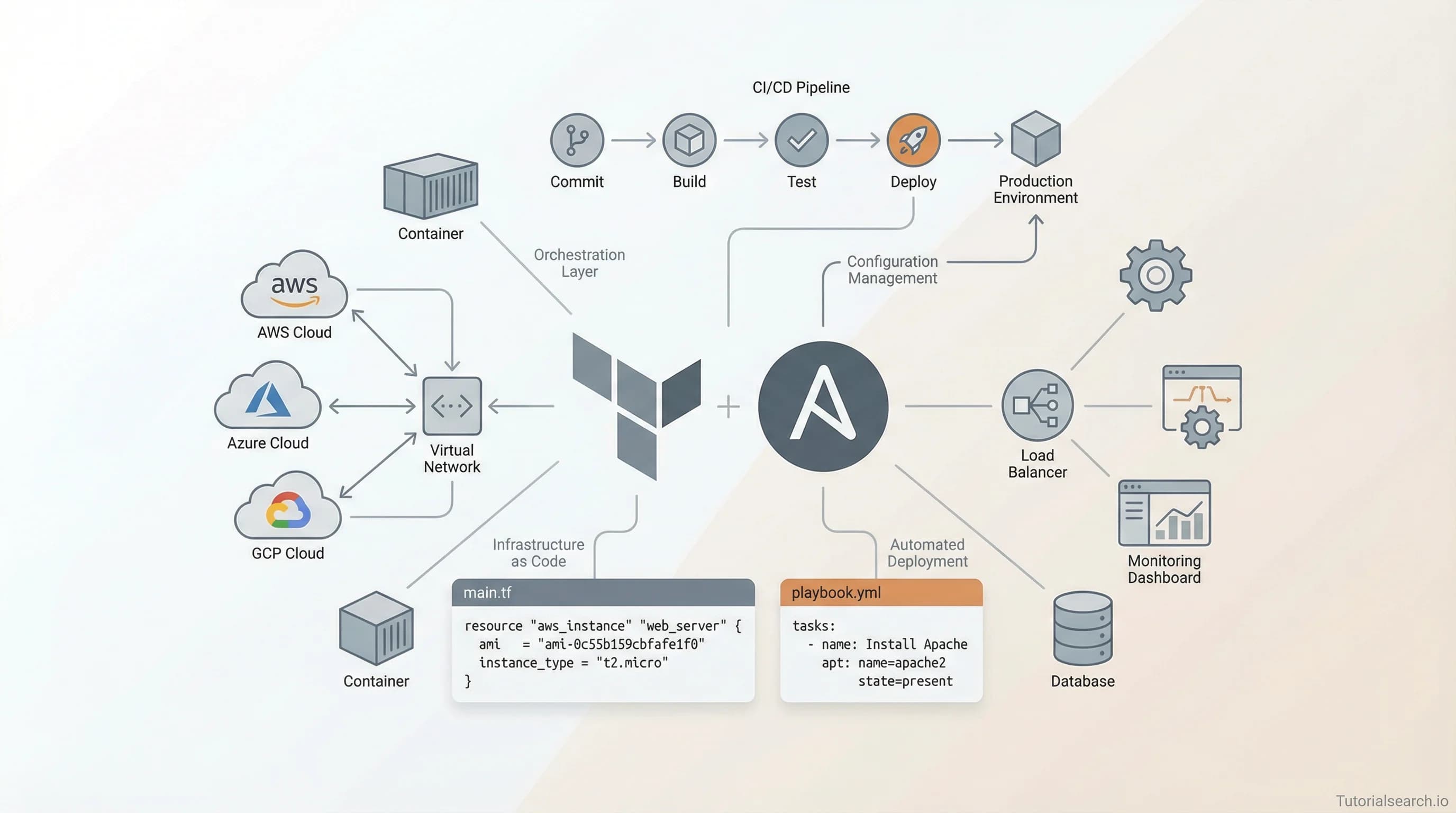
Infrastructure Automation: Your DevOps Toolkit Starts Here
Infrastructure automation is one of the most valuable DevOps skills you can build. Find the best Terraform and Ansible courses, free resources, GitHub repos, and books.
Hire the developers behind TutorialSearch.io
We built this site — full-stack web apps, AI integration & automation. Tell us what you need and we'll build yours.
Infrastructure automation is one of the most valuable skills in the DevOps toolkit. It's also one of the most confusing to learn — especially if you start with the wrong tool.
This guide covers the best courses, free resources, GitHub repos, YouTube channels, and books for mastering Terraform, Ansible, and the tools that run modern infrastructure. You can start browsing 192 infrastructure automation courses right now, or read on to find the right starting point.
Here's the number that stopped me when I first saw it: HashiCorp's Terraform AWS provider has been downloaded over 3 billion times. To put that in context — that's more downloads than most major programming languages accumulate in a year. And Ansible? It runs inside more than half of enterprise IT environments globally.
Infrastructure automation isn't a niche specialization. It's the standard.
The problem most people hit isn't a lack of resources. It's starting by treating Terraform and Ansible like they're interchangeable. They're not. Get that distinction early and everything else clicks faster.
Key Takeaways
- Infrastructure automation makes deployments repeatable and removes manual configuration drift.
- Terraform provisions infrastructure; Ansible configures it — they solve different problems.
- The best infrastructure automation courses use real cloud environments, not sandboxed demos.
- HashiCorp and Red Hat both offer free official learning resources worth using before paying for anything.
- GitHub's infrastructure-as-code topic page is the fastest way to find real-world automation patterns practitioners actually use.
In This Article
- The Infrastructure Automation Courses That Actually Move the Needle
- Terraform vs Ansible: Pick Your Starting Point
- Free Infrastructure Automation Resources Worth Your Time
- Infrastructure Automation GitHub Repos Worth Starring
- YouTube Channels for Infrastructure Automation That Teach You Something
- Infrastructure Automation Books for Going Deeper
- Related Infrastructure Automation Skills to Explore
- Frequently Asked Questions About Infrastructure Automation
The Infrastructure Automation Courses That Actually Move the Needle
Most infrastructure automation courses fall into one of two traps. Either they walk you through toy examples with no real-world complexity. Or they dump fifty tools on you with no clear path forward.
The clearest sign a course is worth your time? It makes you run real commands against real cloud resources — and shows you what happens when things break.
Terraform 101: The Ultimate Hands-On Guide (Azure Edition) [Editors' Choice] by Mark Tinderholt — 4.8 stars, 5,000+ students. This is the most beginner-friendly Terraform course in this list. Tinderholt explains state files, resource blocks, and providers without assuming you know HCL (HashiCorp Configuration Language — Terraform's own config format) beforehand. Most Terraform content defaults to AWS. This one uses Azure, which is a welcome change for engineers in Microsoft-heavy environments.
Terraform for Beginners using GCP – Google Cloud by Ankit Mistry — 4.5 stars, 15,000+ students. Ankit's teaching is methodical without being slow. He builds real infrastructure on Google Cloud Platform from scratch and explains each decision. If your organization works in GCP, this is where I'd send a new team member on their first week.
Dive Into Ansible: Beginner to Expert in Ansible [Editors' Choice] by James Spurin — 4.6 stars, 45,000+ students. Spurin is a Docker Captain and CNCF Ambassador. He's teaching from production experience, not a textbook. This course covers Ansible playbooks, roles, dynamic inventories, and real automation patterns. At 45,000 students, the community around this course is genuinely useful when you get stuck. It's the most comprehensive Ansible course available.
Master Ansible: Automation & DevOps with Real Projects — 4.6 stars, 27,000+ students. The phrase "real projects" gets overused in course titles. This one earns it. It uses multi-tier deployments and CI/CD integrations as the practice environment. Good step-up from beginner Ansible content.
Infrastructure Automation with OpenTofu – Hands-On DevOps by Yogesh Raheja — 4.4 stars. OpenTofu is the open-source fork of Terraform created after HashiCorp changed its license in 2023. If you work in open-source-first environments or want fully vendor-neutral infrastructure automation skills, this course covers the OpenTofu workflow end to end, including real DevOps pipeline integration.
Automation with Ansible Playbooks – Hands-On! by Shikhar Verma — 4.5 stars, 13,000+ students. Pure playbook depth. If you already know Ansible basics and want to get serious about role structure and idempotency (running the same config many times without side effects), this is a focused course worth the time.
[Enterprise] Infrastructure Automation with Terraform Cloud by Infrasity Learning — 4.3 stars. Once you're past the basics, Terraform Cloud (now HCP Terraform) is how teams collaborate on infrastructure code. This intermediate course covers remote state, workspace management, and policy enforcement — the parts that matter when you're not working alone.
Mastering HCP Terraform (Terraform Cloud) with Hands-On Labs by Bryan Krausen — 4.7 stars, 5,800+ students. Krausen has 200,000+ enrollments across his DevOps catalog. This is the most thorough treatment of HCP Terraform features available and a strong pick for Terraform Associate certification prep.
If you're coming from a networking background, pairing these with Network Automation courses is a natural extension — the automation mindset transfers directly.
Terraform vs Ansible: Pick Your Starting Point
Most beginners get tripped up here. Terraform and Ansible aren't competing tools. They solve different parts of the same problem. Using one without the other leaves a gap.
| Terraform | Ansible | |
|---|---|---|
| Primary role | Provisions infrastructure (VMs, networks, DNS) | Configures software on provisioned servers |
| Config format | HCL (HashiCorp Configuration Language) | YAML Playbooks |
| Agent required? | No | No (agentless) |
| State tracking | Yes — state file required | No built-in state |
| Best for | Cloud provisioning, infrastructure lifecycle | Config management, app deployment |
| Open-source fork | OpenTofu | Already fully open-source |
The analogy I keep coming back to: Terraform builds the house. Ansible furnishes it.
Everyone recommends starting with Terraform. I'd push back on that — if you come from a sysadmin or ops background, Ansible's playbook model is closer to what you already do manually. Start there, get comfortable with the automation mindset, then Terraform's declarative approach makes more sense as the next layer.
If you're a developer who's never touched ops work, start with Terraform. The resource-as-code model maps well to how software engineers already think about state.
Combining both tools is what enables the full DevOps Automation workflow — the kind that runs 700+ courses worth of real-world patterns.
Free Infrastructure Automation Resources Worth Your Time
HashiCorp Developer Tutorials [Editors' Choice] — The best free Terraform starting point online, and it's official. The tutorials are hands-on and command-line driven. They cover AWS, Azure, GCP, and Docker. The AWS Getting Started path takes a few hours and ends with actual infrastructure deployed. No toy examples.
Ansible Official Documentation — Dense, but well-organized. The community guide is a better entry point than jumping straight into reference docs. Follow the User Guide links from there.
Beginner's Guide To Automation With Ansible (free on Udemy, 32,000+ students) — A solid no-cost introduction to Ansible playbooks. It won't take you to production level, but it gives you enough to decide if Ansible is the right tool before committing to a paid course.
Scalr's Terraform + Ansible Integration Guide — A free written guide that goes deeper than most blog posts on this topic. It covers integration patterns, practical use cases, and how to wire both tools into CI/CD pipelines. Read this before you start combining Terraform and Ansible on a real project.
Firefly's Terraform IaC Academy — Regularly updated, practically focused. Good companion to the official HashiCorp docs when you want a second explanation of how state files or Terraform modules work.
Nucamp's Infrastructure as Code in 2026 Overview — A free article comparing Terraform, Ansible, and AWS CloudFormation side by side. Useful early in your career when you haven't settled on a toolchain yet.
The free resource most people miss: Red Hat's Ansible + Terraform Hands-On Workshop. It's a guided beginner lab run by Red Hat technical experts at no cost. Better for learners who need structure, not just docs.
Infrastructure Automation GitHub Repos Worth Starring
Hire the developers behind TutorialSearch.io
We built this site — full-stack web apps, AI integration & automation. Tell us what you need and we'll build yours.
The GitHub infrastructure-as-code topic page is the fastest way to discover what practitioners actually build. Filter by most stars and you'll find real-world patterns that most courses don't cover.
awesome-infrastructure-as-code — The standard curated list for IaC tools, Terraform modules, Ansible roles, Packer templates, and configuration management alternatives. Star this before you go deep on any single tool. It's the fastest way to discover what exists beyond the two main tools.
ansible-collections/cloud.terraform — The official Ansible collection for managing Terraform from within Ansible playbooks. This is how production teams run both tools in a unified workflow. Requires Ansible Core 2.15+ and Python 3.9+. If you want to see what "Terraform + Ansible together" looks like in real code, start here.
Tfsec / Trivy — A static analysis tool (now part of Trivy, ⭐ 6.9k stars) that scans Terraform configurations for security misconfigurations before they hit production. When you're writing infrastructure automation for a real team, security scanning becomes part of the pipeline fast. Worth knowing about early.
Infracost — Adds cloud cost estimates directly to Terraform pull requests. When you're spinning up infrastructure with code, costs can surprise you at scale. Infracost puts the dollar number right in the code review where someone can actually act on it.
If you're exploring how infrastructure automation connects to container-based workflows, the Docker Containers courses on TutorialSearch.io cover that intersection well — most Terraform projects end up managing container workloads sooner or later.
YouTube Channels for Infrastructure Automation That Teach You Something
TechWorld with Nana — The clearest visual explanations of DevOps tooling on YouTube. Nana draws architecture diagrams while explaining, which makes the mental model stick. Her Terraform and Kubernetes series are a solid free introduction if you prefer video over docs.
The DevOps Toolkit (Viktor Farcic) — Viktor is opinionated, which is useful. He runs real tool comparisons: ArgoCD vs Flux, GitOps workflow evaluations, infrastructure automation in production setups. You'll walk away with actual opinions about what works, not just "here are five tools, figure it out."
CNCF (Cloud Native Computing Foundation) — The official channel for KubeCon recordings and maintainer project demos. Not a tutorial channel. But if you want to understand where infrastructure automation is heading, this is where practitioners and project leads discuss it publicly. Watch the platform engineering talks to see how IaC fits the bigger picture.
Learn DevOps — Tutorial-focused and covers CI/CD pipelines, Ansible, and Kubernetes deployments from a practitioner angle. Good for building the specific skills you'll see called out in DevOps job postings.
For the broader DevOps context these channels teach within, the DevOps Essentials browse page has 336 courses covering the full stack.
Infrastructure Automation Books for Going Deeper
Terraform: Up & Running by Yevgeniy Brikman [Editors' Choice] — The most practical Terraform book available. Brikman co-founded Gruntwork, a company that manages Terraform infrastructure professionally at enterprise scale. He covers modules, state management, CI/CD integration, and is honest about where Terraform is genuinely painful to work with. Read this after you've completed one introductory course. It's the one book that treats you like an engineer, not a student.
Infrastructure as Code for Beginners by Russ McKendrick (Packt) — Good starting point if you prefer books over video. McKendrick covers Terraform and Ansible across AWS and Azure with real examples and clear explanations. More systematic than a course. Available on Amazon.
Terraform, Ansible & SaltStack For SysAdmins by Rowan Keyston — For sysadmins who want the complete automation picture: Terraform for provisioning, Ansible for configuration management, and SaltStack for compliance enforcement — all tied into GitOps workflows. Good if you want a single reference that covers the full stack. Available on Amazon.
DevOps Automation Essentials (Leanpub bundle) — Combines shell scripting, Terraform, and Ansible in one digital package. The Ansible section alone has 75+ recipe-style practical examples. Useful as a reference companion to any video course. Available on Leanpub.
Related Infrastructure Automation Skills to Explore
Infrastructure automation doesn't exist in isolation. These related skills pair directly with what you've learned here:
- DevOps Automation — 699 courses covering CI/CD pipelines, Jenkins, GitHub Actions, and the pipeline tools that infrastructure automation feeds into.
- Linux Fundamentals — 515 courses. Terraform and Ansible both assume Linux comfort. If your command-line skills need work, fix this before diving into IaC.
- Docker Containers — 411 courses. Most Terraform projects end up managing container workloads. These skills reinforce each other.
- Network Automation — 470 courses. Ansible started as a network automation tool. If your infrastructure includes network devices, these courses extend what you can automate.
- DevOps Essentials — 336 courses. If you want the big picture before specializing in infrastructure automation, start here.
- IT Expertise — 914 courses. Broader cloud and systems administration skills make IaC considerably easier to learn.
The full DevOps & IT category has 4,000+ courses across all of these areas.
Frequently Asked Questions About Infrastructure Automation
How long does it take to learn infrastructure automation?
Most people can write working Terraform configurations within a weekend of focused practice. Getting comfortable with Ansible playbooks typically takes a few weeks. Production-ready skills — state management, modules, roles, and CI/CD integration — usually take 2-3 months of consistent work. Browse infrastructure automation courses on TutorialSearch.io to find options matched to your current level.
Do I need coding experience to learn infrastructure automation?
No, but some scripting comfort helps. Terraform uses HCL, which is closer to JSON than a programming language. Ansible uses YAML. Neither requires traditional software development skills. Basic Linux command-line experience matters more than coding knowledge. If you're unsure where your gaps are, Linux Fundamentals courses are a solid first step.
What are the main benefits of infrastructure automation?
Automated infrastructure solves three persistent ops problems: configuration drift (servers slowly getting out of sync with each other), slow manual provisioning, and undocumented environments where nobody knows exactly what's installed where. With Terraform and Ansible, your entire infrastructure lives in code — versioned in Git, reviewable by your team, and reproducible from scratch.
What tools are most commonly used for infrastructure automation?
Terraform leads in cloud provisioning. Ansible leads in configuration management. Other tools worth knowing: Puppet and Chef (common in older enterprise environments), SaltStack (event-driven automation and compliance enforcement), Pulumi (infrastructure automation in TypeScript, Python, or Go instead of HCL), and AWS CloudFormation (for AWS-only teams). Most modern teams run Terraform and Ansible as their core stack.
Can infrastructure automation skills get me a job?
Yes — it's one of the more valuable specializations in the DevOps career path right now. DevOps Engineers, Cloud Architects, Site Reliability Engineers, and Platform Engineers all rely on infrastructure automation skills daily. The HashiCorp Terraform Associate and Red Hat RHCE certifications carry real weight with hiring managers. Pair IaC skills with broader DevOps Essentials knowledge to match what most employers actually expect.
The clearest path forward: pick one tool — Terraform or Ansible — and take it all the way through one solid course before you touch the other. Trying to learn both at the same time slows everything down.
Once you've got one working on a real project — even a simple one — the second tool clicks much faster. Start with the full infrastructure automation course list here and build from there.