Incident Response: The Courses and Resources I'd Actually Recommend
A curated guide to the best incident response courses, free resources, GitHub repos, YouTube channels, and books for cybersecurity professionals and aspiring DFIR practitioners.
Need a web app built? Hire the team behind TutorialSearch.io
We ship fast, production-grade full-stack apps (Next.js, React, edge infra) — the same stack that powers this site.
Incident response is the skill that separates organizations that survive a breach from those that collapse under one — and as of 2026, it's also one of the fastest-growing career paths in cybersecurity. Whether you're a security analyst building out your blue team skills, a sysadmin who just inherited IR responsibilities, or someone chasing a GCIH or CySA+ certification, the right learning resources make a dramatic difference. This guide covers the incident response courses, tools, and free resources that are actually worth your time.
No filler. No generic "check the NIST website" advice. Just what's genuinely useful.
Key Takeaways
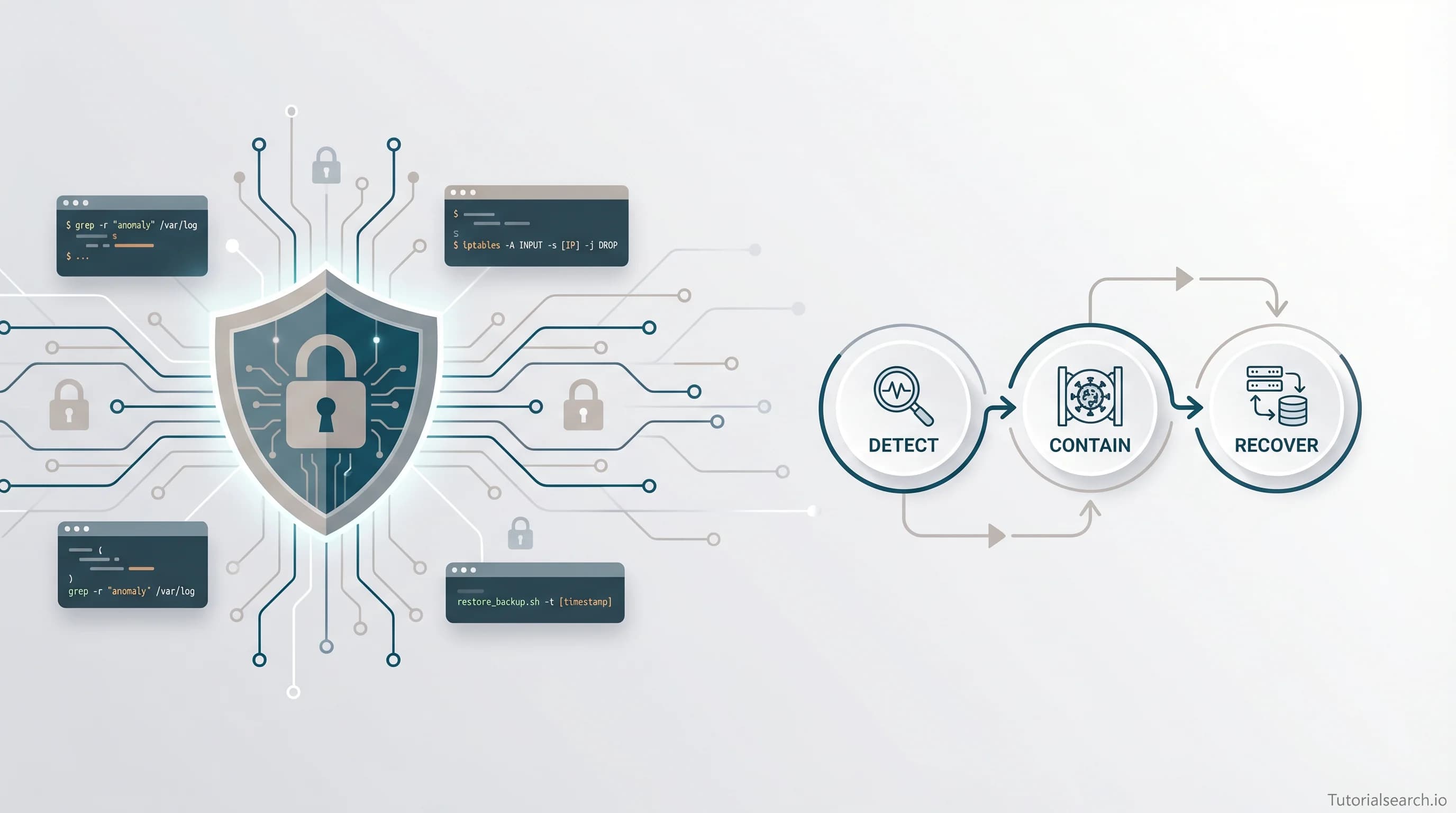
- Incident response follows a defined lifecycle — preparation, detection, containment, eradication, and recovery — and understanding each phase is essential before learning the tools.
- The best incident response courses combine hands-on labs with real-world scenarios, not just theory and slides.
- Free resources from NIST, CISA, and the SANS community rival paid training for foundational knowledge.
- Incident response skills are highly transferable — forensics, threat hunting, and SIEM work all build on the same core competencies.
- You don't need to know everything before starting: pick one platform (Windows or Linux), learn it deeply, then expand.
In This Article
- The Incident Response Courses Worth Taking
- Free Incident Response Resources That Hold Up
- YouTube Channels for Incident Response and DFIR
- GitHub Repos Every Incident Responder Should Know
- Incident Response Books Worth Reading
- Communities for Incident Response Practitioners
- Paid vs. Free Incident Response Training: An Honest Comparison
- Related Cybersecurity Skills Worth Exploring
- FAQ
This guide covers the full stack — from NIST's official IR framework to curated courses, GitHub toolkits, and the communities where working responders actually hang out.
The Incident Response Courses Worth Taking
There's an honest problem with most incident response courses: they're heavy on frameworks and light on the work that actually happens during an active breach. The best ones flip that ratio.
[Editors' Choice] Incident Response: Detection and Analysis by Aaron Rosenmund on Pluralsight is the closest thing to hands-on practitioner training in course form. Rosenmund is a working security professional, and it shows — the content covers log analysis, alert triage, and building detection logic in a way that maps to real SOC work. The 4.7 rating reflects that practitioners actually find it useful, not just beginners checking boxes. If you want one course that bridges theory and practice, this is it.
[Editors' Choice] Incident Response: Containment, Eradication and Recovery — also by Aaron Rosenmund on Pluralsight — picks up where Detection and Analysis leaves off. This is the part most courses skip: what do you actually do once you've confirmed an incident? How do you isolate without tipping off the attacker? When do you wipe vs. remediate? These are the judgment calls that separate junior responders from senior ones, and Rosenmund walks through them with the right level of nuance. Pair it with the Detection course for a complete response picture.
Incident Response by Christopher Nett on Udemy covers the full incident response lifecycle from a more accessible angle. With 2,378 students and a 4.5 rating, it's the platform's most popular IR entry point. Nett's course is well-structured for people new to IR who need to understand the phases before they start digging into tooling — think of it as building the mental model before writing your first playbook.
Incident Response: Network Analysis rounds out the Pluralsight IR series with a 4.7 rating. Network forensics is often the piece that's underemphasized in generalist training — this course fixes that with a focus on packet captures, traffic analysis, and identifying lateral movement in network logs. If your current job involves any network security responsibilities, this pairs well with the detection course.
For those working in cloud environments, Incident Response and Remediation in Microsoft Azure by Ammar Hasayen on Pluralsight is the only IR course I've found that takes cloud-native investigation seriously. The incident response playbooks most organizations use were written for on-premises environments. Hasayen's course addresses what changes — identity logs, cloud storage forensics, Activity Log analysis — and what doesn't. If your environment lives in Azure, this is essential, not optional.
Digital Forensics & Incident Response (DFIR) Masterclass on Udemy covers both disciplines together, which is accurate to how the work often happens. IR and forensics aren't separate careers in most organizations — the same person handles both. The 4.1 rating is honest: it's broad rather than deep, but the breadth is sometimes exactly what you need early on.
If incident response interests you but you want a broader foundation first, browse the cybersecurity fundamentals courses before committing to an IR specialization.
Free Incident Response Resources That Hold Up
The best free incident response resource in existence is NIST Special Publication 800-61 Revision 3. Released in April 2025 and updated to align with the NIST Cybersecurity Framework 2.0, it's the first major revision since 2012 — and the update is significant. The new lifecycle model acknowledges that modern incidents are more frequent, more dynamic, and rarely follow clean linear phases. If you're studying for any IR certification, this is required reading, not optional background. It's free and authoritative.
CISA's Incident Response Training is genuinely underrated. The agency offers self-paced recordings, live virtual training, and a full incident response training playlist covering ransomware, log analysis, and tabletop exercises. The institutional context matters too: CISA responds to real federal incidents, so the content reflects actual operational experience. Everything is free.
LetsDefend is the most hands-on free platform for blue team training. Unlike most courses that explain IR theory, LetsDefend simulates a SOC environment where you work actual alerts — phishing investigations, malware analysis, log review. The free tier gives you access to meaningful labs. I'd put an hour on this platform ahead of ten hours of passive video courses for building practical instincts.
Blue Team Labs Online takes a similar approach with CTF-style challenges focused on defensive security. The incident response challenges walk you through realistic scenarios: compromised systems, suspicious network traffic, attacker artifacts. It's free to start, and the challenge quality is genuinely good.
Cyber.org's free cybersecurity curriculum offers structured learning paths that include incident response modules. It's geared toward students and early-career professionals, but the foundational content on detection and analysis is solid for anyone building from scratch.
For a structured paid alternative, search TutorialSearch to filter by rating, platform, and difficulty level.
YouTube Channels for Incident Response and DFIR
[Editors' Choice] SANS Digital Forensics and Incident Response (YouTube) is the single best free video resource for serious IR practitioners. SANS publishes full talks from their FOR508 and FOR610 courses, conference presentations from DFIR Summit, and technical walkthroughs that go well beyond introductory content. If you're preparing for GCFE or GCIH certifications, the channel alone saves hundreds of dollars in study materials.
13Cubed (YouTube) by Richard Davis is what deep, technical DFIR content looks like when someone genuinely knows the work. Davis walks through Windows forensics artifact analysis, memory forensics, and actual case investigations with a precision that's rare on YouTube. He explains the why behind each artifact — why event log ID 4624 matters, what prefetch files reveal, how timeline analysis actually works — rather than just walking through tools. If you want to level up your forensic thinking, start here.
John Hammond (YouTube) covers malware reverse engineering and threat analysis alongside CTF content. His incident response simulations are useful for understanding attacker behavior — which is ultimately what good IR requires. Understanding what the adversary was doing is how you build better playbooks.
The Cyber Mentor (YouTube) is more red-team focused but invaluable for incident responders. Knowing how attacks work at a technical level — lateral movement, privilege escalation, persistence mechanisms — makes detection and investigation significantly more effective. Understanding offense is how you get better at defense.
Prefer structured curricula over individual YouTube channels? TutorialSearch has a wide selection of incident response and DFIR video courses you can filter by level and platform.
GitHub Repos Every Incident Responder Should Know
Need a web app built? Hire the team behind TutorialSearch.io
We ship fast, production-grade full-stack apps (Next.js, React, edge infra) — the same stack that powers this site.
[Editors' Choice] meirwah/awesome-incident-response (~8,700 stars) is the definitive curated list of IR tools. It's organized by function — evidence collection, log management, memory forensics, network tools, sandboxing — with direct links to each project. Bookmark it; you'll return to it every time you need a specific tool for an investigation. The community keeps it maintained, which matters more than you'd think.
GRR Rapid Response is Google's open-source framework for live remote forensics. If you need to collect evidence from endpoints at scale without interrupting operations — exactly what large-scale incident response requires — GRR is the tool. The architecture is sophisticated, but the documentation is solid, and deploying it in a test environment is an excellent hands-on learning exercise.
TheHive Project is the case management platform used by SOC teams and CSIRT organizations worldwide. Understanding how incident response is tracked, documented, and collaborated on at a team level is as important as the technical investigation skills. TheHive integrates with Cortex for automated enrichment and with MISP for threat intelligence — the full stack is a realistic representation of how mature IR teams operate.
Volatility Framework (~8,000 stars) is the standard tool for memory forensics. Memory analysis is where you find malware that lives only in RAM, extract credentials from process memory, and identify injected code that doesn't touch disk. It's a specialized skill with high value — and Volatility is how you learn it. Pairs well with cloud security skills that modern IR teams increasingly need.
Incident Response Books Worth Reading
The Blue Team Handbook: Incident Response Edition by Don Murdoch is the closest thing to a field manual for working responders. It's concise, practical, and organized for reference during actual incidents rather than cover-to-cover reading. The content on containment decisions, evidence preservation, and communication during a breach reflects real operational experience. If you're a working security analyst, this belongs on your desk.
Digital Forensics and Incident Response by Gerard Johansen takes a structured, methodology-first approach to DFIR. It covers the full investigation workflow from preparing your environment to presenting findings, with practical examples throughout. It's the book that bridges the gap between knowing IR theory and knowing how to actually work a case. Prefer video? The DFIR Masterclass on Udemy covers similar ground in course format.
The Art of Memory Forensics by Michael Hale Ligh, Andrew Case, Jamie Levy, and Aaron Walters is the definitive technical reference for memory analysis. It's dense, it's detailed, and it's not for beginners — but if you want to specialize in forensic investigation, there's nothing else like it. The Volatility Framework content alone justifies the read.
Communities for Incident Response Practitioners
r/cybersecurity on Reddit has over 1 million subscribers and regular threads specifically on IR scenarios, tooling questions, and career path discussions. The quality of answers varies, but the community includes working practitioners who give specific, actionable advice — particularly in threads about real-world incident handling experiences.
r/netsec skews more technical and is where you'll find discussions of specific tools, research papers, and vulnerability analysis that informs IR work. Less career-focused, more practitioner-to-practitioner.
DFIR.training aggregates training resources, tools, and community events focused specifically on digital forensics and incident response — a more focused alternative to general cybersecurity forums when you have specific DFIR questions.
Paid vs. Free Incident Response Training: An Honest Comparison
Here's an opinion that runs against the conventional advice: for incident response specifically, free resources are unusually competitive with paid training.
| Paid Courses (Udemy/Pluralsight) | Free Resources (NIST, CISA, LetsDefend) | |
|---|---|---|
| Structure | ✅ Clear learning path | ⚠️ Requires self-direction |
| Hands-on labs | ✅ Included in better courses | ✅ LetsDefend, Blue Team Labs |
| Certification prep | ✅ Targeted content | ⚠️ Less exam-specific |
| Current content | ⚠️ Varies by course | ✅ NIST SP 800-61r3 is 2025 |
| Cost | $15-30 on sale | Free |
| Authoritative sourcing | ⚠️ Instructor-dependent | ✅ NIST, CISA are definitive |
The honest recommendation: start with NIST SP 800-61r3 and LetsDefend to build your foundation, then use paid courses — particularly Rosenmund's Pluralsight series — to fill specific gaps and prepare for certifications. The combination costs less than a single SANS course and covers more practical ground than either alone.
Related Cybersecurity Skills Worth Exploring
If incident response interests you, these adjacent skills pair naturally with IR work:
- Ethical Hacking — Understanding attack techniques makes detection and investigation significantly more effective. Most senior IR professionals have meaningful offensive security knowledge.
- Network Security — Network forensics is a core IR skill. Understanding packet captures, traffic baselines, and network architecture is essential for investigating lateral movement.
- Security Certifications — CompTIA CySA+, GIAC GCIH, and EC-Council CHFI all formalize IR skills and are recognized by employers. Worth pursuing once you have practical experience.
- Cloud Security — Incident response in cloud environments requires different tools and techniques than traditional IR. As infrastructure moves to cloud, this gap in skills is increasingly visible.
- InfoSec Certifications — Threat hunting and SOC operations sit adjacent to IR; certifications like GCIH and CHFI formalize those combined skills for employers.
FAQ
What are the steps in incident response?
The NIST framework outlines five phases: preparation, detection and analysis, containment, eradication and recovery, and post-incident activity (lessons learned). Each phase has specific tasks — preparation means building playbooks and tooling before an incident happens, while lessons learned means documenting what worked, what didn't, and how to improve detection next time. In practice, phases often overlap and run non-linearly, especially during complex incidents.
How long does it take to learn incident response?
Most practitioners develop functional IR skills within 6-12 months of focused study and hands-on practice. Getting to the point where you can handle real incidents independently typically takes another 12-24 months of working in a SOC or security role. Certifications like CompTIA CySA+ can be earned in 3-6 months with dedicated prep, but certification doesn't equal experience.
Do I need a security background to learn incident response?
You don't need offensive security knowledge or ethical hacking skills, but a working understanding of networking (TCP/IP, DNS, HTTP), operating systems (Windows and Linux), and log analysis makes the learning curve much shorter. Most people who enter IR come from sysadmin, networking, or general IT backgrounds rather than pure security roles.
Can I get a job with incident response skills?
Yes — and the demand is growing. IR skills are directly applicable to SOC analyst roles, DFIR specialist positions, and security engineer roles at mid-to-large organizations. Many companies also hire for internal IR teams. Pair practical skills with a recognized certification (CySA+, GCIH) and documented hands-on experience from platforms like LetsDefend, and you have a competitive profile for entry-level security roles.
How does incident response differ from disaster recovery?
Incident response focuses on containing and resolving active security events — breaches, malware infections, unauthorized access. Disaster recovery addresses broader operational disruptions: hardware failure, natural disasters, data center outages. They're related but distinct disciplines. An organization might invoke both plans in response to a ransomware attack: IR to contain and remove the threat, DR to restore operations from backups.
What is the role of a security analyst in incident response?
Security analysts are typically the first responders — they monitor SIEM alerts, triage events, perform initial investigation, and escalate when an incident is confirmed. In smaller organizations, analysts often handle the full response lifecycle. SIEM proficiency, log analysis, and network traffic analysis are the core technical skills for analyst-level IR work. Browse incident response courses on TutorialSearch to find training that maps to this skill set.