How AI Language Models Work (And Why They're Becoming Smarter)
Discover how AI language models like ChatGPT work, from transformer architecture to training and fine-tuning. Learn the mechanisms behind modern NLP systems.
Want AI in your product? Hire the team behind TutorialSearch.io
LLM features, RAG, agents and automation wired into a real product — built by the devs who shipped this site.
How AI Language Models Work (And Why They're Becoming Smarter)
The way AI understands and generates text has fundamentally changed how we work. Language models power everything from your email spam filter to advanced code generation tools. But how exactly do these systems work, and what separates a basic model from something like ChatGPT?
The answer involves transformers, attention mechanisms, and training on billions of examples. More importantly, understanding these concepts helps you decide which models to learn and how to use them effectively in your own projects.
Key Takeaways
- Transformers are the backbone: All modern language models rely on transformer architecture, which uses self-attention to process entire sequences simultaneously.
- Training is two-stage: Models undergo pretraining on massive datasets, then fine-tuning for specific tasks.
- Attention mechanisms unlock capability: The ability to focus on relevant context is what makes language models understand nuance and generate coherent text.
- Size isn't everything anymore: Mixture-of-Experts architectures now match dense models while using less computation.
- You can fine-tune models: Custom models improve accuracy by 2-4x over standard prompts for your specific use case.
Table of Contents
- The Transformer Revolution in AI
- How Self-Attention Actually Works
- Training Language Models From Scratch
- Fine-Tuning: Making Models Your Own
- Comparing Modern Language Models
- Real-World NLP Applications
- Building With Language Models
- The Future of Language Models
- FAQ
The Transformer Revolution in AI
Before 2017, AI researchers processed language sequentially. Recurrent neural networks (RNNs) read text word by word, like someone reading a sentence left-to-right without going back. This serialization meant training was slow and context was limited.
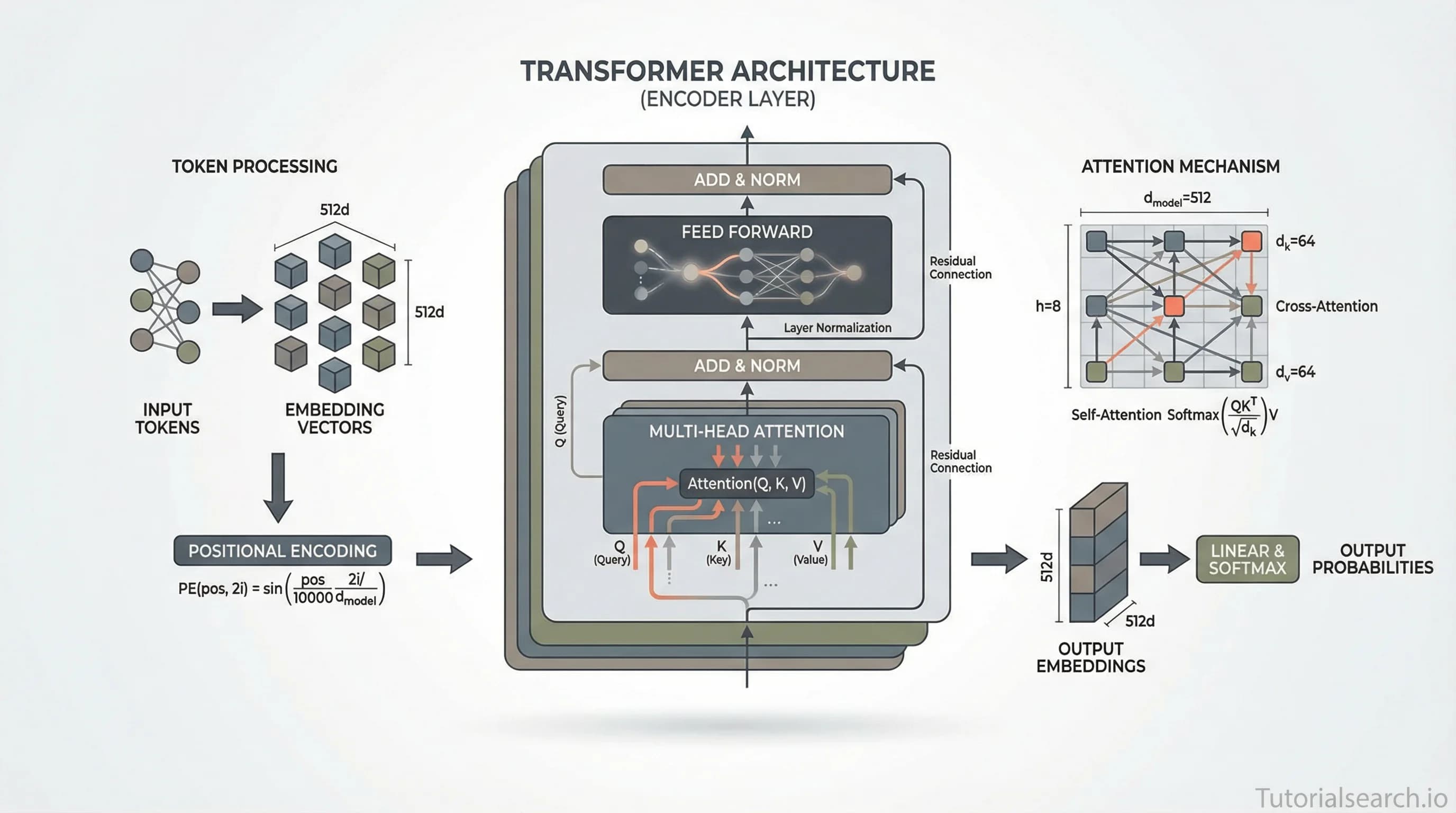
Then came the transformer. In "Attention Is All You Need," Google researchers introduced a fundamentally different approach using self-attention layers.
The key insight: instead of processing words one at a time, transformers analyze entire sentences simultaneously. Each word looks at every other word in the input, calculating relevance scores. This parallelization makes training faster and captures long-range dependencies that RNNs often miss.
Think of it like reading comprehension. When you read the sentence, "The bank executive walked into the bank vault," you understand that "bank" means something different in each case based on surrounding context. Transformers do exactly this through learned attention patterns.
Modern transformers power ChatGPT, Gemini, Claude, and Llama. Understanding their architecture is essential for anyone working with language models. You can explore this visually with the Transformer Explainer interactive tool, which shows how different attention heads focus on different word relationships.
The transformer architecture consists of two main components: the encoder and decoder. The encoder takes raw text input and transforms it into meaningful numerical representations. The decoder generates output by predicting the next word based on previous words and encoded context.
This dual-component design allows transformers to handle both understanding and generation tasks. The encoder captures the semantic meaning of input text. The decoder uses that understanding to generate relevant responses. Some modern models (like GPT) use only the decoder component, which is sufficient for generation tasks.
How Self-Attention Actually Works
Self-attention is not mystical, despite sounding like it. Here's the mechanism at a practical level.
For each word in a sequence, the model asks: "Which other words should I focus on?" The model calculates three matrices from the input: Query (Q), Key (K), and Value (V). These are learned parameters the model adjusts during training.
The attention score for word A focusing on word B equals: (Q_A · K_B) / √d, where d is the embedding dimension. This produces a score for every word pair. Higher scores mean stronger attention.
Next, these scores become weights through softmax normalization (forcing them to sum to 1). The model then multiplies these weights by the Value vectors, creating a context-aware representation for each word.
Multi-head attention extends this by running the process multiple times in parallel. One attention head might focus on syntax (subject-verb relationships), while another captures semantic meaning. This diversity improves translation accuracy, summarization quality, and fact recall.
Here's the contrast with older approaches: RNNs must process "The bank executive walked into the bank" word-by-word, remembering details about the first "bank" long enough to understand its meaning. Transformers process all words together, comparing "executive" and "vault" instantly to disambiguate "bank" in both locations.
The Illustrated Transformer by Jay Alammar is indispensable for learning. It includes animated visualizations showing how attention flows through real examples. Understanding this mechanism is crucial before diving deeper into language model architectures.
The mathematical foundation behind attention is deceptively simple: it's essentially a weighted sum. What makes it powerful is the learned parameters—the model learns what to weight heavily and what to ignore. Through billions of training examples, attention patterns become sophisticated enough to capture linguistic nuance.
Training Language Models From Scratch
Creating a language model involves two distinct phases: pretraining and fine-tuning.
Pretraining teaches the model basic language understanding. Researchers collect massive text datasets (web pages, books, code repositories, forums) and have the model predict the next word. The model adjusts its weights based on prediction errors, gradually learning patterns.
A surprising insight: models aren't trying to memorize text. They're learning statistical patterns. The model learns that "The quick brown fox" usually continues with "jumps," not because it memorized that sentence, but because statistical patterns in English make that prediction likely.
Pretraining requires enormous compute. A 7-billion parameter model might take weeks on 100+ GPUs. This is why most people use pretrained models rather than training from scratch. The computational barrier means that only well-funded organizations typically engage in large-scale pretraining.
Fine-tuning happens after pretraining. You start with a pretrained model and train it on a smaller, task-specific dataset. You're not teaching the model language from scratch—it already knows that. Instead, you're adjusting its style, focus, and behavior for your domain.
The contrast: fine-tuning improves accuracy by 2-4x compared to prompt design alone. If you're building a customer support bot, fine-tuning on your actual support transcripts produces dramatically better responses than generic models, even with carefully written prompts.
The OpenAI Fine-Tuning API and Unsloth documentation provide practical guides. You prepare training data with input-output pairs, upload it, and the API handles optimization.
The training process involves computing gradients—measuring how much each parameter should change to reduce prediction errors. Backpropagation distributes these gradient signals throughout the network. Larger models with billions of parameters require sophisticated optimization techniques like mixed-precision training to complete in reasonable time.
Temperature sampling during generation affects output quality. Higher temperature (closer to 1.0) produces more random, creative outputs. Lower temperature (closer to 0.0) produces more deterministic, conservative outputs. Understanding this tradeoff helps you fine-tune models for different use cases.
Fine-Tuning: Making Models Your Own
Fine-tuning is where language models become valuable for specific businesses. Generic models are good at general tasks. Your model is great at your exact needs.
Here's a concrete example: A legal firm fine-tunes a language model on contract documents and case law. The fine-tuned model learns legal vocabulary, clause structures, and precedent references. It drafts contracts faster than human lawyers and catches unusual clauses that generic models would miss.
Two types of fine-tuning exist:
Supervised Fine-Tuning (SFT) pairs inputs with correct outputs. You provide 100-1000 examples of tasks you want the model to handle. The model learns your exact format, tone, and quality standards.
Preference-based tuning (DPO, ORPO) uses examples where multiple outputs exist, ranked by quality. Instead of saying "this is correct," you say "this is better than that." This aligns model outputs with human judgment.
The practical obstacle: computational cost. Fine-tuning GPT-4 requires significant resources. However, fine-tuning open-source models like Llama 3 on consumer hardware is realistic.
A contrarian take: fine-tuning isn't always necessary. For simple tasks like text classification or straightforward generation, good prompting often suffices. Fine-tune when: (1) you have 500+ domain-specific examples, (2) accuracy improvements matter financially, or (3) you need consistent formatting or style.
Parameter-efficient fine-tuning techniques like LoRA (Low-Rank Adaptation) reduce computational requirements dramatically. Instead of updating all parameters, LoRA updates small adapter modules, reducing memory requirements by 90%. This makes fine-tuning practical for researchers and small companies.
Data quality matters more than data quantity in fine-tuning. Fifty high-quality, diverse examples often outperform 500 low-quality examples. Clean data without errors, consistent formatting, and representative task variety all contribute to better fine-tuned models.
Comparing Modern Language Models
Language models exist on a spectrum. Different models make different tradeoffs.
Closed-source models (GPT-4, Claude, Gemini) are powerful but require API calls and cloud infrastructure. You can't fine-tune them easily. They're hosted, so your data goes to third parties.
Open-source models (Llama, Qwen, DeepSeek) can run locally. You own the model and data. Fine-tuning is possible. However, they're typically smaller and less capable than closed-source equivalents.
Here's the nuance: 2024-2025 blurred this line. DeepSeek-V3 is an open-source model with 671 billion parameters that matches GPT-4o performance. Llama 3.3 70B achieves GPT-4 Turbo-level reasoning. Gemma 2 offers lightweight efficiency.
Mixture-of-Experts (MoE) models represent an emerging approach. Instead of activating all parameters for every input, these models have "expert" subnetworks. For each input, a routing mechanism activates only relevant experts. This allows massive parameters (1.2 trillion) while keeping computation reasonable.
The practical implication: you now have viable choices. Startups can deploy Llama locally, avoiding API costs. Researchers can fine-tune DeepSeek for novel applications. Enterprises can use GPT-4 for mission-critical tasks.
Model selection depends on your specific constraints. Cost-sensitive applications favor open-source models. Privacy-sensitive applications require local deployment. Real-time applications need models with acceptable latency. Choosing the right model means understanding these tradeoffs clearly.
Real-World NLP Applications
Want AI in your product? Hire the team behind TutorialSearch.io
LLM features, RAG, agents and automation wired into a real product — built by the devs who shipped this site.
Language models aren't theoretical. They power everyday tools that millions use.
Code generation is the most visible application. GitHub Copilot uses fine-tuned language models to suggest code completions. Developers describe their intent, and the model generates accurate implementations. Studies show this reduces development time significantly.
Customer service benefits from language understanding. Chatbots extract intent from customer messages, route to appropriate teams, and provide instant first-response answers. Email systems use NLP to filter spam with remarkable accuracy—it's one of the oldest NLP applications and still highly effective.
Content creation is evolving. Models can write initial drafts, suggest headlines, or expand bullet points into paragraphs. The key insight: they augment human writers, not replace them. Human judgment, fact-checking, and editing remain essential.
Real-time translation now works across 50+ languages. YouTube, Zoom, and Teams integrate automatic subtitles powered by language models. Quality isn't perfect, but it's usable.
Business analytics applies NLP to customer feedback. Companies analyze thousands of support tickets, reviews, and social posts to identify patterns. What are customers saying? What problems appear repeatedly? Models surface these insights at scale.
A personal anecdote: I spent two weeks manually reviewing customer feedback, identifying common complaints. A fine-tuned language model completed the same analysis in hours, categorizing issues with 90% accuracy. The model learned my categorization system from a few hundred labeled examples. That experience shifted my perspective on language models—from theoretical tools to practical productivity multipliers.
Building With Language Models
Starting a project with language models requires strategic decisions.
Choose your model: For beginners, use APIs (OpenAI, Claude, Gemini). For sensitive data or cost-sensitive applications, deploy open-source models locally. For enterprise reliability, use providers with SLAs and uptime guarantees.
Define your task clearly: Language models excel at text generation, classification, extraction, and Q&A. They struggle with pure math, recent events, and specialized knowledge. Match the task to the model's strengths.
Prepare evaluation metrics: How do you know if results are good? Define success before building. For customer support, measure response quality and escalation rates. For code generation, measure code correctness. For summaries, use human evaluation.
Implement prompt engineering: The way you phrase requests significantly impacts output quality. Provide context, specify format, give examples. This is learned through experimentation, not rules.
Plan for incremental improvement: Start with prompting. Measure results. Only fine-tune if performance is insufficient. Iterate based on metrics, not assumptions.
The Awesome-LLM GitHub repository curates frameworks, tools, and papers. It's an excellent reference as you build your systems.
The Future of Language Models
Language models continue evolving at remarkable speed. The 2026 frontier shows several clear directions.
Multimodal capabilities combine text, images, video, and audio. Models that understand context across formats will enable new applications. A single model analyzing documents, charts, and spoken feedback simultaneously is within reach.
Specialized models for specific domains (healthcare, law, finance) outperform general models on expert tasks. The trend is toward focused models rather than one model for everything.
Efficiency improvements make deployment cheaper and faster. MoE architectures, knowledge distillation, and quantization reduce model size without sacrificing capability. This democratizes language model deployment.
Reasoning improvements focus on longer, more complex thinking. Current models struggle with multi-step problems. Next-generation models will maintain focus across 10+ logical steps, enabling more sophisticated applications.
Integration with external tools like search engines, calculators, and databases addresses knowledge cutoff and computation limitations. Models that can query information dynamically will be more useful than models with static knowledge.
FAQ
What are AI Language Models used for?
AI language models generate text for applications including chatbots, content creation, code generation, translation, and customer support. They also power text classification, information extraction, and summarization. Essentially, any task involving natural language can benefit from language models.
How do AI Language Models work?
Language models predict the next word based on previous words. They learn patterns from training on billions of text examples. Modern models use transformer architecture with self-attention mechanisms that consider the entire context simultaneously, enabling them to generate coherent, contextually relevant responses.
What skills are needed for AI Language Models?
You need Python programming skills, familiarity with machine learning frameworks like TensorFlow or PyTorch, and understanding of natural language processing concepts. Linear algebra and calculus help with deeper theory. However, prompt engineering and fine-tuning can be learned without advanced math.
What's the difference between GPT and other AI Language Models?
GPT models (OpenAI) are known for large size and few-shot learning capability. Claude offers excellent reasoning and safety. Gemini integrates vision and text. Llama provides open-source alternatives. Each optimizes for different performance dimensions. Choice depends on your specific requirements.
Are AI Language Models replacing writers?
No. Language models are tools for augmentation, not replacement. They accelerate drafting and editing. Human writers provide creativity, fact-checking, critical thinking, and judgment. The future involves humans and models collaborating effectively.
How do I fine-tune a language model?
Start with a pretrained model. Collect 500-1000 domain-specific examples of inputs and outputs. Format them consistently. Use an API (OpenAI, Hugging Face) or local framework (Unsloth, LoRA). Train for a few epochs. Evaluate on your task metrics. Iterate based on results.
Related Topics to Explore
Deepen your understanding of AI and machine learning through these related areas:
- Generative AI - Explore systems that create new content from learned patterns
- AI Assistance - Learn how AI augments human work across domains
- AI Learning - Master the fundamentals of AI training and optimization
- AI Agents - Discover autonomous systems that act in complex environments
- Applied AI - See practical implementations across industries
Recommended Courses
Large Language Models (LLMs) Fundamentals by Mayfair Real Estate Institute covers core concepts including model architecture, training paradigms, and deployment considerations. With a 4.47 rating and 495 student reviews, this course strikes balance between theory and practice. It's ideal for learners who want solid foundations before specializing.
AI Language Models and Foundation Models from Pluralsight provides intermediate-level insight into foundation models and their applications. At 4.2 rating, it assumes some background but delivers comprehensive coverage of enterprise deployments.
LLM Mastery: ChatGPT, Gemini, Claude, Llama3, OpenAI & APIs offers hands-on experience with multiple production models. The 4.64 rating reflects its practical focus on building real applications.
Create a Text Generator in PyTorch From Scratch by Tom Keohane Murray teaches implementation details. At 4.62 rating and free, it's excellent for hands-on learners who want to understand transformers deeply.
LLM Testing Masterclass: Software QA for AI Language Models addresses a critical gap: testing language models. Quality assurance for LLMs is distinct from traditional software testing, and this course covers that specialized knowledge.
Unlocking the Power of ChatGPT 3.5 and 4: The Ultimate Guide by Kingsley Okai focuses on practical ChatGPT usage. With 4.29 rating and 2000+ students, it demonstrates demand for applied ChatGPT skills.
AI Masterclass: Prompt Engineering Fundamentals teaches the most immediately applicable skill. Before fine-tuning or deep learning, master prompt design. This course has 4.69 rating, reflecting community appreciation for practical fundamentals.
External Resources for Deeper Learning
The official transformer paper remains essential reading: "Attention Is All You Need" established the architecture foundations.
For visual learners: The Illustrated Transformer and Transformer Explainer provide animated walkthroughs of attention mechanisms.
Comprehensive learning paths appear in Dive Into Deep Learning which covers attention and transformers with code examples.
Open-source model repositories: Awesome-LLM and open-llms curate papers, frameworks, and models.
For practical deployment: Ollama runs open-source models locally. HuggingFace provides model hosting and the Transformers library.
Authoritative guides: IBM's Transformer Overview, DataCamp's How Transformers Work, and Microsoft Azure NLP Architecture Guide provide framework-specific details.
Last Updated: March 2026
Language models evolve monthly. Check the AI category for the latest courses and resources.