The German Fluency Guide I Wish Existed When I Started
German fluency takes more than a language app. Discover the best courses, free tools, YouTube channels, and communities to take your German from beginner to C1.
Hire the developers behind TutorialSearch.io
We built this site — full-stack web apps, AI integration & automation. Tell us what you need and we'll build yours.
German fluency is the goal everyone announces and the milestone few actually reach — not because German is impossibly hard, but because most people spend years on the wrong things first. If you've been cycling through apps and beginner lessons for months with your German still frozen at "Wo ist der Bahnhof?", this guide is for you. Browse our full German fluency course collection and you'll see just how many structured options exist — the challenge is knowing which ones are worth your time.
Here's what this guide covers: the best structured courses, the free tools that hold up, the YouTube channels worth subscribing to, GitHub-curated resources, books for deep learners, and communities where you can actually practice. Updated for 2026.
Lucia Moretti here. I've studied eight languages and consulted on curriculum design for language learning platforms. The single biggest mistake I see German learners make is treating fluency like a destination you arrive at once — when it's actually a threshold you cross gradually, then suddenly.
Key Takeaways
- German fluency (C1/C2 level) typically takes 700–900 hours of active, focused study to reach
- German fluency accelerates when you combine structured courses with daily listening and real speaking practice
- Free resources like DW Learn German and the Goethe-Institut cover A1 through C1 without spending anything
- The biggest German fluency mistake is drilling grammar in isolation — comprehensible input builds fluency faster
In This Article
- What German Fluency Actually Means
- The German Fluency Courses I'd Actually Recommend
- Free German Resources That Genuinely Deliver
- German YouTube Channels Worth Your Subscription
- GitHub Repos for Serious German Learners
- Books That Actually Move the Needle on German Fluency
- Where to Practice German with Real People
- Related German Language Skills Worth Exploring
- FAQ
What German Fluency Actually Means (and Why Most Learners Aim Wrong)
Most learners describe their goal as "speaking German" but can't define what that looks like in practice. That ambiguity is the first obstacle — and fixing it changes everything about how you study.
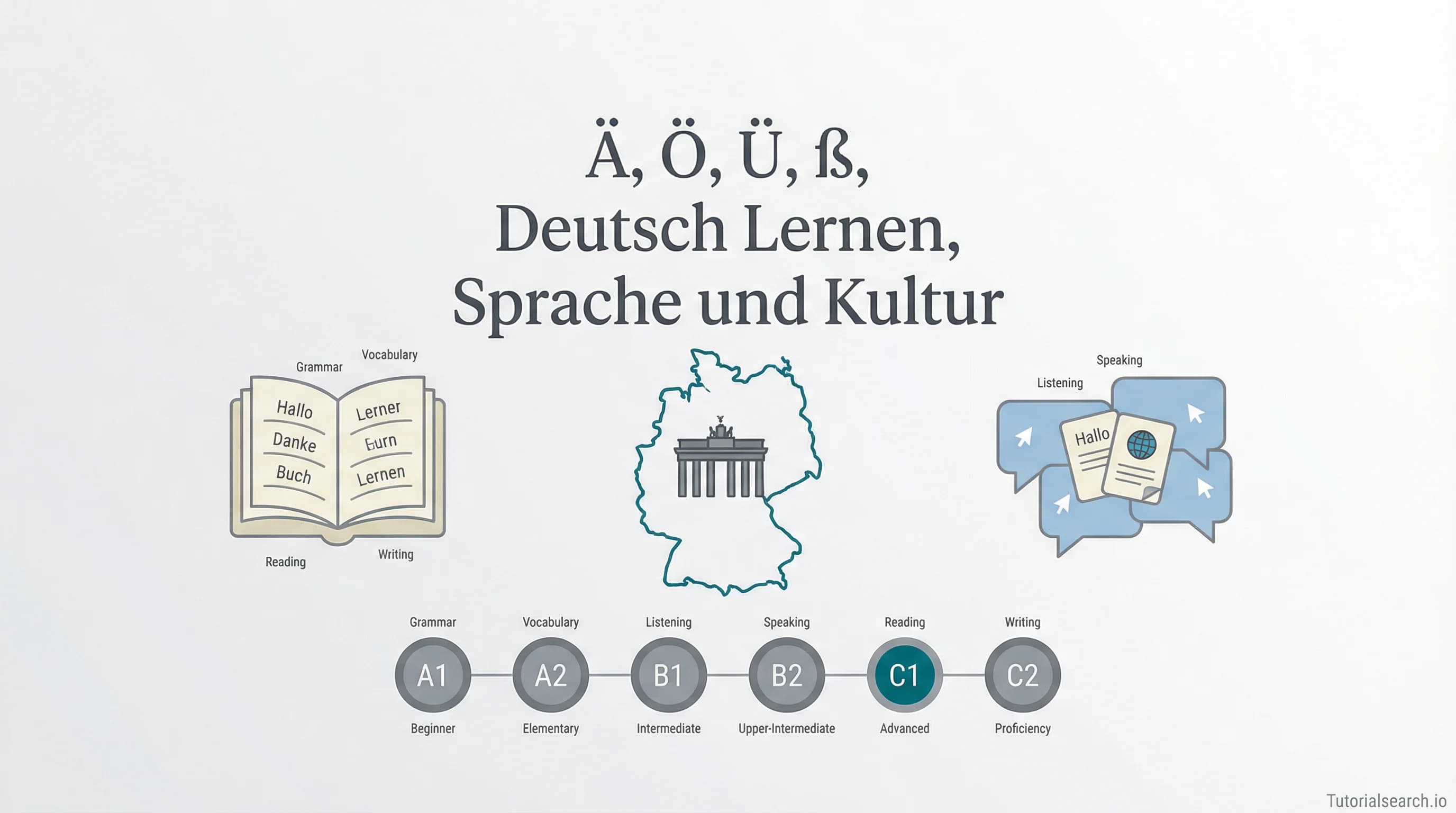
Real German fluency maps to C1/C2 on the Common European Framework of Reference for Languages (CEFR). At C1, you can read German novels, follow native-speed podcasts, and hold professional conversations without significant gaps. C2 is near-native mastery — navigating regional dialects, using idioms naturally, writing without a dictionary open. Most people who describe themselves as "intermediate" are somewhere between A2 and B1: functional in controlled settings, not yet fluent.
Here's the honest level-by-level breakdown:
| CEFR Level | What You Can Actually Do | Approximate Study Hours |
|---|---|---|
| A1–A2 (Beginner) | Greetings, simple questions, basic shopping | 150–250 hours |
| B1–B2 (Intermediate) | Travel conversations, work emails, TV with subtitles | 400–600 hours |
| C1 (Fluent) | Native media, professional use, nuanced discussion | 700–900 hours |
| C2 (Mastery) | Near-native across all contexts, idiomatic expression | 1,000+ hours |
Here's the contrarian take most guides won't give you: the conventional approach to German learning is backwards. Most curricula front-load grammar rules — cases, verb conjugations, adjective endings — before you've built any feel for the language. The research on second language acquisition is fairly clear on this: comprehensible input (listening to and reading German you can mostly understand) is how fluency actually develops. Grammar is the map; immersion is the territory. Learn enough structure to function, then flood yourself with German and let your brain do the pattern-matching it evolved to do.
The German Fluency Courses I'd Actually Recommend
There are hundreds of German courses online. Most are fine. A handful are genuinely excellent. Here's where I'd put someone who's serious about reaching fluency.
1. The Complete German Course | Start Speaking German Today! (Udemy)
[Editors' Choice] Language Studio's flagship course has over 34,000 enrolled students and a 4.65-star average — and it earns both numbers. What sets it apart isn't just breadth. The course pushes you toward active speaking from the first lesson rather than warehousing grammar rules you'll rarely use. It covers A1 through solid B2 territory, with practical vocabulary woven into every section. If you're starting from zero or want a complete structural reset, this is the one I'd recommend first. The listening comprehension exercises are better than most competitors at this price point.
2. 3 Minute German — Course 1 (Udemy)
[Editors' Choice] Kieran Ball's 3-minute method sounds like a marketing gimmick. It isn't. With 14,080 students and a 4.81-star rating, this is the most beginner-friendly German course I've seen — and "beginner-friendly" isn't a backhanded compliment here. Kieran has a gift for explaining why German grammar works the way it does, which prevents the bewilderment that kills motivation at A1. The short sessions remove every excuse not to show up daily. Start here if the idea of a German textbook makes you want to close the tab.
3. Learn German Language: Complete German Course — Intermediate (Udemy)
[Editors' Choice] This is where I'd send anyone who's done the basics and wants to push toward B1/B2. Instruction comes from a native speaker, the rating sits at 4.58, and the curriculum links grammar, vocabulary, and listening comprehension together rather than treating them as separate subjects. The PDF resources packaged with each lesson are a useful bonus — great for review without re-watching. Pairs naturally with the beginner course from the same series.
Free German Resources That Genuinely Deliver
Paid courses accelerate. Free resources keep you immersed every day. These are the ones that hold up under scrutiny.
DW Learn German (Website)
Deutsche Welle's learn-German platform is the best free German resource on the internet. Full stop. Their "Nicos Weg" series follows a single storyline from A1 to B1, with video lessons, interactive exercises, and vocabulary practice built around genuine comprehensible input. The A2 and B1 content is where it really shines — this is the level where most learners stall, and DW handles it thoughtfully. No account required for most content.
Goethe-Institut Free Practice (Website)
The Goethe-Institut is the global authority on German language certification. Their free practice materials are genuinely high quality — apps, podcasts, vocabulary exercises, and reading content organized by CEFR level from A1 to C2. If you're preparing for a Goethe certificate (widely recognized by employers), start here before spending on test prep materials.
DeutschAkademie Online Course (Website)
A full online German course built by experienced teachers — completely free. The grammar explanations are systematic and clear, which makes DeutschAkademie useful as a reference tool even alongside a paid course. Good for filling gaps when something in your main course doesn't click.
deutsch.info (Website)
Four complete courses — A1, A2, B1, and B2 — with audio-visual materials and interactive exercises. Deutsch.info is underrated in most resource lists. The interface is clean, the audio quality is solid, and the progression feels natural rather than artificially paced. Worth bookmarking early and returning to regularly.
Lingolia German Grammar (Website)
Lingolia is the reference grammar site I keep open in a browser tab throughout any German study session. Every German grammar topic from A1 to C2, with clear explanations and practice exercises. Not a course — treat it like the index you flip to when something doesn't make sense. Especially useful for cases and complex verb tenses.
Duolingo German (App/Website)
The controversial entry. Duolingo alone won't get you to fluency — the research on this is fairly unambiguous. But as a daily habit-builder and vocabulary review tool at A1–A2 level, it does exactly what it says. Use it as a warm-up, not a strategy.
For a structured vocabulary-focused supplement, the German Vocabulary Course on TutorialSearch is free to access and covers core vocabulary with a systematic approach.
German YouTube Channels Worth Your Subscription
Hire the developers behind TutorialSearch.io
We built this site — full-stack web apps, AI integration & automation. Tell us what you need and we'll build yours.
Video immersion is one of the highest-leverage habits for building German fluency. These channels are consistently worth returning to across multiple levels.
Easy German (YouTube)
2.82 million subscribers, 1,500+ videos, and the most important free German immersion resource available. The format — interviewing people on the streets of German cities, with dual German/English subtitles — exposes you to multiple accents, real speaking speeds, and natural slang that no textbook can replicate. The "Super Easy German" playlist is the right entry point for beginners. Once you hit A2/B1, the main channel content starts to really click.
DW Learn German on YouTube (YouTube)
DW's YouTube channel delivers structured German instruction that pairs seamlessly with their website content. The "Nicos Weg" video series, grammar explainers, and news-based content for advanced learners make this channel useful at every stage from A1 to C1. For B2 and above, the professionally produced news-format German is excellent exposure to formal register.
Deutsch für Euch (YouTube)
Katja's channel is genuinely fun — and that matters more than people admit, because the content you actually watch is worth more than the content you theoretically should watch. She covers everything from absolute beginner to C1 territory, with humor and a conversational teaching style. Her idiomatic expression content is particularly good for learners who want to sound less textbook-y.
Learn German with Anja (YouTube)
Anja's playlists are organized by level, so you can follow a structured progression rather than watching randomly. Her pronunciation guidance is among the clearest available on YouTube, and her grammar breakdowns hit the right level of detail for beginners and early intermediates. Good for learners who prefer a classroom-like approach to immersion.
Get Germanized (YouTube)
More irreverent than the others. Get Germanized mixes German culture, slang, and language lessons in a way that feels less like studying and more like hanging out with a German friend who finds everything mildly amusing. Their "German words English desperately needs" series is the right entry point. Best for B1+ learners who want exposure to contemporary German without flashcard energy.
Search for video-based structured courses to run alongside these channels: browse German courses on TutorialSearch.
GitHub Repos for Serious German Learners
These aren't coding repositories — they're community-curated collections of German learning resources, organized by type and skill area. The kind of lists only dedicated language learners maintain.
awesome-german/vocabulary (GitHub)
The most organized public repo for German vocabulary resources. Covers dictionaries, apps, frequency word lists, websites, and context-based tools — all organized by topic and use case. If you're at the stage where expanding vocabulary is the main bottleneck (usually B1 and above), start here before spending on another app.
awesome-german/reading (GitHub)
Graded reading materials, articles, short stories, and comprehension resources, curated by level. Reading in German is one of the fastest ways to build vocabulary and listening comprehension simultaneously — and finding the right difficulty level is the hard part. This repo makes that process significantly easier.
willianpaixao/awesome-german (GitHub)
The original community-curated list for learning and practicing German as a foreign language. Broader in scope than the others — covers apps, websites, courses, communities, and tools in one place. Good for mapping the full German learning landscape when you're deciding how to structure your approach.
Books That Actually Move the Needle on German Fluency
Most German learners underuse books. That's a mistake — especially at B2 and above, where structured reference material becomes essential and apps start running out of depth.
Language Hacking German by Benny Lewis
Benny Lewis's approach centers on speaking from day one, which makes this a useful counterweight to grammar-heavy study plans. Each chapter focuses on practical conversations — introductions, directions, daily life — and pushes you to produce language rather than just recognize it. Good for beginners who want a communicative approach from the start, and for any learner whose study has been mostly passive.
Hammer's German Grammar and Usage by Martin Durrell
This is the reference grammar. Dense, comprehensive, and not a pleasure read — but if you're serious about German fluency, Hammer's is the resource you return to at every stage. Advanced learners regularly describe it as the book that finally explained things they'd been doing wrong for years. Get the digital edition so you can search it quickly. For video-based coverage of the same advanced grammar territory, this upper-intermediate course covers similar ground with live instructor explanation.
Café in Berlin by André Klein
André Klein's short story series is written specifically for German learners at A2–B1 level. "Café in Berlin" follows a young man navigating daily life in Germany's capital, with vocabulary support integrated into the text. Reading German fiction — even simplified fiction — does things for fluency that grammar drills simply can't replicate. The plot is engaging enough that it doesn't feel like homework. Klein has written several more books in the same series, all worth working through.
Where to Practice German with Real People
All the courses and resources in the world can't substitute for actual conversation. Here's where to find it.
r/German (Reddit)
One of the largest and most active German learning communities online. Particularly good for grammar questions — native speakers and advanced learners regularly provide detailed, accurate answers. The community wiki is full of curated resources. If you have a specific usage or grammar question your courses haven't answered clearly, post it here.
German Learning and Discussion Discord (Discord)
Over 218,000 members, organized voice and text channels, scheduled conversation events, and native speakers willing to correct your German in real time. If you want to practice speaking and can't yet commit to paid conversation sessions, this Discord is the best free alternative. The community is genuinely helpful at every level, including absolute beginners.
Related German Language Skills Worth Exploring
If German fluency interests you, these areas pair well with your studies:
- Language Learning — Methods, systems, and the science behind learning any language more efficiently
- French Learning — The other dominant European language, sharing some structural overlap with German
- Spanish Fluency — A fluency-focused track with strong methodological parallels
- Korean Language — For learners who enjoy navigating a very different linguistic structure
FAQ
How long does it take to learn German Fluency?
Most learners reach conversational fluency (B2) in about 18 months to 3 years with consistent daily study. True C1 fluency — where you can use German professionally and comfortably in complex situations — typically takes 700 to 900 hours of active study and immersion. With two hours of focused practice daily plus passive listening, 3 years to C1 is a realistic target. Browse German fluency courses by level to find the right starting point for where you are now.
Do I need to know another language to learn German Fluency?
No prior language experience is required. German is often rated as moderately difficult for English speakers — harder than Spanish or French, easier than Mandarin or Arabic. English speakers have one underappreciated advantage: roughly 30% of German vocabulary has English cognates. Words like "Haus" (house), "Wasser" (water), and "Buch" (book) are recognizable immediately. If you already speak Dutch or a Scandinavian language, you'll find German even more accessible.
Can I get a job with German Fluency skills?
Yes — significantly so. German fluency is one of the highest-value language skills in the European and global job market. Engineering, finance, translation, international relations, and tourism all actively seek German-fluent professionals. Germany, Austria, and Switzerland together represent a substantial share of European economic output, and companies operating in those markets often struggle to find German-fluent talent outside the German-speaking world. B2 is typically the minimum employers specify; C1 is strongly preferred.
What level demonstrates German Fluency?
C1 is the professional standard for German fluency. At C1, you can read newspapers and literary texts, follow rapid native speech, and express yourself spontaneously and precisely. C2 indicates near-native mastery. Most job listings that specify German fluency are looking for B2 minimum and C1 preferred.
What are the biggest mistakes German learners make?
Three stand out consistently. First: over-relying on a single app without adding listening or speaking practice — habit-building apps build streaks, not fluency. Second: drilling grammar rules without using them in real sentences — understanding a rule and being able to use it at conversation speed are very different skills. Third: avoiding speaking until their German feels "ready." It never does, and the speaking practice is exactly what makes it ready. The learners who progress fastest are the ones making mistakes in real German conversations early and often.