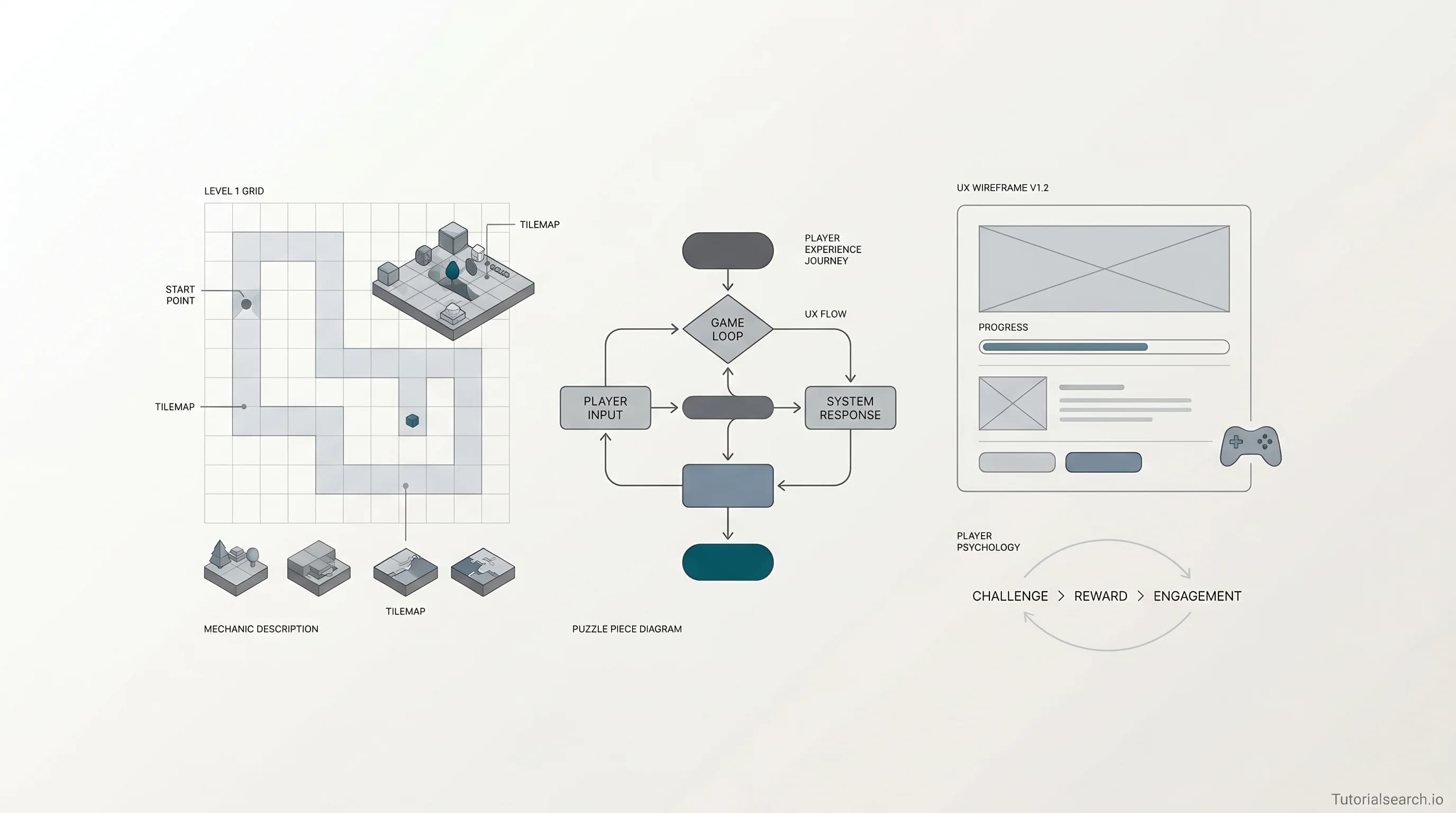
Game Design Skills That Actually Get You Hired
A practitioner's guide to game design in 2026 — covering the courses, free resources, YouTube channels, GitHub repos, and books that build real player-experience thinking.
Hire the developers behind TutorialSearch.io
We built this site — full-stack web apps, AI integration & automation. Tell us what you need and we'll build yours.
Most people learning game design spend months studying mechanics before they've ever asked the one question that actually matters: what do you want the player to feel? That's the core of game design in 2026 — not engines, not code, not tools — but the deliberate craft of shaping experience.
If you've been circling this field and wondering where to actually dig in, this is the game design resource guide you need. It covers the best courses, free resources, YouTube channels, GitHub repos, books, and communities — organized around how professional designers actually think.
Key Takeaways
- Game design is the discipline of crafting player experience — not the same as game development or programming.
- The most important game design skill is understanding player psychology and what motivates engagement.
- You can start learning game design in 2026 with entirely free resources before committing to paid courses.
- A strong game design portfolio matters far more than formal credentials when landing your first role.
- Studying great games critically — not just playing them — accelerates game design learning faster than almost anything else.
In This Article
- Game Design Courses Worth Your Time
- Free Game Design Resources That Hold Up
- The YouTube Channels I Keep Coming Back To
- GitHub Repos Every Game Designer Should Know
- The Honest Comparison: Self-Taught vs. Structured Learning
- Books That Actually Changed How I Think About Game Design
- Game Design Communities Where Real Learning Happens
- Related Game Design Skills Worth Exploring
- FAQ
Game Design Courses Worth Your Time
The honest truth about game design courses: most of them teach you tools, not thinking. The ones worth recommending teach you why players stay engaged — and then show you how to build that intentionally.
Here's what I'd actually enroll in:
Game Design Essentials: Tools, Theories and Techniques (Udemy) — [Editors' Choice] This is the most complete game design theory course I've seen at this price point. Gabriel Chauri walks you through design thinking, player psychology, systems modeling with Google Sheets, and even how to build a card game prototype from scratch. Over 4,200 students and 468 reviews. What makes it stand out is that it teaches how designers think, not just what tools they use. You finish with a card game and a mental framework that applies to any genre.
The Psychology of Games: Secrets of Good Game Design (Udemy) — [Editors' Choice] Nearly 7,000 students and 1,278 reviews. This course focuses entirely on the psychological mechanisms behind compelling gameplay — flow states, intrinsic motivation, retention loops. No programming required. If you've ever wondered why some games are impossible to put down and others feel flat after ten minutes, this is the course that answers that question directly.
Practical Game Design: A Masterclass with Pascal Luban (Udemy) — [Editors' Choice] Pascal Luban has shipped AAA titles and designed for major studios. This isn't theory — it's a practitioner teaching from real production experience. If you're past the beginner phase and want to understand how design decisions get made under actual constraints, this is the course that bridges academic game design with professional practice.
Unreal Engine: Intro to Game Design (Skillshare) — Greg Wondra's course is the best entry point if you want to learn game design inside a professional engine. Over 7,000 students on Skillshare. It covers level design, environment storytelling, and spatial reasoning — all through Unreal Engine's toolset.
Write a Professional Game Design Document (GDD) (Udemy) — Game Design Documents are how designers communicate with the rest of the team. This course teaches you to write one that people will actually read and use. Over 1,200 students, practical focus.
Browse the full game design course library for more options across platforms.
Free Game Design Resources That Hold Up
Paid courses aren't where most game designers start. Here's what's actually worth your time before you spend a dollar:
Unity Learn — Unity's own learning platform is genuinely free, not freemium. The Unity Essentials pathway walks you through the engine in a structured way, and the Junior Programmer path goes deeper. The game design documentation tutorial is particularly good for understanding how to translate design ideas into a structured format.
Unreal Online Learning — Epic's free learning hub for Unreal Engine 5. Covers everything from Blueprints (UE's visual scripting) to level design fundamentals and game systems. Genuinely production-quality content, free.
Harvard CS50's Introduction to Game Development — Free to audit, with a certificate option. Taught at Harvard, covers game development in Lua, C#, and Unity. It's one of the few free resources that treats game design with the same rigor as a computer science course. Demanding, but worth it if you're serious.
GameDev Academy (gamedevacademy.org) — Free tutorials on game design fundamentals, including how to write a Game Design Document, design core loops, and approach level design. Good for dipping in topic by topic rather than committing to a full course.
Nuclino Game Design Document Guide — An extremely practical guide to GDDs with real templates. If you're planning your first game, this is the fastest way to get a working document structure without overcomplicating it.
Game Design Skills (gamedesignskills.com) — A content site with free articles on game design theory, career paths, and tools. The level design and player psychology articles are particularly solid.
Class Central Game Development — Aggregates 5,600+ game development courses from platforms like Coursera, edX, and FutureLearn. Good for finding free auditable courses from universities you'd otherwise never access.
The YouTube Channels I Keep Coming Back To
Video content on game design ranges from genuinely analytical to "let me show you this Unity trick." Here's the signal vs. noise breakdown:
Game Maker's Toolkit — Mark Brown is the best game design analyst working in video format. His videos dissect why specific design decisions work — from Celeste's assist mode to how Dark Souls teaches through failure. The "Developing" series documents him building his own game and is honestly one of the best public records of how messy real design is. Start with his "Boss Keys" series on Zelda dungeon design.
Extra Credits — Covers game design theory, industry analysis, and game history. The "Making Your First Game" playlist is a practical intro to the emotional and practical realities of game development. Weekly episodes, accessible to beginners.
GDquest — Nathan Lovato's channel mixes Godot tutorials with game design thinking. If you're interested in open-source game development with rigorous design principles, GDquest is essential. Very practical, less theoretical than GMTK.
Brackeys — The classic beginner Unity channel. Brackeys' "How to Make a Video Game" series is still one of the clearest introductions to game development basics. Friendly, structured, good for understanding how design ideas translate into actual implementation.
Search for more game design video courses on TutorialSearch for structured, instructor-led alternatives to YouTube.
GitHub Repos Every Game Designer Should Know
Hire the developers behind TutorialSearch.io
We built this site — full-stack web apps, AI integration & automation. Tell us what you need and we'll build yours.
You don't have to be a developer to benefit from these. The design-focused repos are genuinely useful reference material:
awesome-game-design by Roobyx — A curated list specifically for game designers. Covers narrative design tools like Twine and Yarn Spinner, design pattern libraries, postmortem analyses, and theory resources. If you bookmark one design GitHub repo, make it this one.
awesome-learn-gamedev by dawdle-deer — Organized by role (designer, programmer, artist, audio), this repo aims to develop your problem-solving skills rather than just show you how to solve specific problems. The game design section links to resources you won't find on the first page of Google.
Awesome-Gamedev by FronkonGames — Broad scope covering worldbuilding, game economy and balance, monetization guides, and game mechanics reference. Useful as a research tool when you're designing specific systems.
GameDev-Resources by Kavex — A broad list covering engines, assets, tools, audio, art, and design resources. Less curated than the others but useful for discovering tools you didn't know existed.
The Honest Comparison: Self-Taught vs. Structured Learning
Most game design articles avoid saying this directly: there's no certification that makes you a game designer. Studios hire portfolios. Period.
| Path | Time to First Portfolio Piece | Cost | Weaknesses |
|---|---|---|---|
| Self-taught (books + free resources) | 3-6 months | ~$0-50 | Gaps in theory, no feedback loop |
| Online courses (Udemy/Skillshare) | 2-4 months | $15-200 | Quality varies wildly |
| University degree | 3-4 years | $40,000-150,000 | Often behind industry practice |
| Game jam participation | 48-72 hours per jam | $0 | Steep first-time learning curve |
The fastest path to employable skills isn't a degree or a single course — it's participating in game jams (itch.io lists hundreds of upcoming jams), shipping something small, and getting real feedback. A shipped game, however small, is worth ten certificates.
The contrarian opinion worth saying: most game design courses spend too much time on Game Design Documents. A GDD is useful for large teams. If you're making indie games solo or in a small team, a one-page concept and a working prototype will teach you more than six weeks of documentation theory.
Books That Actually Changed How I Think About Game Design
The Art of Game Design: A Book of Lenses by Jesse Schell — This is the foundational text. Schell organizes the entire discipline around "lenses" — different analytical perspectives for examining game design decisions. It's not a how-to manual; it's a way of thinking. Read it once to learn it, then keep it as a reference you return to when you're stuck on a design problem.
Level Up! The Guide to Great Video Game Design by Scott Rogers — More practical and less philosophical than Schell's book. Rogers covers level design, character design, storytelling, boss battles, and UI with a sense of humor. Widely recommended as the first game design book to read, precisely because it doesn't assume you already think like a designer.
Game Design Workshop by Tracy Fullerton — Used in university game design programs. Strong emphasis on playtesting and iteration — the process of designing, not just the theory. The exercises are practical enough to work through solo.
Game Design Communities Where Real Learning Happens
/r/gamedesign on Reddit — A dedicated subreddit for game design theory and practice. Different from /r/gamedev (which skews technical). Good for posting design questions, getting feedback on mechanics, and following industry discussions. Active and generally beginner-friendly.
Funsmith Club on Discord — A game design-focused Discord with regular peer playtesting sessions, portfolio feedback, and structured discussions about design theory. One of the few Discord servers specifically for designers rather than developers.
Game Dev Network on Discord (discord.gg/gamedev) — 38,000+ members across all skill levels. The game design channels are active and welcoming to beginners figuring out their first project.
Related Game Design Skills Worth Exploring
If game design interests you, these related disciplines pair naturally with it:
- 2D Game Dev courses — Learning to build 2D games gives you direct feedback on your design decisions. Nothing teaches you whether a mechanic works like implementing it and playing it.
- Game Systems design — The discipline of designing interconnected rules, economies, and progression structures. Where game design gets mathematical.
- Game Development Basics — If you want to implement your designs yourself, this is the foundation.
- General Game Development — Broader context for how design fits into the full production pipeline.
FAQ
How long does it take to learn game design?
You can understand the fundamentals of game design in 2-3 months of consistent study. Getting to a point where you can design a small, complete, and playable game takes closer to 6-12 months for most people. Professional-level design thinking — where you can predict how players will respond to design choices before playtesting — takes years of shipped projects and critical analysis.
Do I need to know how to code to learn game design?
No. Game design is a separate discipline from game programming. Many professional game designers don't write code. That said, understanding how mechanics are implemented — even at a basic level — makes you a better designer because you understand the constraints your engineers work within. Tools like Buildbox let you build functional games without coding, which is useful for prototyping game design ideas quickly.
Do I need a degree for game design?
Degrees aren't required, but they're not irrelevant either. A strong portfolio of shipped games matters more than any credential at most studios. For indie development or smaller studios, what you've built and what you understand about player experience is the only thing that matters.
What tools are used in game design?
Game designers use a wide range — from engine tools like Unity and Unreal for implementation, to prototyping tools like Figma and pen-and-paper for early concepts, to documentation tools like Notion and Google Docs for GDDs. The Unreal Engine Intro to Game Design course covers tooling inside a professional engine context.
Can I get a job with game design skills?
Yes — but the path looks different from most fields. Entry-level game design roles are rare. Most designers start as QA testers, game writers, or junior developers and transition into design. Building a portfolio of shipped games (even small jam games) and demonstrating that you understand player experience is the clearest route in.
What is the role of a game designer?
A game designer defines the rules, mechanics, and structure of a game — the what of the experience, as opposed to the how (which is the developer's domain). In practice this means prototyping systems, writing design documentation, playtesting obsessively, and iterating based on how players actually respond rather than how you expected them to.