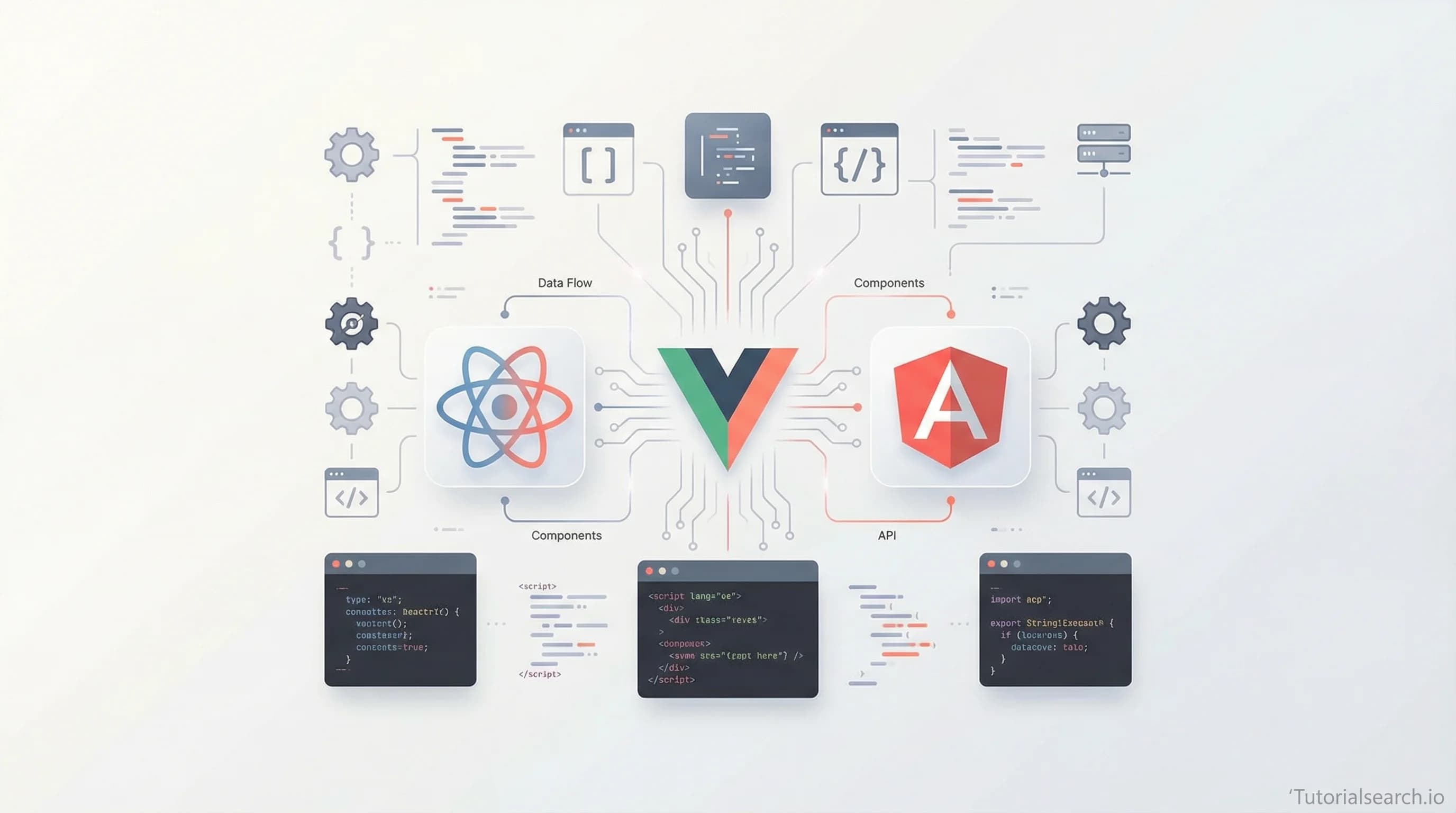
Front-End Frameworks I'd Recommend to a Friend
Cut through the React vs. Vue vs. Angular debate with an honest guide to picking your first front-end framework — plus the courses, free resources, and tools that actually teach you something.
Need a web app built? Hire the team behind TutorialSearch.io
We ship fast, production-grade full-stack apps (Next.js, React, edge infra) — the same stack that powers this site.
Front-end frameworks are easy to get wrong before you even start. Not by picking React over Vue — but by spending weeks comparing them instead of building.
I've seen this pattern play out constantly. Someone decides to learn front-end development, discovers there are three major frameworks to consider, and then spends a month reading comparison articles. They end up knowing more about framework benchmarks than actual JavaScript.
This guide skips that trap. With over 529 front-end framework courses on TutorialSearch.io, there's no shortage of quality learning material. What's harder to find is a clear answer to the actual question: which one should you learn, and what should you use to learn it?
Key Takeaways
- React, Vue, and Angular all lead to the same destination — pick based on your goal, not the hype cycle.
- Vue has the gentlest learning curve for anyone new to front-end frameworks.
- React dominates job listings, making it the safest choice if employment is your goal.
- Angular is the strongest option for enterprise environments and TypeScript-first workflows.
- You can get genuinely far with free resources — the official docs for all three frameworks are excellent.
In This Article
- Picking Your Front-End Framework Path
- Front-End Framework Courses That Actually Teach You Something
- Free Front-End Framework Resources Worth Bookmarking
- Front-End Framework GitHub Repos Worth Starring
- The Front-End Framework YouTube Channels I Keep Coming Back To
- Front-End Framework Books for When You Want to Go Deep
- Front-End Framework Communities Where Developers Actually Help
- Related Front-End Skills Worth Exploring
- Frequently Asked Questions About Front-End Frameworks
Picking Your Front-End Framework Path
Before you open a single course, make one decision: which framework fits your goal?
Choose React if:
- You want the best job market odds. React is used by 44.7% of developers according to the 2025 Stack Overflow survey — far ahead of Vue and Angular.
- You're building web apps that might also need a mobile companion. React Native uses the same mental model, so the skills transfer.
- You want the largest ecosystem of third-party libraries, tutorials, and Stack Overflow answers.
Choose Vue if:
- You're new to frameworks and want the gentlest start. Vue's template syntax feels closest to plain HTML, which makes the jump less jarring.
- You're working on a mid-sized project that doesn't need Angular's full weight.
- You care about documentation quality. Vue's official docs are a benchmark for the industry. If front-end development is new territory, Vue's docs will explain things other frameworks assume you already know.
Choose Angular if:
- You're targeting enterprise environments. Banks, large internal tools teams, and government software tend to use Angular.
- You already know TypeScript, or you're comfortable with a structured, opinionated workflow.
- You want everything included by default: routing, forms, HTTP, state management. With React, you assemble these pieces yourself. With Angular, they come in the box.
One honest take worth sharing: the common advice is to learn React because it wins the job numbers game. That's true for job hunters. But for someone building their first front-end project, Vue's learning curve is noticeably gentler. The productivity difference in your first two months is real. If you're heading toward full-stack development, React is the safer long-term bet — but Vue will get you building something real faster.
If You Only Pick One:
| Your Goal | Framework to Start |
|---|---|
| Getting hired at most companies | React |
| Learning your first framework | Vue |
| Enterprise or large-scale apps | Angular |
| Side projects and indie development | Vue or React |
| TypeScript-first from day one | Angular |
Front-End Framework Courses That Actually Teach You Something
Structured courses take you further faster than bouncing between documentation pages. These are the ones worth your time — organized by framework.
Vue.js Courses
1. Vue.js for Beginners: Up and Running with Vue (Udemy, Free) [Editors' Choice]
Dan Vega's course is one of the rare free options that actually earns the "beginner-friendly" label. It covers Vue 3 foundations — reactivity, components, props, events — without assuming you already know another framework. Over 8,000 students have taken it, and the 4.7 rating reflects consistent quality. Start here if you've chosen Vue.
2. Vue Masterclass (Covers Vue 2 and 3) (Udemy, Paid)
Rated 4.8 with nearly 7,000 students — this is the most polished Vue course in this list. The dual-version coverage matters more than it sounds: many companies still run Vue 2 codebases, and seeing both versions side by side clarifies why Vue 3 changed what it changed. Covers Vuex, Vue Router, and real project structure.
3. Complete Vue Developer Bootcamp (Pinia, Vitest) (Udemy, Paid)
The modern take: Vue 3, Pinia (the official Vuex replacement), and Vitest for testing. Nearly 18,500 students have gone through this course. Pinia and Vitest are the current production tools — if you want to build apps that don't need a rewrite in two years, this course teaches the right stack.
Angular Courses
4. The Complete Angular Course: Beginner to Advanced (Udemy, Paid) [Editors' Choice]
Over 119,000 students. This is the most popular Angular course on Udemy for a reason: it covers components, directives, services, HTTP, routing, and authentication all in one place. The scope is comprehensive without being bloated. For a framework as feature-rich as Angular, having everything in one course matters.
5. Complete Angular Course 2025 – Master Angular in Only 6 Days (Udemy, Paid)
36,000+ students and a 4.5 rating. The "6 days" headline is optimistic, but the pacing is genuinely brisk. Good choice if you prefer a time-boxed approach: cover the essentials, build something, then go deeper on what confused you.
6. Angular 6: The Big Picture (Pluralsight, Paid)
Joe Eames is one of the clearest Angular explainers around. This Pluralsight course isn't deep on implementation — it gives you the mental model before you tackle Angular's complexity. Think of it as a 2-hour orientation. Angular has a steep learning curve, and this course explains why things are the way they are before you write a line of code.
7. Interactive Angular Fundamentals — Practice-Driven Approach (Udemy, Paid)
The name says it all. Practice-driven means you code alongside every concept instead of watching someone else type. The 4.5 rating with over 200 students is modest but consistent. Good supplement to a more comprehensive course.
React Courses
8. Mastering Modern Web Development Using React (Udemy, Paid) [Editors' Choice]
A solid mid-level course that takes you past the beginner tutorials: hooks, context, performance patterns, and how React fits into a real project. The 4.5 rating comes from 1,700+ students who mostly use this after finishing a beginner course and wanting to understand how React actually works in production.
9. Official Next.js Tutorial Code Along – React Web Development (Udemy, Paid)
Rated 4.76 — one of the highest in this list. If you know basic React and want to understand how it works in real applications (routing, server-side rendering, API routes), Next.js is the natural next step. This course walks through the official Next.js tutorial with added explanation at every turn.
Cross-Framework Skills
10. TypeScript Bootcamp: Beginner to Advanced (2024 Edition) (Udemy, Paid) [Editors' Choice]
Angular University's TypeScript course is the best standalone TypeScript resource on Udemy. TypeScript is now standard in modern front-end development — Angular requires it, React teams increasingly use it, and Vue 3 is written in it. 6,500+ students, rating of 4.66. Learn this alongside your framework of choice, not after.
11. Angular, React and Vue 3 Translations (i18n) (Udemy, Free)
A practical skill that most framework tutorials skip entirely: internationalization (making your app work in multiple languages). Antonio Papa covers all three major frameworks — useful both as cross-framework exposure and as a real-world skill. Over 11,000 students have taken this free course.
12. Svelte Crash Course through Projects with Backend Connections (Udemy, Paid)
Everyone recommends React, Vue, and Angular — but Svelte is quietly building serious momentum. Dr. Mohammad Nauman's course builds real projects with backend connections. If you want to stand out from the sea of React developers, knowing Svelte is a genuine differentiator. A 4.57 rating across project-based content is strong.
Free Front-End Framework Resources Worth Bookmarking
Paid courses are great for structure. But some of the best front-end learning is entirely free.
The React docs were rewritten a few years ago and are now genuinely excellent. The "Learn" section uses interactive examples where you can edit code in the browser. Two million developers visit these docs every month. If you start here for React, you won't need a paid course until you hit advanced patterns like performance optimization or custom hooks.
Angular's new docs site includes in-browser tutorial lessons — you write Angular code right in the documentation, no local setup needed. For absolute beginners, the interactive walkthrough is worth 2-3 hours before you touch a course. Google maintains this with serious care, and the in-browser tutorials are one of the better onboarding experiences across any framework.
Vue's docs toggle between two API styles — the Options API (more beginner-friendly, class-based) and the Composition API (Vue 3's modern approach). That side-by-side comparison is genuinely useful for understanding the tradeoffs. Vue's documentation is often cited as the best in the JavaScript ecosystem, and the reputation is earned.
The Odin Project is free, project-based, and structured like a real curriculum. It covers HTML, CSS, JavaScript, and React with projects at every stage. The curriculum is open source and community-maintained. If you want a free path that's actually structured rather than a collection of random tutorials, this is it. Pairs naturally with website development fundamentals if you're building sites alongside apps.
freeCodeCamp – Front-End Development
freeCodeCamp's full curriculum is free and comprehensive. Their React section is thorough, with projects at each checkpoint. The community forums are active. For self-motivated learners who don't need hand-holding, freeCodeCamp covers more material than most paid courses.
Scrimba – Front-End Career Path
Scrimba has a format I haven't seen elsewhere: you can pause any tutorial and edit the instructor's code in place. That interactive layer makes a real difference between watching and learning. Their front-end career path covers HTML, CSS, JavaScript, and React with hands-on coding baked into every lesson.
MDN Web Docs – Front-End Frameworks Guide
Mozilla's framework guides are thorough and platform-agnostic. They cover React, Vue, and Angular with clear, technical explanations. MDN is where you go when you want to understand why something works, not just copy a pattern. An essential bookmark alongside any framework course.
Front-End Framework GitHub Repos Worth Starring
Need a web app built? Hire the team behind TutorialSearch.io
We ship fast, production-grade full-stack apps (Next.js, React, edge infra) — the same stack that powers this site.
A curated collection of tutorials, tools, libraries, and design assets for front-end developers. Well-organized by category. Good for finding resources that don't show up in search results — tools and learning sites that the community actually uses.
A community-driven roadmap with resources organized by skill level — from beginner through advanced. Useful if you want a structured overview of what to learn in what order, not just a list of every tool that exists. The skill-level organization makes it easy to find resources that match where you are right now.
The official Vue 3 documentation repository. Worth starring if you want to follow documentation updates or find issues other developers have flagged. Many specific Vue questions you search for online end up in discussions here. If you're going deep with Vue, following this repo gives you visibility into what's changing.
A curated list of official Discord servers for development communities. React, Vue, and Angular all have dedicated servers listed here. This one isn't framework-specific — it's useful for finding the community that matches your chosen technology stack and your current level.
The Front-End Framework YouTube Channels I Keep Coming Back To
The Net Ninja
Probably the most consistent framework tutorial channel on YouTube. The Net Ninja has complete series on Vue, React, Angular, and Svelte — all structured with logical progression. The pacing is measured, not rushed. His Vue 3 and React series in particular are among the best free video resources available for either framework. Good for building your mental model before you open a code editor.
Fireship
Fireship's short-format videos on front-end frameworks are the fastest orientation to any new tool. The channel covers modern web development and framework news, often within days of a significant release. When Vue 3.5 shipped new APIs, Fireship had a clear explainer up immediately. Not the place for deep tutorials — the place for "what just happened in the front-end world and should I care?"
Traversy Media
Brad Traversy does longer project-based tutorials. His crash courses on React, Vue, and Angular each run 1.5–3 hours and take you from setup to a working application. The approach is practical and skips theoretical background in favor of hands-on building. When you've finished a conceptual course and want to solidify the ideas, Traversy's crash courses are the next logical step.
Codevolution
Codevolution's React and TypeScript series go deeper than most YouTube content. Every concept is introduced, demonstrated, and then applied to an example — methodical and clear. Worth bookmarking for the moments when a course explains something too quickly, or when you want to revisit a concept with a different explanation style.
Front-End Framework Books for When You Want to Go Deep
The Road to React — Robin Wieruch
The Road to React is available free online (updated annually) and as a paid ebook. It's the most complete beginner-to-intermediate React book available: hooks, data fetching, testing, performance, and deployment in one place. Wieruch rewrites it every year to stay current. Many developers find this more effective than paid courses for structured React learning because the explanations don't rush past the hard parts.
Frontend Development Projects with Vue.js 3 — Maya Shavin et al.
Published by Packt, this book covers Vue 3 fundamentals through building real projects — a shopping cart, a calendar app, a data dashboard. It assumes basic JavaScript knowledge but no prior Vue experience. If you prefer project-based learning in book format, this is the best Vue 3 option currently available. Available on Amazon.
JavaScript: The Definitive Guide — David Flanagan (O'Reilly)
Not framework-specific, but this belongs in any serious front-end developer's reading list. Understanding JavaScript deeply — closures, prototypes, async behavior, the event loop — makes every framework click in a way that tutorials can't replicate. Most framework bugs beginners struggle with are actually JavaScript misunderstandings. This book removes them.
Learning JavaScript Design Patterns — Addy Osmani
Addy Osmani's book is available free at patterns.dev and covers module patterns, observer patterns, factory patterns, and how they map to modern React and Vue usage. Understanding these patterns makes the "why" behind framework architecture click. Worth reading after you've built a few things and started wondering why they're structured the way they are.
Front-End Framework Communities Where Developers Actually Help
Front-End Developers Discord — discord.com/invite/aBx8dcu
A 20,000+ developer community organized around web development. Not framework-specific, which is its real strength: you can ask a Vue question and get input from people who've worked with all three frameworks. Good for honest opinions on tooling choices and for career advice from developers who've hired.
Reddit: r/reactjs, r/vuejs, r/Angular
All three subreddits are active. The React subreddit is the busiest by far. For "why is this breaking?" questions, these communities respond quickly. The Vue subreddit tends to be especially friendly toward beginners — the community is smaller than React's but more focused. If you're learning web application development, these communities also cover deployment, performance, and architecture questions that go beyond the frameworks themselves.
Official Vue Forum — forum.vuejs.org
Vue has the most organized official forum of the three frameworks. The format (threaded discussions, searchable history) is better for technical questions than Discord's real-time chat. The Vue Discord is also very active for quick help. If you're learning Vue and hit a wall, these two are faster than Stack Overflow for framework-specific questions.
DEV Community (dev.to)
DEV Community has dedicated tags for React, Vue, Angular, and Svelte. The content is practitioner-written — tutorials and opinion pieces that are more readable than Stack Overflow answers and more current than books. Following the front-end framework tags is a good way to stay aware of what's actually being discussed by working developers, not just what's trending in conference talks.
If you're exploring adjacent skills like general web development or HTML fundamentals, these communities overlap heavily. Most front-end developers in these spaces work across all of these areas.
Related Front-End Skills Worth Exploring
Front-end frameworks don't exist in isolation. These related skills pair naturally with any framework you choose:
- Front-End Development — The broader context: HTML, CSS, JavaScript, and browser APIs that all frameworks are built on. With 1,526+ courses, this is where many framework learners discover what foundational knowledge they were actually missing.
- Web Applications — The end goal of learning any framework. 2,249 courses covering SPA architecture, PWAs, performance, and deployment.
- Full Stack Development — Frameworks handle the frontend. Full-stack development pairs them with backend skills: Node.js, databases, and APIs. Over 965 courses available.
- Website Development — For when you're building complete sites rather than apps. Strong territory if you're going freelance or building client projects. 1,679+ courses.
- WordPress Development — React powers the WordPress block editor (Gutenberg). If you plan to work with WordPress professionally, your React skills transfer directly.
- Web Site Creation — Rapid prototyping and site-building fundamentals. Good complement to framework learning when you want to move faster.
- HTML Fundamentals — Before picking a framework, solidify your HTML. Most framework bugs beginners hit are actually HTML misunderstandings. 376+ courses available.
- General Web Development — Covers what doesn't fit neatly into frameworks: browser DevTools, debugging, accessibility, and performance fundamentals.
Frequently Asked Questions About Front-End Frameworks
How long does it take to learn a front-end framework?
Most people can build basic apps in 4–8 weeks with consistent daily practice. Getting production-comfortable — understanding routing, state management, and testing — takes 3–6 months. This assumes you already know JavaScript reasonably well. If you don't, add 2–3 months for that foundation first. You can browse front-end framework courses on TutorialSearch.io to find options at every pace and experience level.
Do I need to know JavaScript before learning a front-end framework?
Yes — but not at an expert level. You need the basics: variables, functions, arrays, objects, and how asynchronous code works (promises and async/await). You also need a working understanding of how the browser's DOM works. Skipping this foundation is the main reason beginners get stuck in the middle of a framework course.
Can I get a job with front-end framework skills?
Yes. React skills are in especially high demand. Front-end developer job listings consistently list React as a primary requirement. Vue and Angular also appear regularly, with Angular more common in enterprise environments. Pair your framework knowledge with TypeScript and a portfolio of real projects, and you have a competitive profile. For context on what employers typically expect, our web applications courses cover deployment, performance, and architecture skills that complement framework knowledge.
What's the difference between React and Angular as front-end frameworks?
React is a UI library — you assemble the tools you need (router, state management, etc.) separately. Angular is a complete framework that includes routing, forms, HTTP, and state management out of the box. Angular is opinionated and uses TypeScript by default. React is more flexible, has a larger community, and appears in more job listings. Angular has more built-in structure, which many enterprise teams prefer for large codebases.
Is Vue worth learning when React is more popular?
Vue is absolutely worth learning, especially as a first framework. The learning curve is gentler than React, the documentation is excellent, and Vue 3 with Pinia and the Composition API is a modern, capable stack. Nearly 18,500 students in the Complete Vue Developer Bootcamp suggest there's genuine demand for structured Vue learning. The tradeoff: React wins on raw job listings. If freelance and indie projects are your goal, Vue is a strong choice. If you want the widest job market, learn React.
The debate about which front-end framework is "best" doesn't have a final answer — because it depends entirely on what you're building and what job you want.
Pick from the table above, choose one course from this list, and commit to it for eight weeks. The developers who move fastest aren't the ones who chose the perfect framework. They're the ones who stopped choosing and started building.