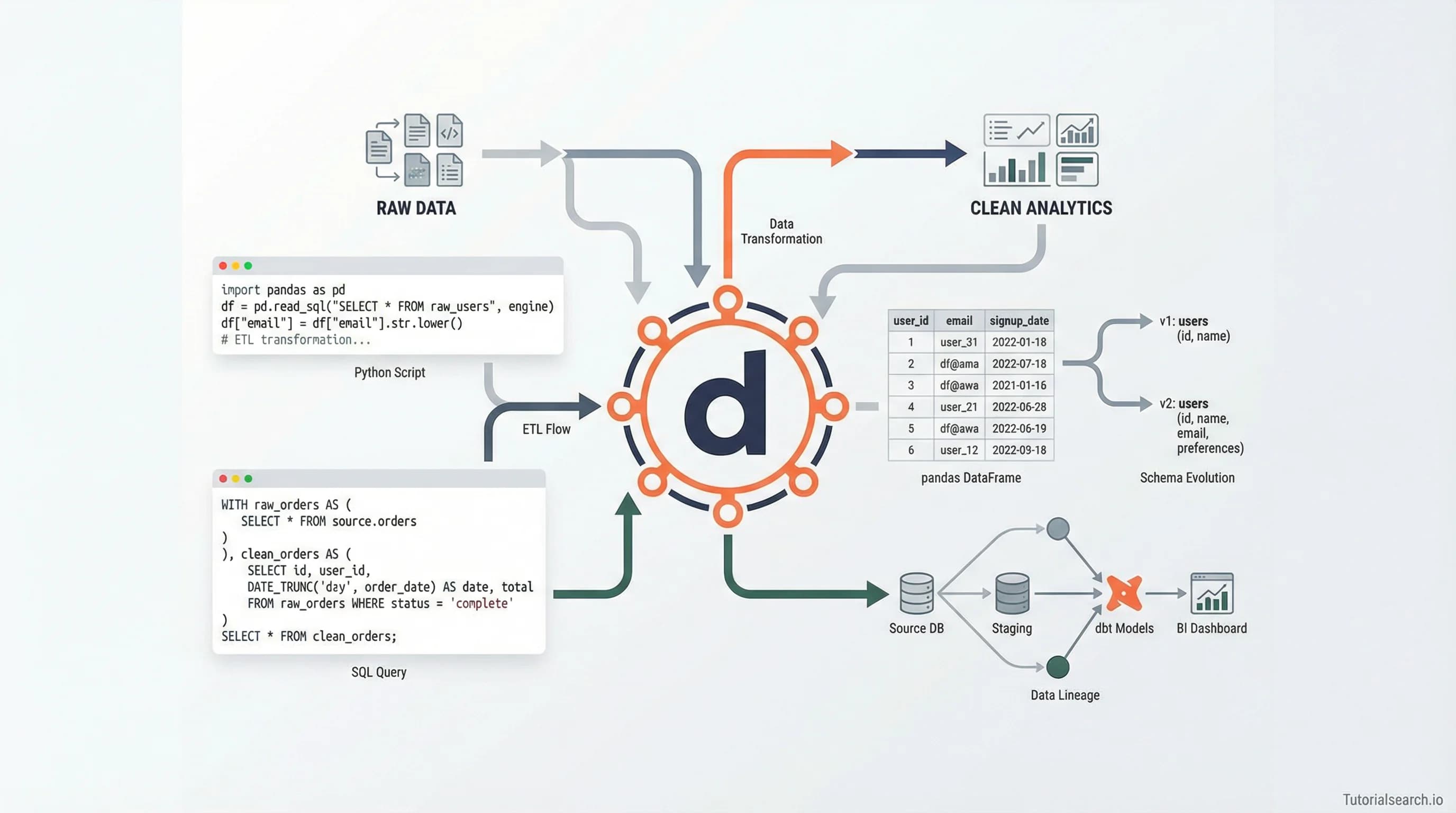
From Raw to Ready: Your Data Transformation Learning Path
Data transformation is where most real data work happens. This guide covers the best courses, free tools, GitHub repos, and YouTube channels for learning Python, SQL, dbt, and Power Query.
Want AI in your product? Hire the team behind TutorialSearch.io
LLM features, RAG, agents and automation wired into a real product — built by the devs who shipped this site.
Data transformation is where 80% of real data work actually happens. Most people expect the exciting part — modeling, prediction, visualization — but the truth is that cleaning, reshaping, and structuring raw data consumes the vast majority of a data professional's time. If you want to be effective with data, this is the skill to build first.
This guide covers the best data transformation courses, free resources, YouTube channels, GitHub repos, and books — all structured as a learning path so you know what to tackle and in what order. Browse the full collection of 231+ data transformation courses if you want to explore beyond this list.
Key Takeaways
- Data transformation skills (Python, SQL, dbt) are among the most in-demand across all data roles in 2026
- You can learn data transformation fundamentals for free using pandas tutorials and dbt's official documentation
- Power BI's Power Query is the fastest on-ramp for analysts who don't yet write code
- Building one real messy project is worth more than five clean tutorial datasets
- Courses from Pluralsight and Udemy cover data transformation from beginner through enterprise-scale ETL
In This Article
- Before You Start Learning Data Transformation
- Data Transformation Courses That Build Real Skills
- Power BI Data Transformation: Where Analysts Live
- Free Data Transformation Resources Worth Bookmarking
- Data Transformation GitHub Repos Worth Starring
- Data Transformation YouTube Channels Worth Following
- Data Transformation Books Worth Your Time
- Related Data Skills Worth Exploring
- Frequently Asked Questions About Data Transformation
Before You Start Learning Data Transformation
Here's something that trips up beginners: they try to learn "data transformation" as a single, unified skill. It isn't. It's a cluster of related techniques that depend heavily on the tools you're working with.
If you use Excel or Power BI, the natural entry point is Power Query — Microsoft's visual transformation engine built on a language called M. If you write code, Python's pandas library is the standard. If you work on data pipelines at a company, SQL and dbt (data build tool) are what you'll actually use day to day.
So before picking a course, answer this: what's your context?
- Analyst using Microsoft tools → start with Power BI or Power Query
- Python learner → start with pandas
- Aspiring data engineer → go straight to dbt and SQL
If you're unsure, start with Python and pandas. The skills transfer directly into every other tool.
One piece of advice that changed how I learned transformation: don't wait for a course to hand you clean practice data. Download something genuinely messy from Kaggle — I used a real NYC taxi trips dataset with missing fields, duplicates, inconsistent date formats, and city codes that didn't match any lookup table — and try to clean it alongside whatever you're studying. The confusion you hit is exactly how you build real skill.
A quick reality check on tools before we dive in:
| Tool | Best For | Learning Curve |
|---|---|---|
| Power Query (M) | Excel/Power BI analysts | Low — visual interface |
| Python pandas | Programmatic transformation | Medium — requires Python basics |
| SQL + dbt | Warehouse-scale pipelines | Medium-High — needs SQL fluency |
| Apache Spark | Big data / distributed processing | High — needs engineering background |
| Apache Pig | Hadoop-based batch transformation | High — niche but powerful |
Start at the row that matches where you are. Move down as your work demands it.
Data Transformation Courses That Build Real Skills
The course landscape here is mixed. Some "data transformation" courses are just Power BI basics with a better title. The ones below are genuinely worth your time.
Beginner
Data Transformations with Apache Pig (Pluralsight) [Editors' Choice]
Instructed by Janani Ravi, one of Pluralsight's highest-rated data instructors at 4.9 out of 5 stars. This course teaches data transformation at scale using Apache Pig — a platform built on Hadoop that lets you write transformation workflows using a simple scripting language, instead of raw Java code.
Don't let "Apache Pig" put you off. I know it sounds dated, but the transformation mindset this course teaches — thinking in pipelines, not row-by-row operations — is exactly what transfers into modern tools like Spark and dbt later. Janani doesn't assume you already know Hadoop internals, which makes it unusually accessible. The course covers filtering, grouping, joining, and aggregating datasets.
If you're heading toward big data or data engineering, this is a smart early investment. The logic you learn here directly maps to how modern data platforms work.
Prophecy Data Transformation Copilot for Data Engineering (Udemy)
Taught by Mei Long, this course covers Prophecy — an AI-assisted visual data transformation platform that generates Apache Spark code behind the scenes. With 2,945 students and a 4.5 rating, it's found its audience. This is a good pick if you're interested in where enterprise data engineering is heading. The combination of visual interfaces and AI-generated code is genuinely the direction the industry is moving. It's not for absolute beginners — you'll want some SQL or scripting background — but it's approachable if you have that.
Excel Formulas: Data Transformation and Analysis Done Right (Udemy)
Sunil Nair (MCT) is a certified Microsoft trainer, and that credential matters here. This course targets the Excel-first analyst who wants to go beyond basic formulas and build proper transformation logic. 4.49 stars. If you're embedded in a corporate environment where Excel is the default tool, this closes the gap between "person who makes spreadsheets" and "person who actually transforms data correctly." Highly practical, no fluff.
Intermediate
Microsoft Power BI for Advanced Data Transformations (Udemy) [Editors' Choice]
Enterprise DNA is a well-regarded Power BI training brand, and this course has 16,648 students. That number is telling — word of mouth doesn't work for bad courses. It covers advanced Power Query (M language), complex DAX transformations, and building reusable transformation logic you can apply across multiple reports. If you're an analyst doing real Power BI work, this is the course to take after you understand the basics.
Power BI Data Transformation: Where Analysts Live
Power BI deserves its own section. It's the most widely deployed business intelligence tool in most enterprises, and its data transformation capabilities — via Power Query — are genuinely powerful once you learn them properly.
The most popular starting point is the Complete PowerBI Course with Augmented Analytics & Auto ML (Udemy) by SeaportAi, which 6,036 students have completed. It covers the full Power BI workflow, including transformation, but the standout is the section on AutoML integration — useful if your organization is moving toward self-service analytics.
For anyone preparing for Microsoft certification, Microsoft Power BI Data Analyst: PL-300 Certification Prep (Udemy) by Uplatz Training covers transformation within the context of the full PL-300 exam. It's not the most personal teaching style, but the coverage is thorough and the certification carries real weight in enterprise hiring.
If you want to see how transformation decisions affect the final output, Power BI - Building Interactive Dashboards by Lenny Wu (4.52 stars) teaches you to see the whole pipeline from transformation through visualization — a useful mental link to build early.
One honest take: most beginner guides tell you to start with Power BI's "Transform Data" view because it's visual and beginner-friendly. That's not wrong, but I'd argue you're better off spending 30 minutes understanding what Power Query's M language actually does before clicking anything. The mental model you build in that 30 minutes will improve every query you write afterward.
Browse all Power BI Analysis courses on TutorialSearch.io for a broader selection.
Free Data Transformation Resources Worth Bookmarking
You can get surprisingly far without spending anything. Here's what's actually worth your time.
dbt Official Documentation — The official dbt docs are some of the best-written technical documentation in data. Even if you're not using dbt yet, reading the introduction teaches you how professionals think about transformation: modular models, version control, data testing, documentation. The quickstart guide gets you running with your first transformation project in under an hour. Free, comprehensive, and kept current.
GeeksforGeeks Pandas Tutorial — GeeksforGeeks' pandas guide is reference-grade: comprehensive, well-organized, and covers everything from loading data to reshaping DataFrames to handling missing values. Use it as a companion while building something rather than reading straight through.
LearnDataSci's Pandas Introduction — This guide is different: narrative, well-paced, and genuinely beginner-friendly. It covers the full pandas workflow with real examples. One of the better free starting points if you're new to Python data work.
Kaggle Learn (free micro-courses) — Kaggle's free Pandas and Data Cleaning micro-courses run in your browser with no setup. The Data Cleaning course in particular teaches exactly the transformation mindset: how to spot problems in a dataset, what to do about them, and how to decide between imputation and removal.
Official pandas documentation — pandas.pydata.org is dense but accurate. The User Guide sections on "Reshaping and Pivot Tables" and "GroupBy: split-apply-combine" cover the core transformation patterns every data professional needs.
Start Data Engineering's dbt Tutorial — This free guide is one of the clearest walkthroughs for getting started with production-grade SQL transformation using dbt. More practical than most blog posts on the topic. If you're building toward Data Engineering work, bookmark it now.
W3Schools Pandas Reference — W3Schools' pandas section isn't a course, but it's an excellent quick reference for transformation methods when you're building something and need to look up syntax fast.
Towards Data Science: 8 Ways to Transform Pandas DataFrames — This article walks through the most common transformation patterns with real code. Short, practical, and bookmarkable.
Data Transformation GitHub Repos Worth Starring
Want AI in your product? Hire the team behind TutorialSearch.io
LLM features, RAG, agents and automation wired into a real product — built by the devs who shipped this site.
GitHub is underused for learning data transformation. Not just for tutorials — for reading code you can study and run.
dbt-core ★ 10,000+ — The open-source core of dbt. Even if you're not contributing, the examples in the repo show how professional teams structure transformation logic. The README alone teaches you to think about transformation at a systems level. Highly recommended to read before you start any serious dbt project.
awesome-data-engineering (awesomelistsio) — A comprehensive curated list covering transformation tools from Apache Spark and dbt to DuckDB and Polars. Useful for getting a bird's-eye view of the tooling landscape before you decide what to learn.
awesome-modern-data-stack — Focused on the modern cloud data stack. It curates tools by category, with a dedicated transformation section covering dbt, SQLMesh, Polars, and DuckDB. If you want to understand what "modern data transformation" looks like in a real company, this is where to start.
awesome-datascience (academic) ★ 24,000+ — One of the most-starred data science repos on GitHub. Less transformation-specific, but excellent for understanding how transformation fits into the broader data science workflow. Good for context before you go deep on any single tool.
Data Transformation YouTube Channels Worth Following
Alex Freberg (Alex The Analyst) — Alex covers the full data analyst skill stack, including solid content on SQL-based data transformation, pandas, and data cleaning. His style is direct and practical: he shows real messy datasets and walks through how he cleans them. No filler. His YouTube channel is one of the most recommended resources in data communities for exactly this reason.
Darshil Parmar — Darshil focuses on data engineering, with detailed end-to-end project walkthroughs using Airflow, Python, and cloud data warehouses. His videos are longer and more technical than most — which is exactly what you want if you're learning pipeline-level transformation. His "End-to-End Data Engineering Project" series is a genuine standout in the free YouTube data engineering space. [Editors' Choice]
Simplilearn — A reliable large-format channel with videos on Hadoop, Spark, Apache Pig, and SQL-based data transformation. The teaching isn't particularly personal or opinionated, but the coverage is thorough and the production quality is high. Good for breadth.
Analytics Vidhya — Covers a wide range of data science topics including data preprocessing and transformation. Their format tends toward tutorial-style explainers on specific tools and techniques, which works well for targeted learning.
One honest note: be careful about "data transformation in 5 minutes" content. The topic doesn't compress well. The channels above don't promise shortcuts, which is why they're actually useful.
Data Transformation Books Worth Your Time
Python for Data Analysis by Wes McKinney — McKinney created pandas, so there's no one better to explain how to use it for transformation. This book covers everything from basic reshape operations to performance optimization for large datasets. Both a learning resource and a reference you'll return to for years. A used copy is fine since the core pandas API is stable. [Editors' Choice]
Practical SQL by Anthony DeBarros — Covers SQL for real data analysis, including transformation patterns (CTEs, window functions, aggregations). Unusually readable for a SQL book. If you're going to use SQL for transformation work — and you probably will — start here.
SQL for Data Analysis: Advanced Techniques for Transforming Data into Insights by Cathy Tanimura — More advanced than Practical SQL. This book focuses specifically on using SQL to transform and analyze data, covering time series, cohort analysis, and the complex transformations that come up in real analytics work. Good second book after DeBarros.
Data Engineering with Python by Paul Crickard — If you're heading toward pipeline-level transformation, this book covers the full workflow from ingestion through transformation and loading. More engineering-focused than analytics-focused. Works well alongside the Data Science Skills courses that cover complementary methods.
If you want more Python-oriented resources, the Python Analysis section on TutorialSearch.io has a solid collection of courses that pair well with these books.
Related Data Skills Worth Exploring
Data transformation doesn't exist in a vacuum. These skills pair naturally with it:
Data Visualization — Transformation shapes the data; visualization tells the story. You need both. Over 1,500 courses available. If your data isn't clean and structured right, your charts will mislead you.
Data Engineering — Pipeline-scale transformation is the core of data engineering. Natural next step once you've mastered fundamentals with pandas or Power Query.
Power BI Analysis — Power Query's M language is a full transformation engine inside Power BI. Worth dedicated study if you're in a Microsoft environment.
Python Analysis — Python and pandas are the dominant tools for programmatic data transformation. Huge overlap with what you're learning here.
Data Science Methods — Understanding downstream analysis helps you make better transformation decisions. What shape does the model need the data in?
Business Analytics — Transformation is ultimately in service of business questions. This context helps you transform for purpose, not just correctness.
Big Data — When datasets grow beyond what pandas handles comfortably, you need distributed transformation tools like Spark or Hadoop.
Frequently Asked Questions About Data Transformation
How long does it take to learn data transformation?
The basics take 2-4 weeks of consistent daily practice. You can clean simple datasets and reshape data in pandas or SQL within a month. Production-level transformation skills — pipeline design, dbt, performance optimization — take 3-6 months of real hands-on work. The gap between "I know pandas" and "I can build a reliable transformation pipeline" is real, but it closes fast if you work with actual messy data rather than textbook examples.
Do I need to know Python to learn data transformation?
No, not to start. Power Query in Excel or Power BI uses a visual interface and the M language, which is learnable without any Python background. SQL-based transformation using tools like dbt also doesn't require Python. That said, learning Python's pandas library opens up significantly more flexibility — I'd add it at some point regardless of your starting tool. Browse data transformation courses on TutorialSearch.io to find options that match your current skill set.
Can I get a job with data transformation skills?
Yes, and these skills are in high demand. Data transformation is core to data analyst, data engineer, analytics engineer, and BI developer roles. Specifically, dbt skills are among the most requested in modern data engineering job postings right now. If you can show that you know how to clean, reshape, and model data — with examples from real projects — you have a marketable skill set. Pair it with Data Visualization and you're close to a full analyst profile.
What is the difference between ETL and ELT in data transformation?
ETL stands for Extract, Transform, Load: data is transformed before it enters your data warehouse. ELT (Extract, Load, Transform) flips this — raw data goes into the warehouse first, then you transform it there using SQL. Modern tools like dbt are built specifically for ELT. Both approaches involve the same core transformation skills; the difference is where in the pipeline the transformation happens. For most modern data teams, ELT has become the standard approach because cloud warehouses are powerful enough to run transformations at scale.
What tools do data engineers use for transformation?
The current standard is dbt for SQL-based warehouse transformation, combined with Python/pandas or PySpark for programmatic transformation of larger datasets. Orchestration tools like Apache Airflow manage when transformations run. For no-code environments, Power Query, Fivetran dbt, and Matillion are common. The Data Engineering courses on TutorialSearch.io cover most of these tools in depth.
Data transformation is unglamorous work. It doesn't make it into conference keynotes the way machine learning does. But every data professional who's done real work knows: the model is only as good as the data going in.
Start with pandas or Power Query depending on your context. Get one genuinely messy dataset clean. Then layer in SQL, dbt, and engineering concepts as your work demands them. That's the path.
You can browse all 231+ data transformation courses on TutorialSearch.io, or explore the broader Data Science category for related learning paths.