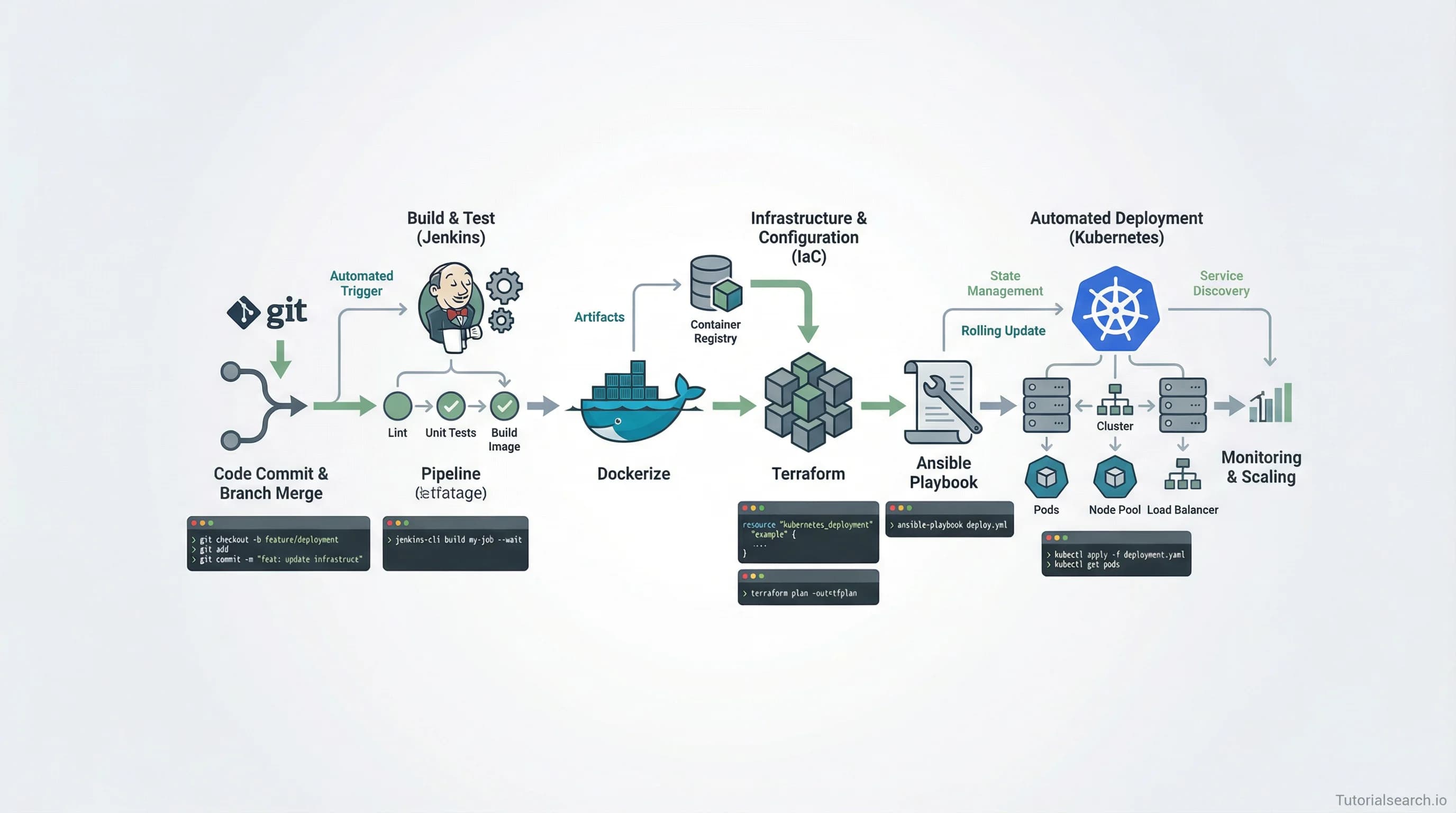
From Manual Deploys to Full Automation: Your DevOps Learning Path for 2026
A hands-on guide to the best DevOps automation courses, GitHub repos, YouTube channels, and books — organized by what to learn first and what's actually worth your time in 2026.
Hire the developers behind TutorialSearch.io
We built this site — full-stack web apps, AI integration & automation. Tell us what you need and we'll build yours.
It's 3 AM. Your phone buzzes. The deployment failed — again. You SSH into the server, scroll through logs, find the typo in the config file someone edited manually, fix it, restart the service, and crawl back to bed. By 7 AM, it happens again on a different server.
I spent two years in that cycle before I finally committed to learning DevOps automation properly. Not just reading about it — actually building pipelines, writing playbooks, and treating infrastructure like code instead of a collection of snowflake servers I'd hand-configured over months.
If you're still doing manual deployments, manually configuring servers, or copy-pasting shell scripts between machines, this post is your escape plan. I've pulled together the courses, repos, tutorials, and books that actually moved the needle for me and for teams I've worked with. Some are free, some cost money, and I'll be upfront about which ones are worth paying for. You can also browse all 699+ DevOps automation courses on TutorialSearch.io to find exactly what fits your stack.
Start Here (Seriously, Don't Overthink It)
The biggest mistake beginners make with DevOps automation is trying to learn everything simultaneously. Kubernetes, Terraform, Ansible, Jenkins, GitHub Actions, ArgoCD — the tool landscape is overwhelming, and most people stall out before automating their first deployment.
Pick one pipeline. Automate it end to end. Then expand.
Here are two free courses that get you from zero to "I just automated something real" faster than anything else I've found:
CI CD Pipeline - DevOps Automation in 1 Hr (Udemy, Free) — Sanghapal S strips away all the theory and walks you through building a working CI/CD pipeline in under an hour. With 35,898 students enrolled, this is the most popular free DevOps automation course on the platform for a reason. It's not deep, but that's the point — you need a quick win to build momentum. [Editors' Choice]
DevOps: Beginner's Guide to Automation with Ansible (Udemy, Free) — TetraNoodle Team's introduction to Ansible has over 32,000 students and a 4.3 rating. What I appreciate about this course is that it doesn't pretend Ansible exists in a vacuum — it connects automation concepts to real DevOps workflows. If you've never written a playbook before, start here. [Editors' Choice]
Both of these are on TutorialSearch.io's DevOps Automation page, where you can filter by price, platform, and difficulty level.
The Courses That Separate Tinkerers from Professionals
Once you've tasted automation, you'll want structure. These paid courses go deep enough to actually change how you work.
The Complete Jenkins DevOps CI/CD Pipeline Bootcamp (Udemy, Paid) — 48,390 students. 4.4 rating. This is the course I recommend when someone asks me "how do I learn CI/CD for real?" The instructor covers scripted pipelines, declarative pipelines, integration with Docker and Kubernetes, and — critically — how to debug pipelines when they break. Because they will break. [Editors' Choice]
Dive Into Ansible - Beginner to Expert in Ansible - DevOps (Udemy, Paid) — With 45,278 students and a 4.6 rating, this is the most comprehensive Ansible course I've come across. It takes you from "what is a playbook?" to writing complex roles, managing dynamic inventories, and integrating Ansible with your CI/CD pipeline. The progression feels natural rather than rushed.
Puppet for the Absolute Beginners - Hands-on - DevOps (Udemy, Paid) — Mumshad Mannambeth is one of the best DevOps educators on the internet, period. His teaching style is methodical, visual, and lab-heavy. This Puppet course (21,000+ students, 4.4 rating) follows the same formula that made his Kubernetes courses legendary. Even if you end up choosing Ansible over Puppet, the configuration management concepts transfer directly.
The Ultimate Chef Training Course: DevOps Automation (Udemy, Paid) — This one flies under the radar with only 1,093 students, but it has the highest rating on this list at 4.71. Robert Wilcox clearly knows Chef inside and out. If your organization uses Chef (and plenty of legacy enterprises still do), this is the definitive course.
Python 4000: Linux Commands & DevOps Automation (Udemy, Paid) — Most DevOps automation courses assume you already know Python. This one doesn't. Mr. Nagy bridges the gap between "I can write a Python script" and "I can automate Linux infrastructure with Python," which is exactly the gap most junior DevOps engineers fall into.
If you're also exploring related areas, check out Linux Fundamentals — solid Linux skills are the foundation everything else sits on.
AI Meets Automation: The New Frontier
Everyone's talking about AI-powered DevOps, and honestly, most of the hype is overblown. But two courses actually deliver practical value here:
DevOps Automation with ChatGPT: From Beginner to Expert (Udemy, Paid) — Infrasity Learning's course (4.7 rating) teaches you how to use LLMs to write Terraform configs, debug Ansible playbooks, and generate CI/CD pipeline code. It's not about replacing your skills — it's about amplifying them. I was skeptical going in, but the productivity gains are real for routine automation tasks.
PromptOps: AI-Powered DevOps (Udemy, Paid) — Vimal Daga coins the term "PromptOps" and builds an entire workflow around it. It's more experimental than the ChatGPT course, but if you want to see where the industry is heading, this gives you a concrete preview.
That said, don't learn AI-powered DevOps before you understand manual DevOps. You need to know what good automation looks like before you can evaluate whether an AI-generated pipeline is any good. I've seen junior engineers generate Terraform configs with ChatGPT that looked correct but had security groups wide open to the internet. The AI didn't know better. You need to.
For more on the intersection of AI and operations, the IT Expertise collection on TutorialSearch.io covers 914+ courses across the broader IT landscape.
Repos Worth Starring Right Now
GitHub is where DevOps engineers actually learn. Not from courses — from code, examples, and community-maintained roadmaps. These repositories have taught me more than most paid content:
90DaysOfDevOps by Michael Cade — This started as one person's public learning journal and became the definitive community DevOps curriculum. Three years of content covering everything from Linux basics to GitOps, with 91 video sessions on YouTube. It's structured enough to follow as a course but flexible enough to skip what you already know. [Editors' Choice]
DevOps-Roadmap by Milan Milanović — Updated for 2026 with mostly free learning resources. What makes this roadmap different from the dozens of others is that it's opinionated — it tells you what to learn first and why, instead of dumping every possible tool on a diagram and letting you drown.
awesome-devops — The classic "awesome list" format applied to DevOps platforms, tools, and practices. I use this as a reference when evaluating new tools rather than a learning path. When someone mentions a tool I haven't heard of, this is where I check first.
devops-resources by Arie Bregman — More curated than the awesome list, with an opinionated roadmap. Covers Linux, Jenkins, AWS, Prometheus, Docker, Python, Ansible, Git, Kubernetes, and Terraform. The advice to "not attempt learning everything at once" is printed at the top, which tells you this was written by someone who's mentored beginners.
devopshobbies/devops-roadmap — 6,000+ interactive exercises and real-world projects. If you learn by doing rather than watching, this is your repo. Includes hands-on labs for CI/CD with GitHub Actions, Kubernetes, Prometheus & Grafana monitoring, and Logstash pipelines.
Speaking of containers, if you're diving into Docker and Kubernetes alongside your automation journey, our Docker Containers collection has 411+ courses sorted by rating and difficulty.
YouTube Creators Who Actually Ship Code
Hire the developers behind TutorialSearch.io
We built this site — full-stack web apps, AI integration & automation. Tell us what you need and we'll build yours.
There's a particular flavor of DevOps YouTube content I can't stand — someone reading documentation on camera and calling it a tutorial. These channels are different. They build things, break things, and show you what real automation workflows look like.
TechWorld with Nana is the channel I recommend to everyone, regardless of experience level. Nana Janashia has a rare talent for making complex topics (Kubernetes, Terraform, GitOps) feel approachable without dumbing them down. Her "DevOps Concepts Explained" playlist is the best free overview of the entire field I've found anywhere. [Editors' Choice]
KodeKloud — Mumshad Mannambeth (yes, the same person behind the Puppet course above) runs this channel alongside KodeKloud's interactive lab platform. The labs are the real draw here — you solve real problems on real systems in your browser, and most labs are free. The YouTube channel supplements the labs with conceptual walkthroughs.
DevOps Directive focuses specifically on Kubernetes, Helm, GitOps, and cloud-native tooling. Less personality-driven than Nana's channel, more technically dense. If you already understand the basics and want to go deeper on specific tools, this is your channel.
Abhishek Veeramalla runs a free "DEVOPS ZERO TO HERO COURSE" playlist that covers fundamentals through GitOps and Docker. It's not polished, but it's comprehensive and completely free.
Jeff Geerling brings an open-source perspective with practical projects. His Kubernetes 101 series is excellent, covering containers, DNS, TLS, and more — and he shares all his code on GitHub so you can follow along commit by commit. Jeff also maintains several popular Ansible roles, so his channel is especially valuable if you're going the Ansible route.
Bret Fisher runs live streams, Q&A sessions, and deep-dive tutorials focused on Docker and Kubernetes. His content sits in the sweet spot between "explain it to me like I'm five" and "show me the production config." He also manages the Cloud Native DevOps Discord community mentioned below, so the learning extends beyond YouTube.
For broader DevOps context, the CNCF YouTube channel posts talks from KubeCon and other events. Not tutorials, but invaluable for understanding where the ecosystem is heading.
Read Your Way In
I know — reading a book about automation sounds ironic. But these fundamentally changed how I think about DevOps, not just what tools I use.
The Phoenix Project by Gene Kim, Kevin Behr, and George Spafford — Yes, it's a novel. Yes, it's about IT operations. And yes, it will make you angry at how accurately it describes the dysfunction you've probably experienced. Read it before you learn any tools. It explains why DevOps exists, not just how to do it.
Continuous Delivery by Jez Humble and David Farley — The definitive book on deployment pipelines. Dense, thorough, and practical. If you only read one technical DevOps book, make it this one. It covers everything from version control strategies to deployment automation patterns.
Infrastructure as Code by Kief Morris (O'Reilly, updated 2025 edition) — This book defines how to use Terraform, Ansible, and CloudFormation to automate infrastructure. The updated edition addresses infrastructure sprawl and cost management, which are the real problems teams face at scale.
Accelerate by Nicole Forsgren, Jez Humble, and Gene Kim — Data-driven analysis of what makes high-performing DevOps teams actually high-performing. If you need to convince your manager to invest in automation, this book gives you the numbers. It identifies four key metrics (deployment frequency, lead time, change failure rate, mean time to recovery) that correlate with organizational performance. Spoiler: the teams that automate everything consistently outperform on all four.
The DevOps 2.0 Toolkit by Viktor Farcic — More practical than the books above, with hands-on exercises and GitHub repos you can clone and follow along with. Covers containerization, CI/CD, and how all the pieces fit together. Good for people who learn by building rather than reading theory.
If you're building cloud automation skills alongside your DevOps journey, these books provide the theoretical foundation that courses often skip.
Quick-Fire: My Tool-by-Tool Picks
Can't decide where to start? Here's my opinionated cheat sheet:
| Automation Need | My Pick | Why | Free Alternative |
|---|---|---|---|
| CI/CD Pipelines | Jenkins (take the Bootcamp) | Battle-tested, massive plugin ecosystem | GitHub Actions (built-in, great for smaller projects) |
| Configuration Management | Ansible (take the Beginner's Guide) | Agentless, YAML-based, lowest learning curve | SaltStack (steeper curve, faster execution) |
| Infrastructure as Code | Terraform | Cloud-agnostic, declarative, huge community | OpenTofu (open-source Terraform fork) |
| Container Orchestration | Kubernetes | Industry standard, every cloud supports it | Docker Swarm (simpler, fine for small teams) |
| Scripting & Glue Code | Python (take Python 4000) | Ubiquitous, massive library ecosystem | Bash (fine for simple tasks, painful for complex ones) |
Your Support Network
DevOps automation is hard to learn in isolation. When your Terraform state file gets corrupted at midnight, you need people who've been there.
Discord: The Cloud Native DevOps server (26,000+ members, managed by Bret Fisher) and DevOps, SRE, & Infrastructure (22,000+ members) are the most active communities I've found. Both are welcoming to beginners.
Slack: SweetOps by Cloud Posse is my go-to Slack workspace for infrastructure-as-code discussions. The signal-to-noise ratio is better than most Discord servers.
Reddit: r/devops is the obvious choice, though it skews toward opinion pieces over technical help. r/homelab is surprisingly useful for practicing automation in sandbox environments.
Free Learning Platforms: KodeKloud's interactive labs let you practice in real environments without setting anything up. Atlassian's DevOps Automation Tutorials are underrated for understanding CI/CD concepts. And GeeksforGeeks' DevOps Tutorial serves as a solid free reference.
If you're interested in adjacent skills, explore Network Automation (470+ courses) and DevOps Essentials (336+ courses) on TutorialSearch.io.
The Honest Version
Here's what I wish someone had told me when I started: you don't need to master every tool on the DevOps & IT landscape. You need to master automation thinking — the ability to look at any manual process and design a repeatable, version-controlled, testable replacement.
Start with the free Ansible or Jenkins course. Automate one thing this week. Then automate another. Within a month, you'll wonder how you ever tolerated doing things by hand.
The tools will change. Kubernetes might get replaced. Jenkins might fully give way to GitHub Actions. But the engineer who thinks in automation — who sees a manual process and instinctively reaches for code instead of a terminal — that engineer will always be in demand.
Pick a course. Star a repo. Build something. The 3 AM phone calls can wait.
FAQ
What are the key benefits of DevOps automation?
DevOps automation eliminates manual, error-prone processes from your software delivery pipeline. Teams that invest in automation see faster release cycles, fewer deployment failures, and — perhaps most importantly — engineers who can sleep through the night. The data from Accelerate shows that high-performing teams deploy 208 times more frequently than low performers, with 106x faster lead times.
What tools should I learn first for DevOps automation?
Start with one CI/CD tool (Jenkins or GitHub Actions) and one configuration management tool (Ansible is the easiest entry point). Once you're comfortable automating deployments and server configs, add Terraform for infrastructure as code and Kubernetes for container orchestration. Don't try to learn all four simultaneously.
How does infrastructure as code improve DevOps automation?
Infrastructure as Code (IaC) lets you define servers, networks, and services in version-controlled files instead of clicking through cloud consoles. This means your infrastructure is reviewable (pull requests for server changes), repeatable (spin up identical environments in minutes), and auditable (git blame tells you who changed what and when). Tools like Terraform and Ansible make IaC practical for teams of any size.
What skills do I need for a DevOps automation role?
At minimum: proficiency in Python or Bash scripting, comfort with Linux, understanding of at least one cloud platform (AWS, Azure, or GCP), and hands-on experience with CI/CD pipelines. Beyond the technical skills, you need the ability to look at a manual process and systematically break it into automatable steps. The courses and resources in this guide cover all of these areas.
Is DevOps automation only for large teams?
Not at all. Solo developers and small teams often benefit more from automation because they have less margin for manual errors and fewer people to share on-call rotations. A solo developer with a solid CI/CD pipeline and infrastructure as code can operate at a scale that would have required a team of five just a decade ago.