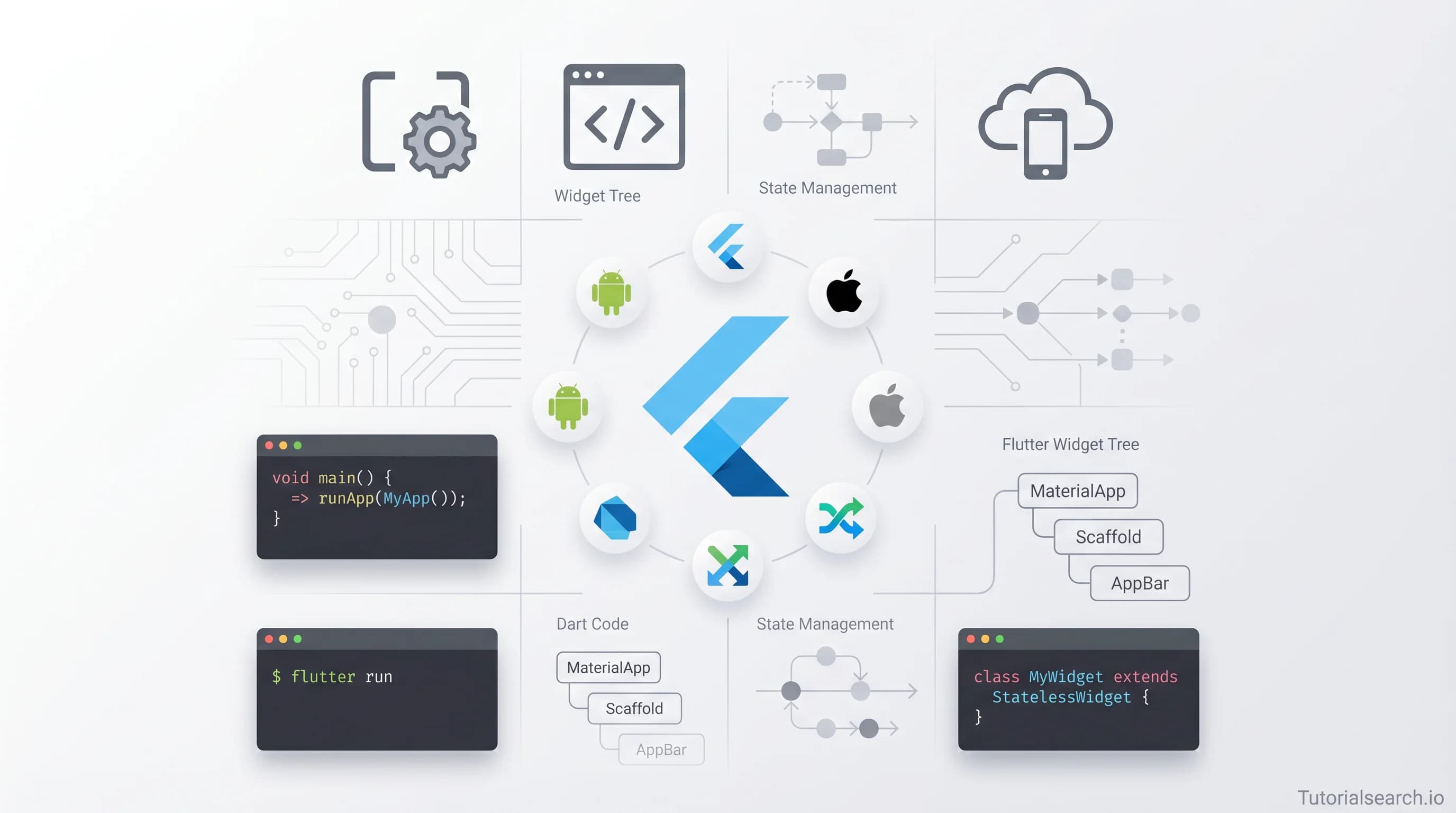
Flutter Development: The Courses and Resources I'd Actually Recommend
A curated guide to the best Flutter development courses, free resources, YouTube channels, GitHub repos, and books for building cross-platform mobile apps with Dart.
Need a web app built? Hire the team behind TutorialSearch.io
We ship fast, production-grade full-stack apps (Next.js, React, edge infra) — the same stack that powers this site.
Flutter development clicked for me the third time I tried — not when I found a better course, but when I stopped treating Dart like an obstacle and started treating it like an asset. If you're looking to build cross-platform mobile apps with Flutter and want a curated map of where to start (and where not to waste your time), this guide is for you. As of 2026, Flutter's ecosystem has matured considerably, and the gap between "learning project" and "production app" is narrower than most tutorials admit.
Start with a browse of Flutter development courses on TutorialSearch to get a sense of what's out there before committing to anything. There's a lot of noise — this post cuts through it.
Key Takeaways
- Flutter development uses Dart to build production-ready iOS, Android, web, and desktop apps from one codebase — no native code required.
- Learning Flutter development is faster than most expect: competent UI work in 4–6 weeks, production-ready apps in 3–4 months.
- The best Flutter development courses combine Dart fundamentals with real project builds, not just toy demos.
- Free Flutter resources have improved dramatically — you can get surprisingly far without paying for anything.
- State management (Provider, Riverpod, BLoC) is the hardest part of Flutter development and deserves dedicated study.
In This Article
- Flutter Development Courses Worth Your Time
- Free Flutter Resources That Are Surprisingly Good
- YouTube Channels for Flutter Development That Actually Teach
- Flutter GitHub Repos Worth Starring Right Now
- Flutter Books for When You Want to Go Deeper
- Flutter Communities Worth Joining
- Beginner vs. Advanced: Pick Your Flutter Path
- Related Flutter and Mobile Dev Skills Worth Exploring
- FAQ
Flutter Development Courses Worth Your Time
There are 76 Flutter courses indexed on TutorialSearch. Most of them follow the same pattern: install Flutter, build a calculator, wave goodbye. A handful go further. Here's what I'd actually recommend.
1. The Complete Flutter Development Bootcamp with Dart (Udemy)
[Editors' Choice] This is the course. Dr. Angela Yu has built a reputation for courses that are thorough without being punishing, and her Flutter bootcamp earns that reputation. Over 200,000 students have taken it — a number that matters because active communities form around popular courses, and you'll find answers to your specific bugs faster. The course covers Dart from scratch, moves through UI layout with Flutter's widget system, integrates Firebase, and delivers a portfolio of real apps. Dr. Yu's strength is making complexity feel approachable without pretending it's simpler than it is. Rating: 4.54 · Udemy.
2. Dart & Flutter | The Complete Flutter Development Course (Udemy)
[Editors' Choice] Hussain Mustafa's course is the stronger technical choice for people who already have some programming experience. It's dense with real-world patterns — REST API integration, state management with Provider and Bloc, and local storage with SQLite and Hive. Nearly 75,000 students have taken it, and the reviews consistently praise the practical depth. If Angela Yu's course is the warm welcome, this is the follow-up that turns you into a practitioner. Rating: 4.49 · Udemy.
3. Complete Flutter Guide 2025: Build Android, iOS and Web Apps (Udemy)
[Editors' Choice] Sagnik Bhattacharya's course has the highest rating of any Flutter course in this list (4.69) and covers web app deployment alongside mobile — a practical addition now that Flutter Web is production-ready. Over 25,000 students, strong pacing, and genuinely up-to-date content. This one deserves more attention than it gets. Rating: 4.69 · Udemy.
4. Flutter Advanced Course — Clean Architecture With MVVM (Udemy)
For developers who've done the beginner courses and want to write code that doesn't embarrass them in a PR review. Mina Farid covers MVVM architecture, dependency injection, and scalable project structure. If you're targeting a job or shipping a real product, architecture matters more than most tutorials acknowledge. Rating: 3.93 · Udemy — the lower rating reflects its difficulty, not its quality.
5. Complete Flutter Development — Build 14 iOS and Android Apps (Udemy)
Fourteen projects is ambitious. Igneus Technologies delivers on it — the sheer volume of hands-on practice is the value proposition. Not the most polished course in production quality, but building 14 apps will do more for your muscle memory than watching 40 hours of video. Rating: 4.36 · Udemy.
6. Flutter 101 — Your Ultimate Guide to Flutter Development (Free, Udemy)
If you're genuinely new to programming and want to test whether Flutter is worth investing in before spending money, this free course is the right entry point. It covers the essentials without assuming prior mobile experience. Rating: 4.10 · Udemy.
If Flutter interests you, JavaScript development pairs well — many Flutter developers also work on web frontends and find the two ecosystems complement each other.
Free Flutter Resources That Are Surprisingly Good
Paid courses aren't the only path. The Flutter ecosystem has unusually good free material, partly because Google actively funds its development and documentation.
Flutter Official Documentation — Start here. The Flutter docs are genuinely good: structured learning pathways, interactive codelabs, and a comprehensive widget catalog. The Getting Started guide walks you through installation and your first app. Most developers skip the official docs too quickly; don't. The quality here is high.
Flutter Codelabs (Google) — Structured hands-on exercises covering specific Flutter topics. These are browser-based, which means zero setup friction. The Flutter basics codelab is a reliable starting point even if you've touched Flutter before.
Code With Andrea — Andrea Bizzotto's site is one of the best free resources for intermediate Flutter content. The free articles and tutorials cover state management with Riverpod, testing, and project architecture with unusual clarity. Opinionated, well-reasoned, and worth bookmarking. If you're past the beginner stage, this should be your first stop before paid courses.
Flutter Community on Medium — A curated publication with hundreds of practical Flutter articles. Quality varies, but the top-rated posts are consistently useful — especially for debugging specific issues or learning narrow patterns like animations or platform channels.
Class Central — Free Flutter Courses — Aggregates free Flutter courses from across the web, including free versions of some Udemy content. Good for surveying what's available without committing.
For a more structured path, search Flutter tutorials on TutorialSearch to find instructor-led options with community support built in.
YouTube Channels for Flutter Development That Actually Teach
Video is where Flutter education is strongest. These channels are worth subscribing to.
Flutter (Official Channel) — Google's official Flutter YouTube presence. The "Widget of the Week" and "Package of the Week" series are genuinely useful for discovering what's possible in Flutter. The longer conference talks cover architecture and performance topics you won't find in beginner courses. Subscribe for updates on new Flutter releases.
Reso Coder — [Editors' Choice] Matej Rešetár's channel is where Flutter developers go when they've outgrown beginner content. The tutorials on BLoC state management, clean architecture, and test-driven development are among the best on YouTube. The code is actually good — not the simplified toy code you often see in tutorial videos. Essential for intermediate developers.
The Net Ninja — The Flutter beginner playlist is one of the most-recommended starting points online. The teaching style is methodical and well-paced for people new to mobile development. If Angela Yu's course isn't the right format for you, Net Ninja's free playlist covers similar ground.
The Flutter Way — Focus on UI implementation: beautiful interfaces, complex layouts, and animations. The channel publishes speed-build videos that show how experienced developers think about UI structure. Valuable specifically for the visual design side of Flutter, which other channels under-serve.
Marcus Ng — Consistently good UI clones and project tutorials. Strong for building the kind of polished apps you'd actually want to ship.
Flutter GitHub Repos Worth Starring Right Now
Need a web app built? Hire the team behind TutorialSearch.io
We ship fast, production-grade full-stack apps (Next.js, React, edge infra) — the same stack that powers this site.
These repositories are practical tools, not just reading lists.
Solido/awesome-flutter — The canonical curated list of Flutter libraries, tools, tutorials, and articles. If you want to know what packages exist for a specific problem, start here. It's well-maintained and community-contributed. Star it and use it as a reference index.
flutter/samples — Official Flutter sample apps from the Flutter team at Google. These are reference-quality implementations of real features: navigation, animation, state management. When you're unsure how to structure something, there's likely a sample that shows the intended pattern.
fluttergems/awesome-open-source-flutter-apps — A curated list of open-source Flutter apps with real-world scope. Reading production code is how you learn what good Flutter development looks like beyond tutorial examples. Clone a few and read them.
Hamed233/Flutter-Awesome-Projects — 200+ open-source Flutter projects organized for learning. Good for finding projects at your current skill level and working through them. Pairs well with programming fundamentals courses if you need to shore up your foundations first.
Flutter Books for When You Want to Go Deeper
Most Flutter developers skip books. That's a mistake — the right book fills gaps that video courses don't cover, especially around architecture and testing.
Flutter Apprentice (Kodeco) — The most comprehensive beginner-to-intermediate Flutter book currently available. Covers UI construction, state management, navigation, networking, and persistence across both iOS and Android targets. The Kodeco (formerly raywenderlich.com) editorial standards are high, and this book reflects that.
Beginning Flutter: A Hands-On Guide to App Development by Marco Napoli — A good entry point for developers with no prior mobile experience. The teach-by-example approach means you're building throughout, not just reading theory. Particularly useful for understanding Flutter's widget model before it clicks.
Prefer video? The Complete Flutter Development Bootcamp with Dart (listed above) covers similar foundational material with Angela Yu's trademark clarity.
Flutter Communities Worth Joining
Learning in isolation is slower. These communities help when you're stuck — and they answer Flutter questions faster than Stack Overflow for platform-specific issues.
FlutterDev Discord — Over 73,000 members, active channels for package development, Dart questions, and general Flutter help. The volume of activity here means most questions get answers within hours.
r/FlutterDev (Reddit) — The main Flutter subreddit. Good for project showcases, career questions, and opinions on libraries. The community skews practitioner, so beginner questions get respectful answers and package discussions get real-world input.
Flutter Community (flutter.dev) — The official community hub aggregates Discord, Stack Overflow, and forum links. Useful starting point for finding where conversations are happening.
Beginner vs. Advanced: Pick Your Flutter Path
Not all Flutter courses serve the same learner. Here's how to match resources to where you are:
| If you are... | Start here | Then go here |
|---|---|---|
| New to programming | Flutter 101 (free) or Net Ninja YouTube | Angela Yu's bootcamp |
| Developer new to Flutter | Angela Yu or Hussain Mustafa bootcamp | Reso Coder on BLoC architecture |
| Intermediate, wanting real apps | 14-App course (Igneus Technologies) | Open-source Flutter apps on GitHub |
| Want production-quality code | Flutter Advanced — Clean Architecture (Mina Farid) | Multi-modular architecture with Bloc |
| Self-directed learner | Flutter official docs + Net Ninja YouTube | Code With Andrea for intermediate depth |
One contrarian opinion worth stating: most Flutter learners spend too long on state management debates. Provider vs. Riverpod vs. BLoC is a real consideration, but agonizing over it at the beginner stage is counterproductive. Pick Provider, ship something, then revisit the decision with context. The architecture debates make more sense after you've felt the pain they're solving.
Related Flutter and Mobile Dev Skills Worth Exploring
Flutter doesn't exist in isolation. These adjacent skills sharpen your Flutter work directly.
- JavaScript Development — Flutter Web bridges mobile and web, and most Flutter developers eventually work in web contexts. JS fundamentals translate directly.
- Python Applications — Backend services and APIs pair naturally with Flutter frontends. Python powers more Flutter backends than you'd expect.
- Modern Languages — Dart shares DNA with modern typed languages. If you're moving between ecosystems, understanding the family tree helps.
- Object Programming — Flutter's widget tree is object-oriented at its core. A strong OOP foundation makes Flutter architecture decisions much clearer.
FAQ
How long does it take to learn Flutter development?
Most people with some programming experience can build functional Flutter apps in 4–6 weeks of consistent practice. Production-ready, well-structured apps take closer to 3–4 months. The Dart learning curve is shallower than most developers expect — a week of focused work is usually enough to feel comfortable with the language. Browse Flutter development courses on TutorialSearch sorted by level to find where to start.
Do I need prior mobile development experience to learn Flutter development?
No. Flutter is specifically designed to be approachable without native iOS or Android experience. The Flutter documentation, Angela Yu's bootcamp, and Net Ninja's YouTube playlist all assume no prior mobile knowledge. What helps more than mobile experience is comfort with object-oriented programming — Flutter's widget system is deeply OOP, and that foundation matters more than knowing Swift or Kotlin.
Can I get a job with Flutter development skills?
Yes, though the market is more specialized than general web development. Flutter developers are in demand at companies building cross-platform mobile apps — startups especially, since Flutter's single-codebase approach reduces development costs. The strongest candidates combine Flutter UI skills with state management expertise and some experience with Firebase or REST API integration. Architecture knowledge (clean architecture, MVVM) is increasingly asked about in interviews for senior roles.
What is Flutter development used for?
Flutter is used to build cross-platform mobile, web, and desktop apps from a single Dart codebase. Common use cases include consumer mobile apps for iOS and Android, internal enterprise tools, and MVPs where speed-to-market matters. Major apps built with Flutter include Google Pay, eBay Motors, and the BMW My BMW app — real production use cases, not just prototypes.
How does Flutter development compare to React Native?
Flutter uses Dart and its own rendering engine (Skia/Impeller), compiling directly to native ARM code. React Native uses JavaScript and bridges to native components. Flutter tends to produce more consistent UI across platforms because it renders widgets itself rather than mapping to native components. React Native has a larger ecosystem and more JavaScript developers already familiar with the paradigm. Explore the programming languages category on TutorialSearch to compare ecosystems and decide which mobile path fits your background.