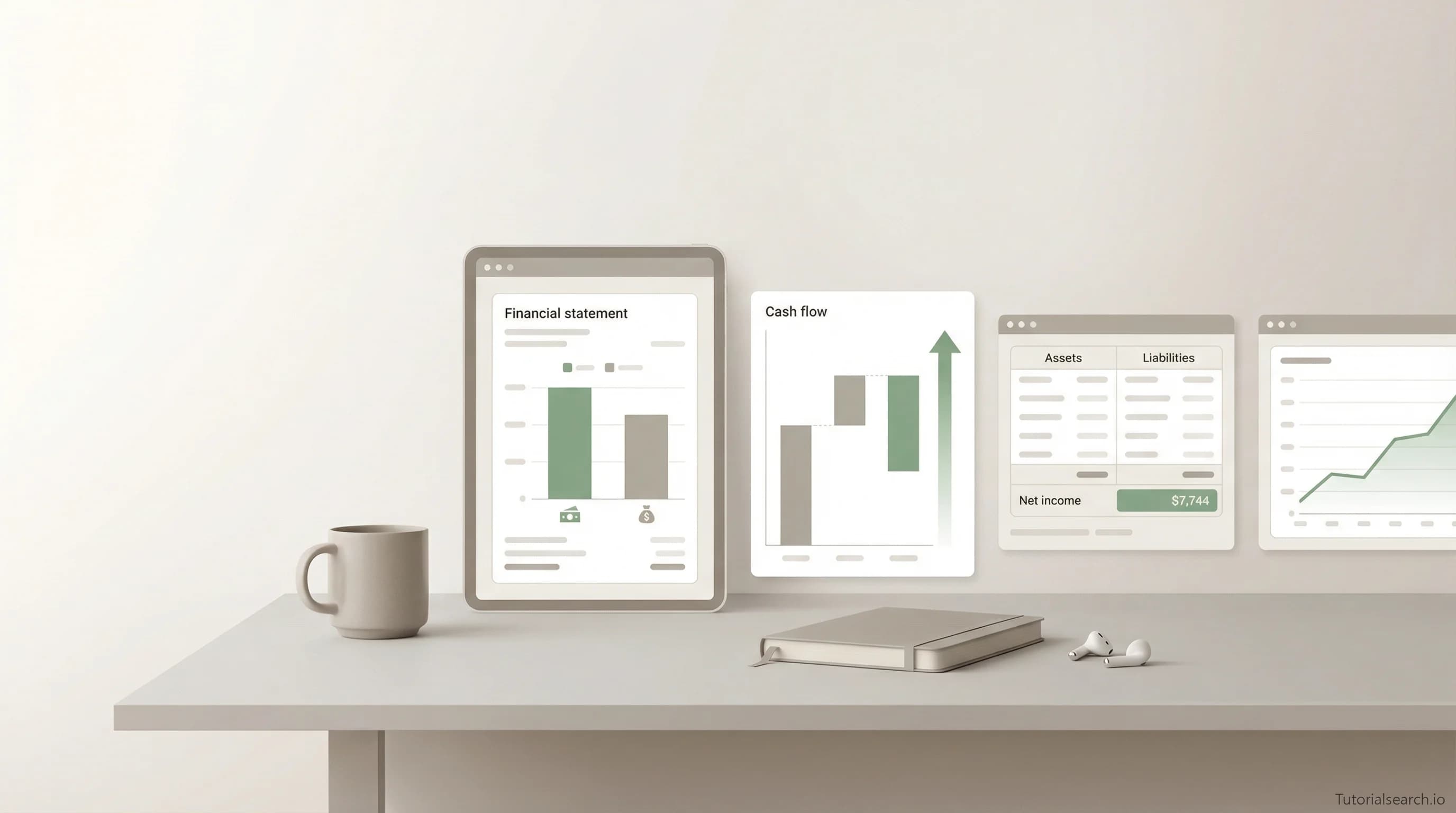
Financial Statements Every Investor Should Know
Financial statements — the balance sheet, income statement, and cash flow statement — reveal what earnings headlines never show. Here's a curated guide to the best courses, free resources, and books for learning to read and analyze them.
Hire the developers behind TutorialSearch.io
We built this site — full-stack web apps, AI integration & automation. Tell us what you need and we'll build yours.
Financial Statements Every Investor Should Know
Financial statements are the three documents that tell the real story behind any business. Learn to read them, and you can spot red flags that earnings headlines never mention.
Most people treat financial statements like a locked room. They assume you need an accounting degree to get anything useful out of them. That's the mistake I made for years — skimming stories about a company's "record quarter" without ever opening the actual 10-K filing.
The income statement gets all the attention. Revenue up 20%? Great quarter. But that revenue figure says nothing about whether the company has enough cash to survive a downturn. The cash flow statement does. And the balance sheet tells you how much debt it's carrying to hit those revenue numbers.
Here's the part that surprised me: financial statements are designed to be read together. Each one answers a different question. Once you understand that, the intimidation mostly disappears. You can find 142 courses on these documents at TutorialSearch's financial statements browse page — from beginner walkthroughs to professional modeling.
Key Takeaways
- Financial statements include three core documents: the balance sheet, income statement, and cash flow statement
- Reading all three together gives a fuller picture than any one statement alone
- The cash flow statement often reveals a company's real health better than the income statement
- Several free resources — including a 1h45m CFI course and the SEC's official guide — teach financial statements with no prior background needed
- Understanding financial statements is foundational for investing, business analysis, and financial planning
In This Article
- Three Financial Statements Every Company Publishes
- Financial Statements Courses That Actually Teach Analysis
- Free Financial Statements Resources Worth Bookmarking
- The Financial Statements YouTube Channels I Keep Coming Back To
- Open-Source Financial Statements Tools Worth Exploring
- Financial Statements Books That Changed How I Think About Numbers
- Related Finance Skills Worth Exploring
- Frequently Asked Questions About Financial Statements
Three Financial Statements Every Company Publishes
Before picking a course, it helps to understand what you're actually looking at.
Every public company must file three core financial statements with the SEC. That means you can pull up real statements for any publicly traded company — for free — at any time. Most investors never do.
Here's what each statement answers, and where it can mislead you on its own:
| Statement | The Question It Answers | The Danger of Reading It Alone |
|---|---|---|
| Income Statement | Did the company make money this period? | Profit can be shaped through legitimate accounting choices |
| Balance Sheet | What does the company own and owe right now? | A snapshot in time — doesn't show whether things are improving or declining |
| Cash Flow Statement | How much real cash moved in and out? | Can look weak even for healthy, fast-growing businesses |
This is where most beginners go wrong. They read the income statement — revenue up, expenses down, profit looks strong — and stop there. But the cash flow statement might show the company is burning through reserves to hit those numbers. And the balance sheet might reveal a debt load that makes those profits fragile.
Read all three. Every time. That's the discipline that separates informed investors from those who get caught off guard.
The SEC's Beginners' Guide to Financial Statements is worth reading before you start any course. It's free, authoritative, and written in plain English. No accounting background needed. Think of it as the orientation session before the actual training begins.
Financial Statements Courses That Actually Teach Analysis
There's no shortage of courses on financial statements. Most of them cover recognition — here's what a balance sheet looks like, here's what goes on an income statement. The courses below go further and teach you what to do with the numbers.
1. Financial Statements Analysis for Absolute Beginners [Editors' Choice]
Irfan Sharif is a bestselling accounting instructor — genuinely one of the more respected names in online finance education — and this course justifies that reputation. Over 26,000 students have enrolled, which is a meaningful signal in a field where most courses struggle past a few hundred.
Rating: 4.5/5 · 26,961 students · Paid
What separates this from a typical beginner course is its emphasis on ratios. Irfan walks through liquidity ratios, profitability ratios, and solvency metrics — the tools that turn raw financial statement numbers into actionable insights. If you're investing or making business decisions, those ratios are what you actually need. Knowing that net profit is 12% means more when you can compare it to industry benchmarks.
2. Financial Statements: Balance Sheet, Income Stmt, Cash Flow
Steve Ballinger covers all three statements methodically. With 12,000+ students, this is one of the more popular foundational options available. Steve has an MBA background and teaches in a way that feels like a colleague walking you through documents at a desk — clear, practical, no unnecessary jargon.
Rating: 4.5/5 · 12,398 students · Paid
A solid choice when you want structured coverage of all three statements before moving into analysis work.
3. Financial Statements for Beginners in 1 Hour or Less [Editors' Choice]
This course surprised me. Mathew Georghiou's course carries the highest rating of any financial statements course I reviewed — 4.71/5 across nearly 3,100 students — and the "1 hour or less" promise holds. It's built for people who need a working understanding quickly, without committing to a 10-hour program.
Rating: 4.71/5 · 3,083 students · Paid
It won't make you a financial analyst. But it will get you to the point where you can open a company's annual report and understand what you're reading. For a lot of people — business owners, entrepreneurs, early investors — that's exactly what they need.
4. Financial Statements Analysis for Investors
Free, investor-focused, and highly rated at 4.57/5. Aleksei Gerasimenko builds this course around the investor's perspective specifically, which is a different angle from the accounting-focused courses above. If your reason for learning financial statements is to evaluate stocks or businesses — rather than prepare them — start here.
Rating: 4.57/5 · 1,634 students · Free
5. Financial Statements Modeling [Editors' Choice]
Luis Romero's course shifts from reading to building. Once you can interpret financial statements comfortably, learning to model them in a spreadsheet is a significant skill upgrade — used by analysts, consultants, and anyone doing valuation work.
Rating: 4.62/5 · 1,090 students · Paid
This pairs naturally with skills in financial analysis and investment strategies. If you're aiming at a finance career, modeling is where the real differentiation happens.
A few more solid options: Financial Statements Explained by Finance and Accounting Academy (4.27/5, 6,847 students) covers the core concepts cleanly. Financial Statements for Beginners by Daniel Keating is free with a 4.56/5 rating — a good starting point if you'd rather explore before paying. And Financial Statements Analysis: Learn to Invest Like a Pro! from Global Finance School adds an investment lens for those already heading in that direction.
Free Financial Statements Resources Worth Bookmarking
Structured courses are useful when you want a guided path. These resources are what I'd use alongside a course — or as a standalone starting point if you want to explore the topic first.
Corporate Finance Institute — Reading Financial Statements
CFI's free course runs 1 hour and 45 minutes, is fully self-paced, and uses real company annual reports. You're not working through abstract examples — you're looking at actual documents companies have filed. It covers the balance sheet, income statement, cash flow statement, and the Management Discussion & Analysis section that most beginners skip (but shouldn't — it's where management explains what happened and why).
Some prior accounting fundamentals help, but it's not required for most of the content.
Alison — Introduction to Financial Statements
Alison's free course covers financial statements from zero — including how to create them, not just read them. It includes financial ratio analysis, which puts it ahead of many introductory resources that only describe what statements contain. Free to take, with a paid certificate option.
Coursera — Reading Financial Statements (University of Illinois)
Free to audit. The University of Illinois course on Coursera focuses on the balance sheet and company financial position. A good academic complement if you want a second perspective on what you're learning elsewhere.
Investopedia — Financial Statements Reference
Investopedia's financial statements section is where I go when I hit an unfamiliar term in a real 10-K. Definitions are clear, examples are helpful, and the coverage is thorough. Not a course — more of a reliable reference dictionary.
Acumen Academy — Financial Statements 101
Acumen Academy approaches financial statements through a business decision-making lens rather than an accounting one. Useful framing if you're coming from an entrepreneurship or management background.
Khan Academy — Accounting and Financial Statements
Khan Academy's accounting section covers financial statements alongside accounting fundamentals — debits and credits, the accounting equation, and how entries flow into statements. Good if you want to understand the mechanics behind the numbers you're reading. Also free, always.
The Financial Statements YouTube Channels I Keep Coming Back To
Hire the developers behind TutorialSearch.io
We built this site — full-stack web apps, AI integration & automation. Tell us what you need and we'll build yours.
YouTube is genuinely useful for this topic. Balance sheets and cash flow statements are easier to understand when someone walks through them live on screen — especially when you can pause, rewatch, and skip to the part that isn't clicking.
Accounting Stuff
James from Accounting Stuff is one of the clearest accounting educators on YouTube. His financial statement content covers income statements, balance sheets, and cash flows with a level of clarity that makes most formal courses look over-engineered. The videos are concise, don't waste your time, and don't talk down to viewers. This is the first channel I'd send a smart non-accountant to.
Farhat Accounting Lectures
With almost 1,900 videos, Farhat Lectures is the most comprehensive free accounting library on YouTube. It covers everything from basic concepts to advanced topics. For financial statements specifically, the depth is impressive — from introductory material to nuanced interpretation. Useful when a course covers something briefly and you want to go deeper.
Accounting Basics for Beginners (Class Central Playlist)
This structured YouTube playlist includes dedicated videos on each statement type. Works well as supplemental material alongside a course — a second explanation of something that isn't clicking often makes the difference.
If you're already comfortable with financial statements and want to move toward trading analysis or business finance, YouTube channels focused on equity research and fundamental analysis are a natural next destination.
Open-Source Financial Statements Tools Worth Exploring
FinanceToolkit (GitHub) [Editors' Choice]
FinanceToolkit has 4.5k GitHub stars and earns them. It's a Python library that pulls balance sheets, income statements, and cash flow statements from data providers and automatically calculates 150+ financial ratios. It's not a learning resource in the traditional sense — it's a tool. But working with real financial data in code accelerates understanding in a way that passive reading can't replicate.
If you're building toward financial analysis work or quantitative investing, this is worth exploring once you have the conceptual foundation from a course.
Awesome Finance (GitHub)
Awesome Finance is a curated list spanning 13 categories: accounting and reporting (covering IFRS, GAAP, and accounting software), financial data APIs, modeling tools, and learning resources. Think of it as a well-organized library card catalog for finance topics. A practical bookmark to keep around.
Financial Statements Books That Changed How I Think About Numbers
Financial Statements: A Step-by-Step Guide by Thomas R. Ittelson
This is the book I'd hand to someone who learns better by reading than watching. Ittelson translates financial statements into accessible language with no accounting background assumed. The book focuses specifically on how the three statements interact — which most beginner resources treat as an afterthought but is actually the most important thing to understand. Available via Goodreads and major retailers.
Financial Intelligence by Karen Berman and Joe Knight
This book changed how I read profit numbers — and I mean that specifically. Berman and Knight argue convincingly that financial statements involve more judgment and estimation than most people realize. Revenue recognition, depreciation, and inventory accounting all involve choices that management makes. Knowing that shifts how you read an income statement from passive observation to active interpretation. Available from Business Literacy Institute and major retailers.
Pairing either book with a course on investment strategies will get you further faster than either alone. The book gives you the conceptual foundation; the investment strategies courses show you how to put the analysis to work.
If financial statements feel confusing at the concept level — not just the practical level — a foundation in accounting fundamentals will make the statements much clearer. The accounting equation and double-entry bookkeeping explain why statements look the way they do.
Related Finance Skills Worth Exploring
Financial statements don't exist in isolation. These skills connect directly with what you're learning here:
Financial Analysis — The natural next step. Covers ratio analysis, trend analysis, and comparative evaluation of companies. Where financial statement reading becomes financial statement using.
Investment Strategies — Where you put statement reading to work. Covers valuation methods, portfolio construction, and fundamental analysis. Over 596 courses to explore.
Accounting Fundamentals — The foundation under financial statements. If the statements feel confusing, understanding debits, credits, and the accounting equation will clarify everything. 443+ courses available.
Business Finance — Applies financial statement concepts to business decisions: capital allocation, cost of capital, and how companies actually use their financial data internally.
Financial Planning — Uses statement analysis for both personal and organizational planning. Even a simple personal income statement and cash flow tracker follows the same logic.
Personal Finance — The skills that connect financial statement literacy to your own financial decisions and long-term wealth building.
Trading Strategies — For traders, fundamental analysis requires reading financial statements to assess company health before taking a position. Over 1,000 courses across this topic.
Frequently Asked Questions About Financial Statements
How long does it take to learn financial statements?
You can cover the basics of all three statements in a weekend. Most beginner courses run 2–5 hours of content. Becoming genuinely proficient — able to read a real company's annual report and draw useful conclusions — takes a few months of regular practice with actual documents. Start with a course, then spend time with real 10-K filings from companies you're familiar with.
Do I need accounting knowledge to understand financial statements?
No prior accounting knowledge is required for most beginner courses. You'll pick up what you need as you go. If terms like "accruals" or "depreciation" keep tripping you up, the Accounting Fundamentals track covers exactly that foundation. The CFI free course and Ittelson's book both start from zero.
Can I get a job knowing how to read financial statements?
Yes, and the job list is longer than most people expect. Financial analysts, accountants, auditors, controllers, investment analysts, management consultants, and CFOs all work with financial statements regularly. But so do product managers, operations leaders, and startup founders who want to understand their own business. If you're targeting a finance-specific role, pair financial statement skills with financial analysis coursework to build a stronger profile.
What's the difference between financial statements and an income statement?
The income statement is one of three financial statements — not the same thing. Financial statements is the full package: the income statement (profit and loss over a period), the balance sheet (assets and liabilities at a point in time), and the cash flow statement (cash movement in and out). Most confusion in financial reporting comes from treating "financial statement" and "income statement" as synonyms. They're not. The income statement is the most discussed, but it's also the most manipulable. The cash flow statement is harder to game.
Why do investors care so much about financial statements?
Financial statements let you look past the headlines. A company can announce record profits while its cash reserves are falling, its debt is growing, and its core business is contracting. None of that shows up in the earnings announcement — but all of it shows up in the statements. Investors who read them have an informational edge. Pair this knowledge with investment strategies to put that edge to practical use.
The best next step is practical: pull up any public company's investor relations page, find the most recent annual report, and read all three statements alongside one of the courses above. Fluency comes from repetition with real documents — not from studying examples in isolation. Start there.